
The Change

Change

A reader writes:

Something really caught me today while reading your blog — this clip from the Iranian protests.

All of our media coverage today seems to be focused on spinning election results from last night, and what they mean for our "big two" political parties.  Doesn't anyone else see the deeper meaning of what last year meant?  You don't need to look any further than how Iran was united against the U.S. during the Bush administration, to now a splinter revolution taking place that is drawing a line in the sand against its government.  I don't mean to imply that Obama waved some magic wand here; all of the credit goes to Iranians willing to stand up to the thugs patrolling their streets.

But would it be happening this way if the Middle East still viewed the United States the way it did during the Bush

years? 

Would the Green Revolution exist if its members still felt an obligation for their nationalism to arise in response to an empire's consistent sabre rattling?  Would they ask for an American President to stand by their side?

I kinda doubt it.  This isn't meant as cheer leading for Obama; his only achievement thus far has been to step back from the cliff's edge.  But the view is so much better from our current position.

Obama may not live up to the wildest hopes of his supporters, but this is exactly the type of "change" I thought possible when Ohio was called last year.  I don't have the same chills and sense of awe as then, but this will do.

I feel the same way, as I said on Colbert. But equally, I see real signs that those who are threatened by this change at home and abroad are redoubling their efforts to kill this window of promise, because they are far more comfortable in the easy polarization of the past.

What we are about to see is if Obama has the mettle to overcome them. What I do believe is that the stakes are extremely high – in terms of core global security and national cohesion – if he fails. And what I also believe is that without us pushing, fighting, arguing, supporting and constructively criticizing, success will be impossible.
Profile Of A Prisoner

Tehran Bureau:

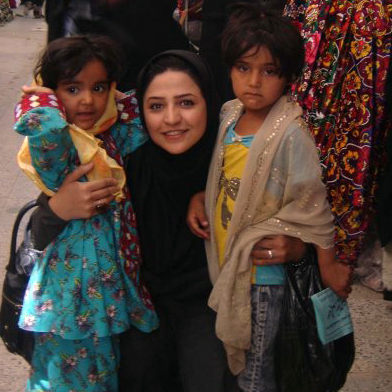
Fariba, a twenty-nine year old journalist who may have voted for Mir Hossein Mousavi, was arrested on August 22, the first day of Ramadan near Iftar time at her father's home. According to her father, Reza Pajooh, a former officer in the Air Force, she spent the entire month of Ramadan in solitary confinement. […] Her parents, who had only heard rumors of her hungerPajooh strike, were allowed to pay her a visit at Evin. According to their account, her mental and physical state was very troubling. They had previously declared that she had been subjected to severe mental and physical pressure to make confessions.
Her father claims that on the occasion of his previous visit to see his daughter in jail she had been so angry that she made a scene yelling about the way her prison guard and interrogators were treating her. She had submitted to a very 'vulgar' body search that had apparently traumatized her and complained of her interrogators accusing her of moral misconduct and leading an immoral personal life, an accusation that is routinely made towards female political prisoners. She has thus far been denied access to her lawyer.

Fariba Pajooh is a child of the Islamic Revolution. She was born a year after the Revolution to a mother who is a medical doctor and an Air Force officer father who served sixty-eight months at the Iran-Iraq front and sustained lasting injuries. […] Fariba's only apparent crime was to support a carefully vetted reformist candidate. The Islamic Republic is indeed devouring her own children.

Why Do They Hate Us? (Or Maybe They Don’t)

GallupMove

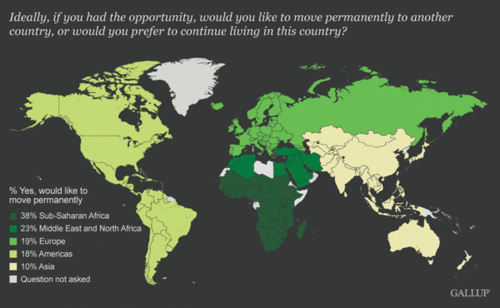
About 16% of the world's adult population would like to emigrate permanently:

The United States is the top desired destination country for the 700 million adults who would like to relocate permanently to another country. Nearly one-quarter (24%) of these respondents, which translates to more than 165 million adults worldwide, name the United States as their desired future residence. With an additional estimated 45 million saying they would like to move to Canada, Northern America is one of the two most desired regions.

Karl Rove Discovers Fiscal Conservatism

The man who pioneered policies that bankrupted the America government is now allegedly concerned about the cost of the health insurance reform.

He forced the massive and truly crippling Medicare prescriptions drug benefit through the Congress, backed two hugely expensive wars, refused to raise any taxes, and presided over an unprecedented rise in domestic discretionary spending. He took a surplus and gave us back a recession and a trillion dollar deficit. He believed that the executive branch had total authority to ignore the laws on torture, and possessed war-powers within the United States with respect to American citizens captured without due process.

But he is now intent on restraining "runaway spending and government expansion."

The great thing about shamelessness is that in an amnesiac culture, it works.

If your primary motive is winning and keeping power, and you have few principles you wouldn't shelve for a tactical win, shamelessness can be temporarily attractive. It is in the long run self-defeating, as the ruins of the post-Rove GOP reveal. But one can never under-estimate the shamelessness of it all. I mean: does Rove actually believe that he is in a position to criticize Obama for spending in a steep recession when Rove broke the budget in a boom? Does he think we have simply wiped clean our memory of the last decade? Is he seriously posing as a limited government, balanced budget conservative nine months after his model presidency left the stage?

Look: I've said many times before, if Obama and the Dems do not follow health insurance reform with a serious, credible bid to cut entitlement and defense spending in the medium and long-term, they will deserve their comeuppance next year. Claiming that the bend-the-curve healthcare provisions will do it won't wash. Politically, it makes sense as well: ask the GOP what they'd like to cut.

Obama’s Window Is Closing

Marc Lynch on the state of Arab public opinion:

Arab audiences see Guantanamo still open (including in an endlessly repeating al-Jazeera promo), US troops escalating in Afghanistan, Gaza still blockaded, and no settlement freeze or peace talks between Israel and the Palestinians.  They have seen little follow-up on the ground on the Cairo address (regardless of what's been cooking secretly in Washington).  A narrative is clearly hardening that Obama has not delivered on his promises, and that he hasn't really changed American policies despite his personal appeal.

U.S. officials may complain that this is unfair, that it's only been four months since Cairo, that they are preparing a lot of programs… but the world isn't fair.  This window isn't closed yet, but it's closing fast and opinions appear to be hardening.   I don't think that the risk here is that al-Qaeda will take advantage of it, given its weakened state — in fact, Secretary Gates made an uncharacteristic mistake when he lapsed back to the Bush-era argument that we had to win in Afghanistan because otherwise al-Qaeda would capitalize.  It's more that the mobilized Arab and Muslim publics which Obama hoped to win over will be lost.

The problems are so deep and the time so constrained … In some ways, we're seeing if Obama's patience and calm is viable in an impatient and frenzied world. And yet we also know that more frenzy will not help. 

The View From Their Recession

The Awl rounds up some sobering stats:

1. “Nearly half of all U.S. children and 90 percent of black youngsters will be on food stamps at some point during childhood.”

2. “The U.S. Department of Agriculture said nearly 200,000 retailers nationwide now accept food stamps, 20 percent more than in 2005.” […]

4. “Some 36 million Americans are on food stamps, an increase of nearly 10 million over the past two years…. Some 66 percent of those eligible participate.”

Sarah From Alaska

PALINBANDAIDRobynBeck:AFP:Getty

Marc has an interesting interview with Shushannah Walshe and Scott Conroy, authors of a new book about Palin. On why she tells easily disprovable lies:

Palin almost always seems outwardly poised and confident in front of a microphone, but she also demonstrates time and again–often in more subtle ways–signs of profound insecurity. It takes a self-confident person to admit mistakes and acknowledge one's own shortcomings, but Sarah Palin is quick to cast aside people who cross her in even minor ways, and her unwillingness to tolerate much dissent often leads to an infallibility syndrome.

And the conservative movement is enabling it all. Oh God. What a November it's gonna be.

Texting Is Destroying Love?

TNC wasn't impressed by Brooks's article on technology allegedly ruining romance:

I read Brooks's column and thought of the 80 and 90 year old slaves interviewed by the WPA. There is a lot in those oral histories that is, as they say, old and true. But there's a lot that's old and false. A constant refrain is the notion that the "moving pictures" were ruining young people, and the next generation wasn't worth anything. To be clear, that would be the same generation that gave us Martin Luther King, and effectively finished the Civil War.

This is a theme residing in the conservative soul–a professed, thinly-reasoned skepticism of the fucked-up now, contrasted against a blind, unquestioning acceptance of the hypermoral past. This is a human idea–most people, like those slaves, believe some point in the past was better. And indeed, in some case the past was demonstrably better. But the writer who would argue such has to prove it. He can't just accept his innate hunch. He has to bumrush and beat down his theories of the world, And should they emerge unbroken, that writer might have something to tell us. It's got to be more than justifying your prejudice. It's got to be more than those meddling kids.