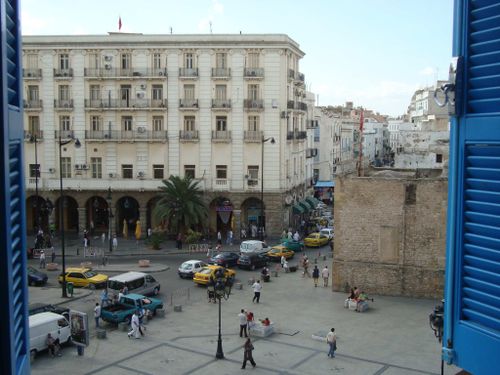
Tunis, Tunisia, 8 am
Tunis, Tunisia, 8 am
Josh Green isn't expecting many revelations tonight. His general feelings about the state of the parties:
The lesson of NY-23, if one is to be drawn (and regardless of whether Doug Hoffman wins or loses), is that the Republican right wing is now the dominant wing of the party. If, when GOP presidential aspirants position themselves in earnest for the party primary in 2011, the tenor of the candidates resembles that of Hoffman and his major supporters, I'd bet on Obama to win in a rout.
"This is no different than the Klan standing outside of voter booths in Alabama when blacks would dare to go vote," – Larry Stickney, the campaign manager of Protect Marriage Washington, regarding the push to make public the 120,000 names on a petition that got an anti-domestic partnership referendum on the ballot today.
Nate Silver says the races in VA and NJ are not going to tell us much about 2010:
[T]he fact that gubernatorial races are not a reliable benchmark does not mean the Democrats are not in trouble in 2010 — whoa, too many double negatives there — nor that Democrats might not have done better if Obama's approval rating was 62 percent instead of 52 percent. It just means that New Jersey and Virginia don't have particularly much informational value — we won't become very much smarter about the future based on what happens there. To the extent that we do learn something, it will probably be hints about turnout, motivation and enthusiasm, rather than something about the electorate's policy preferences.

Here's a beautiful reflection on faith and life through tragedy by Robbins Milbank. It speaks to me and to many, and is worth taking a moment in the middle of a crazy day to remember:
I believe it is very easy to build God in your own image and very hard to rebuild Him when you crumble. I was born to see and experience the love of God. I saw Him in my father, whose kindness and wisdom led me through a thousand anguishes of youth. I saw Him in my wife–especially in her. I told my father about her when I was nine years old. “We’re going to marry,” I said.
He smiled. “I’m glad you feel like telling me. I hope you’ll always want to tell me things like this.”
For many years I was rich, seeing and loving and touching these children of God. I knew what I believed, because I believed in them and they in me.
They died. First my father. Then my wife.
Why do I still arrange my desk-work in neat piles? Why do I straighten a piece of furniture? Why do I try to arrive at appointments a minute early? Why do I lie down to sleep or get up in the morning? Have you ever wandered through an empty house looking for a purpose? You do a lot of little things automatically.
I’d like to talk about my house. It talks to me quietly in the night of the love it still shares, of the garden that still surrounds it, of the laughter of our children and grandchildren and our pride in them. I lie on my bed pulling words around, trying to understand their meaning. Words like “I believe.”
This is know: I believe in the Lord’s Prayer, all of it, but particularly where it says, “Thy will be done.” For me, that’s one clear channel to God. That one belief, “Thy will be done,” carries me through each act of each day.
I'll be on Colbert tonight, a year after I went on to urge support for Obama. I'll be asked whether I'm still all hopenchangy. You betcha.
Jeffrey responds:
On the larger question of whether Trita Parsi functions as a lobbyist for the Iranian regime, based on what I know, I'd have to say yes: He has argued consistently against any sanctions against Iran, and an end to sanctions is obviously what the Iranian regime wants. So he is working on behalf of a stated interest of the Iranian government.
If by "the regime" you mean Mousavi and Karroubi, then I guess Jeffrey's right. But if Karroubi and Mousavi are "the regime", then the entire matter of the Green Revolution was utterly irrelevant, right? And yet it wasn't. At all.
On the specific matter of Trita Parsi: I have no long-term knowledge of the dude (and for quite a while thought he was a woman) and have never met him. I just know that when the Dish was covering Iran's revolution, few people were as committed or as devoted to the Greens as Parsi or his organization. To conflate him with the dictators he so actively exposed and resisted and who murdered or tortured people he loves and cares about is just wrong. After the trauma of last June, it's deeply hurtful and offensive.
And Parsi's opposition to sanctions reveals something essential to understand about Iran now: Mousavi and Karroubi, if allowed to take their rightful offices, would almost certainly have been as passionate in defending Iran's nuclear options as Ahmadinejad. In fact, in the latest round of negotiations, Ahmadi may be the most amenable to a nuclear deal – because it would give him some breathing space at home. Mousavi would have been totally constrained as president given the need to shore up his nationalist credentials. That's why Daniel Pipes and many neocons wanted Ahmadinejad to win. Anything else would complicate a policy of isolating, suffocating or bombing Iran to delay its nuclear capacity. And complicate it it has.
All of which is to say: the US's main opponent in preventing Iran's military nuclear development is … the Iranian people.
Yes, the neocon analysis once again falters when it reaches the ground. It is extremely difficult to support the Greens and yet also support a military strike (which the Greens vehemently oppose) or more punitive sanctions (which Mousavi and Karroubi also oppose). And yet this seems lost on many in Washington. And I fear they are making the same mistake we made in the past (and I totally include myself). That mistake is in projecting onto people we do not know our own views about what is in their best interest.
The world is not as we may want it to be. Iranians are also a proud people, members of an ancient and noble and great civilization that is clearly asking for greater respect from the countries of the world, and see a nuclear capacity – for energy and bombs – as integral to that respect. Even if there is a democratic transition, that will remain the case. And Iran would become a very different and very Muslim democracy – and probably just as vehemently anti-Zionist – than any Western version. The neocons keep talking about the Middle East as if it were Eastern Europe after the Cold War. It clearly isn't. Culture matters. Religion matters. Pride matters. History matters.
Of course, all this leads to a highly problematic set of choices. If the Iranian people continue to believe in their nuclear capacity, if their loathing of Ahmadinejad continues to be tempered by their disdain of Israel, then it will be very, very hard for the United States to persuade Iranians that Israel has the right to 150 nukes and they have none. If the Green opposition were actively opposing the nuclearization of Iran, it would be one thing. We could leverage the people against the regime. But we are trying to leverage the regime in the one area where all the internal pressure is for Iran to be tougher with the US. If this is the main focus, we will end up strengthening Ahmadi, not weakening him.
But can we tolerate what that really implies – a nuclear balance in the Middle East between Israel and Iran? I should say I trust Israel infinitely more than Iran on using nuclear weapons. But the question is also harder than this. If Iran's acquisition of a nuclear bomb is inevitable at some point, and I suspect it is given their technological sophistication and educated populace, should we draw a line in the sand forbidding it? Or should we take a leap of faith and leverage a nuclear deal that includes aggressive monitoring with an end to sanctions as a sop to the opposition?
I'm not saying this is an easy choice. But it is the actual choice in front of us. Better to discuss this openly than cling to rigid ideological positions which have much more to do with us, than with them.
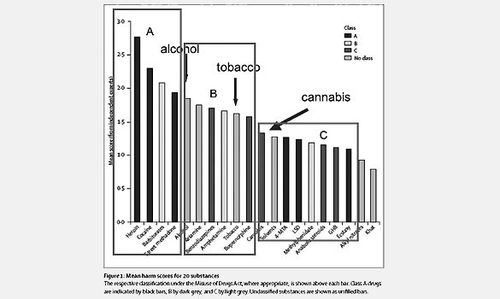
The Brown government is in danger of losing all its scientific advisers in a fascinating moment in which truth meets political and social prejudice. David Nutt, one of the government's chief advisers, was fired, in part, for the graph above which tries to assess the relative dangers of various drugs. Nutt assessed them on three variables:
a) the physical harm to the individual user caused by the drug; b) the tendency of the drug to induce dependence; c) the effect of drug use on families, communities and society. Within each category there are three components, leading to a nine-category matrix of harm, with scores of zero to three for each category. This is the final list based on that classification. In brackets is the classification given under the Misuse of Drugs Act, with Class A attracting the most serious penalties.
The Brits classify drug penalties according to the tree types A, B, and C. It's hard to read, so here are the drugs in order of harm, according to scientific studies, revealing how some drugs are categorized according to social attitudes rather than reality:
1. Heroin (Class A)
2. Cocaine (Class A)
3. Barbiturates (Class B)
4. Street methadone (Class A)
5. Alcohol (Not controlled)
6. Ketamine (Class C)
7. Benzodiazepine (Class B)
8. Amphetamine (Class B)
9. Tobacco (No class)
10. Bupranorphine (Class C)
11. Cannabis (Class B)
12. Solvents (Not controlled)
13. 4-MTA (Class A)
14. LSD (Class A)
15. Methylphenidate (Class B)
16. Anabolic steroids (Class C)
17. GHB (Class C)
18. Ecstasy (Class A)
19. Alkylnitrates (Not controlled)
20. Khat (Not controlled)
You immediately see that marijuana and ecstasy are far less dangerous than tobacco and alcohol. Ditto steroids – largely harmless if used properly. Nutt wonders why the government hires scientists if they refuse to abide by government policies:
My sacking has cast a huge shadow over the relationship of science to policy. Several of the science experts from the Advisory Council on the Misuse of Drugs (ACMD) have resigned in protest and it seems likely that many others will follow suit. This means the Home Office no longer has a functioning advisory group, which is very unfortunate given the ever-increasing problems of drugs and the emergence of new ones. Also it seems unlikely that any “true” scientist — one who can only speak the truth — will be able to work for this, or future, Home Secretaries.
Others have suggested a way forward: create a truly independent advisory council. This is the only realistic way out of the current mess.
A reader writes:
FYI, I received robocalls from both Palin and Steve Forbes (remember him?) in the last couple of days here in New Jersey. Palin, in her call, was careful not to name the Republican candidate, Chris Christie, by name (for whatever reason), but urged me to “vote my values” on Tuesday. These included traditional marriage and lower taxes. Whatever. I’m pulling the lever for Corzine, though I’m not a Democrat (I’m an Independent). Christie and the Palinites scare me.
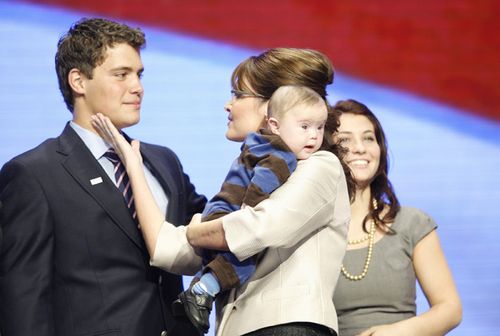
“Voting Sarah’s Values”: that’s a theme that’s being robo-called a lot. In a way, Palin is more effective as some kind of cultural talisman than as an actual, you know, politician, who has to know things, govern states or countries, and hold press conferences. She’s being turned into a kind of Marian figure, a blessed icon whose mere touch bestows some kind of aura on a candidate or race. Her book will become some kind of touchstone in this firmament of religious Republicanism. Now, if only Levi would just shut the fuck up …
“Hoffman, Baby, Hoffman!” – former Alaska governor Sarah Palin, on Facebook.
 The Dish