When Creationism Was Fringe

P.Z. Meyers says creationism isn't as old as we assume:

The mainstreaming of literalist creationism occurred in the 1960s, when John Whitcomb and Henry Morris wrote The Genesis Flood. It's basically the same nonsense he Seventh Day Adventists were peddling, but Whitcomb and Morris were not SDAs, making it possible for conservative Christians, who regarded Seventh Day Adventism as a freaky cult, to coalesce in the formation of the Creation Research Society. These people had no ambition to convert the research community, but instead wanted to wean bible-believers away from what they considered the compromises of day-age and gap theory.

When Hellfire And Hospitality Collide

Hitch talks about debating religious people:

Usually, when I ask some Calvinist whether he is really a Calvinist (in the sense, say, of believing that I will end up in hell), there is a slight reluctance to say yes, and a slight wince from his congregation. I have come to the conclusion that this has something to do with the justly famed tradition of Southern hospitality: You can't very easily invite somebody to your church and then to supper and inform him that he's marked for perdition.

More to the point, though, you soon discover that many of those attending are not so sure about all the doctrines, either, just as you very swiftly find out that a vast number of Catholics don't truly believe more than about half of what their church instructs them to think. Every now and then I read reports of polls that tell me that more Americans believe in the virgin birth or the devil than believe in Darwinism: I'd be pretty sure that at least some of these are unwilling to confess their doubts to someone who calls them up on their kitchen phone.

Is Atheism Scientific?

Massimo Pigliucci argues that atheism is philosophical, not scientific. Jerry Coyne differs:

I’ll call “weak sense atheism” the position that, I think, most atheists hold.  It is this:  “There is no convincing evidence for God, so I withhold belief.”…Now I don’t know anyone who is a strong-sense atheist.  Even Dawkins, as I recall, is a “70% probability” man — he thinks it pretty improbable that God exists, but adds that he can’t disprove the existence of some kinds of gods. I’m pretty much on board with him. You’d be a fool to say that you know absolutely that there is no being up there at all, including one that doesn’t interfere in the workings of the universe.

So let’s take weak-sense atheism (WSA) as the default stance.  In its very weakest, “no-evidence-for-God” sense, WSA is absolutely scientific.  After all, what is science but the claim that one needs empirical evidence before accepting something as a reality? When one says, “I see no evidence for a god, and therefore refuse to accept his/her/its reality,” one is saying nothing different from, “I see no evidence for the view that plants have feelings, and therefore I don’t accept the idea that they do.”

Creationism In The Islamic World

It's on the rise:

Unlike in the West, creationist beliefs are not associated in the Muslim world with religious fundamentalism, but instead are often espoused by members of the mainstream intellectual elite – liberals, by their own lights, who see the expansive, scientific-sounding claims of creationism as tracing a middle way between the guidance of religion and the promise of modern science. Critics of the movement fear that this makes it more likely that creationism will find its way into policies there, especially when the theory of evolution is portrayed among Muslim thinkers, as it often is, as an instrument of Western intellectual hegemony.

Drake Bennett points a paradoxical reason for that rise:

[T]hose places where the theory of evolution is seen more warily, the fact that there is a creationist debate at all can be seen as a sort of progress – a symptom at the very least of a newfound interest in science. In the most conservative parts of the Muslim world, creationism isn't a political or philosophical force because it doesn't need to be – there aren't enough people who believe in evolution, or have even been exposed to it, to require a counter-doctrine.

The rise of Islamic creationism, then, may be a sign that more of the Muslim world is at least wrestling with the idea of evolution, and more broadly with the power of scientific explanations. Much though it may alarm Western scientists, creationist thought may offer people an acceptable point of entry into a science-driven world.

Yearning To Serve

A reader writes:

Now that the Catholic Church has decided married Anglican priests are welcome to join the fold so long as they're opposed to the ordination of women and gays, I find myself thinking about my sister's college friend in the early 1980s. He was a devoted Midwestern Catholic who very much wanted to become a parish priest, preferably in his native Indiana. He fell in love with my sister, who regarded him (in that deadly parlance of young women everywhere) as "just a friend."

The night before he was to be ordained, he called her. If there was even a hope she could one day see him as her husband, he would forgo his ordination. She told him the truth: no.

I've thought many times over the years about his painful position and the Church's ridiculous celibacy requirement (particularly given the history). How many young men could the Church recruit into the priesthood if it would acknowledge a simple truth: most human beings crave the sustaining and enriching bond of a partner? That question doesn't even touch on women and gay Catholics who feel the call to minister.

How does the Church in the 21st Century double down on "thanks but no thanks" to thousands, possibly tens of thousands, of Catholics who yearn to lead others in the Profession of Faith? What does the Anglican decision communicate to Catholics priests who sacrificed the the foundation of a loving, human companion for life?

Of course, what the Anglican offer communicates to female and gay Catholics who yearn to become clerics is clear.

My sister's friend never received his parish appointment. He was scholarly guy, so the Church sent him on to grad school, then law school, then to a PhD program. He has since the 90s been an ordained priest who serves as an attorney in the legal division of the Vatican. When my sister became engaged to marry nine years ago at age 40, he offered to fly back to the states to perform the ceremony. They were unable to coordinate their dates.


Beneath it All, Desire of Oblivion Runs

Macy Halford plucks out a few choice paragraphs from philosopher Jean-Luc Nancy's The Fall of Sleep:

By falling asleep, I fall inside myself: from my exhaustion, from my boredom, from my exhausted pleasure or from my exhausting pain. I fall inside my own satiety as well as my own vacuity: I myself become the abyss and the plunge, the density of deep water and the descent of the drowned body sinking backward. I fall to where I am no longer separated from the world by a demarcation that still belongs to me all though my waking state and that I myself am, just as I am my skin and all my sense organs. I pass that line of distinction, I slip entire into the innermost and outermost part of myself, erasing the division between these two putative regions.

Sometimes a great image and a poseur alert are very close together.

Your Government Is Monitoring Your Listserv

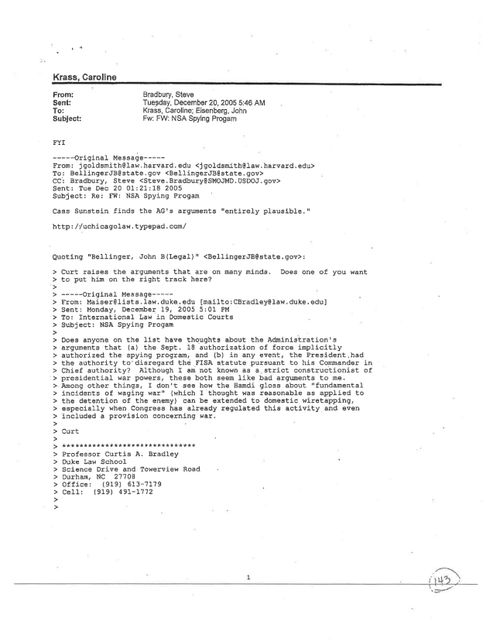
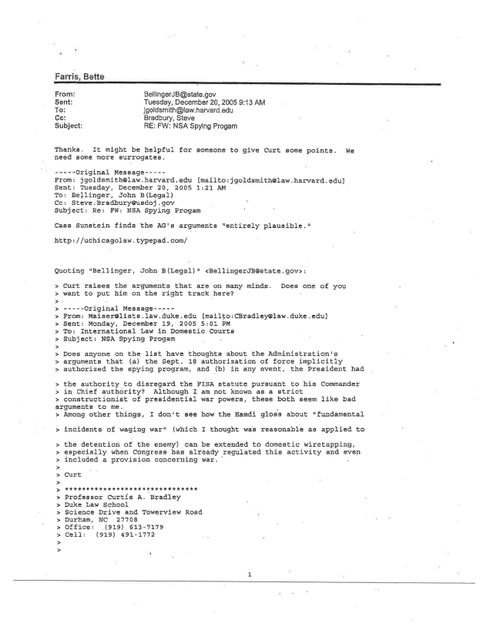
Two interesting documents from the Friday DOJ doc dump: emails between John Bellinger (at State) and a recently out-of-government Jack Goldsmith (from his Harvard Law School address), ccing Steve Bradbury (at DOJ), discussing how to find surrogates to make the government's case, after noting debates on a law professor list-serv. I have no idea where this went, and there may be no outrage here. It just creeps me out a little to find private emails being forwarded to government officials who strategize how to find other professors to push back. Maybe I'm too squeamish. Make of them what you will:

20091031JUSTICE_8

20091031JUSTICE_8b