Dopamine Makes The World Go Round

Jonah Lehrer profiles the neurotransmitter:

The caricature of dopamine as the chemical of hedonism and pleasure – it's what drives us to enjoy sex, drugs and rock and roll – was always mostly misleading. While dopamine does predict the arrival of rewards, the neurotransmitter is much more important that. Many dopamine researchers, for instance, refer to the chemical as our "neural currency," since it allows us to quickly assign a value to the multitudes of things and ideas in the outside world. (In other words, dopamine is the price tag of sensory information.) When we see something we want – and it doesn't matter if it's a chocolate cupcake or a glass of water – the mere sight of the object triggers a wave of emotional desire, which motivates us to act. (Emotion and motivation share the same Latin root, movere, which means "to move.") The world is full of possibilities, and it is our dopaminergic feelings that help us choose between them.

A Modest Case For Dithering

Alex Massie provides one:

Muddling through doesn't sound very heroic and it's not a very noble thing to die for. But our Afghan policy is, in some ways, defined by negatives: it's hard to say what victory looks like, but defeat is easier to recognise. We may hope that our troops in Helmand can do some good but perhaps their main role is to prevent things from getting worse. As I say, none of it is satisfactory and much of it is pretty grim. But that's where we seem to be and it's not clear, to me at least, that the choices are quite so clear as some suggest, nor that, as others argue, the act of chooing is more important than the actual choice that's made.

The Daily Wrap

Today on the Dish, Andrew spelled out the shrewd politics behind the opt-out public option, with reader input here, here, and here, and further input from Josh Marshall and Megan. Warranted Wiretaps’ take was especially short and sweet. On Lieberman’s veto threat, Ambinder analyzed, Beutler reported, and Chait proposed a threat of his own.

Exum, Greenwald, and Yglesias ruminated over Matthew Hoh’s big resignation. John Kerry gave his version of what the Afghan surge should be while the Iraq government continued its dysfunction. Andrew chastened Anita Dunn (and others) for quoting a Chinese dictator, which spurred the most dissent of the day. Sully also made sense of the GOP civil war erupting over NY-23.

In other assorted coverage, some homophobes spewed some hate, some Californians were charged with torture, someone spotted more drug hypocrisy, and we spotted some hilarious hathos.  And Levi looks like he won’t be wearing these – or anything else.

— C.B.

The Wages Of Misinformation

A reader writes:

This Sunday, I volunteered with Equality California and the No On 1 Campaign to make calls to Maine residents to inform them about the measure and urge them to vote (No) early if they can. There was one call in particular that I thought was interesting. I introduced myself by explaining that I volunteered for the campaign to vote No on Question 1 and the first thing the lady said to me was “look, I don’t think this stuff should be taught to 1st graders.”

Not knowing what kind of ads the opposition had been running, I assured her that the purpose of the call was only to inform her that the measure intends to overturn an equality law that is already in place. I told her that I personally feel it should be up to the parents to talk to their kids about sexuality, and that the law has no bearing on the school system, that the law is about marriage equality and nothing else. Next thing she says is, “well yeah, I think anyone should be allowed to marry the person they love. If they’re in love, who am I to say to them that they can’t marry, right?”

So this was someone who believed in marriage equality but was being harassed by those insidious ads into possibly voting against her own instincts. I hope that I’ve convinced one person not to pay any mind to them, but I do hope that others realize what the real issue at stake here is.

Off A Cliff, Ctd

Reacting to yesterday's news, Drum sticks by a prediction:

A few years ago I was on a panel discussion and the moderator asked us all how long newspapers distributed on newsprint would last in the United States.  My guess was 20 years: that is, the last newspaper in the country would shut its doors in 2025.

Megan is equally gloomy.

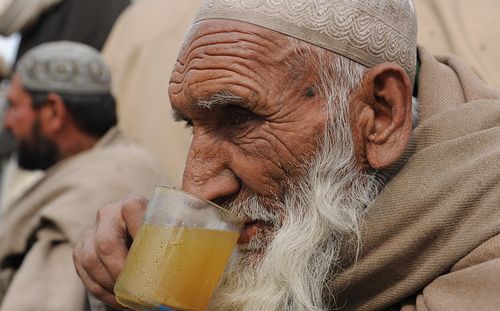
Face Of The Day

ElderlyAfghanManGetty3

An elderly Afghan man drinks chicken soup in Kabul on October 27, 2009. Afghanistan's presidential rivals are reigniting their campaigns for a second vote, but analysts question whether a new election can be credible as calls for a government of national unity persist. Many observers fear a second round run-off on November 7 will be plagued by the same problems of fraud, low-turnout and Taliban violence that hit the first round of voting two months ago. By Shah Marai/AFP/Getty.

Uniting Against Islam?

Ross ruffles some feathers in his latest column:

[I]n making the opening to Anglicanism, Benedict also may have a deeper conflict in mind — not the parochial Western struggle between conservative and liberal believers, but Christianity’s global encounter with a resurgent Islam. Here Catholicism and Anglicanism share two fronts. In Europe, both are weakened players, caught between a secular majority and an expanding Muslim population. In Africa, increasingly the real heart of the Anglican Communion, both are facing an entrenched Islamic presence across a fault line running from Nigeria to Sudan.

Greenwald says Ross is "call[ing] for a Christian religious war — certainly metaphorical and perhaps literal — against Islam." He continues:

How ironic that someone who is virtually calling for a worldwide religious conflagration is simultaneously condemning his targets for lacking "Western reason."  It's obviously true that some Islamic extremists are inherently incompatible "with the Western way of reason," but that's just as true of Christian extremists and Jewish extremists and a whole array of other kinds of extremists. […] But the claim that Islam itself — and the world's 1.5 billion Muslims — cannot be accommodated by, or peacefully co-exist with, Western values or Christianity specifically is bigotry in its purest and most dangerous form.  It's hard to imagine anything more inflammatory, hostile and outright threatening than a call for Christians of all denominations to unite behind the common cause of fighting against Islam as Christianity's most "enduring and impressive foe."

Serwer adds:

[T]here's a great deal of common ground between Douthat's perception of a grand conflict between Islam and Christianity and the tribalism of Pat Buchanan. Each is grounded in a hostility to cultural pluralism and fear of an encroaching, menacing other. The major difference being that while outright prejudice against black people is largely culturally taboo, prejudice against Muslims is so acceptable as to be found expressed openly in the op-ed pages of the New York Times.

I'm with Greenwald and Serwer about 80 percent. But they miss Ross's context: Islam currently is nowhere near the levels of openness and dialogue that have been achieved in the West within Christianity these past few decades. It isn't wrong to point this out or to see it as a very large obstacle to a civil modus operandi between Muslim citizens and the liberal Western state. In fact, to deny this is to betray those who really are working within Islam for some kind of reformation.

But Ross, of course, is also a believing Benedict-follower. So while he is not averse to engaging in Western debates about theology or secularism, his interest is primarily in the developing world, where the kind of faith he holds still retains luster and force. So his column is really both an example of classic zero-sum religious thinking, and an analysis of it. It's that line between believing and analyzing that Ross leaves somewhat vague. I don't blame him. This stuff is hard. And he has a new audience to reassure.
Washington Rituals

Christopher Orr describes one:

[A]nyone who imagines that New Gingrich is going to make a serious bid for the presidency in 2012 is nuts. (The smart money is that he'll muse endlessly about the possibility; let it be known that if the party wants him badly enough he'll allow himself to be drafted; and, when this does not happen, publicly take his name out of contention, explaining that he's abruptly found himself far too busy with some new organization with the word "Future" in the name. This is, after all, what he always does.)