A Pissing Match Of Pretend Sanctimony

Michael Wolff does his usual stuff on the Obama-Ailes dust-up. This is a pretty hilarious set-up on Ailes:

Before getting to my relative affection for Ailes, let me note that he will be 73 in 2012; he’s vastly overweight (and sensitive about it); he has health problems and can’t walk very well; he’s ghoulish looking; he’s deeply and nuttily paranoid (he discusses freely, albeit in lowered voice, the plans of radical Muslims to storm his house in New Jersey); and he may not be capable of doing 15 minutes without an offensive utterance.

Run, Roger! Run! And who doesn't pine for the "relative affection" of Michael Wolff?

The Latest Victim

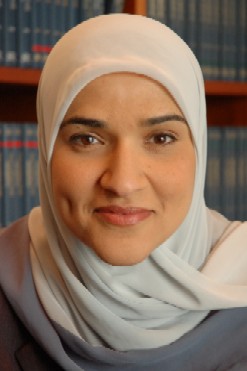
Goldblog goes to bat for Dalia Mogahed, who was recently smeared as a radical by Hannity and others for misconstrued remarks made on a TV show hosted by a member of Hizb-ut-Tahrir, an extremist Muslim group:

Well, I know Dalia Mogahed, and if she’s a Muslim extremist, then I’m the King of Sweden. From  everything I can see, Dalia went on the show in her role as a pollster, and, in the conversation, stuck to her polling data.

I’ve heard her present the same findings she presented on British television on two separate occasions. I’m sure some people are freaked out by Dalia’s appearance — she covers her hair MogahedFinal_2and dresses very traditionally, though she is not a “veiled woman” in the language of some of the more ridiculous posts on the subject — but I know her as a devout, modest and sensible woman, someone who likes being American very much, and someone who even has — shocking though it may seem — Jews to her home at Ramadan (that would be moi, along with Mrs. Goldblog and several smaller Goldblogs).  Do we agree on much? Nah, especially on Middle East politics. But so what? I don’t agree with this guy on everything, and I don’t think he’s a member of Hizb ut-Tahrir.

One key difference between American Muslims and British Muslims — and this is a massive over-generalization, of course — is that American Muslims seem to like their country very much. Obviously, there are pockets of Muslim extremism in America and I’m all for watching the extremists, and arresting them if needed — but Dalia doesn’t live in one of those pockets. In fact, she is quite often criticized by Muslim radicals as a “sell-out.” Most recently, she was attacked for speaking at an iftar (the Ramadan break-fast meal) at the Pentagon. She’s stuck in the responsible middle, in other words. Right where many thinking people find themselves these days.

Fighting Online ADHD

A reader writes:

I believe it was August when you posted a request for people reading your blog to subscribe to the print version of "The Atlantic."  Despite being unemployed and living at my mother's house back home in Michigan, I plunked down the $14.95 for a year-long subscription and received the October issue in the mail a couple weeks ago.  I only today got around to reading it.

Thank you for reminding me that the magazine was available in print form, not just online.  How remarkably refreshing.  There's something to be said for having an actual piece of writing that you can feel with your hands, especially one so well written.  I spent two hours reading, not distracted by IMs,

Tweets, email notifications, or Facebook posts.

(Text messages are another story; I'll have to remember to turn off my phone next time.) And I still only managed to get through barely half of the contents.

I'm just now realizing how the way that I intake information has caused me to develop ADHD-like qualities.  My attention span has dwindled to a pathetic level.  My need for constant and quick inputs of information makes me have to focus just to get past the abstract of a news article.  Because of this, I'm making a concerted effort to slow myself down and actually digest the information that is coming at me.  And reading articles on actual paper instead of off my glaring computer screen is one of my methods to reverse this trend.  It won't happen overnight, but thanks for reminding me of the importance of print media, even if it's a dying species.

Beyond Black And White In Seattle

A reader writes:

Aaron Renn says that "progressive cities" like Portland, Seattle, Austin, Minneapolis, and Denver having less African Americans than the national average "raises troubling questions."

Seattle has a small black community, but very large Asian and Indian communities (from India).  The conclusion that everyone who is not black is white makes his article not about diversity but his own narrowness of view.

Another writes:

Moved to a Seattle suburb two years ago from Nashville, TN.  At first, I was struck by the lack of African Americans–and in particular, black-owned businesses.  There is an odd, "let's not talk about race attitude here"…which comes from a "we're beyond it" place, but often smacks of "not wanting to deal with it." HOWEVER, Seattle has quite the diverse population:  the 4th largest Asian population in the U.S.  And, mixed marriage is so commonplace it goes virtually unnoticed.  (Can't say that about the South–where "miscegenation" still turns heads). And speaking of diversity, estimates for Seattle's gay population vary but are placed as high as 12.9%.

According to these numbers from 2005, Seattle's black population is 8%, with an Asian population of 14% and Hispanic population of 6%. Another reader addresses the bigger picture:

The idea that all American cities should have a set percentage of blacks is not only a fundamental misunderstanding of the word “diversity,” as Joyner notes, but a surprisingly ignorant of history and people in general.  Did I miss the part of my history class where there was a post-slavery migration of blacks to Denver (little more than a village of cowboys and railroad workers in the 1860s)?  Or the part about the plantations in Minneapolis?  Of course those cities don’t have as many blacks as Pittsburgh.  There was no reason for freed slaves to travel to Seattle or these other cities – many of which were barely on the map at all in 1865.  Like all migrating peoples, African-Americans followed geography, opportunity, and personal connections. 

The pathways originally blazed by the underground railroad didn’t go through Austin or Portland, they went through what is now the rust belt, what was then the locus of industry.  So, yes, if one ignores history, culture, community, economics, and physical geography, blacks should have spread out evenly throughout the United States.  And Arizona and North Dakota should have the same number of Latinos, San Francisco and Des Moines should have proportionally sized Chinatowns, and St. Paul and New Orleans should have equal number of people with Scandinavian heritage.
Exporting The Drug War

Conor Friedersdorf points to recent drug violence in Brazil and Mexico in his call for ending prohibition in the US:

Rio’s favelas [slums] date back to Brazil's abolition of slavery in the 19th century. The causes of poverty, crime, and dysfunction in the city are too myriad to list. It is nevertheless true that American demand for illegal narcotics bankrolls murderers, rapists, paramilitary terror squads, and all manner of other ills in the country. Absent the enormous sum our citizens pour into a black market that is largely of our creation, countless Brazilian lives would be better, Rio would be safer, and we’d all be better off.

Too Late, Too Late, Ctd

A reader writes:

On your latest Afghanistan post, I'm not sure people understand how true your statement is: "What Bush and Cheney threw away Obama cannot recapture."

My wife has worked for Tolo TV, the station that hosts the Afghan version of American Idol. She told me a story very illuminating along the Bush-Cheney front. Tolo sent a crew down to Uruzgan province last year — a clearly Pashtun, clearly pro-Taliban region, historically — and the tribal chiefs were having a big meeting, at which many of them said that shortly after 2001 they decided they would back Karzai's government and the U.S., feeling that the U.S. could and would improve the country and their lives. But no investment, no aid, no improvement ever came. America's resources were in Iraq. And now Uruzgan is a province where a man with white skin dare not walk without a very large military force behind him. Uruzgan reverted back to the Taliban. And it will stay that way for a very long time.

We had our chance once. It's long gone.