Dissent Of The Day, Ctd

Freddie of Ordinary Gentlemen further counters yesterday's dissent of the day:

[T]here are very strange and illegitimate turns of moral logic here that you routinely see when discussing Israel that you never see anywhere else. Chief among them is the fact that we generally reject relative morality, whether in the vast scope of international affairs or in the day to day of human life. Saying one moral actor is superior to another is irrelevant to the question of whether that actor is moral. This is taken as such a basic element of standard human assumptions about morality that it goes unspoken, and yet it is routinely and flagrantly violated in discussing Israel. Children on the playground know that their actions are not rendered moral or immoral in relation to the other children but rather that their conduct has independent moral value. They likewise know that being of superior morality to some of the worst behaved children on the playground means nothing.

The Wrong Line Of Attack

Weigel is right:

The Democrats are in worse political shape than they were a year ago because unemployment is at 9.8 percent, the war in Afghanistan has grown less popular, and the bailouts of struggling banks are seen as wastes of money that haven’t worked. Republicans benefit when they talk about this stuff. But Beck and the others don’t let them talk about this stuff. For the past few months, they have moved the discussion onto fantasy terrain, accusing the president of reaching for dictatorial powers and surrounding himself with “radicals” who want to destroy capitalism.

…[In] the current political context, it seems like they’re missing the forest for some shrubs. It’s as if Democrats tried to press their advantages in 2005 not by going after the Iraq War or the mishandling of Hurricane Katrina, but by spending weeks attacking mid-ranking members of his administration and claiming that President George W. Bush was driving the nation toward fascism. And remember, one of the huge political mistakes of 2005 was the Republican decision to do a full-court press on an issue that had come from conservative activists and pundits: the fate of Terri Schiavo.

Hewitt Award Nominee

"There were few who remarked with astonishment at a President whose inaugural address was themed around “remaking America.” But millions wondered in breathless anticipation what this “remade” America would look like. Just look at Obama’s role models, and the role models of his appointees and political supporters, and you’ll know. Obama’s remade America would look like Cuba. North Korea. The former Soviet Union. Venezuela. Cambodia. Myanmar. China," – Laura Hollis, Townhall.

These people are out of their minds.

More Voting Isn’t The Answer?

Despite the announcement a few days ago, Jean MacKenzie, director of the Institute for War and Peace Reporting in Afghanistan, doesn't think a runoff vote is likely:

Chances are there will not be a second round; weather and logistics could easily combine to torpedo the effort, and the challenger Dr. Abdullah Abdullah has already hinted that he is open to talks “if winter should make a second round impossible.” A runoff is in no one’s interests. The Afghan people are tired and disgusted, and no second round is going to redeem the democratic process in their eyes. The turnout is likely be miniscule – under 20 percent – making any talk of government legitimacy more than a little absurd.

[…] The object of [Tuesday's] morality play was to force Mr. Karzai to acknowledge, at least tacitly, that he could not get away with the wholesale disregard for the law that he had shown throughout the election process.

That accomplished, there is really no need to go the rest of the way. It would be expensive, dangerous, and chancy. Given an extremely low turnout in the south, Mr. Karzai could even lose, which would mean that his supporters would feel the need to resort to fraud, albeit a little more skillfully this time.

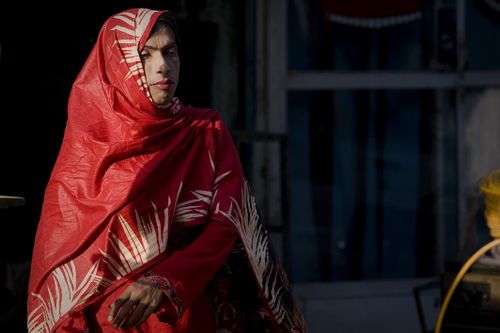
Face Of The Day

TRANSNicholasAsfouri:Getty

A Pakistani transgendered woman walks in a street near a mosque in Rawalpindi, on the outskirts of the capital Islamabad on October 22, 2009. The insurgency-hit country is fearing fresh attacks in a month that has left around 185 people dead as troops pressed a major offensive against Taliban networks. Either that, or Michael Jackson lives! By Nicolas Asfouri/Getty.

The Bribe Fails, Ctd

A reader writes:

I certainly agree with you in theory, however, in reality I have to tell you that I am really nervous.  I am 64 and am currently employed and have insurance.  I am retiring in January and will continue with my current insurance until April when I turn 65 at which time Medicare kicks in.  Here’s the rub.  I wanted to change docs and guess what the first question was when I gave them my date of birth.  You got it – what insurance do you have?  Hmmmm wonder if they would have taken me as a new patient (or will keep me) when I am on Medicare.  Asking the docs to take a 20% hit on Medicare patients is not exactly incentive to take anyone over 64.  Do you have an alternative suggestion?

Another writes:

The Medicare bill that failed yesterday was far from a bribe. It was an attempt to fix an accounting error that could cripple the primary care system for seniors.

The Sustainable Growth Rate formula that determines payments to physicians (but not to hospitals) has required physician payments cuts for the last several years. The formula is complicated, but one of its biggest flaws is its failure to account for the rapid rise in the costs of providing care. Congress has understood this for the most part and voted to stop smaller scheduled cuts many times before. Many physicians are small business owners, and when their costs are rapidly rising out of their control and their payment is being forced downward, they often stop taking Medicare patients or adjust their practice styles in other ways.

The difference between yesterday’s bill and previous interventions was that instead of just passing a one-year fix, Congress was finally trying to find a long-term solution. The can has been kicked down the road so long that physicians are facing a 21% cut in Medicare payments in January. That won’t happen because it would be disastrous to the healthcare system. The shock of such a financial hit alone would be disruptive, plus you’d probably have a lot of physicians dropping Medicare. Instead, once again Congress will slap a Band-Aid on the SGR, freeze payments for one year to avoid a 21% cut, and have to address the problem again and again and again until a long-term solution is found.

The politics of it were indeed sketchy, and you’re right in calling for pay-go funding, but I thought you might be interested in some in-the-weeds details about why the bill mattered in terms of policy.

Just find a way to pay for it, that's all.
From The Annals Of Chutzpah

Michael Kraft contributes:

The Iranian President said the “Campaign against terrorism would yield fruit only through the presence and joint cooperation of countries in the region," according to Xinhua, the Chinese news agency. […] This is the height of chutzpah from a leader not known for understatement. Iran has been behind major terrorist attacks against the United States, Saudi Arabia and other Arab countries. It is a major backer of Hamas and helped create Hezbollah, terrorist groups whose trademarks are suicide bombings and firing of rockets against Israeli civilian targets.

But it certainly seems to be the case that the mullahs and Revolutionary Guards are feeling a little heat these days. It's hard for them to fight on two fronts – domestically and internationally.