Big Brother vs The Stork

Kerry Howley disapproves of government tweaking the birthrate:

I wrote a long article on fertility trends last year, and in the course of my research I became wary of politicians who think there is a “right” birthrate to be achieved through domestic policy. American women are not a population of breeders to be incentivized toward motherhood whenever politicians want a few more natives around. The further talk of paid maternity leave can be kept from talk of birthrates, the better.

On Thought Crimes

John Holbo blurs the lines:

Practically all crime is ‘thought crime’ in the good ol’ common law sense of the Latin phrase actus non facit reum nisi mens sit rea – ‘the act does not make guilt unless the mind be guilty.’ If we were to take a strict liability approach to all violent crime we would be obliged to place wrongful death on a par with premeditated murder. (After all, it’s not as though the lives of those killed accidentally are worth less.) This refutes the notion that there is something sinister and Orwellian about post-Drakonic/post-Hammurabian developments in criminal law. (Damn liberals and their newfangled political correctness!) It doesn’t follow that ‘hate crime’ legislation makes moral and practical sense, of course.

Google Plays Librarian

Erick Schonfeld deciphers what the internet hegemon is really up to:

Google is not digitizing these books so it can sell copies of them. They are out of print for a reason. There is no market for them as whole books. Their value lies in cutting them up into snippets and relevant excerpts, and showing those snippets along with search ads to people looking for related information. The reason they are valuable to Google is because they are a rich source of high quality information that will improve its search results, and in fact give them an information advantage over other search engines without equal access to the world’s books.

There would be some value in printing them out via the espresso book machine. The demand for any individual out of print book is small but the sum demand for all out of print books is significant. When doing a run of one costs the same as doing a run of 10,000 such exchanges suddenly become profitable. Alan Jacobs has mixed feelings.

The GOP’s 2012 Line-Up

Larison has a shrewd take on the bewildering dynamics of a dreadful field:

I have thought for a while that Huckabee’s personality could have some of the appealing all-things-to-all-people quality that Obama had during the election. If the economy remains a major issue in the next election, as it most likely will be, the sheer disgust economic conservatives still have for him could be worn almost as a badge of pride in the general election. An early opponent of the bailout, Huckabee could tap into populist dissatisfaction with the coziness of corporations and government without being pigeonholed as nothing more than an obsessed tax-cutter.

Huckabee isn’t going to have that chance.

Even if it seems irrational, movement activists who are not primarily interested in social issues distrust Huckabee intensely, and they will work to block him and deny him funding just as they did last time. The anti-Huckabee sentiment among movement activists is a useful reminder that all the Republican culture war defenses of Palin during the general election were aimed at mobilizing all the people whose candidate, Huckabee, they had just spent the previous 18 months mocking and ridiculing with all of the same language used against Palin. For turnout purposes, the GOP still finds Huckabee’s people useful, but its leaders and activists will not tolerate Huckabee taking the lead in the party as the nominee.

The effect this will have, as Stuttaford’s post suggests, is that most Catholic, mainline Protestant and secular Republicans will rally to whichever anti-Huckabee candidate appears strongest. This will most likely mean a coalition of voters arrayed behind Romney, who will then be a far weaker draw in the general election than Huckabee would have been. At first, that sounds implausible. Surely the more “moderate,” less “sectarian” candidate should be able to win more support, right?

No, not really, because the things that make Romney more attractive to non-evangelicals in the GOP also force him to spend more time trying to prove that evangelicals and social conservatives can accept him. Aside from the complication that his religion introduces into this, this means that Romney has to emphasize social issues, on which he has no credibility, and public professions of religious faith, which are some of the things that so many Republicans and independents find viscerally unappealing about what they perceive to be the norm in Republican politics.

Are Videogames The New B Movies?

Peter Suderman speculates:

Absurd, mega-budget summer blockbusters like Transformers and G.I. Joe have siphoned off a lot of the energy that used to go into making moderately priced genre flicks, but recently, it’s struck me that another part of the equation is probably the emergence of scripted, action-movie style video games — everything from the Halo games to Assassin’s Creed and Half-Life. I’ve been playing a lot of Killzone 2 this week — which, by the way, I highly recommend — and, in many ways, it’s really just an interactive B-movie. The scripted bits that carry along the in-game action consist almost exclusively of tough-guy cliches pieced together from the last forty years of action movies, comic books, and war films. It’s silly, outrageous, over-the-top, and incredibly entertaining — just like a good B-movie should be.

And B-list actors are already getting the picture.

That Mushy Steel

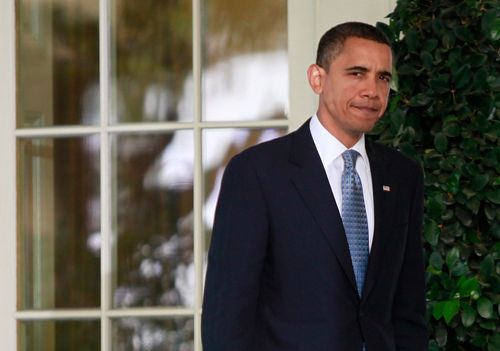
OBAMA09MarkWilson:Getty

My column this week tries to parse this president's style of pragmatism. History alone will determine if it's effective in the long run, but this is my best attempt to explain it in real time nine months in:

There is a strange quality to Barack Obama’s pragmatism. It can look like dilly-dallying, weakness, indecisiveness. But although he may seem weak at times, one of the words most applicable to him is something else entirely: ruthless. Beneath the crisp suit and easy smile there is a core of strategic steel. In this respect, Obama’s domestic strategy is rather like his foreign one — not so much weakness but the occasional appearance of weakness as a kind of strategy. 

The pattern is now almost trademarked. He carefully lays out the structural message he is trying to convey. At home, it is: we all have to fix the mess left by Bush-Cheney. Abroad, it is: we all have to fix the mess left by Bush-Cheney. And then … not much. 

The agenda may be clear. He wants an engaged Iran without nuclear weapons. He wants to be the first American president to enact universal health insurance coverage. He wants a sane two-state solution for Israel/Palestine. He wants to leave Iraq without having it blow up on him. He wants to find a way to solve the AfPak Rubik’s Cube. He wants to allow gays to serve openly in the military. But on all these things, it’s mid-October and still … nothing substantive. So obviously, he’s a total fraud and failure, right? 

Wrong. 

He sets out a goal and then he waits. He waits for the other players to show their hand. He starts a process that itself reveals that certain options are unfeasible, until he is revealed by events to have no other choice but … well, the least worst practical way forward. He always knows that things can change, and waits for the optimal moment to seize the initiative.  

On Iran, for example, he has done not much more on the surface than open up direct talks. Beneath, you see deeper shifts. His election itself and his Cairo speech laid some important groundwork for June’s Green revolution. He managed to inspire the opposition without throwing his lot in with them (playing the supreme leader, Ayatollah Khamenei, with finesse). In America, he has slowly defused the debate away from the polarising “Are you a patriot?” or “Are you with those scary Muslims?” to the more realistic: “If we want to keep Iran from having a nuclear weapon, what’s the least worst way of trying — or is it impossible after all?” By waiting, we learn. 

We now know, for example, that Russia’s president, Dmitry Medvedev, is more sympathetic to sanctions against Iran than Vladimir Putin. We learn more about divisions within the Tehran leadership. We may also discover that even with a transparent, good-faith engagement from Obama, the Chinese and Russians have no intention of shifting. That will leave him with a clearer, if narrower, set of policy options. The president can afford to do this because he has more power than anyone else. But he doesn’t have total control, especially as America’s global power is balanced by China, India and Russia. He’ll act when he knows what the options really are. And not until.

On health insurance reform, you see the same cunning.

Continued here

(Photo: Mark Wilson/Getty.)

Do You Know What I am Saying?

A reader writes:

My stepson came over to visit. He is a lifelong criminal and "num sayin" follows every sentence. We watched Butters and my stepson rolled in the floor laughing. He promised if/when he goes back to prison, he plans to change the lexicon with "do you know what I am saying."

Thank God for South Park. I am pretty sure I am my wife's bottom bitch.

Not. Going. There.