A Moore Award Near-Miss

A reader writes:

I sometimes disagree with your Moore Award nominations, and I like Dan Savage, but this bit that you posted:

American opponents of reproductive freedom—people who seek to ban abortion—are trying to kill American women. The end.

Seems to merit a nomination.  I believe that pro-lifers are wrong (especially amongst those who oppose contraception distribution or promote abstinence-only education), but they're not trying to kill American women.

Agreed. And now Dan will kill me.

How Extreme Is Michael Oren?

We're beginning to find out. The neocon campaign to kill any Jewish-American alternative to the Israel-Never-Does-Anything-Wrong crowd is also in full force, with Schumer pulling out of a J-Street event he'd already apparently agreed to. Goldfarb celebrates the exit of another Democratic  Republican congressman, Mike Castle.

What Simply Cannot Be Done

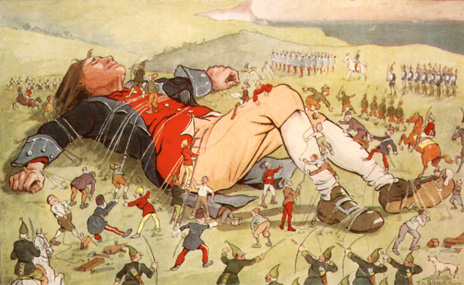
Gulliver1

Steven Metz says a "civilian surge" is impossible:

We could belly up and provide the resources for a serious expeditionary civilian corps. But a few hundred or even a couple of thousand people is not enough. We would need many thousands, perhaps tens of thousands, of advisers with linguistic skills and cultural knowledge willing to leave home and live under risky conditions for years at a time. And we are not talking about 20-somethings paid a pittance and fueled by idealism, but skilled professionals demanding serious pay for their expertise and sacrifice. (The difficulty that the State department had convincing even its hardened professionals to volunteer for duty in Iraq showed what a challenge this is.) Of course, if the pay is high enough, the experts will come. But, at a time of massive government budget deficits and a persisting national economic crisis, this is simply not in the cards.

What, then, is Plan B? If we are unwilling to pay the price for a serious civilian capability–and admit that foisting the job of development and political assistance on the military is a bad idea–the only option is to alter our basic strategy. We could find a way to thwart Al Qaeda and other terrorists without trying to re-engineer weak states. We could, in other words, get out of the counterinsurgency and stabilization business. This is not an attractive option and entails many risks. But it does reflect reality. Ultimately, it may be better than a strategy based on a capability that exists only in our minds.

This is my Tory fear: that there are some things that cannot be done. Ad there are certainly things that cannot be done when the imperial power is bankrupt. One of them is transforming Afghanistan into a place where al Qaeda will never be able to take sanctuary with Karzai as the head of government – and with an intervening power still there after eight years. We had a window. We blew it. Move on.

The Hangings Continue

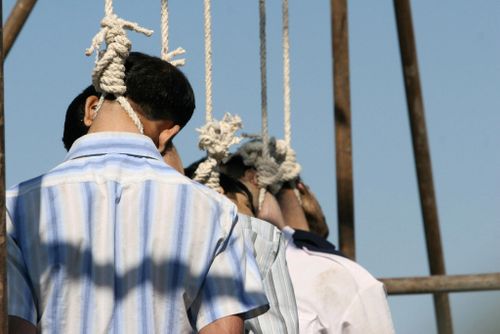
IRANHANGINGAFP:Getty

Hadi Ghaemi, director of the International Campaign for Human Rights in Iran, highlights the protesters being sentenced to death in Iran (there are also reports that a gay Iranian was hanged last week):

The international community's focus on the nuclear issue and the P5+1 negotiations with Iran are taking place against a backdrop of serious human rights crimes in Iran. The Obama administration is so enthralled by the possibility of finally getting Iran to the negotiation table and extracting concessions, that it is all but ignoring the human rights crisis, the post-election violence, and now the rising number of political death sentences. It is a folly to consider the nuclear negotiations and human rights concerns as mutually exclusive. They are indeed inter-related as state-sponsored violence and human rights violations are closely interwoven into Iran's foreign policy calculations at the moment. It remains to be seen if Iran has indeed achieved a form of nuclear deterrence–if, by having even appeared to join the nuclear club, it will be immune from pressure about human rights.

(Photo: young gay Iranians hanged for alleged sexual "crimes" three years ago in Iran. AFP/Getty)

Quote For The Day

Eli's latest, somewhat wrily delivered, scoop:

“While there were preliminary indications that Kashmiri may have been dead, there is now reason to believe that he could be alive,” a senior U.S. official told The Washington Times on the condition of anonymity because he was discussing intelligence matters. “It’s not always an open-and-shut case.”

Why God Backs Beating The Crap Out Of You

6a00d8341c730253ef0120a5e967c0970b-800wi

Below is a video of a vicious gay-bashing in Queens. It's below the fold because it's painful to watch. But the most amazing part of the news segment is an interview with one of the suspect's buddies, who accused the victim of "coming on" to his friends and thereby deserving a beatdown – near to death. As he denies there was any anti-gay bias in the attack, he wears a proud Leviticus tattoo above. Video and news segment after the jump:

Chart Of The Day

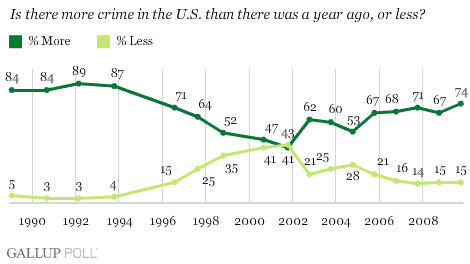
GallupCrime

Ryan Sager scratches his chin:

With the exception of 2001 and 2002 (9/11 effect?), between 52% and 89% of Americans every year since 1990 have thought that crime is on the rise. That’s a pretty remarkable statistic, given that crime declined steadily nationally throughout the 1990s and has remained essentially level in the 2000s. Whatever the year-to-year correspondence is, we know that people have gotten the big picture wildly wrong, year after year.

That is, people pretty much always seem to think that this year is worse than last, regardless of the actual trends.

He wonders if this is a consequence of the perennial suspicion that this "generation is so much stupider/lazier/ruder than the last; politics is so much dirtier these days; the world is going to hell in a hand basket." The trouble is: crime always makes the local news. Non-crime almost never does.

They Are The Ones They’ve Been Waiting For

A reader writes:

I just returned from a week-long trip to Tehran and wanted to share some observations. Most people I met felt strongly that the movement generated before and after the June election is badly in need of a leader.  Interestingly Mousavi is seen as too politically naive and unwilling to risk a violent backlash. Karoubi, while hugely popular is also not viewed as someone who has the charisma necessary to mobilize a cohesive opposition.  Remarkably everyone anticipates the next mass demonstration to be on November 4th, "students day" which commemorates the day the students occupied the US embassy and the start of the US hostage crisis.

They know this without any announcement from Mousavi or Karoubi.  That is, the people are anticipating when to act.  Also, there is general consensus that Ashura day (January 7) will be a landmark day in Iran.  Ashura marks the death of Imam Hussein whose martyrdome on Ashura marks the begining of Shia Islam.  The official color of Ashura is green and massive street demonstrations are common.  It would be interesting to see how Ahmadi and the Sepah will react this upcoming Ashura to people in green chanting anti-government slogans on "martyrdome day".  I heard from a few that Iran will be a different place after Ashura day, January 7th 2010.

My reader's first paragraph somewhat contradicts the second. It seems to me that the the strength of the movement is the spontaneous popular co-optation of the Revolution's own landmarks. It is that cooptation that will be more effective in the long run than a charismatic leader who could be demonized by Khamenei. Yes, they will need a broker at some point. But the green revolution was more effective for not being led by a single person but galvanized by many.