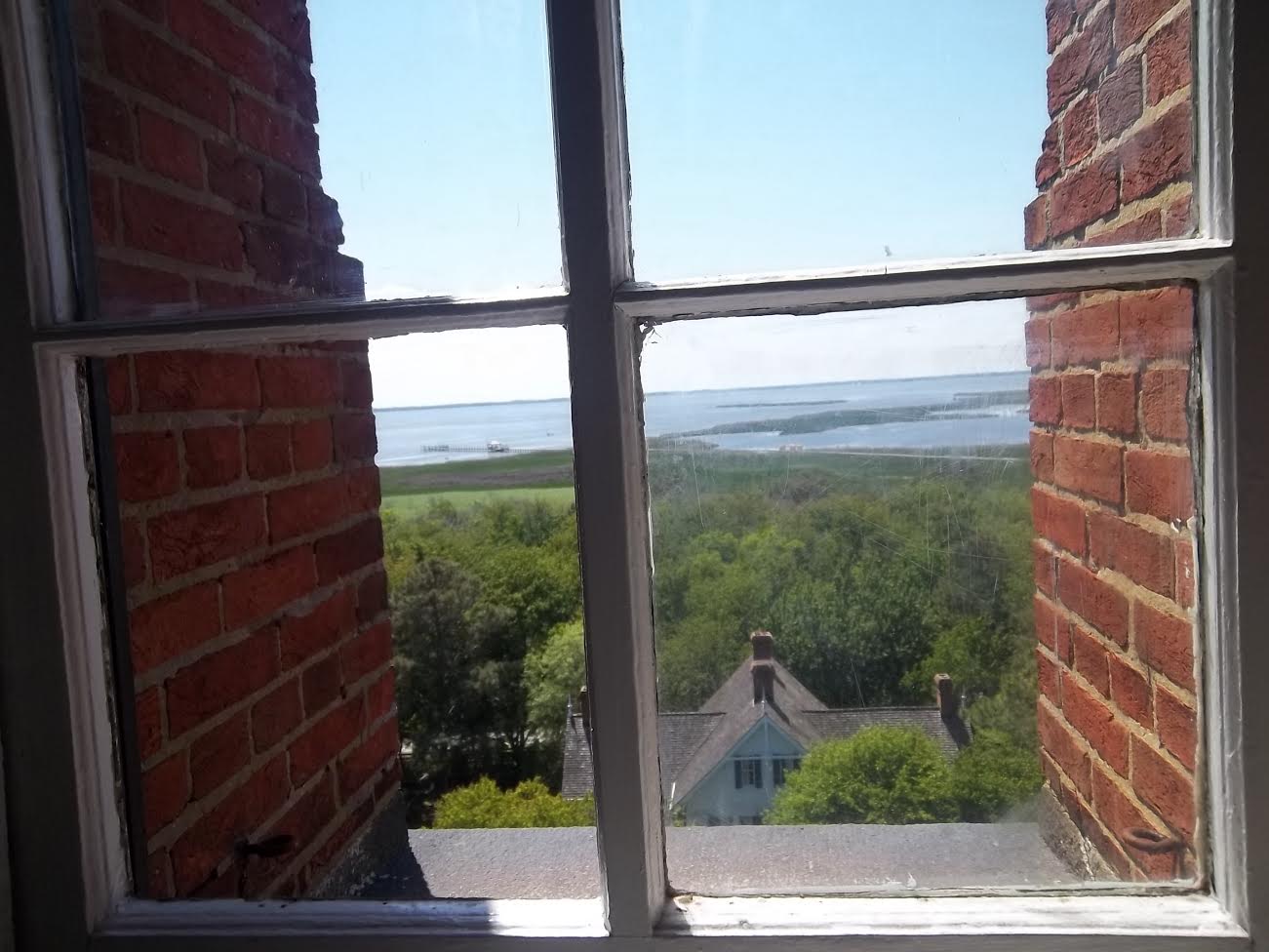
Corolla, North Carolina, 2.37 pm
Corolla, North Carolina, 2.37 pm
Motyl sees last Sunday’s successful presidential election as a huge defeat for Russia’s ambitions in Ukraine:
First, Ukraine is hardly the unstable almost-failed state that Putin and his Western apologists say it is. The terrorist violence was confined to two provinces—Luhansk and Donetsk. In the rest of the country, the voting proceeded smoothly. On top of that, Ukraine’s security forces were able to maintain law and order in much of the country, a positive development that builds on the armed forces’ creditable performance in their “anti-terrorist operations” in April and May.
Second, Ukraine is anything but the illegitimate state Putin and his western apologists say it is. Voting participation for the entire country was high: about 60 percent. Not including the two provinces that were terrorized by Putin’s commandos, participation was even higher. Everyone knows that the only thing that kept Ukrainians in the Donbas from voting was Putin’s terrorists.
Third, Putin’s terrorist commandos have been outflanked by the elections. People want stability; they want a return to normality. And they know that elections can bring about both.
But Marc Champion doesn’t believe for one second that Putin intends to back off, noting the presence of Russian citizens, including Chechens, in this week’s fighting in Donetsk:
Although transparent, Russia’s subterfuge is useful. It provides Europe’s leaders cover to avoid imposing costly economic sanctions on Russia. Putin withdrew troops from its border with Ukraine just before Sunday’s election there, the failure of which German Chancellor Angela Merkel had set as a trip wire for broader sanctions. European Union leaders who met on Tuesday were plainly relieved that they would not have to follow through on her threat.
However, the clash in Donetsk demonstrates that Ukraine’s presidential election alone will not stabilize the country. The decision by the city’s separatist leaders to declare martial law and send troops to seize the airport the next day showed they saw the vote as a starting pistol to renew hostilities rather than a signal to de-escalate.
Anna Nemtsova analyzes the discrepancy between Russia’s words and deeds:
Why would the Kremlin embrace Poroshenko’s victory with one hand, and feed violence and atrocities with the other, if indeed that is what’s going on?
Igor Bunin of the Center for Political Technologies, a think tank in Moscow, told The Daily Beast on Tuesday that the Kremlin gave up on the previous designs to annex the southeast regions of Ukraine (Plan A); or make them independent from Kiev (Plan B). “Now,” says Bunin, “we see the realization of Plan C: turning the east of Ukraine into a region of chaos and lawlessness, so neither the European Union nor NATO would dare to ever put their bases in that region.” It is this chaos by design that may become the biggest challenge for Poroshenko’s presidency, Bunin explains, “unless he finds a way to agree with the Kremlin.”
In the end, what has Putin gained from all this, Drum wonders. What he comes up with:
Crimea. And possibly a slowdown in the pace of Ukraine’s integration with the West. That’s about it. But I wouldn’t underestimate the cost of this to Putin. Threats of military force are flashy, but unless you’re willing to back them up regularly, they do a lot more harm than good. I’m not sure why so many people who are generally clear-sighted about the drawbacks of military action suddenly get so smitten by it when it’s wielded by a thug like Putin. Hell, he doesn’t even use it well.
When the dust settles, it’s hard to see Putin gaining much from all this in the places that count.

Brad Plumer deflates some of the hype over Google’s new driverless car prototype:
Now, before anyone gets too excited, note that self-driving cars are still a ways off from reality, especially given all the legal and regulatory hurdles they face. (And, for now, Google’s cars will only go 25 miles per hour — so the cars won’t run on highways.) But why not dream a bit? It’s worth thinking through what a future filled with self-driving cars might actually look like. Boosters often claim that the technology will have massive benefits for everyone: traffic jams will become a rarity, deadly crashes will drop dramatically, commuting will become far less stressful. We’ll all be happier, healthier, and wealthier. Maybe so. Yet self-driving cars could also have a number of downsides and unexpected consequences, too — from more suburban sprawl to layoffs for the nation’s millions of truckers and taxi drivers.
McArdle examines Google’s approach to the liability issue:
Essentially, Google is building a driverless golf cart, not a driverless car. With a top speed of 25 mph — therefore making collisions less likely to be fatal — there’s less risk that your vehicle will hurt someone if something goes wrong. There’s a lot to like about this approach. Of course, it means you lose some speed. On the other hand, most commutes aren’t that speedy. And I think many people would rather have a 45-minute commute during which they can read than a 35-minute commute during which they have to listen to talk radio while white-knuckling the steering wheel and silently wishing elaborately horrible deaths on the drivers around them. It also offers Google a way to prove the concept at relatively low risk.
But she also sees downsides:
The 25-mph speed is dictated by a regulatory threshold; try to take your car to 45 mph, and suddenly you’re in a different regulatory class, with higher safety standards (read: a lot more weight on the car) and various other requirements. So while in theory it’s easy to start slow and incrementally improve, in practice, Google is eventually going to have to get regulators to let it push beyond the current limitations.
Joshua Gans counters:
[A]s McArdle notes, slowing down cars to golf carts speeds of 25 mph as Google appears to be doing, does change the picture as it reduces the probability of accidents substantially. In which case, it seems that the liability system is working as intended. It isn’t stopping driverless cars but promoting their development in a healthy direction.
For this reason I have started to wonder whether the ‘regulation kills innovation’ theme is far more nuanced than many have been thinking. Why do we think that regulation will hold back driverless cars rather than actually promote them?
In Timothy Lee’s view, driverless cars will mean the end of mass car ownership:
Because the US is a high-wage country, it’s cheaper to own a car that sits idle 23 hours per day than to hire a human driver for one hour every day.
But as Uber CEO Travis Kalanick pointed out at the Code Conference today, that’s going to change once cars can drive themselves. Renting a car instead of owning one has a lot of advantages. People will be spared the hassle of buying gas, changing the oil, and taking the car in for repairs. Both workers and their employers will be spared the expense of finding somewhere to park our vehicles. Driverless taxis will improve average fuel economies too.
Edward Niedermeyer adds, “Google’s decision to abandon traditional vehicle controls is what will keep auto executives up at night”:
[T]he overwhelming fixed costs of the traditional business model has always hindered automakers from really changing things. The companies are also largely made up of people who genuinely love cars and driving, making them highly adverse to autonomous technology. By fostering the automotive enthusiast culture, to the tune of trillions of dollars over the last century, automakers have created performance-related profit centers that pad their bottom lines. Good luck convincing Google’s robot driver to upgrade to the turbocharger or sport suspension.
Ezra faces facts:
If you had told most Democrats in 2010 that by the time the 2014 election rolled around Obamacare would have rolled out with lower premiums and higher enrollment than anyone projected they would have been thrilled. They knew when they passed the law that it was going to be a political loser in the 2010 election but they figured that if they could just get it up-and-running — and insuring millions of people — it would be a winner in future elections. And perhaps it will be. But the definition of “future” keeps getting pushed out. Obamacare is working, but not for Democrats.
But the Kentucky Senate race could be a turning point. Drum explains:
[I]t turns out that Obamacare, of all things, is causing [Mitch] McConnell some serious heartburn.
You see, unluckily for McConnell, Kentucky has possibly the best, most popular Obamacare exchange in the country—though nobody calls it an Obamacare exchange, of course, since Obamacare is the work of Satan. It’s called Kynect. Everybody loves Kynect. So when McConnell was asked recently if he favored getting rid of Kynect, he had a problem. It’s Obamacare, and he’s on record favoring the root-and-branch repeal of Obamacare. But Kynect is popular. Nobody wants to see a root-and-branch repeal of Kynect. What to do?
So far, McConnell has taken a creative approach to this dilemma: He basically denies that Kynect has anything to do with Obamacare. McConnell remains in favor of total repeal of Obamacare, but says this wouldn’t cause any problems with Kynect. It would just keep motoring along without missing a beat.
Joe Sonka calls out McConnell:
Kynect could not have existed without the Affordable Care Act, and it would cease to exist if the Affordable Care Act ceased to exist. There would be no people eligible for the expanded Medicaid—the large majority of those who signed up through Kynect—and there would be no exchange for people to sign up for affordable private insurance with federal subsidies. Saying that Kynect is unconnected with the ACA or its repeal is just mind-numbingly false. The ACA and Kynect are one in the same.
Michael Tomasky agrees with that:
This is obvious to anyone with a brain. The category of humans with a brain includes McConnell. He’s not that stupid. That leaves only one other choice: hypocritical. Well, two other choices: hypocritical and lying. That is, he knows Kynect can’t exist without the ACA, but he just said it anyway, without any concern for the truth. And the hypocrisy part comes in, of course, because, well, how can he have stood up there for years saying that, no, Americans should not be permitted to get health care the Obama way, and he’s going to strike it down the second he can—but Kentuckians, they’re different?
Beutler urges Democrats to go on the offensive:
Democrats can alter the currents of Obamacare politics at key moments, but only if they’re willing to occasionally brave its waters. McConnell’s opponent, Alison Lundergan Grimes, dipped her big toe in those waters Wednesday, but couldn’t ultimately bring herself to dive in with the crucial words “Affordable Care Act.”… Remember, McConnell’s goal is to mislead voters into believing that repealing Obamacare won’t have any bearing on Kynect. And his plan will only work if voters are confused about the connection between the two. Thus, Grimes can only close the loop by making it clear that repealing Obamacare is the thing that will destroy Kynect even if that means making common cause with the Affordable Care Act.
Move over, Nate Silver; Stephen Hawking is now dabbling in data-driven sporting analysis:
“[England’s] chances of triumph [in the World Cup] can be worked out by looking at a number of environmental, physiological, psychological, political and tactical variables,” he wrote. According to his apparently very scientific calculations, the team should wear red, and play in a 4-3-3 formation for a psychological boost.
His data crunching of results from finals since the 1966 Cup (all too long again when England won) also revealed that England wins 63 percent of games when the referee is European and only 38 percent when they’re from elsewhere, and that the team is twice as successful at altitudes below 500m over sea level, and a third more likely to do well when kick-off is around 3pm.
Regardless, Goldman Sachs expects a Brazilian victory:
According to the report authors, the results are surprising in how strongly they favor a win by Brazil. … They write that “it is hardly surprising that the most successful team in football history is favored to win a World Cup at home. But the extent of the Brazilian advantage in our model is nevertheless striking.”
“I do not have a problem with guys who sound gay. I actually like the gay voice. I mean… I like like it. I think gay voices are sexy. (I could binge watch an entire season of Project Runway with my eyes closed and still enjoy it.) I could blame my preference for gay voices on lousy gaydar—”gay accents help me spot other gay men!”—but my gaydar is excellent. The real reason gay voices and other overt manifestations of gayness appeal to me, I think, is because they’re so paradoxically masculine. The only openly gay kid at my Catholic high school in the early 1980s would roller skate into school every morning wearing satin short-shorts and a mesh tank top. He wasn’t afraid of the homophobic jocks at St. Greg’s. The jocks were afraid of him. I wanted to be him,” – Dan Savage.
I had a similar role model back in high school. He was a few years ahead of me, and his name was Johnny. At some point, Johnny started wearing make-up to my all-boys school, along with a pretty impressive pseudo-afro with his curly mope of hair. Eye-liner, lipstick, mascara, the whole nine gay yards.
He was constrained to some extent, since we all wore uniforms – cap, jacket, school tie, gray pants, black shoes. Then halfway through my time, the school went co-ed, and they introduced a school uniform for girls. Sure enough, the next day Johnny showed up in a charcoal skirt, with his hair like something out of, well, Hair. He used to catch the same public bus as I did on the way to school and I remember being in awe of his courage. But he carried it off with ease. And, as with Dan, the other boys – in a rowdy rugby-worshiping place – never took the bait. There was a steely self-confidence, an aura of aplomb, that simply disarmed those who might have wanted to bully him. Yes, they were a little bit afraid of his giant, pendulous balls.
Johnny died of AIDS in his twenties. He lives forever in my heart.
A brief description from National Geographic:
While serving in Afghanistan, U.S. military combat dog Layka was shot four times by the enemy at point-blank range. Despite her injuries, she still attacked and subdued the shooter, saving her handler and the other members of the team. Seven hours of surgery and the amputation of one leg saved her life. Her handler, Staff Sgt. Julian McDonald, fought hard to adopt her and she’s now become a part of his family.
Tripods are the best.
Katie Crouch declares, “There is something decidedly disorienting about becoming a child of divorce at 40”:
For one thing, my brother and I are extravagantly late to the party. During the first wave of divorces among my parents’ group when I was 8 or 9, I pined for the family breakup. It wasn’t that I was terribly miserable. (Moderately, maybe.) The real draw was that the attention seemed glamorous. … At 40, for me my parents’ separation draws no pity slumber parties, no new cars. Blank stares are usually what I get when I drop the sad news. Though it rarely comes up. Why would it? There are no arrangements to make to pick me up from dance class, no birthday parties to choreograph.
What does it mean, when your parents split apart after you yourself have lived half of your life? For one thing, there isn’t a shred of innocence left. I know exactly what my mother and father are losing, because I’ve known these people for four decades. I’ve witnessed their stubborn affection for each other; I’m old enough to get their private jokes. If I were younger, perhaps I could trick myself into imagining a cute “Parent Trap” situation, but my middle-aged mind knows reconciliation is not possible, not after almost half a century of two people struggling with a disease no one beats. Certainly, I am less shattered than I would have been as a kid. But I am sadder, too.
I have to say I don’t find late divorce to be inherently sad. The ability in your sixties or seventies to say that you want a new start, a fresh life, if your marriage has become toxic and irreparable, strikes me as a vote of confidence in the future. Staying in a marriage that hurts both parties – out of mere pride or exhaustion – is not a great way to round out your days. And the relationship may even blossom with a little late-life distance. There’s a phrase from a Pet Shop Boys track that has long played in the back of my mind during life’s tough patches and a relationship’s constant challenges. Happiness is an option. Words to live by. Words to die with.
“If we destroy creation, creation will destroy us. Never forget this!” – Pope Francis.
It’s when, not if: Veterans Affairs Secretary Shinseki’s fate appears sealed http://t.co/3vl6f2JBy8 pic.twitter.com/h3EL8Rz3H2
— NBC News (@NBCNews) May 29, 2014
The findings of the newly released inspector general’s report are pretty grim:
Some 1,700 veterans waiting for an appointment at Veteran Affairs clinics across Phoenix, Ariz. were nowhere to be found in the system’s official wait list, federal investigators reported on Wednesday. Investigators for the Veteran Affairs Office of Inspector General said they had found initial evidence of “inappropriate scheduling practices” in the Phoenix Health Care System, which had led to “significant delays in access to care.”
Although data reported by Phoenix authorities suggested a statistical sample of 226 veterans waited an average of 24 days for their first primary care appointment, the review found that those 226 veterans actually waited on average 115 days to receive a primary care appointment. Only 16 percent got an appointment in 14 days or less, according to the interim report.
Shinseki’s days appear to be numbered:
Increased calls for political action came swiftly in the report’s wake and focused on VA Secretary Shinseki.
“I haven’t said this before, but I think it’s time for Gen. Shinseki to move on,” Sen. John McCain said in an appearence on CNN Wednesday. Rep. Jeff Miller, chairman of the House Veterans’ Affairs Committee, responded to the report with a statement that said Shinseki should “resign immediately.” … In addition to Miller, four other lawmakers also called on Shinseki to resign after the report was released, adding to the more than 50 members of Congress who have called for him to step down since the scandal broke last month. At least two new Democratic senators joined the chorus Wednesday, suggesting that more members of the president’s party are turning against his appointee in the wake of the OIG’s findings.
But Mataconis points out that removing Shinseki won’t solve the VA’s problems:
In the end, of course, the problems at the Department go far deeper than Eric Shinseki. In many cases, they predate him and to a large degree they involve the actions or failures to act of people under him over which he does not have direct supervisory control. Getting rid of the Secretary of Veterans Affairs isn’t going to solve the problems at the VA unless it is also accompanied by the removal of the people further down the chain responsible for these decisions. There also needs to be examination of the bizarre incentive structure that led to the creation of secret waiting lists that made it appears as though hospitals were doing a better job of addressing veteran’s health needs than they actually were. And, a reassessment of the idea that the VA should be the source of all the health care that veterans receive. … In other words, what’s needed is a transformation of the VA from the bottom up, not just the removal of the guy at the top.
Alesh Houdek argues that the real scandal here is in how long it took for anyone to blow the whistle:
Improvements in oversight and auditing are surely part of the solution here, but there’s a much more fundamental change that needs to happen: Regular line-level employees who see wrongdoing on the part of their coworkers, or are asked to engage in wrongdoing by their supervisors, need to be able to do something about it without threat of retaliation. Any human endeavor examined closely enough is a disgraceful mess, and most of us know this most directly from our jobs. But we also instantly recognize true malfeasance when we directly encounter it. So, of all the people who were involved or knew about these terrible practices who worked at the VA, why did it take so long for the truth to come out? …
Since the Phoenix revelations, employees from VA offices around the country have gone to the press with reports that similar practices exist at their offices. Had there been a robust and reactive system for internal whistleblowing, this would not have happened.
Update from a reader:
I am an ER nurse at a VA hospital (not in Arizona, thankfully). The comments from politicians on this scandal are just asinine.
Why is nobody asking why it takes over 100 days to get a primary care appointment? I hear these same complaints from people in the ER every day, that they come to the ER because it takes months to see their PCP. It takes that long because the VA is not given the budget to hire enough PCP’s. That’s the real fucking scandal. The politicians sent our troops to war and they are not willing to pay for their care when they come back.
Is the claim really that there is some nefarious plot to keep our Veterans from seeing their providers? Who believes that shit? We just don’t have enough primary care doctors and nurse practitioners to see them. Hire some more PCP’s and the wait times will decrease.
As for privatization, that is a fucking joke. Only about half of veterans actually use the VA for their health care now, because those who receive insurance through their employer usually go to private hospitals. The ones we see on a daily basis in the ER are older, poorer, often homeless, with more illness and co-morbidities. They are a distinct population and their level of care will decline if they don’t have a specialized service like the VA serving them.
You may not believe it, but most of us working at the VA actually believe in our mission. We mean it when we thank a veteran for their service. Rather than fixing the problem, and fixing our budget, they are just trying to shuttle more money to private hospitals and continue their anti-government grandstanding. The Republican party and the weak-kneed contingent of the Democratic party make me sick. The only Senator who seems to actually care about the veterans is Bernie Sanders.

