More evidence of continued resistance in Iran. This footage is taken from yesterday and today at Sharif and Tehran universities:
Just remember that every one of thse students knows what happened to the others.
Know hope.
More evidence of continued resistance in Iran. This footage is taken from yesterday and today at Sharif and Tehran universities:
Just remember that every one of thse students knows what happened to the others.
Know hope.
“She has a gift for prose. Hopefully that comes across," – Rick Santorum, on Going Rogue: An American Life.
 A reader writes:
A suggestion hits me for your reader who thinks Darwinists who haven't read Niebuhr are ignorant. Read the chapter on innate morality in Pascal Boyer's Religion Explained.
It's true that 21st century genetics and neuroscience have yet to fill in details of how natural selection gave us a sense of good and evil that appears in most of us as surely as walking and talking. Which genes code for which proteins that cause various desires to form in our brain, including the desire to be good, which one can't be if one hurts other people without a good reason? Science needs more than my lifetime to go through all 20,000 of our genes and follow their products out into who and what we are, but it's straightforward how to do that. It's not a fantasy.
What will be left unexplained at the end of that?
Not only will this process show what biological evolution has done to us, it will show how cultural evolution has built on that, what is not strictly biological, even though culture needs biology to exist and shows the effects of that collaboration. I'm sure many aspects of hatred, indifference, and falseness will be examined in this. Biology surely gives us a physiological foundation for these, and culture shapes when and how we think such evil is OK. Of course a limited amount of hate isn't evil. It might be righteous indignation that helps other people more than it hurts them. A limited amount of indifference is simply practical. So is some limited spin on the truth. Yes, evil is subjective and relative, even if it certainly exists in some sense.
That is certainly one reason I looked to God for help. Life is not about following a clear set of rules. It's not that easy. People who say it is that easy are being false. The gospels taught me that. Reaching for God directly taught me more. Yet God not only helped me with what I should do with my innate sense of morality, otherwise known as my pesky conscience, God also helped me with what I should do with my walking and talking, two processes almost everyone would accept as biological. So why is there such resistance to morality being biological? Is it that cognitive sciences are so new? Is it that scientific illiteracy is so much worse than the 40% of Americans who think the Bible sould be taken literally? I'm sure it's a lot of things, but there is a God who will help.
I reached for that God and found something. Perhaps I overgeneralize from my own experience as human beings naturally do. Maybe my way isn't for everyone any more than Niebuhr is for everyone. But it's not ignorant, and it's not evil. Read academic anthropologist Pascal Boyer's book. Read the ongoing scientific literature. Or just read old books that will help you relax about what you already believe, in your cocoon or otherwise. It's a free country. Then you die. Then new people come along who are somewhat different.
A reader writes:
Scott Ritter reminds me of the Bush administration–he has a tendency to omit inconvenient facts when making his arguments. The Guardian op-ed that you cite in your recent post contains two glaring flaws:
First: Ritter claims that Iran was not bound by Code 3.1 of the "additional protocols" (requiring it to inform the IAEA of the construction of new nuclear facilities), because Code 3.1 had not been ratified by the Iranian Parliament. However, Ritter fails to mention that the Iranian government never even bothered to submit Code 3.1 to the parliament for ratification.
That's not surprising, since Code 3.1 (which is part of the Nuclear Nonproliferation Treaty's "Subsidiary Arrangements") does not require ratification by national parliaments. Iran did, however, send a letter to the IAEA in 200, promising to adhere to the code (which is considered the proper legal protocol). As such, when Iran declared in 2007 that it would no longer be bound to Code 3.1 (due to lack of parliamentary ratification), the IAEA emphatically (and correctly) rejected the decision.
Ironically, it was Iran's 2007 announcement that alerted intelligence agencies that something was amiss. By this time, arms control experts were in agreement that Iran could not divert sufficient amounts of enriched uranium for weapons production from its Isfahan facility without being caught by the IAEA–hence, the real possibility that Iran intended to build another, clandestine facility that would not be monitored by the IAEA.
Which brings me to Ritter's second glaring misstatement: "The size of the Qom facility, alleged to be capable of housing 3,000 centrifuges, is not ideal for large-scale enrichment activity…" That would be true if Iran was using its older centrifuge design, the P-1. However, at the same time Iran withdrew from its agreement with the IAEA, it resumed work on perfecting the IR-2 enrichment centrifuges–a variation on the P-2 centrifuges used by Pakistan. The IR-2 design is smaller, more energy efficient–only 1,200 such centrifuges would be required to produce enough weapons-grade uranium for a bomb in just one year.
I certainly agree that we should proceed cautiously based on the latest revelations. But to suggest, as Scott Ritter does, that Iran's actions demonstrate that the country has been acting in good faith is a bit of a stretch.
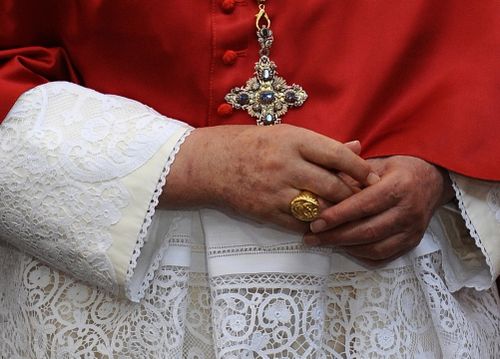
The Church has put out a statement:
The statement, read out by Archbishop Silvano Tomasi, the Vatican's permanent observer to the UN, defended its record by claiming that "available research" showed that only 1.5%-5% of Catholic clergy were involved in child sex abuse.He also quoted statistics from the Christian Scientist Monitor newspaper to show that most US churches being hit by child sex abuse allegations were Protestant and that sexual abuse within Jewish communities was common.
Melissa McEwan notes that the Vatican is trying to pin this on the gays, again:
The statement said that rather than paedophilia, it would "be more correct" to speak of ephebophilia, a homosexual attraction to adolescent males. "Of all priests involved in the abuses, 80 to 90% belong to this sexual orientation minority which is sexually engaged with adolescent boys between the ages of 11 and 17."
She vents:
The Catholic Church has a problem with priests who rape children below the age of consent. That is a fact which is not changed by what name it's called. And, at this point, the last thing any thinking person with a conscience wants to hear from the Vatican is a bunch of bullshit technicalities being substituted for any serious acceptance of accountability. But, as usual, that's all we're gonna get.
But this is Ratzinger's real view: that the sex abuse crisis was basically a liberal plot to discredit the Church, rather than what it was, an international conspiracy for the molestation of children, enabled by the Vatican.
(Photo: Benedict XVI, by Joe Klamar/AFP/Getty.)
Daniel Drezner rightly whacks the Leveretts:
Seriously, how did this paragraph get past the op-ed editors? First of all, beyond a rhetorical flourish or two and asking Twitter to hold off on their scheduled maintenance, what exactly did the Obama administration do to foment regime-toppling instability? Second, if the largest street demonstrations since the 1979 revolution don't qualify as a big event, what would convince the Leveretts of the import of the June election? More YouTube videos? Hand puppets?
Daniel channels my own thoughts on sanctions:
This seems as propitious a moment as any to cave to popular demand that I articulate some thoughts on the sanctions question with regard to Iran. I would expect some somewhat more utility in the sanctions process than the Leveretts. If the U.S. can foster cooperation among the P5 + 1, and the Iranians see the extent of this cooperation, then I think they'd be willing to deal. That's not an easy proposition to pull off, and would require both diplomatic skill and will. That does not mean it shouldn't be tried, however. Even the effort to build momentum in the Security Council might prompt serious bargaining from the Iranians.
And here's another point I'd second:
I would also like to know how the Iranian opposition feels about sanctions. If they reject them as a policy tool, well, that's a good argument against their imposition. On the other hand, if this is a replay of South Africa, then that's something else to consider.
During the first wave of the Green Revolution, this blog had loads of Iranian readers in Iran, or Iranians outside the country able to convey what the sentiment was within. Please email your thoughts on sanctions and I'll do my best to air them.
In a way the ultimate MHB:
Friedersdorf examines the GOP's refusal to extend fiscal restraint to foreign spending:
Unfortunately, the conservative movement's impulse is to afford military leaders too much deference. Take its stance on our nuclear arsenal. After the military presented a plan to reduce it, President Obama signaled his displeasure by demanding more ambitious cuts. "Obama knows more about weapons requirements than the military now?" conservative blogger Dan Riehl wrote, echoing many on the right. "I think it's time to start ringing the alarm bells with this guy, folks." Conservatives respond quite differently when domestic-affairs bureaucrats claim special knowledge. Expertise in education, or welfare spending, or environmental stewardship is afforded some respect. Deference is tempered, however, by the understanding that people aren't very good at judging the relative importance of their own work, and that every institution is reflexively opposed to shrinking itself. Should our nuclear arsenal shrink? I haven't any idea, but a better counterargument is required than "the military knows best."
It seems to me to be an inherent part of conservatism properly understood to constantly evaluate means and ends, to ensure that a country is not over-extended, to maintain a viable fiscal balance for the foreseeable future, with some cushion for an emergency. Assessing whether a country's military commitments exceed its fiscal grasp would be an obvious part of that equation. But, of course, among today's loony rightists, it isn't.
You will never hear a neocon talk about the expense of empire or the burden of imperial debt. The neoconservative outlook focuses on the internal nature of foreign regimes, but it refuses to look at the internal financial collapse of contemporary America.
Neocons favor more defense spending, period. I do not recall a single recent instance in which they did not want to project military power, regardless of its expense. There have been no conservative worries about the cost of nation-building in Iraq and Afghanistan, even as they fulminate against big government spending. To ask the question of why American tax-payers are still financing the defense of Germany, for example, is to commit heresy (I exclude Ron Paul from all this, of course). And yet if we know one thing from history it is that empires crumble from a function of mounting debt, often caused by unnecessary or hubristic wars. If today's astounding debt – created in large part by Republican tax cuts, war, failure to rein in entitlements or regulate the financial industry sufficiently – does not wake them up, what will?

Mark Freuenfelder explains:
Like AYDS and Beaver College, the WTF (Wisconsin Tourism Federation) got tired of being the butt of jokes and changed its name to the Tourism Federation of Wisconsin.
Marc Lynch lists several diplomatic moments that Obama "failed to capitalize on."
Take the exemplary June speech in Cairo, where Obama delivered a brilliant speech which captivated international and Muslim attention. It offered a real opportunity to reset American relations with the Islamic world, and to begin a new kind of relationship and engagement. But after the speech… almost nothing followed. Few new programs, few new initiatives, few efforts to capitalize on that moment. (And don't tell me about the number of text messages or twitter tweets sent during the speech — could there be a more pointless metric for success?) I'm told that a number of new programs are in the works, but it's far too late — they should have been "shovel-ready" on June 5. Now, the Cairo speech might as well have happened in the Jurassic period and the momentum of that one-time-only speech has been squandered.
Sometimes the lower profile is intentional, and correct. The administration was absolutely right to not take the lead during the Iranian electoral protests, helping to prevent the regime from making the U.S. the issue. It has also done a great job of quietly de-emphasizing al-Qaeda, rarely referring to it (except in the AfPak zone) and deflating rather than exaggerating its threat. But in so many other areas, better public diplomacy and strategic communications could make a real difference in shaping the conditions for foreign policy success.
 The Dish