A World Without Pain

GAZAGRIEFMahmudHams:AFP:Getty This post on vegetarians opposed to genetically engineering pain-free animals is fascinating in itself. But you can't help but free associate to Jerry Coyne's assertion that suffering disproves God's existence. Pain in the physical world is actually a necessity for survival and hugely beneficial to society. Pain and suffering are not synonymous, of course, but they are obviously related (I think of suffering as the long-term, self-conscious experience of pain). Consider the case of Gabby Gingras, a girl born without the ability to feel pain:

"Pain teaches," said her mother, Trish Gingras. "Pain protects. Pain can save you from a lot of bad things in life." Gabby, who is 5, suffers from an extremely rare disorder called congenital insensitivity to pain. For unknown reasons, the connection between the nerves that sense pain and the brain's recognition of pain is missing. Her other sensory areas — touch, heat, vibration, and the ability to perceive movement — are normal.

Some of the complications this has caused:

Gabby can't tell when she's hurting herself.

"She started cutting teeth and she had bit down through the skin. She would have bit down to the bone had I let her. It was just chewed up," Trish Gingras said.

"We decided to pull her teeth because she was mutilating her fingers," Steve Gingras said.

Learning to walk just made Gabby more vulnerable. By the time she was 2½, she had been injured and hospitalized multiple times. At age 2, Gabby broke her jaw and didn't know it until infection caused a fever. To treat the infection, she had to be on an IV medication for six weeks.

Her eyes were especially at risk.

"You'd look away for one second, you'd look back and she'd have her fingers in her eye," Steve Gingras said. "You're watching your child go blind right in front of you."

Her desperate parents tried restraints and then goggles. But by the time Gabby was 4, she needed to have her left eye removed. Her right eye was also damaged, and she wears a lens over it to help her see better. Although Gabby is legally blind with 20/200 eyesight, she can still see shapes.

Maybe one can imagine a physical existence where pain does not exist. But not on this planet, where pain has helped organisms survive and prosper, and where suffering has often prodded humankind's spiritual dimension. This complex interaction between good and bad – captured graphically in the Gospels' Passion stories, where intense suffering is inextricably bound up with salvation – seems too much for the Coyne position. But it should not be too much for anyone capable of more than a sophomoric understanding of human experience.

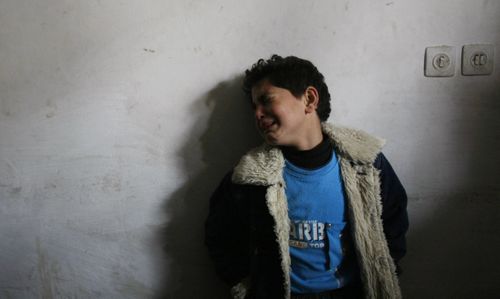
(Photo: a Gazan child mourning the death of his father under Israeli assault last January. By Mahumd Hams/AFP/Getty.)
Karl Rove As Boris Badenov

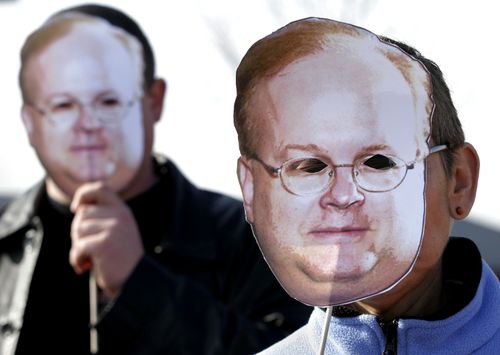
ROVEMASKBillPugliano:Getty

Bruce Bartlett is reading and re-reading Matt Latimer's new book on Bush. He's struck by the accurate and devastating account of the dumbness of Karl Rove contained therein:

Latimer is surprisingly critical of Karl Rove, given that he remains a darling of conservatives. Latimer correctly notes that Bush should have won the 2000 election easily and that it was close only because Rove stupidly wasted millions of campaign dollars in a futile effort to win California in the last days of the campaign instead of shoring up Florida. Latimer also notes that Bush's re-election should have been a slam-dunk but ended up being close. Thus Latimer thinks that Rove's reputation as a political genius is totally undeserved. I agree. Here Latimer summarizes his assessment of Rove:

"Karl was not the hero of the Bush White House, the brilliant behind-the scenes strategist. He was what all the liberals said he was: the villain. And to make matters worse, a clumsy one at that. He employed ham-handed tactics, put forward obviously unqualified subordinates, and stubbornly defended them. He'd turned out to be less a Voldemort than a Boris Badenov chasing Rocky and Bullwinkle."

In the second link above Bartlett also has some worthwhile throughts on the communication strategies of Bush II, Reagan, and Obama.

Leveraging The People Against The Regime

Here are some encouraging numbers from a new poll of Iranians:

A new WorldPublicOpinion.org poll finds that two-thirds of Iranians would favor their government precluding the development of nuclear weapons in exchange for the lifting of international sanctions against Iran.

Only one-third would be ready to halt enrichment in exchange for lifting sanctions. However, another third, while insisting on continuing enrichment, would agree to grant international inspectors unrestricted access to nuclear facilities to ensure that that there are no bomb-making activities.

The WPO poll also finds that six in 10 Iranians believe that economic sanctions, imposed by the United States and the United Nations over fears that Iran's nuclear program might produce an atomic weapon, are having a negative impact. Seven in 10 say they believe sanctions will be tightened if Iran continues its current nuclear program.

The case for using the threat of tighter sanctions to further undermine the regime's legitimacy is growing stronger.

“Occupation”

Obama uses plain English to describe the Israeli control of the West Bank. He also attempts to re-balance international relations in the wake of the Cheney era, insisting that from now on, the US will not be a human rights abuser, but equally insisting that America cannot solve the world's problems alone:

"Those who used to chastise America for acting alone in the world cannot now stand by and wait for America to solve the world's problems alone. We have sought — in word and deed — a new era of engagement with the world. Now is the time for all of us to take our share of responsibility for a global response to global challenges."

America’s First Brain Drain, Ctd

A reader writes:

I'm an immigration attorney and can verify that this is absolutely true.  Here's another indicator from the opposite direction: This year, for the first time in recent memory, the H-1B cap still has not been reached for FY2010.  Historically, it is reached the first day one is allowed to file petitions for the following fiscal year: April 1. This was true as recently as last year. 

Of course the economy has played a significant role in the drop-off in companies' willingness and ability to sponsor highly-skilled and professional foreign workers for H-1Bs. But the hassle and expense ($2320 in USCIS application fees alone – that doesn't even take into attorney fees, which can run several thousand dollars) of securing even these temporary work visas (not to mention the nightmare of the green card process) has certainly also played a role in making the H-1B less attractive for both companies and foreign workers. 

Just ask Microsoft, which opened its new software development center in Canada last year because the company came to the conclusion that dealing with the Alice in Wonderland world of U.S. immigration was no longer worth it.

What Will They Think In “Real America”?

Regarding Palin's speech to Credit Lyonnais Securities Asia, Michelle Cottle notes:

1. Someone is actually giving Palin money to talk to 1,000 or so international investors about global economics and what's going on in Asia.

2. In her new role as buck-raker extraordinaire, the darling of wingnut conservatives is pocketing a fat wad of cash from a China-based financial brokerage owned by a French banking conglomerate.

How perfect is that?

Health Insurance Reform Gets More Popular

But only a little. The country seems evenly split. But the debate clearly turned a corner in August when the townhalls were at their splenetic height. The GOP might have galvanized their base – but at the expense of turning off the center:

45% approve of Obama’s handling of health care, while 46% disapprove, which is up from his 41% – 47% score last month. By comparison, just 21% approve of the Republican Party’s handling of the issue.

So the GOP may lose on the substance and also be regarded as irresponsible by much of the American middle. If the reforms prove popular (and why would they not in the next few years when the package is mainly sugar?), Obama could have the last laugh.

Think of this possible scenario in the fall of 2010: healthcare has passed, the economy is rebounding a little more briskly than some now expect, and troops are returning from Iraq. The pattern is somewhat Reagan-like in its chronology.

The American Diaspora, Ctd

A reader writes:

I'm an American who has also decided to leave the US.  However, it's not because of HIV status.  It's because of my concerns over healthcare.  You see, my European wife has a chronic disease that worsened soon after we moved to the US two years ago.  I have insurance, but with a sick wife and two children, our bills are quite high.  Worse, should I ever change jobs, or get fired,  I have no doubt our insurer would drop us, or at least dramatically increase our premiums.

I'm a senior exec in a software company.  I've always wanted to run my own company, and I have an idea that I think will work. 

But we'll move back to Europe before I take that risk.  In the US, I just cannot be without healthcare for any length of time.  I wonder how many other potential entrepreneurs are discouraged from striking out on their own for this very reason?

Another writes:

You essentially ascribe bad immigration policy to homophobia. I work at the NIH and I've come to a bigger conclusion; the US simply does NOT have a rational immigration policy. I see so many brilliant scientists from abroad that simply can't stay in the US because of absurd rules. These are exactly the kind of people that every country should want to have. There is no logical explanation for having such strong barriers to attracting such educated and capable people. While I don't argue that immigration policy may be homophobic, I think the larger issue is that there is no immigration policy; the system is just a bunch of inhumane and illogical rules.

I agree entirely. I was only citing two examples of needless discrimination in immigration laws. There are so many others – including the failure to expand H1 visas and to retain talented foreigners who come for education and want to stay and contribute but cannot. We have become so obsessed with illegal immigration that we do not face the irrational, talent-phobic, bureaucratic and cripplingly expensive legal immigration process. It's impossible to contemplate a serious immigration reform, because the political system is incapable of any such action. And so the stupidity endures.

Handling The Iran Scorpion

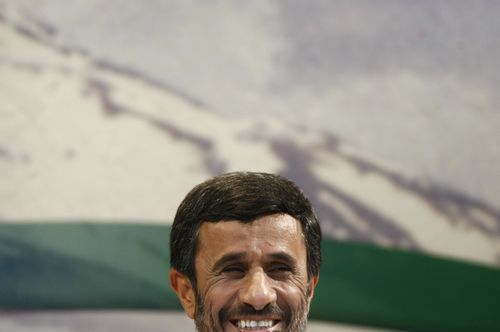
AHMADINEJAD09BehrouzMehri:AFP:Getty

On the one hand:

I would hope by now that the murderous crackdown on Iran’s mass democracy movement by the country’s oil-funded ruling cartel would have removed the last scales from the eyes of those Iran watchers who think this is simply a poor, misunderstood regime that really wants to repair its relations with the West, and we just have to learn how to speak to it properly. This is a brutal, cynical, corrupt, anti-Semitic regime that exploits the Palestinian cause and deliberately maintains a hostile posture to the West to justify its grip on power. A regime that relates to its own people with such coercive force is not going to be sweet-talked out of its nuclear program. Negotiating with such a regime without the reality of sanctions and the possibility of force is like playing baseball without a bat.

On the other, as Tom Friedman also argues, the deep unpopularity of the regime, and the divisions within the elite, may make economic sanctions more potent. Juan Cole notes:

Further unilateral U.S. sanctions and collective UNSC measures should be taken more seriously than they are by Iran.

Ahmadinejad defiantly told NBC, “We think for one or two countries to think that they own the world and they are the ones that make the major global decisions and others should follow — that period has come to an end.” But Iraq’s economy was ruined by U.S. and U.N. sanctions in the 1990s, and the lack for some period of time of chlorine for water purification and of some medicines is thought to have been responsible for the deaths of 500,000 Iraqi children.

Targeted sanctions on North Korea interdict military and technological equipment, exclude luxury goods, and constrain the country’s finance system. This summer, the UNSC went further and urged member nations actually to board suspect North Korean ships. China, which had earlier blocked such moves, agreed to this resolution because its leaders were furious about North Korea’s underground nuclear test. The Khamenei-Ahmadinejad regime risks making Iran a pariah on the North Korea model if it goes on defying the international community. Iran’s people will be the real losers if that happens.

All one can say is that this is an extremely delicate and difficult balancing act for the US. On the one hand, the US has to prevent Israel detonating World War III in the Middle East; on the other, the US has to ensure the security of Israel. On the one hand, Obama has no choice but to talk to the regime to address the nuclear issue; on the other, if he only addresses the nuclear issue, then the Green Revolution might feel slighted. On the one hand, sanctions might tip the balance toward revolution and regime change; on the other, they might isolate the regime – and entrench it – on the North Korean or Saddam’s Iraq model. God knows the coup-leaders have no qualms in using Kim Jong-Il type brutality. But Iranians are not North Koreans. Real sanctions could heighten the regime’s contradictions and bring it down.

From a laptop, these maneuvers are impossible to judge. This is a prudential judgment that we have no choice but to delegate to leaders and diplomats. But it seems to me that the worst possible outcome would be an Israeli attack; the best would be regime change from within. Between those two, a policy of containment – economic and financial sanctions wrapped in both the nuclear issue and the legitimacy issue – seems the most practical way forward to me.