"There are different kinds of truths for different kinds of people. There are truths appropriate for children; truths that are appropriate for students; truths that are appropriate for educated adults; and truths that are appropriate for highly educated adults, and the notion that there should be one set of truths available to everyone is a modern democratic fallacy. It doesn't work," – Irving Kristol.
The View From Your Window

Chagrin Falls, Ohio, 10.35 am
From Kristol To Beck
James Warren recalls the good old days of intelligent conservatism. what he doesn't say, understandably, is that, as neoconservatism became a dogma, and support for general common sense morphed into the loopiest fundamentalism and know-nothing populsim, Kristol retained his Trotskyite political sense. No enemies to the right was his motto. Beck's ignorant, know-nothing, populist bile is the tiger neoconservatism rode. And you cannot write a history of neoconservatism without understanding that it became corrupt, cynical and so divorced form the reality it once championed that it unraveled itself. Bruce Bartlett has a good take, as usual, on the decline of the right under Irving's son Bill:
There is still a need for serious conservative social science research that has no other publication outlet. Commentary is now just a highbrow version of National Review, which is just a glossy version of Human Events, which has become a slightly less hysterical version of nutty websites like WorldNetDaily. The Wall Street Journal editorial page and the Weekly Standard, founded by Kristol's son Bill, just parrot the Republican Party line of the day. The intellectual bankruptcy of conservatism today is even greater than it was when Irving Kristol founded The Public Interest in 1965. What passes for a conservative movement these days wears its anti-intellectualism as a badge of honor.
My own interactions with Kristol and his wife were always cordial; he was a gentleman and a sharp mind. In the end, he surrendered the worst elements of Republican foreign adventurism and fiscal insanity. But, unlike with his son, there was once a core of intellectual courage and independence.
Pre-Emptive Diplomatic Strikes
The Onion goes there:
U.S. Condemned For Pre-Emptive Use Of Hillary Clinton Against Pakistan
The Social Network Revolution
Results, mostly, in people looking at pictures of women.
Teaching Conservative Thought
Mark Lilla wants the conservative intelligentsia to be taken seriously. His grievance:
The unfortunate fact is that American academics have until recently shown little curiosity about conservative ideas, even though those ideas have utterly transformed American (and British) politics over the past 30 years. A look at the online catalogs of our major universities confirms this: plenty of courses on identity politics and postcolonialism, nary a one on conservative political thought. Professors are expected to understand the subtle differences among gay, lesbian, and transgender studies, but I would wager that few can distinguish between the American Enterprise Institute, the Heritage Foundation, and the Cato Institute, three think tanks that have a greater impact on Washington politics than the entire Ivy League.
He also writes about Paul Lyons class on conservatism at Richard Stockton College:
Lyons's class was split almost evenly between liberal and conservative students, who had no trouble arguing with each other. They seemed to understand what thin-skinned professors wish to forget: that intellectual engagement is not for crybabies. The students had loud debates over Reagan's legacy, Bush's foreign policy, religious freedom, abortion, even the "war on Christmas"—and nobody broke into tears or ran to the dean to complain. And the more the students argued, the more they came to respect one another. According to Lyons, students learned that that conservative guy was no longer just the predictable gun nut or religious fanatic. And the conservative students learned that they had to make real arguments, not rely on clichés and sound bites recycled from Fox News.
Discussion of the article is continued here.
Our Eyebrows, Ourselves
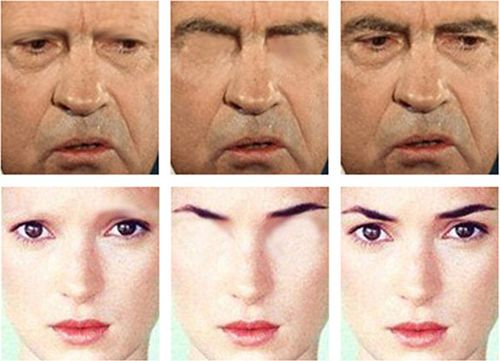
Jena Pincott describes a study from a few years ago:
Volunteers were asked to identify fifty famous faces, including that of former U.S. president Richard Nixon and actor Winona Ryder. The photos were digitally altered and shown either without eyebrows or without eyes. When celebrities lacked eyes, subjects could recognize them nearly 60 percent of the time. However, when celebrities lacked eyebrows, subjects recognized them only 46 percent of time. The lesson: eyebrows are crucial to your identity — they’re at least as important as your eyes, if not more so.
The Blogosphere Evolves …
highlights "one of the most remarkable developments in the Israeli blogosphere" – the Second International Jewish Blogger Convention, held last week. He writes:
[T]his would mark an intriguing period in the evolution of diplomacy. After all, what's better: to have one's foreign policy influenced by a bevy of lobbyists, NGOs, think-tanks and advocacy organizations or a decentralized army of patriotic bloggers? […] One thing about bloggers as lobbyists is that they do not leave a public trail of evidence: unlike think-tanks, most of them do not require funding and have no formal affiliation with a government whose policies they endorse. They may be benefiting from the skills that they learn at conventions like the one in Jerusalem but they behave as fully independent actors of civil society, deliberately distancing themselves from official institutions. This makes it extremely difficult to accuse them of spreading propaganda or repeating the usual talking points: after all, they are acting as citizens rather than politicians. Consequently, what they say is usually treated in a much more serious fashion than the boilerplate of politicians.
I do think that the blogosphere has the potential to become a kind of virtual citizens' parliament – a place where ideas and arguments can be exchanged by conversationalists more engaged than mere writers, yet not forced to placate various interests and coalitions as politicians must. With this role comes more responsibility – which, of course, the writer in me resists.
Lumping The Moderates In With The Crackpots?
Jesse Walker begs for opinion makers to stop painting with such a broad brush:
When pundits weave a small number of unrelated incidents into a "pattern" of crime, then link it to the rhetoric of Obama's opponents, it becomes easier to marginalize nonviolent, noncriminal critics on the right, just as a red scare makes it easier to marginalize nonviolent, noncriminal figures on the left.
His closer:
It's comforting to imagine that violence and paranoia belong only to the far left and right, and that we can protect ourselves from their effects by quarantining the extremists and vigilantly expelling anyone who seems to be bringing their ideas into the mainstream. But the center has its own varieties of violence and paranoia. And it's far more dangerous than anyone on the fringe, even the armed fringe, will ever be.
This Is The Blogosphere On Drugs, Ctd
A reader writes:
The problem with Megan's position is that the demand curve for drugs is vertical, or nearly vertical. Sick people will consume only the quantity they need to stay alive/healthy, but will pay any price for that. If pricing was left up to the market, supply and demand for patented, life-saving drugs would reach equilibrium at about 100% of the consumer's assets, plus five years of indentured servitude. Maybe I'm exaggerating, but it would be ugly.
I take this personally. I have narcolepsy, a rare disease, and only one company manufactures the drug I need (Xyrem). It's an "orphan" drug: The monopoly is the government's incentive to make it available, otherwise no company would find the R&D investment worthwhile, given the small number of patients. However, without insurance, my monthly drug costs would be greater than my monthly earnings. What does Megan think about this?
"If people, in their role as consumers, decide that the new pharmaceuticals coming out aren't worth their price, and decline to buy them, I like that too."
What really bothers me is that medicine is literally the Econ 101 textbook example of vertical demand curves. How does Megan not know this?
 The Dish