Can Pakistan And India Make Nice?

Yesterday’s inauguration of India’s new prime minister Narendra Modi was marked by the surprising appearance of his Pakistani counterpart Nawaz Sharif. Isaac Chotiner isn’t sold on the theory that “someone like Modi, known for his nationalist views and aggressive posture, might find it easier to negotiate peace with Pakistan”:

Modi is surrounded by extreme hardliners; he has used Pakistan in the past to make alternately silly and demagogic remarks; and his constant nationalistic rhetoric is the type that often goes hand-in-hand with aggression on the world stage. As for the invitation to Sharif, it isn’t clear whether it was made because Modi genuinely wants peace and increased ties, or because he wanted to cause Sharif political difficulties. (Sharif’s decision to accept Modi’s invitation was controversial in Pakistan.) If there is another Pakistani-supported terrorist attack, such as the one on Bombay in 2008, Modi would likely respond very forcefully, as the previous government did not.

The mention of Pakistani aggression against India recalls the greatest barrier to peace, and it isn’t Modi. Pakistan’s powerful military has already halted Prime Minister Sharif’s moves toward establishing closer ties with India.

Bruce Riedel notes the challenges Sharif faces from Pakistan’s “deep state”:

Modi has pledged to seek better relations with Islamabad but only if it cracks down seriously on the deep state’s patronship of terror. He has significant potential economic carrots and sticks to use with Sharif, who knows Pakistan needs to dramatically improve trade with India if it is to get its own economy moving.

But Sharif is also very aware that the last time he was prime minister, he tried to get peace talks moving with India—only to be sabotaged by the deep state.  Early in 1999 Sharif invited then-Prime Minister Atal Vajpayee to Lahore to talk about reducing tensions. Less than six months later Sharif’s army chief, Pervez Musharraf, broke the cease-fire in Kashmir and started a small war around the town of Kargil.  The small war threatened to escalate into a full-scale catastrophe with nuclear weapons until Sharif bravely came to Washington on July 4th and was persuaded by President Bill Clinton to unilaterally pull back the Pakistani army behind the cease-fire line. By the end of 1999 Sharif had been overthrown in a coup by Musharraf. The deep state had triumphed.

Pointing to an attack on the Indian consulate in Herat, Afghanistan, last Friday, Paul Staniland weighs Modi’s “limited” options for dealing with Pakistani terrorism:

Modi can try to reach out to Pakistani civilian leaders in hopes of splitting them from a skeptical military, but this has been India’s strategy in the past with little success. “Spoilers” like the Haqqani network and Lashkar-e-Taiba have repeatedly undermined India-Pakistan rapprochement. Pakistan’s powerful army seems to be in no mood for a deal with New Delhi, viewing India as a rising power now run by a Hindu chauvinist, and regularly alleging that India is supporting militant groups along the Afghan-Pakistan border. Simmering civil-military tensions over media freedom and policy toward the TTP have limited Sharif’s ability to deliver on policy change.

India cannot credibly threaten military retaliation. As Vipin Narang has shown, Pakistan’s mixture of conventional and nuclear forces is intended to rapidly escalate any conflict, making Indian ground or even air strikes extremely risky. … In the face of these constraints, we are likely to see a two-pronged Indian strategy. First, outreach to Pakistan’s civilians will continue. Modi has a commanding majority and hard-liner credibility that limit his vulnerability to domestic criticism. Sharif is believed to be interested in improving ties with India, and there is always a chance that he and Modi can craft some forward progress. Second, India is likely to expand its overseas intelligence operations in Afghanistan and Pakistan.

Documenting Density

dish_megacities

The megacities in China captured by German photographer Michael Wolf are “as surreal as they are kinda terrifying,” states Tom Hawking. Wolf describes his project in an interview with Vice:

First off, what’s a megacity?

Cities that have a population with more than 5 million. I wouldn’t really consider any European city a megacity. Paris has a population of 2 million, whereas in China, for instance, a city with 3 million is considered small. I’m talking about populations of 5, 10, 20 million—up to 25 million.

Why do they look so depressing in your photos?

Well, some things about megacities have a lot of downsides. These are profit centers. The people who run them are not really concerned about the populations that live in them. They are concerned about making money. So on the one hand they are very intimidating and frightening but on the other hand they are extremely beautiful. In The Architecture of Density (his photo series featuring an extremely dense Hong Kong high-rise), you can almost see them as a tapestry.

How he describes the message of his work:

I’ve always been a social liberal. I’ve always been for the underclass. For example, I did a project called 100×100 where I photographed 100 apartments in a Hong Kong building that was about to be demolished, all measuring ten feet by ten feet. I am showing the living conditions of the city—but again, I’m looking at the vitality and resourcefulness of the people. They are everyday human beings and that’s what I am trying to document.

Previous Dish on Wolf’s work here.

Did Slavery Make Whites Poorer?

In a response to TNC’s reparations essay, Tyler Cowen suspects so:

I would suggest that most living white Americans would be wealthier had this nation not enslaved African-Americans and thus most whites have lost from slavery too, albeit much much less than blacks have lost.  For instance it is generally recognized that freer and fairer polities tend to be wealthier for most of their citizens.  (We may disagree about what “fair” means for many issues, but slavery and its legacy are obviously unfair.)

More specifically, many American whites benefited from hiring African-American labor at discrimination-laden discounted market prices, but many others lost out because it was more costly to trade with African-Americans.  That meant fewer good customers, fewer eligible employees, fewer possible business partners, fewer innovators, and so on, all because of slavery and subsequent discrimination.

Cowen concedes that there “is still a moral case for reparations even if most American whites have lost from slavery rather than benefited.” But he thinks “this analysis makes slavery out to be all the more destructive, and reparations to be all the more unlikely.” Recent Dish on TNC’s cover-story here and here.

Thailand’s Love Of Coups

THAILAND-POLITICS

General Prayuth Chan-Ocha, the leader of last week’s coup d’etat in Thailand, announced yesterday that the coup had received the blessing of King Bhumibol Adulyadej. Ritika Singh considers the “convoluted” relationship between the monarch and the military a big part of the country’s problem:

The ailing King, who enjoys prestige in Thailand that is hard for Westerners to understand, has been largely absent from this recent political crisis. There has been speculation about his role behind the scenes, but his lack of open involvement—unlike in previous crises—could actually have exacerbated this situation. The monarchy and the military have been intricately tied together for decades, and the King has supported many of the coups that have plagued Thailand. At the end of the day, what the King wants, goes. Thais who believe that the King’s playing puppet master to the country is preferable to the machinations of inept politicians, again, do not see the long-term erosion of democratic institutions that this induces.

The Thai military’s adventurism in its country’s politics—and the popular support for it—demonstrates how complicated the problem of extricating the military from politics still is in many developing countries. Thailand is not alone here. It is one of the biggest hurdles to a democratic transition in Pakistan, Egypt, and other countries as well. If the role of the military and people’s attitudes toward it don’t change, the endless cycle of coups won’t change either.

Recalibrating his prognosis for Thailand, Jay Ulfelder expects that the “risk of yet another coup will remain elevated for several years.” Furthermore:

Thailand’s risk of state-led mass killing has nearly tripled… but remains modest.

The risk and occurrence of coups and the character of a country’s national political regime feature prominently in the multimodel ensemble we’re using in our atrocities early-warning project to assess risks of onsets of state-led mass killing. When I recently updated those assessments using data from year-end 2013—coming soon to a blog near you!—Thailand remained toward the bottom of the global distribution: 100th of 162 countries, with a predicted probability of just 0.3%. If I alter the inputs to that ensemble to capture the occurrence of this week’s coup and its effect on Thailand’s regime type, the predicted probability jumps to about 0.8%.

That’s a big change in relative risk, but it’s not enough of a change in absolute risk to push the country into the end of the global distribution where the vast majority of these events occur.

Uri Friedman sees Thailand as an example of a new trend, in which the middle class chooses stability through military rule over democracy with less certain outcomes:

[T]he Thai military’s express goal in seizing power this week was to restore political stability and economic growth. And the move followed massive anti-government protests, just like the coup in Egypt that overthrew Mohammed Morsi last year. In both Egypt and Thailand, the protest movements that prompted military intervention enjoyed support from middle- and upper-class citizens. These aren’t isolated cases. Joshua Kurlantzick, a fellow at the Council on Foreign Relations, has argued that around the world, a growing middle class “is choosing stability over all else,” and embracing “the military as a bulwark against popular democracy.”

The idea of a popular, “middle-class military coup” isn’t necessarily new—it has echoes in Latin America in the 1960s and 70s—but it’s making a comeback in the few coups we’re still seeing today, with troubling implications for democracy in the countries where they take place.

Jessica Schulberg contemplates the US response:

That the U.S. is now legally bound to do something that would be contrary to its interestsand not necessarily beneficial to the Thai peopleraises doubts about the utility of Section 508 of the Foreign Assistance Act [which requires cutting aid to countries that experience military coups]. “Laws that don’t have escape clauses, like national interest waivers or national security waivers, almost never work,” said a former State Department official. “All that happens is that the government will either deny the obvioussay it’s not a coupor if the government allows itself to be bound by it, it is deprived of the necessary flexibility in coping with each unique circumstance.”

(Photo: Roses given by coup-supporters decorate a military vehicle as Thai army soldiers stand guard at the Victory Monument in Bangkok on May 27, 2014. By Manan Vatsyayana/AFP/Getty Images)

How Germans Buy Drugs

Olga Khazan explains how Germany’s healthcare system has kept drug costs in check by refusing to pay extra for new medicines that don’t actually work any better than the old ones:

Almost every German belongs to one of some 160 nonprofit “sickness funds,” or nonprofit insurance collectives. The sickness funds cover both medical visits and prescription drugs. Drug prices there are already lower than in the U.S. because sickness funds negotiate with both physician groups and drug manufacturers to set costs of all treatments across the board. In the U.S., Medicare isn’t even allowed to negotiate lower drug prices. …

Enter 2010′s Pharmaceutical Market Restructuring Act, or Arzneimittelmarkt-Neuordnungsgesetz, abbreviated in German as AMNOG. As in “AMNOGonna pay drug companies for new meds that are more expensive but not any better than the old ones.”

Under AMNOG, as soon as a new drug enters the market, manufacturers must submit a series of studies that prove it heals patients better than whatever was previously available. If the new drugs don’t seem any better than their predecessors, the sickness funds will only pay for the price of the earlier version. Patients can still buy the newer medicine, but it’s up to them to make up the price difference out of pocket.

A Capital Cock-Up?

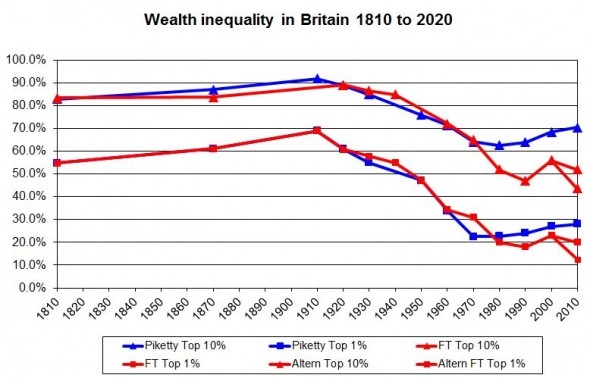
wealthinequalityinbritain590x378_1.jpg.CROP.promovar-mediumlarge

Last Friday, Chris Giles alleged on the pages of the Financial Times that Thomas Piketty’s Capital in the 21st Century contains major data errors that undermine his entire theory. Jordan Weissmann outlines Giles’ accusations:

First, it says Piketty has covered up a giant gap in America’s historical records on wealth concentration. “There is simply no data between 1870 and 1960,” the newspaper states. “Yet, Prof. Piketty chooses to derive a trend.” This charge is neutered a bit by the fact that Gabriel Zucman and Emmanuel Saez recently released a detailed analysis of U.S. wealth inequality dating back to 1913 that shows an even more dramatic increase than what Piketty found. But Piketty will nonetheless need to spell out how he reached his own conclusions in a bit more detail.

The much more important point of contention is Great Britain. The FT argues that Piketty’s graphs simply “do not match” his underlying data on the UK, and that official estimates show no significant increase in the country’s concentration of wealth since the 1970s. Once Britain’s corrected data is included in the picture, the FT argues, the evidence that wealth inequality is growing across Europe disappears.

“But,” Tim Fernholz interjects, “it’s not clear that Piketty’s analysis is entirely doomed”:


Giles says that he has refuted two of Piketty’s notions: That wealth inequality has begun to increase in the last 30 years, and that the US has a more unequal distribution than Europe. But Giles’ final chart, comparing US and European inequality, is ambiguous on this score. The chart is a mix of different datasets, some of which show wealth inequality appearing to increase—albeit so slightly that it might be a statistical error—after 1980. And some show that US inequality is higher than in Europe—even without including the Saez-Zucman data [here], where the effect is more pronounced …

By that reading, Piketty’s ideas could still be plausible, even though problems need to be rectified and further work is needed. No doubt many eager economics grad students are licking their chops.

Krugman is incredulous over Giles’ contention that there is “no obvious upward trend” in inequality:

I don’t know the European evidence too well, but the notion of stable wealth concentration in the United States is at odds with many sources of evidence. Take, for example, the landmark CBO study on the distribution of income; it shows the distribution of income by type, and capital income has become much more concentrated over time:

It’s just not plausible that this increase in the concentration of income from capital doesn’t reflect a more or less comparable increase in the concentration of capital itself. Beyond that, we have, as Piketty stresses, evidence from Forbes-type surveys, which show soaring wealth at the very top. And we have other estimates of wealth concentration, like Saez-Zucman, that use completely different methods but point to the same conclusion.

“Even if you believe that Giles’s findings dramatically change Piketty’s results,” Danny Vinik argues, “they have little bearing on his economic theory”:

Giles makes a passing comparison to economists Carmen Reinhart and Ken Rogoff (R&R), who drove a significant part of Republican austerity agenda, but saw their findings disproven in 2013. Liberals celebrated when Thomas Herndon, a graduate student from UMass Amherst, discovered a spreadsheet error in R&R’s results that invalidated their main finding. But unlike Piketty, Reinhart and Rogoff largely had no economic theory to ground their argument that national debt crises occur when a country’s debt level surpasses 90 percent of GDP. Once their data fell apart, their theory had no legs to stand on. On the other hand, Piketty fits data to this theory, but does not depend on it. Piketty’s theoryright or wrongis largely unaffected by these results.

Ryan Avent makes a similar point:

First, the book rests on much more than wealth-inequality figures. Second, the differences in the wealth-inequality figures are, with the exception of Britain, too minor to alter the picture. And third, as Mr Piketty notes in his response, Chapter 10 is not the only analysis of wealth inequality out there, and forthcoming work by other economists (some conclusions of which can be seen here) suggests that Mr Piketty’s figures actually understate the true extent of growth in the concentration of wealth.

Mike Konczal piles on, saying Giles misconstrues Piketty’s argument:

[R]ising inequality in the ownership of capital is not the necessary, major driver of the worries of the book. It isn’t that the 1% will own a larger share of capital going forward. It’s that the size and importance of capital is going to go big. If the 1% own a consistent amount of the capital stock, they have more income and power as the size of the capital stock increases relative to the economy, and as it takes home a larger slice. However, obviously, if inequality in wealth ownership goes up, it will make the situation worse. (It’s noteworthy that these numbers Giles is analyzing aren’t introduced until Chapter 10, after Piketty has gone through the growth of capital stock and the returns to capital at length in previous chapters.)

The way that Giles could put a serious dent into Piketty’s theory through this analysis is by showing that inequality of wealth ownership is falling in the recent past. This is not what Giles finds. He mostly finds what Piketty finds, except in England, where it’s flat instead of slightly growing in the recent past.

But Cowen takes the data problems seriously:

Now, when you cut through the small stuff, the new empirical problem seems to be that UK revisions, combined with a population-weighted series for Europe, contradicts Piketty’s claim of rising wealth inequality for Europe.  I would call that a serious problem.  I am not impressed by the “downplaying” responses which focus on coding errors, Swedish data points, and the other small stuff.  Let’s face up to the real (new) problem, namely that robustness suddenly seems much weaker.

In any case, Patrick Brennan believes that Piketty never made a convincing case for his general thesis:

Piketty set out to do something much more audacious than prove that income inequality is rising in the United States and in most wealthy countries — that’s relatively easy to prove, even if the increase has been substantially overstated. Rather, he wanted to show that this plays into a loop with increasing wealth that needs to be arrested by huge global interventions. One common objection to Giles’s skepticism tonight has been that increasing wealth inequality is simply an obvious fact of this world — why do we need the data to back it up? Well, Piketty needs the data to back up the arguments he made with it — he needs wealth inequality not just to appear high or to be rising, but to be returning to 19th-century levels as a matter of economic inevitability. The errors he made may not be devastating to the work he’s done to prove this so far, but even without taking them into account, he hasn’t yet justified his dramatic conclusions.

Lastly, noting that data errors are a fact of life in the social sciences, Nate Silver encourages skepticism of both Piketty’s argument and Giles’ critique:

The closest thing to a solution is to remain appropriately skeptical, perhaps especially when the research finding is agreeable to you. A lot of apparently damning critiques prove to be less so when you assume from the start that data analysis and empirical research, like other forms of intellectual endeavor, are not free from human error. Nonetheless, once the dust settles, it seems likely that both Piketty and Giles will have moved us toward an improved understanding of wealth inequality and its implications.

Previous Dish on Capital here.

What’s The Truth About Gluten?

A gastroenterologist well known for a 2011 study that “served as as one of the strongest pieces of evidence to date that [gluten intolerance] is a genuine condition” has backed down from that position:

A study [Peter] Gibson published last summer suggests that, when it comes to gut distress, gluten is getting a bad rap. The study focussed on thirty-seven people who identified themselves as having both NCGS [non-celiac gluten sensitivity] and irritable bowel syndrome (IBS), an ailment characterized by a range of gut issues, including diarrhea or constipation, bloating, and stomach pain. The subjects all said that they felt better when they avoided gluten. To test whether the protein was really to blame, Gibson put them on one of three diets: gluten-free, low-gluten, and high-gluten. Each diet consisted of the same foods; the only difference was the amount of gluten. … It turned out that gluten seemed to have no measurable harmful effects.

What gives? As Robert T. Gonzalez puts it, “it is the pursuit of more definitive scientific evidence that makes Gibson’s research so noteworthy”:

That Gibson’s team found no specific response to gluten is not surprising in and of itself. (News flash: Scientific research often appears to contradict itself. For more on this reality as it pertains to health research, see this timely NatGeo piece by Virginia Hughes on the ongoing effort to determine whether resveretrol – a compound found in red wine – is or is not good for you.) Rather, it was Gibson’s willingness to call his own research into question – his readiness to double back and reevaluate his previous research on more rigorous terms – that we found not only striking, but encouraging for the future of research in this area.

Which suggests that headlines like “Researchers Who Provided Key Evidence For Gluten Sensitivity Have Now Thoroughly Shown That It Doesn’t Exist” and “Being Gluten-Free is Dumb” may be oversimplifying matters a bit. As gastroenterologist William Chey says:

It’s really hard to design and execute studies that really separate out constituent effects of food. … We’ve still got a long ways to go.

So I’ll keep avoiding the wheat. Update from a reader I can definitely relate to:

As one of those reviled gluten-sensitive folks, those terrible headlines you mention are truly annoying, but I’m definitely all for more research on this topic! After years of extremely annoying and embarrassing rashes and hives, and then a negative test for celiacs, my doctor (who has celiacs) recommended I try a gluten-free diet for a month anyway, just to see. I went (mostly) gluten free in June 2013 and haven’t had a major rash since. The occasional beer or sandwich with real bread doesn’t seem to bother me, but when I go overboard (as I definitely did on a recent trip to Napa) I get the faint beginnings of hives and eczema-like rashes, which then go away after I’m good for a few days.

Is it all in my head? Is it something else in gluten-containing foods doing this to me? I’d love to find out, but in the meantime this works!

Another reader:

I thought I would write because anyone who read the reader comments might have got the wrong idea about celiac disease. Your reader referred to a negative test for celiac disease – presumably he/she meant the anti-transglutaminase antibody test. While that is a typical test done for celiac disease, it is not conclusive on its own. This link is from Dr. Fasano naming the 4-out-5-rule criteria. The gold standard test for celiac disease is the small bowel enteroscopy. I would also note that many patients with celiac disease think they are fine with a bit of gluten here and there based on symptoms, but that is actually very dangerous; it could lead to EATL – Enteropathy-associated T-cell lymphoma.

I have celiac disease as well as three generations of my family including my grandfather who died of cancer because of untreated celiac disease. Anyone who thinks they may have celiac disease should NOT go on a gluten-free diet before seeing their doctor. Please see any of the national celiac associations for more advice.

Dish Intern Wanted: Three Days Left For Applications

[Re-posted from last week]

It’s that time of year again. Dish Publishing LLC is seeking an all-purpose intern to handle both administrative tasks and contribute to the editorial process. The admin side of the job will include: dealing with press inquiries and permissions, helping with support emails, managing the staff calendar, taking notes during meetings, making travel arrangements, and generally assisting the executive editors and me with sundry tasks. Strong organizational skills and attention to detail are musts. You need to be self-starting and pro-active in getting shit done.

The editorial side of the job will consist of ransacking the web for smart and entertaining nuggets, maintaining our social media presence, working on larger research projects, and helping the team guest-blog when yours truly takes a vacation. We prefer individuals who can challenge me and howler beaglemy assumptions, find stuff online we might have missed, and shape the Dish with his or her own personal passions. Reporting experience is also a big plus as we try to deepen our coverage. Someone with a background in web entrepreneurialism could catch our eye too.

The full-time internship pays $10 an hour, includes health insurance, and lasts for six months. The position is based in New York City. Since the Dish doesn’t have an office, most of the work will be done from home, but the staff meets regularly for lunch and coffee meetings and social gatherings.  I want to emphasize that this is an intense job for the intensely motivated, and one that can get a little isolating at times. But it’s a pretty unbeatable chance to learn what independent online journalism can be as an integral part of a close-knit team. We’ve decided to pare down to one intern to keep our lean budget under control, which means the one individual really does have to be special. You have to already know what we do here and care deeply about the Dish. And a sense of humor is a real asset.

We are hoping to hire very soon, so don’t delay if you’re interested. The cutoff for applications is this Friday, May 30, at midnight. The start date is July 7, but we are flexible. To apply, please e-mail your resumé and a (max 500-word) cover letter to apply@andrewsullivan.com.

What The Hell Just Happened In Europe? II

You can makes plenty of arguments that the results in the European elections for the populist right and left are not that big a deal. For that perspective see here. I’m not sure I share the complacency and for a simple reason. Of the many aspects of Europe’s sudden lurch toward populism, one looms large to me: the same core cultural divide we have seen polarize and gridlock America, a blue-red culture war over modernity. Blue Europe is internationalist, globalized, metrosexual, secular, modern, multicultural. Red Europe is non-interventionist, patriotic, more traditional, more sympathetic to faith, more comfortable in a homogeneous society. The essential deal between these two complex coalitions was always a simple one: the Blues got to engineer their European dream, as long as it gave the Reds prosperity. Money would take the multicultural blues away. And for so long, it sure did.

But when the money ran out, and the recession hit, and the EU only bailed out members on the basis of brutal austerity … the deal began to fray. Now that growth is returning, if only anemically, it appears, moreover, to be benefiting Blue Europe – the elites, the property-owners, the transnationals – while leaving ordinary, working- and middle-class Europeans in the dust. That fuels another layer of mistrust and despair. Then a reform like marriage equality is imposed from above (unlike the US), despite ferocious opposition from the social right in France and back-bench Tory queasiness in French Far-right Front National (FN) Party President Marine Le Pen Gives A Press Conference The European ElectionsBritain, leading to more discomfort. Mass immigration or migration across Europe – a wonderful idea in theory – only made things worse, leading to resentment and racism when it has occurred in already-beleaguered working class Europe. The emergence of an unassimilated Muslim population didn’t help things either. And, more to the point, Europeans increasingly feel they are not given a choice in any of this. So they vented. And America’s culture war finally put down roots in Europe.

I see both red and blue sides to this. I grew up in a prosperous part of Europe, Southeast England, but in a nonetheless recognizably English small town. I maybe ate at a restaurant a handful of times before I went to college. My high school class was 100 percent white. I was brought up in a church-going household with not much extra money around. And we were Tories of a patriotic hard-working type. These days, I’m an inhabitant of a very blue and different world. Catapulted from my home town and life by a magnet school, and then an Oxford scholarship, I now live on the East Coast of the US, married to a man, earning money off the Internet, and stay in hotels when I visit London.

And here’s the thing about the last ten years or so. When I go to London now, it feels very much like home – i.e. a US blue state, multicultural, cosmopolitan, and slightly more international than even New York. It’s jammed full of Starbucks and Uber and hot spots. Only an hour south of there, you’re in a somewhat different world, changed but still culturally recognizable as the place I grew up in. Yes, there are pizza chains in the High Street, and a smattering of dudes on gay hook-up apps, and a Muslim cab driver, but there is also the cumulative weight of centuries of Englishness, an Island identity, a storied past. In the fields around where I grew up, you might still stumble across an Prime Minister David Cameron Visits A Construction Siteold concrete tank-barricade, designed to prevent a Nazi invasion. In the High Street, there’s a World War I memorial, and one to commemorate the Protestant martyrs burned at the stake under Queen Mary. Every part of this history tells the tale of an island nation, with a distinctive culture and amazing story. You don’t feel the weight of this history as powerfully in the roiling post-everything multicultural melee that is modern London. And you don’t internalize it quite as much.

What globalization is doing to us is scrambling these identities – creating one class doing relatively well with globalization and one that absolutely isn’t. The first is likely to be more tolerant, progressive, modern, risk-taking. The second is likely to be more traditional, conservative, cautious, security-seeking. This doesn’t completely square with left and right. In Europe, the right fostered the economic liberalization that undermined its traditional middle-class base. The populist left remains deeply suspicious of economic liberalism, but became a beneficiary of its cultural consequences. And in these circumstances, of course immigration would come to be an issue, as it has in the US. When you’re out of work in a part of the country left behind by the 21st Century, and suddenly have to compete for what jobs there are with thousands of new immigrants from Poland or Romania, you’re going to get mad. And the EU itself – especially among its elites – seems a spectacular symbol of this cultural and economic disconnect, a perfect target for the new populism.

That’s why I don’t believe the latest upset in the European elections is a fluke. I think it’s the new reality.

My sense from Britain, the country I know best, is that a hefty chunk of the population feels no connection to either major British party or to either party leader. David Cameron and Ed Miliband are products of Blue Britain. Nigel Farage is recognizably not. One recent moment of truth was the debate that Farage had with Nick Clegg, the Liberal-Democratic leader, over membership in the EU. Farage won it hands down against Clegg, a multilingual European elitist if ever there was one. And it was a victory of style as well as substance.

The task of a conservative in this moment, it seems to me, is not to resolve this struggle for either side – an impossibility anyway. It is to attempt to keep these two tendencies from going to war with each other in politics and culture. It is to retain a sense of national coherence and continuity in the midst of large-scale social change. That may prove impossible, but it can be done (look at the London Olympics opening and closing ceremonies). And it’s what David Cameron is now apparently trying to do. And about time. Over the next few years, Cameron and his successor will be confronting not only the possibility of Britain’s withdrawal from the EU but also the possibility of an end to the United Kingdom, if Scotland votes for independence. Both moves, it seems to me, are signs of an attempt by the English and Scottish to reassert control of their own destinies and to preserve their own cultural identities – which is why it would be foolish not to take both possibilities seriously. They remind me at least of a vital truth: that national identity remains the most potent and democratic form of political association. Screw with that, and you’ll merely have nationalism come back at you, with nostrils flaring. Europe’s elites have indeed screwed with that over the last decade or so. We have to hope the backlash does not destroy more than it builds.

(Photos: British Prime Minister David Cameron visits a construction site on May 27, 2014 in London, England. By Andrew Winning – WPA Pool/Getty Images. French far-right party National Front (FN) president Marine Le Pen delivers a speech during a press conference at the party’s headquarters on May 27, 2014 in Nanterre, France. By Chesnot/Getty Images.)

The View From Your Window Contest: Winner #206

vfyw_5-24

A reader writes:

This looks to me like a view of the Alexandra Bridge that connects Ottawa, Ontario with Gatineau (Hull), Québec, taken on the Gatineau side (call it 2km NE of Parliament Hill). I used to ride my bike along the Ottawa River, on both the Ontario and Québec sides, and this looks familiar, if not 100% right. But I can’t name the building.

Another totally e-mails it in:

The blue banner on the light post is clearly shaped like Vietnam, so (equally clearly) the picture must be from Hanoi.

Another:

I’m pretty sure this is taken from the eastern bank of the Schuylkill River in Philadelphia. I feel like I’ve walked on that bridge and that is the fairly new bike path they’ve built. This is my first time entering. I do love the contest. It would be baller to get it right the first time!

Another rookie:

Very first attempt! My guess is Louisville, in the park along the Ohio River, where there is a memorial to Abraham Lincoln. The bridge is a former railway bridge to Indiana, and is now used as a bike or running bridge.

Another stays in the South:

Probably not right, but it looks so damn much like Brown’s Island Park in Richmond, VA. I’ve run on the James River North Bank Trail that ends at that park. The bridge design and river look so insanely like Richmond, but the picture’s just slightly off. Who knows, maybe I’m insanely wrong.

Or wanting to be:

Augusta, Georgia. I hope I’m wrong.

Several others were wrong about the man from Hope:

Clinton Presidential Museum, Little Rock, Arkansas. I knew it the minute I saw the railroad trestle.  The museum is nestled just on the edge of Little Rock in one of the prettiest settings.  I visited it during an International Master Gardener Conference a few years ago.

Little Rock was the most popular incorrect guess this week. The most popular correct guess attracted 117 entries – a whopping 84% of the total submitted. One of those correct readers:

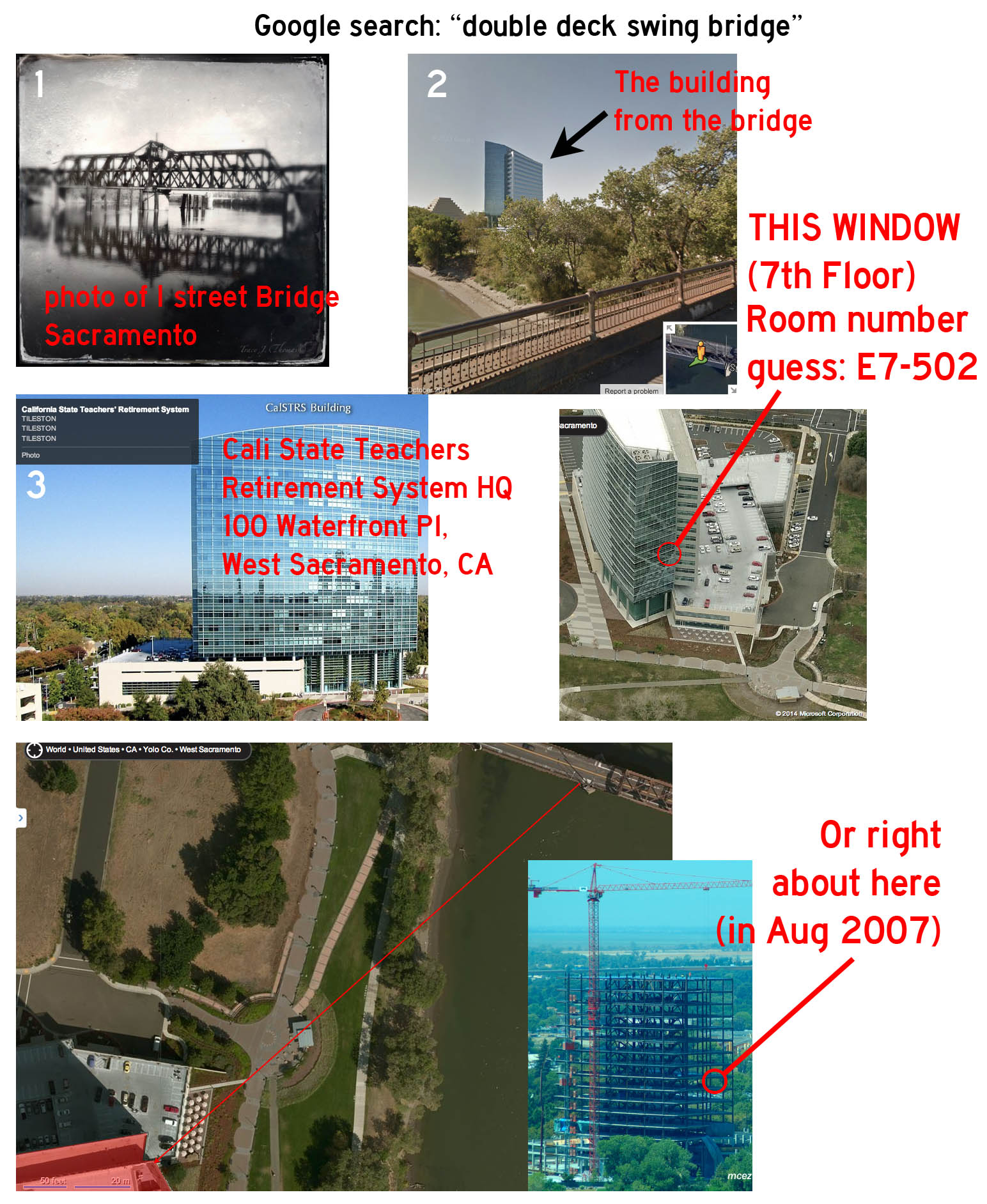
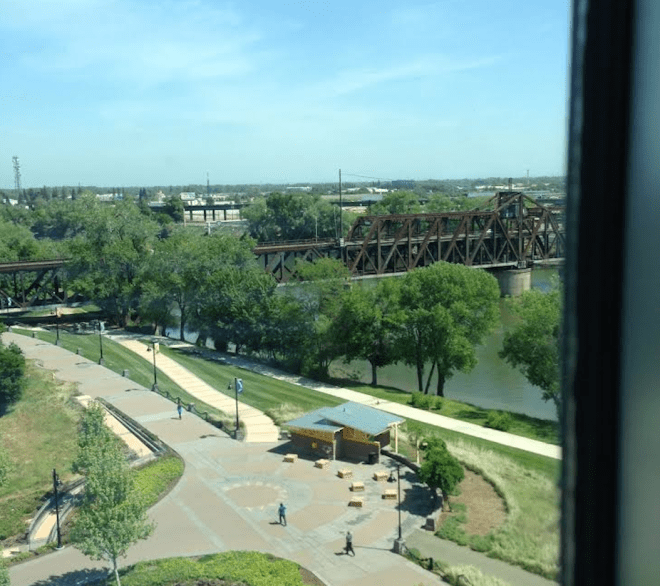
First impression was: Upper Midwest due to the rail bridge, somewhere in Minnesota or Iowa on the Mississippi. Then I realized way too flat for Saint Paul or Minneapolis and the adgate snip west scramentorest of the Mississippi valley. Usually my gut is right on these things, but a bit of searching for a double-decker bridge brings one to West Sacramento, California.

You’ll have lots of people who’ll get the location, but Google Streetview only has a 2007 photo of the building under construction or a more recent bad angle shot from the street (damn you Google for not having the foresight to send a rogue self driving car to that spot).  Nonetheless I’ve attached my guess on the right window. The obsessive Dishheads will spend hours on the angles, cosines, etc, and a few may resort to psychotropics, peak beard, or a bear with a divining rod. Lacking access to any of these I’ll go with with the 6th floor, room 659 and the fat red X. I await being corrected by Doug Chini. But the city location was easy: if a slacker like me can find it in 15 minutes, the heat map of West Sacramento will show one huge blue dot.

He’s sure right about that:

This embed is invalid


Another reader squeals:

IGotOneIGotOneIGotOne!  As all the train-and-bridge spotters have figured out, a Google search of “railroad swing bridge double” served up the “I” Street bridge in Sacramento lickety quick, and maps revealed the 100 Waterfront Place building.  I’m sure the pros have already sussed out the latitude, longitude, elevation, time of day, temperature, paint color, bar menu, beagle population and average beard length of the neighborhood, and then taken the rest of the afternoon off for beer and volleyball.  They can have it; i’ll just bask in the satisfaction knowing I beat one of these things.

An elaborate visual entry:
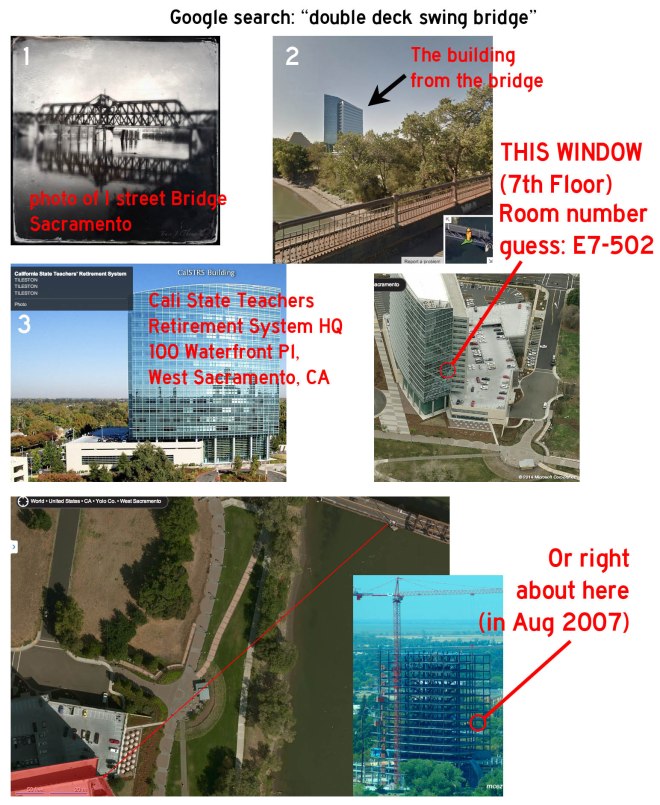
this-window

Marriage finally pays off for this contestant:

My lovely wife of nearly 40 years is pretty tolerant of me, especially when I call her over to the computer, point at a VFYW picture, and ask where she thinks it is. Usually she just shrugs, says “no idea”, and heads off to more important things. To my amazement, this week she looked at the picture for about 5 seconds and said “I Street Bridge”, not as a question but as a statement. She is a Sacramento native, so I guess I should not be too surprised.

Another goes into detail about one of the central clues:

The first thing I did was search for images of double-decker railroad bridges. The search led within a few minutes to this page showing the I Street Bridge on the site bridgehunter.com. It describes the bridge in detail and includes a photo gallery, map links and street views. (Bridgehunter.com, by the way, looks like it’s going to be an invaluable resource in future window contests involving American bridges.)

From there, identifying the building the window is in was as easy as falling off a piece of cake: California State Teachers’ Retirement System, at 100 Waterfront Pl in West Sacramento, California. This modified Google Earth view shows the angle of the photograph indicating roughly where the window is.

VFYW 5-26 Camera Angle1

The I Street Bridge, by the way, was completed in 1911; its two decks accommodate rail and highway traffic. It’s of a type known as a swing bridge, which means that the center span of the bridge pivots to allow boats to pass, as seen here:

1227680

Several readers flagged this blog post about the I Street Bridge written by California bridge engineer Mark Yashinsky:

A swing railroad bridge has stood at this site since 1858. The current double-deck bridge was built in 1911. Note the round pivot pier supporting the swing span. This bridge is 840 ft long with a 340 ft long swing span. A 34 ft tall boat can pass under it at low tide. Otherwise, the captain must signal to the bridge operator to get through. Boaters need to check with the US Coast Guard when planning a trip to find out the bridge’s hours of operation. …

This is one of the largest center bearing swing bridges ever built. It weighs about 6800 kips. At the turn of the 19th century, such big swing bridges had rim bearings with rollers along the perimeter. When this large bridge was successfully built and operated with a center bearing, no one wanted to go through the trouble of fabricating the conical rollers that supported a rim bearing swing bridge and they were no longer built.

Another reader found an additional bridge resource:

Once more the VFYW contest has been a learning opportunity.  I came to realize after some hours of poking about that without a base in bridge terminology, finding this thing wasn’t going to be a snap.  I tried every combination I could think of involving steel bridge, railroad-bridge, double-decker, riverwalk, river park.  Eventually a likely-but-too-tiny-to-tell icon showed up, and that led me to historicbridges.org, which would have been great if only I’d already known where in the world I thought this bridge was to search their database efficiently. But historicbridges.org introduced me to the descriptors I needed: steel truss bridge, swing bridge.  If only I’d known those terms to begin with!  A search for “steel truss bridge” delivered the culprit about 200 images down in a few moments of skimming the Google images result, unmistakable (it’s amazing how subtly distinguishable steel truss bridges are one from another, though).

Then I realized that I had ridden Amtrak over that very bridge on my way home to the Bay Area from Manhattan just two months ago.

Another skipped the bridge for a different clue:

Three in a row for me, and a chance to avenge a past near-miss! Early last year I had narrowed a view to Sacramento on little more than hunches, a red curb, and fertile farmland near a sizeable city. But having no luck scanning Google Earth or proof I even had the right city, I called off the search. In my personal tally it wears an asterisk, a badge of shame on my record.

But goddammit, this week we’re straight-up comin’ atcha from the neighboring town of West Sacramento, CA. Nothing fancy this week – didn’t even flex my bridgespotting muscles. Just stared at the letters on the pavement and wrote out twelve blank spaces on a sheet of paper, Wheel of Fortune-style. Funny thing, I was listening to a recording of Bruce Springsteen’s recent Charlotte show when I finally made out what it read: E Street Plaza. A few of those about, but not hard to whittle down.

The pic is from the California Teachers Retirement System Building, seventhish floor. No doubt shot from the employee break room, where somebody recently ate Alice’s sandwich even though she clearly wrote her name on it. Turkey and Swiss with avocado because it’s California.

More word-gaming:

I started with the letters on the walkway. I could tell there are 12 letters, but they were very difficult to make out. Did you know that ‘Extravaganza’ is the only english word I could find with 12 letters and ends with za?

Eventually I went with “streetplaza”, although I could not make out the first letter and had to go through the alphabet until I found a picture of a train trestle crossing a river. It is actually a train/automobile swing bridge – the I Street Bridge – that spans the Sacramento River and connects West Sacramento to Sacramento. One can see Interstate 5 in the background. Based on the shadows the picture was taken in the late morning.
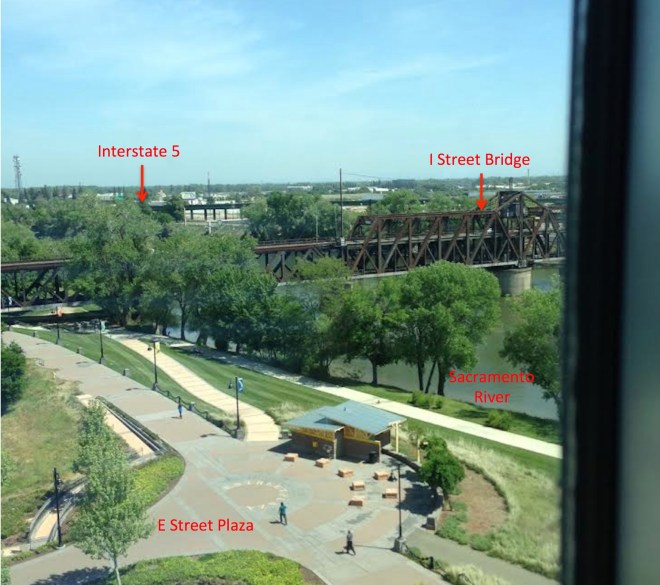
annotated-206

This reader had to step back:

The giveaway clue is the yellow writing – which, in this case, was a “full Monet”: more easily decipherable from a distance, rather than zooming in. I got the “STREET PLAZA” pretty quickly, but what was that first character? It had to be a letter – so my first instinct was to go to DC, but the lack of East Coast buildup suggested otherwise.

I started Google Mapping “[letter] STREET PLAZA”, and discovered that several towns in California are named by single letters – San Diego, Modesto, Merced – and checking for cities with rivers, and especially railroad bridges over them, Sacramento’s E Street Plaza was quickly identifiable!

Another method focused on the economic evidence:

I was pretty certain this was somewhere in the Midwest, based on the flat terrain and old-style railroad trestle. After doing some unsuccessful image searching for railroad bridges in Iowa and Illinois, I started thinking about that riverfront walk. Not just any city can afford to re-do their riverfront like that (with the old-style lightposts, the landscaping and the facilities). This would need to be a medium-sized city with a decent economy to justify that kind of public spending on their riverfront. I started thinking of cities that were focusing on riverfront redevelopment, and as a native Californian, Sacramento popped into my head. Sure enough, that bridge came up at the top of my search, making this one of my fastest (and luckiest) VFYWs yet!

A former winner geeks out with some labels and factoids:

contest pic with labels

Several peculiar items can be seen in this week’s picture. First, the large tower on the left side of the picture is part of a police communications center.  Watch one of the dishes being removed here.  Second, in the middle of the picture there seems to be a pipe climbing out of the berm across the river.  It turns out to be one of NOAA’s numerous water gauges that monitors river crests and flooding.  Third, the faint smokestack on the right hand side of the picture is the Sacramento Tower.  Built over a hundred years ago at the city incinerator, it was climbed for the first time by a local rock climber.  He dedicated his ascent to the Americans taken hostage by Iran.  Slightly odd and inefficient means of communication, but I’m sure the hostages appreciated the gesture.

Another provides some detail about the building:

The photographer took this from CalSTRS, which according to Wikipedia “is the largest teacher’s retirement fund in the US”. It’s also the 8th largest public pension fund in the US. But it pails against the largest public fund in the state – CalPERS, which is #2 over all. CalPERS funding is also a bone of contention here in the state because of the unfunded contributions owed to it by many cities, counties and of course the state itself. Because of these unfunded liabilities, a couple of cities have filled for bankruptcy. Many more might follow.

Another casts a critical eye:

I don’t know much about economics and stuff, but even I know that the pension fund for California’s underpaid state teachers should not be headquartered in a 19-story, $266 million gorgeous monstrosity of glass and steel that was built for the purpose:
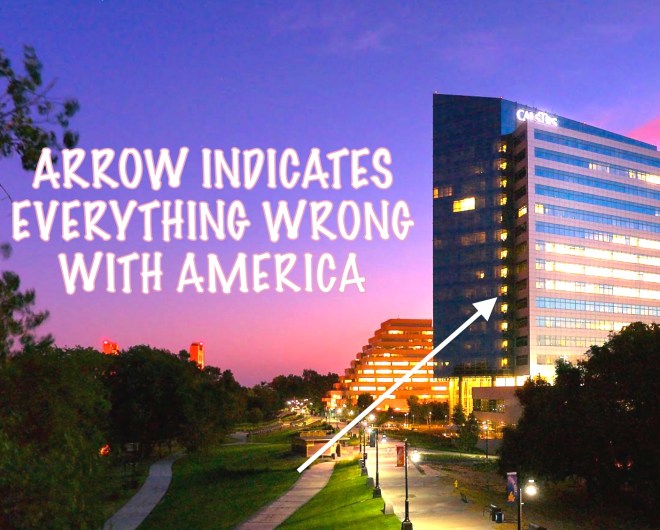
sacramentoVFYW

I’ll leave it to more qualified readers to say if this is capitalism run amok or socialism run amok, but it’s clearly one or the other, and quite possibly both. Seriously, CALSTRS. When you’re dwarfing the neighbors, and the neighbors happen to live in a ziggurat, that’s when you know you’ve overdone it.

Update from a reader who works at the building:

CalSTRS is the 2nd largest public pension fund in the US (by value of assets), not the 8th. CalPERS is the largest.

As far as socialism or capitalism running amok, I’ll just say that the workers here – a very dedicated lot, in my opinion as an outside consultant in organizational behavior – were in multiple and decrepit quarters before this building was built, and now they are in an environmentally healthy and sustainable building. And the only reason it dwarfs its neighbors is that it’s not in downtown Sacramento. Were it a bit more to the east, it would be dwarfed by a bunch of … wait for it … banks.

Finally, the view was taken from a conference room. The employee break room is in the middle of the floor. Nobody here steals anyone else’s sandwich.

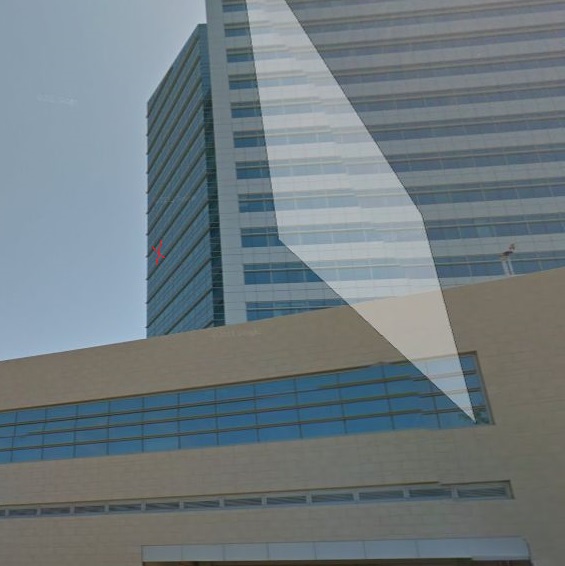
On to the winner selection. The photo was taken from the fifth floor, but as is often the case, many readers wrote that their choice was the fifth floor but then circled a window on another floor. Most of these guesses started with the exterior window and then attempted to discern the floor number incorrectly. The following reader found a useful link for better understanding the layout of the building and which floor is which:

The CALSTRS office was finished in 2007 and was constructed to have low emissions and energy-use, enough so that some researchers at UC-Berkeley used it in a case study of environmentally-friendly building design.

The photo’s submitter said that the window “is in the northeast corner of the building on the 5th floor.” That makes the following reader the only one to guess it exactly right:

We’re looking out at the I Street Bridge. A quick image search for double-decker truss bridges got things narrowed down. I have no idea how the building offices are numbered, but I’m going to guess that this was taken from the 5th floor corner window closest to the river, facing the bridge.

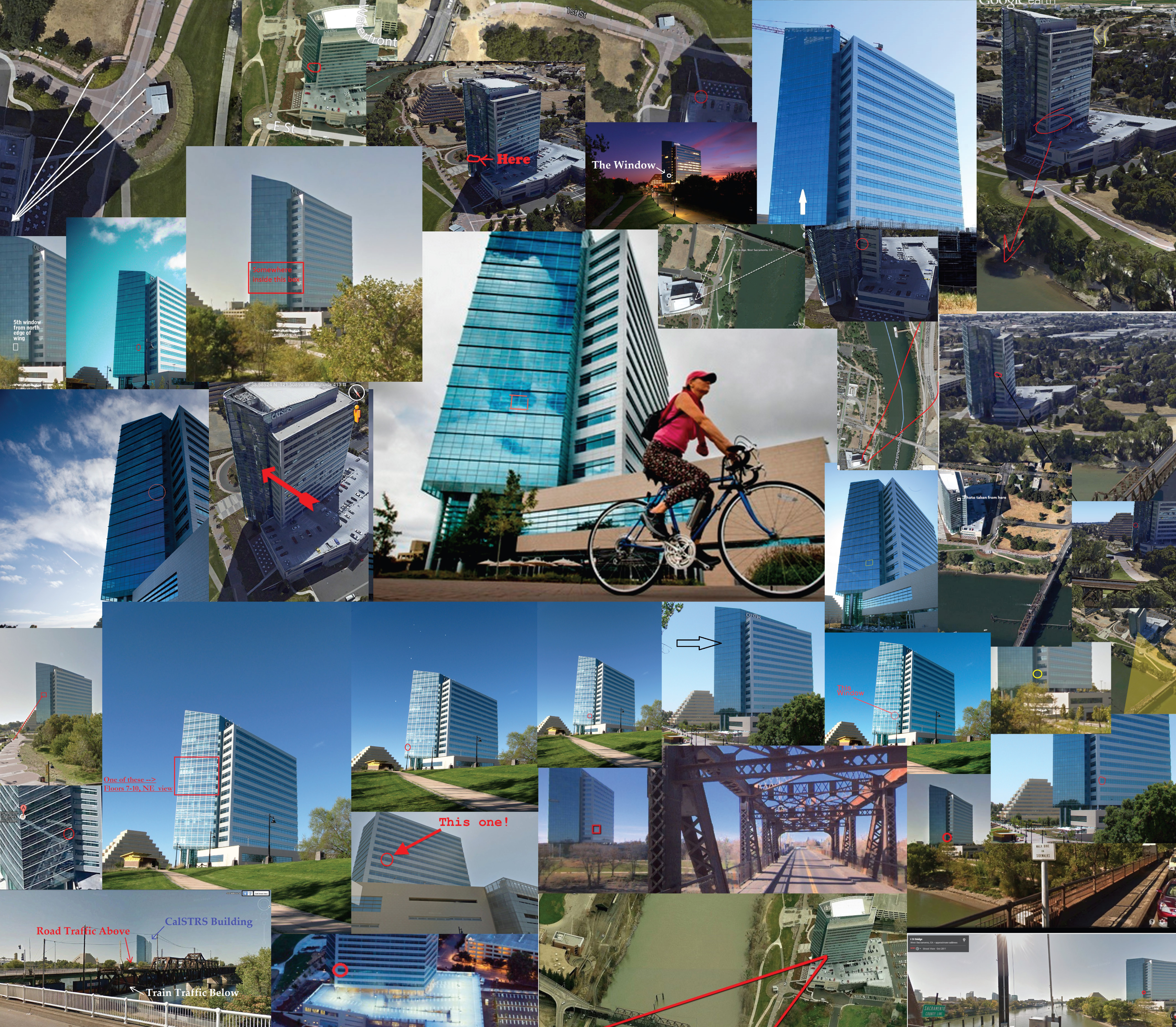
Congrats to our winner on what is essentially an upset over many more experienced players. Among them:
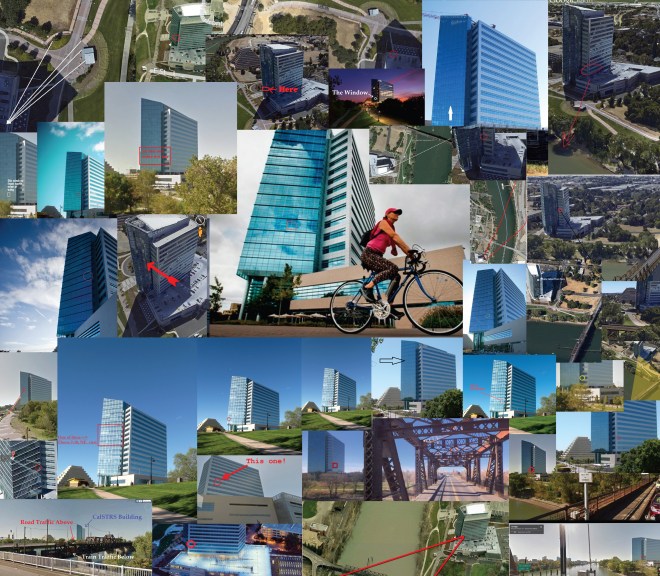
vfywc-206-guess-collage

Meanwhile, a former winner writes:

I dunno, 12th floor? Chini’s going to be like, “Well it looks like from the ground it’s about a 65.12265578456132° angle and it was taken about 10 minutes after the submitter, who’s a Scorpio, had a turkey sandwich and a Sprite at their desk, which is located approximately 52 feet from the elevator.” Seriously how has the CIA not contacted him yet? OR HAVE THEY?

Chini, who was actually off by two floors this week, marks his second anniversary with the contest:

The first view I ever found was posted on May 26, 2012 (VFYW #104), so it’s nice that we’ve returned to the state where this odd little journey began two years ago. Back then the contest seemed impossible, so I was disappointed when my entry for that week wasn’t published. But if at first you don’t succeed, try, try again …

Here’s that entry from his first week:

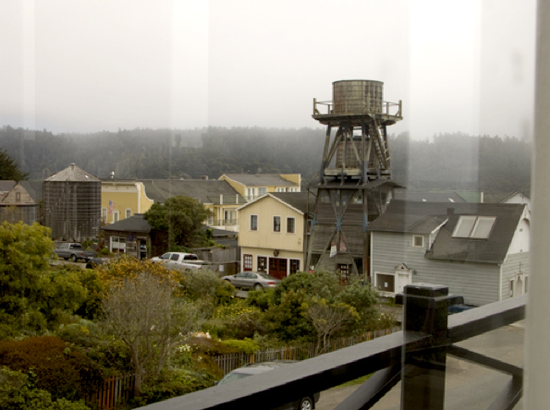
Years of reading the Dish and finally I got one! This week’s VFW shows a row of buildings on Albion Street in Mendocino, California. The picture was taken from the southernmost of three side windows on the second floor of Odd Fellows Hall located at 10480 Kasten Street between Albion and Ukiah, or 39°18’20.01″N and 123°48’5.94″W. Originally built in 1878 as a meeting house, it’s used today primarily for local art exhibitions.
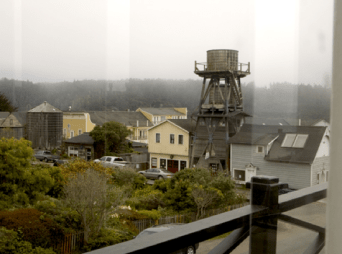
As for locating the reader’s building, the key was the water tower. A Google search for wooden water towers will bring up quite a few in Mendocino, including a view that is a near mirror image of the one your reader submitted. Much like last week’s contest, the buildings’ style threw me off a bit, as my first guess was Maine. (According to Wikipedia the town was settled by former New Englanders who brought their architecture with them, so much so that Mendocino was used as the setting of the fictional Cabot Cove, Maine in the TV show Murder, She Wrote).

Finding the particular window was a bit harder. The rearmost of the three second floor windows is blocked up, but the first two were prime candidates. To choose between them I focused on the reflections of the building’s thin front windows that are faintly visible in your reader’s picture. The rapid increase in their apparent width looking left to right meant that the shot was likely taken from the front-most side window; from a position near the middle side window, those reflections would appear much more uniform in width.

Finally, having never been there, but having been to the Marin Headlands down the coast, it sure seems like a nice place for a getaway weekend!

(Archive: Text|Gallery)