Who's right about the long-term costs of the current proposals – the CBO or the Institute of Medicine?
Face Of The Day

Barry Delaney kneels weeping as mourners gather at Barnhill Cenetery for the funeral of Black Watch soldier Kevin Elliot on September 15, 2009 in Dundee, Scotland. Private Elliot was killed during a rocket attack in the Babaji district of Helmand in Afghanistan. Delaney wagered Kevin Elliot that they would wear this lime-green dress to either's funeral. By Jeff J Mitchell/Getty.
Medicare Part D vs Obamacare
Megan responds here. A reader retorts:
Pace McArdle, health reform is nothing like Medicare Part D. Medicare Part D is available to all beneficiaries regardless of income. The subsidies provided in the reform bills scale with income and are in place to make workable a mandate that will, by itself, lower the average cost of individual care relative to current law. Additionally, health subsidies are fully funded for 10 years according to stingy estimates by the CBO (that don't jive with reform advocates' predictions of how reform will bend the cost curve). On top of that, Obama's now pledged that deficit neutrality will be written into the bill; finding new funding or modifying the program would require Congressional action in the future. There is simply no comparison between Medicare Part D and
health reform.
I think you're being far too kind to her commentary. In fact, the CBO scoring of the HELP bill, which has the most generous subsidies proposed at 400% of the federal poverty line shows total subsidies costing $140B/yr 10 years from now. Medicare Part D is expected to hit that mark a year earlier according to Kaiser's projections … and, you know, Congress is actually going to fund health subsidies by fining employers that don't providing insurance, etc.
Torture Returns To Liberated Iraq
Along with anti-gay pogroms, torture is making a comeback:
Muntader al-Zaidi said that when he was arrested after hurling his shoes at Mr. Bush at a December news conference, those inside could probably still hear his screams. He said he was shackled, soaked in water and kept in a place with no heat in the cold night. “I will name later those involved in torturing me, among them high-ranking officials in the government and the Army,” he said. He claimed that he was beaten with pipes and steel cables and that he received electric shocks while in custody.
The Economist reports on the slow migration of al-Maliki toward the techniques of Saddam:
Torture is routine in government detention centres.
“Things are bad and getting worse, even by regional standards,” says Samer Muscati, who works for Human Rights Watch, a New York-based lobby. His outfit reports that, with American oversight gone (albeit that the Americans committed their own shameful abuses in such places as Abu Ghraib prison), Iraqi police and security people are again pulling out fingernails and beating detainees, even those who have already made confessions. A limping former prison inmate tells how he realised, after a bout of torture in a government ministry that lasted for five days, that he had been relatively lucky. When he was reunited with fellow prisoners, he said he saw that many had lost limbs and organs.
Chart Of The Day
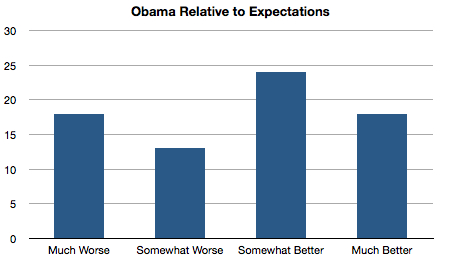
Yglesias graphs data from that latest WaPo poll.
A Marijuana Arrest Every 37 Seconds
Jacob Sullum parses the new drug arrest numbers. He reminds us:
As I noted in the January 2008 issue of Reason, there is no obvious relationship between marijuana arrests and marijuana use: Increases in arrests do not seem to be driven by increases in consumption, and busting more pot smokers does not seem to result in less pot smoking. While the odds of getting arrested have roughly doubled since the early 1990s, the overall of level of use is no lower now than it was then and may be somewhat higher (changes in survey methodology make it difficult to be sure). In the last several years, self-reported marijuana use has been essentially flat, while arrests continued to climb before dropping slightly last year, when survey data indicate that use rose slightly.
Mark Jacobson has an excellent piece on New York's schizophrenia on the subject here. The contradictions keep heightening.
Mental Health Break
A tad preachy at the end, but pretty cool:
Bottled Water, photographs by James Worrell from James Worrell on Vimeo.
More Raids On Gay Bars In The South, Ctd
The cops keep changing their story.
Margaret Thatcher, Secret Defender Of Soviet Security, Ctd
Matt Steinglass differs with Conor Friedersdorf over how to interpret the Thatcher news from last week:
I don’t think the revelations should lead one to mistrust politicians in quite the way Friedersdorf does. It’s true that politicians’ most simplistic public statements and slogans will not always be adhered to in the details of their diplomatic maneuvering. But I don’t actually think Margaret Thatcher thought it was okay for Communism to persist indefinitely in Eastern Europe. It’s just that she also didn’t really think the Soviet Union was a rabid totalitarian dictatorship bent on invading Western Europe, and whose leaders could never be trusted; and apparently, in late 1989, she thought there was more risk in a sudden collapse of Communism, with Eastern European countries ripping away from the Soviet orbit, than in a slower evolutionary transition. Her public political pronouncements were a camera-friendly, lowest-common-denominator version of her somewhat more sophisticated actual anti-Communism. And the same was true of George H.W. Bush. Both were capable of tempering their ideological preferences with a healthy dose of realism.
But Thatcher was utterly wrong about Germany – and fueled by paranoia. She was a pragmatist, as Reagan was (and Bush wasn't), and, in my view, she single-handedly rescued Britain from terminal decline. But she blew this one big. It was her foreign policy poll tax. And it was party why her colleagues decided she had to be pushed out of power.
Racially Motivated?
That is Michelle Malkin's categorical claim about the ugly incident on a school bus in Saint Louis this morning. She wrote that post at 12.02 pm, linking to this story which says it was updated at 11.35 am to rebut the notion that this schoolyard fight was racially motivated. The police chief rushed to judgment and later recanted. Maybe Malkin missed it and will soon qualify her claim. But here's a revealing statement:
A Belleville police spokesman now says an incident where a white student was beaten by teen black assailants on a bus “may not be racially motivated.” “It was premature on my part,” said Belleville Police Capt. Don Sax. “It was my personal and emotional comment after only seeing the video briefly.”
And yet Malkin has not yet corrected her story or changed its headline from "Racial thuggery." Dan Riehl ramps up the race war talk. A Malkin commenter piles on:
Can you tell me there is no race war going on? While white people sit around shaking their heads and looking the other way black people have made every possible issue about race and their anger is erupting more daily. It’s only going to get worse.
Now, I don't know what the motive on that schoolbus was, and in schoolbus fights (and I saw many as a boy), there might be many, including racial tension. But we don't know this yet. Can we withhold judgment until we do? Or is that much too much to ask?
 The Dish