Egypt’s Pre-Election Pulse

In the lead-up to Egypt’s presidential election next week, Max Rodenbeck examines the findings of a recent Pew survey, which puts putative winner Abdel Fatah Al-Sisi’s favorability at 54 percent and shows “declining faith in democracy”:

In the heady days of 2011, 54% favoured “democracy, even with some risk of political instability”, over stable government without full democracy. Those proportions have now reversed, a factor that has clearly played to Mr Sisi’s electoral advantage.Egypt

But Egypt’s new leader should take little comfort from other trends. Trust in national institutions, including the army, the media, religious leaders and the courts has slumped to an all-time low; in the case of the military from 88% approval in 2011 to just 56% now. This is an indication that the post-coup-regime’s use of harsh policing and harsher justice has carried a heavy cost in public support. Significantly, some 63% or respondents said the government now “does not respect” personal freedoms, up from 44% under Mr Morsi.

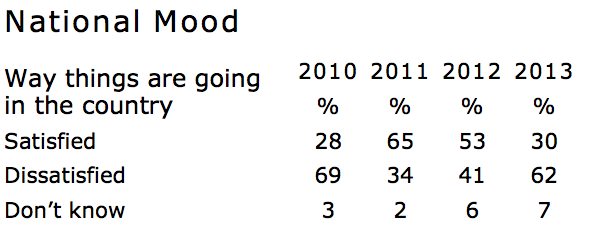
Perhaps most ominously, a solid 72% of respondents say they are dissatisfied with the country’s general direction. That is a higher proportion than in 2010, the year before Egyptians rose up and overthrew Hosni Mubarak, their dictator for three decades.
Richard Wike focuses on what Pew found out about the Muslim Brotherhood:

Back in 2011, just after the revolution, three-quarters of Egyptians had a favorable opinion of the Muslim Brotherhood, and even in the spring of 2013 a solid majority (63 percent) still expressed a positive view. In the new survey, however, just 38 percent give the Brotherhood a positive rating. Still, the fact that roughly four in 10 Egyptians continue to have a favorable opinion of the Islamist organization, which the Egyptian state has declared a terrorist group, means that Sisi will come to office facing significant opposition to his rule.

In some ways, the Brotherhood’s resilience shouldn’t be a surprise: The organization has been around for nearly nine decades and has survived varying levels of repression over time, adapting and transforming itself as the political context changes. Egypt remains a country where many Islamist positions enjoy a great deal of acceptance, providing groups like the Brotherhood an ongoing base of support.

Meanwhile, Eric Trager interviews Sisi’s quixotic challenger Hamdeen Sabahi:

Sabahi, who finished a strong third in the 13-candidate 2012 presidential election, knows that the odds are severely stacked against him. “I think the political atmosphere says that there is a state candidate,” he said, referring to Sisi, during an interview at his Giza-based office in early April. “I think this atmosphere does not give an equal competitive opportunity in this election.” … Yet despite the hopelessness of his relatively small campaign, Sabahi is making one important contribution to Egypt’s political landscape. In an otherwise repressive political environment, he is working to preserve Egyptians’ ability to challenge Sisi’s emerging regime. …

Yet despite the hopelessness of his relatively small campaign, Sabahi is making one important contribution to Egypt’s political landscape. In an otherwise repressive political environment, he is working to preserve Egyptians’ ability to challenge Sisi’s emerging regime. “I am not an idealist who stays at home waiting for this state to be neutral,” he told me. “For this reason, I believe in running for this presidential election so that democracy becomes a right.”
About That 15-Hour Workweek …

by Jonah Shepp

Reviewing Brigid Schulte’s Overwhelmed, Elizabeth Kolbert ties Schulte’s exploration of American busyness back to John Maynard Keynes’s famously incorrect prediction that dramatic increases in productivity would lead to less work and more leisure time in the 21st century:

Eighty years after Keynes first composed “Economic Possibilities,” a pair of Italian economists, Lorenzo Pecchi and Gustavo Piga, got to chatting about it. How could “a man of Keynes’s intelligence,” they wondered, have been “so right in predicting a future of economic growth and improving living standards” and so wrong about the future of leisure? They decided to pose this question to colleagues in Europe and the United States. Perhaps some of those they asked were women; in any event, all those who responded were men. The result, “Revisiting Keynes” (2008), suggests that Nobel Prize-winning economists, too, are perplexed by “the overwhelm.”

Several contributors to the volume attribute Keynes’s error to a misreading of human nature. Keynes assumed that people work in order to earn enough to buy what they need. And so, he reasoned, as incomes rose, those needs could be fulfilled in ever fewer hours. Workers would knock off earlier and earlier, until eventually they’d be going home by lunchtime. But that isn’t what people are like. Instead of quitting early, they find new things to need.

But Derek Thompson pushes back on the notion that Americans are busier than ever:

For much of the essay, this premise survives unchallenged. Obviously, we’re working more than ever, because it feels like we are. Right? Actually, no, we’re not.

As a country, we’re working less than we did in the 1960s and 1980s and considerably less than we did in the agrarian-industrial economy when Keynes foresaw a future of leisure. It’s not until the end of Kolbert’s essay that the reader steals a glimpse of the cold hard statistical truth: Every advanced economy in the world is working considerably fewer hours on average than it used to. …

For many Americans, particularly less-educated men and women, Keynes’ crystal ball has correctly foretold a future of historically high leisure time. But single parents in the U.S. report the most hours worked and severe time shortage in the developed world, and higher-educated men and women are actually working more than they were 50 years, bucking the global trend. Economists call this the “leisure gap,” and it’s a mirror reflection of the income gap. When it comes to leisure, the rich have less, and the poor have more.

He thinks this leisure gap reveals Schulte’s and Kolbert’s biases:

It’s appropriate that both Brigid Schulte and Elizabeth Kolbert are successful working moms, since this category of workers has seen its leisure time fall despite rising incomes. Since 1950, young married women’s work hours have tripled while married men’s hours have declined, according to the Philadelphia Fed. The well-educated rich, married, working mother is overwhelmed. But there are a lot of Americans who are neither well-educated, nor rich, nor working, nor parents. For them, there are probably more pressing concerns than belonging to (in the words of Swedish economist Staffan Linder) a “Harried Leisure Class.”

Previous Dish on Overwhelmed here.

Why Airplane Food Has Gotten Worse

by Jonah Shepp

Yes, airlines have scaled back their offerings, but as Julie Beck explains, there’s another, less obvious reason:

Today’s planes, which reach altitudes of 35,000 feet or more, are pressurized so you only feel like you’re about 6,000 to 8,000 feet above sea level. This helps keep you, you know, breathing at those high altitudes, but it also numbs your taste buds, making food taste blander. Older aircraft didn’t fly as high, meaning the prime cuts of steak being served on those early flights tasted more like they would have on the ground.

Other aspects of the airplane environment make it less than gastronomically ideal—cabin humidity is typically lower than 20 percent (as opposed to the 30 percent or more that is normal in homes), which can dry out your nose, weakening your sense of smell. And smell is inextricably linked to taste. (The dryness of the cabin makes you thirsty, too.) Also, the air in the cabin is recycled about every two to three minutes. That, plus air conditioning, can dry up and cool down food very quickly, according to [airline food historian Guillaume] de Syon.

“If you were to serve a nice breast of chicken, which you can do on board, within a minute or two, the chicken would be like sawdust,” he says.

The Unemployed Don’t Need Tough Love

by Patrick Appel

UI Cut Off

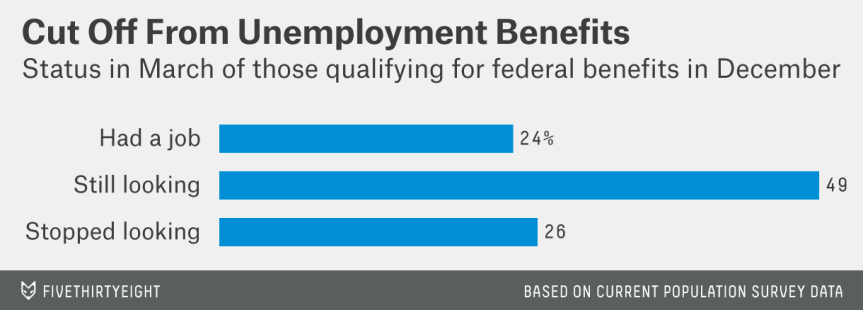
Ben Casselman makes clear that Congress cutting off unemployment benefits “hasn’t spurred the unemployed back to work.” He finds that “the roughly 1.3 million Americans whose benefits disappeared with the end of the program, only about a quarter had found jobs as of March, about the same success rate as when the program was still in effect”:

There has been no sudden surge of former benefits recipients into jobs. Nor have they abandoned the labor force in droves. Most have done what [Helene] Laurusevage [who lost her unemployment benefits] has done: continued looking for work, but without the lifeline that benefits provided.

For Laurusevage, the cutoff has been wrenching. Her husband’s salary, combined with the $563 a week she got in unemployment benefits — the equivalent of about $30,000 a year — was enough to make ends meet. But once her benefits expired in December, life got harder. Their savings depleted, they scraped together this month’s mortgage payment only by borrowing from David’s 79-year-old mother. They don’t know what they’ll do this month.

“We are about to go under,” Laurusevage said. “My entire savings account is gone. Everything I spent years to save is gone.”

Can Conservatives Help The Poor? Will They?

by Jonah Shepp

Earlier this week, Ramesh Ponnuru urged Republicans to embrace alternatives to the minimum wage that he believes would better help low-wage workers and the middle class, such as raising the Earned Income Tax Credit and addressing rising costs of living:

Republicans should attack both ends of the problem. Rising health-insurance premiums are a big reason wages have stagnated. Scaling back the tax break for the most expensive policies, as part of a market-based reform of health care, could help wages rise again. And wages would stretch further if costs were lower. Higher education seems ripe for reforms that make financing easier and create lower-cost alternatives to a traditional four-year degree. Energy costs could be restrained through increased exploration and decreased regulatory mandates. The cost of raising children would fall if the tax code did more to recognize it as an investment in the future.

Chait responds that the Republicans of Ponnuru’s idyll are not the ones who actually sit in Congress:

One problem with this plan to get Republicans to increase the Earned Income Tax Credit is that, as Ezra Klein points out, they’re currently fighting extremely hard to cut the Earned Income Tax Credit. Ponnuru’s column doesn’t mention this highly relevant detail.

What’s more, one of the main reasons the Earned Income Tax Credit exists is to cushion the impact of state taxes, which often force workers on the bottom half of the income spectrum to pay higher rates than the rich. And why are state taxes so regressive? Well, a main reason is that Republicans want it this way. The states that raise the highest proportion of their taxes from the poor are Republican states. The EITC is in large part a way of using the federal tax code to cancel out Republican-led policies of taking money from poor people, so naturally Republicans at the national level oppose it, too.

Ramesh fires back, and Ross Douthat comes to his aid with an argument that Republican tax policy has helped the poor:

If you look at this table, for instance, you’ll see that federal income tax liability for the poorest 10 percent declined pretty steadily from the 1986 tax reform onward — quite often thanks to policy changes that Republicans either accepted or actively endorsed. Or again, if you look at this chart, you’ll see that we cut taxes on low-wage workers three times (relying on the EITC and child tax credits) in the twenty years before the Obama era: first in the ’86 tax reform, under Reagan; then in 1997, in a Clinton-Gingrich deal, and finally in 2001, in the Bush tax cuts. Those were not policies supported by all Republicans and conservatives by any means — hence the internal party debate, which swung in more Randian direction in 2009-2012 — but they were ideas that many Republican leaders embraced, pushed for, and signed into law.

And of course they were accompanied, as in many of today’s reformist proposals, by changes and cuts to existing welfare programs, with the overall goal of changing the incentive structures facing the poor, so that work would become more rewarding and attractive and idleness less so. Reasonable people can disagree about the consequences of these reforms, but there’s a pretty plausible case that this combination of increased take-home pay and lower guaranteed benefits, rather than punishing the poor, tended to help them: At the very least, we seemed to make more progress reducing child poverty from the 1990s onward, as Scott Winship argued earlier this year in Politico, then we did in the years before the EITC/welfare reform/child tax credit combination became federal policy.

Chait remains convinced that “the reformers are massively understating the obstacles before them”:

There are reasons Republicans have fought so hard to claw back subsidies for the least fortunate. Active philosophical opposition to redistribution is one. A general detachment from the poor is another. The unforgiving zero-sum math of budgets, which means a dollar spent on helping a Walmart mom is a dollar in higher taxes or lower defense or politically painful cuts in retirement benefits, is a third. I do think the Republican reformers can nudge their party to a better, or at least less terrible, place. But I don’t think they’re being very straight about it.

An Unhealthy Lack Of Slaughterhouses

by Patrick Appel

US_Number_Slaughterhouses

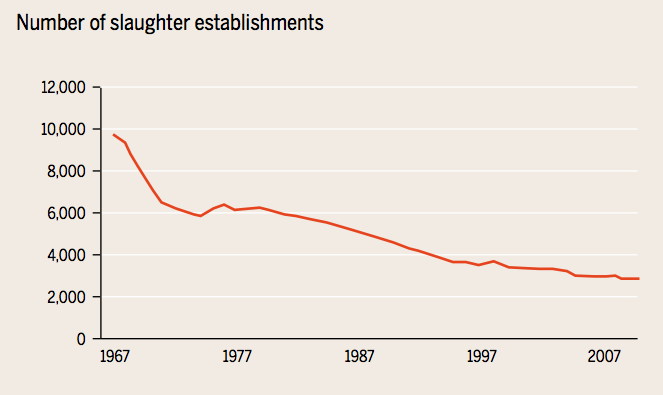
On Monday, a Detroit meatpacking company recalled 1.8 million pounds of beef. Susannah Locke conveys how the centralization of the meat industry amplifies the risks of widespread contamination:

Just four companies slaughter 80 percent of cattle in the United States. (The meat-packing company involved in the current recall isn’t one of those big four, however.) And three companies control half of America’s chicken, according to Christopher Leonard’s new book The Meat Racket.

That industry concentration has, in turn, led to more meat being slaughtered and processed in larger, centralized facilities — since it’s more efficient that way. And that, in turn, can make it easier for contamination to spread more widely.

Lindsay Abrams also warns of the disease-spreading potential of modern-day slaughterhouses:

As thousands of cows pass through assembly lines, a single ceiling drip, to take one example, could contaminate large swaths of them in record time, and safety inspectors can have a hard time spotting a problem amid the chaos. Then, of course, there’s the poop: “These animals are all raised on factory farms now,” Leonard explained, “where they’re much more crowded than ever before. And chickens and cows literally live their whole lives standing on beds of manure and feces.” They enter the slaughterhouse already covered in fecal matter, upping the odds of contamination once they’re killed.

It’s not just your mass-produced, factory farmed meat that’s in danger, however. A full quarter of the cows slaughtered in Ranchero’s slaughterhouse, site of the 8.7 million pound recall [in February], came from small, local and sustainable ranchers who sold “niche” products like grass-fed and organic beef. Even mid-sized slaughterhouses are closing their doors, said Leonard, meaning those ranchers didn’t have much of a choice but to rent out space from a large facility that was also processing cattle for the big four meat companies. Once there, those animals, regardless of how responsibly they were raised, became a disease risk as well.


The Gridlockpocalypse

by Patrick Appel

Cassidy heralds its coming. He contends that “the G.O.P. is likely to gain the six seats it needs to capture the Senate, which could well usher in a two-year standoff with the White House that would make the current gridlock look like a model of benign administration”:

It’s not just that nothing would get done about things like climate change, gun control, and long-term budget reform. With the Republicans exercising a legislative veto through their majority in the House of Representatives, we have already been stuck on these issues, and many others, for three-and-a-half years. If the G.O.P. takes over the Senate, it will also gain the power to block Presidential appointees much more easily than it can do as the minority party—and a good deal of day-to-governance will probably grind to a halt. Judgeships and ambassadorships will remain vacant for want of candidates acceptable to both parties. Cabinet members and other nominees to the executive branch will have an even harder time getting appointed than they do now—and the situation is already so dire that it’s an international embarrassment to the United States.

But John Dickerson wants the GOP to take the Senate and be forced to govern:

For the moment, partisanship provides an excuse and impediment to action. House Republicans pass legislation, but their views never have to be sharpened or reconciled with those of their Senate colleagues. Control of both houses could force clarity in the GOP on issues like immigration, which leaders have ducked so far, claiming they didn’t have a trusted partner in the president. That is a dodge to keep from starting a fight in the party over a contentious issue.

When you control both houses, this kind of inaction can’t be allowed if the goal is to be taken seriously as a governing party. Republicans would also have to provide more concrete votes on issues like health care, tax reform, and implementing portions of Rep. Paul Ryan’s budget. Republican strategists know the GOP has to shake the “Party of No” label, which means producing actual accomplishments—that is, unless you want the governors in the GOP 2016 field using you as a foil. (Of course they’re already doing that anyway).

Burning Problems

by Tracy R. Walsh

fire-costs-dishedit

According to Brian Mockenhaupt, decades of aggressive fire-fighting efforts have left the West more prone to blazes than before:

During [the Great Depression], the Forest Service decided that every wildfire in the country should be put out by the morning after it was reported. The country had the manpower to try. This new approach coincided with the onset of several cool, wet decades, which aided the effort: forests weren’t as dry, so they grew more and didn’t burn as often. Smoke jumpers joined the fight, first parachuting into a fire in 1940, and after World War II their ranks swelled with veterans who had made combat jumps across Europe. After the war ended, firefighters also had surplus military trucks and bulldozers at their disposal, and by the mid-’50s they were using helicopters and retired military airplanes to drop water and flame retardant on fires. …

It seemed like a great success story:

Americans were fighting fire, just as they had fought their military enemies, and they were winning. But when wildfires don’t burn regularly, fuels simply accumulate, and bigger fires become inevitable—something policy makers took decades to recognize. “What they didn’t see at the time,” says Don Falk, a forest-and-fire ecologist at the University of Arizona, “is that fire is inevitable. You can defer it, but it’s a pay-me-now-or-pay-me-later scenario. There’s no fire-free scenario.” We’re paying for that blindness now. Across the West, enormous swaths of forest and shrubland are loaded with decades’ worth of built-up fuel.

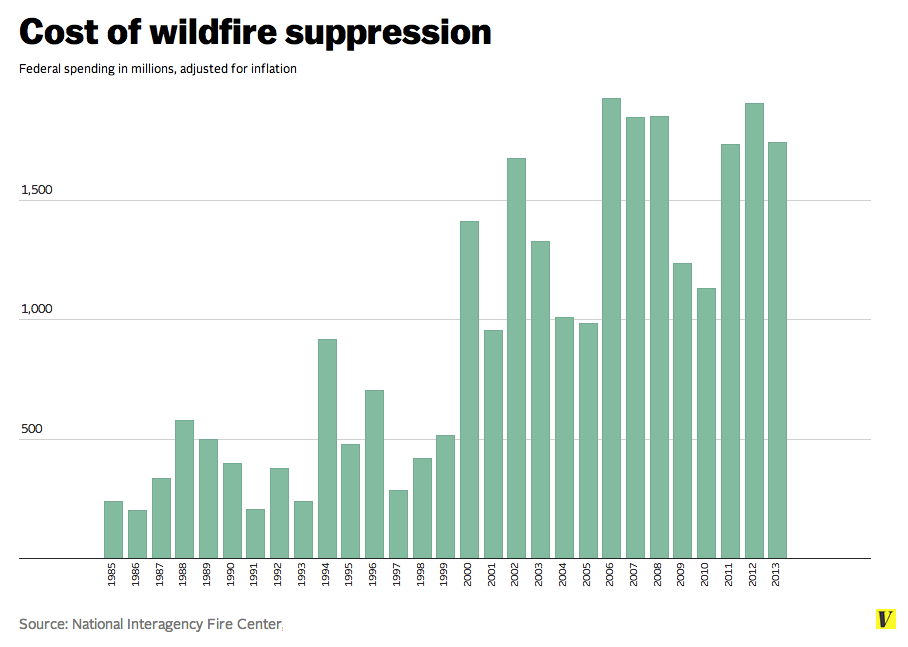
Plumer passes along the above chart:

Costs are going up partly because the wildfires themselves are getting bigger. But it’s also a function of the fact that more and more people are living in fire-prone areas. In Colorado, for example, some 250,000 new residents have settled into the fire-prone “red zone” over the past two decades. … Right now, Congress gives agencies like the US Forest Service a budget for fire suppression that’s based on the average cost of wildfires over the previous 10 years. Of course, if wildfires are getting bigger over time, that’s going to create constant shortfalls.

An Accounting Of American Racism, Ctd

by Patrick Appel

Dan Savage has effusive praise for TNC’s reparations article:

Gay marriage went from inconceivable to laughable to an existential threat to obviously just in a few short decades. I expect that reparations for slavery (and Jim Crow and redlining) will do the same—and I epxect that we will one day look back at Ta-Nehisi Coates’ 2014 piece in The Atlantic the same way we look back at Andrew Sullivan’s 1989 piece in the New Republic (“Here Comes The Groom: A (Conservative) Case For Gay Marriage”). This is an essay that could jumpstart a movement. It’s certainly a piece that everyone is going be talking about.

John McWhorter is more critical:

Despite frequent claims that America “doesn’t want to talk about race,” we talk about it 24/7 amidst ringing declamations against racism on all forms. Over the past year’s time, I need only mention Trayvon Martin, Paula Deen, Cliven Bundy, and Donald Sterling. Over the past few years, three of the best-selling and most-discussed nonfiction books have been Isabel Wilkerson’s chronicle of the Great Migration, The Warmth of Other Suns, Rebecca Skloot’s book about the harvesting of a black woman’s cancer cells (The Immortal Life of Henrietta Lacks), and Michelle Alexander’s invaluable The New Jim Crow. And let’s not forget recent major release films such as The Help, 12 Years a Slave, and The Butler.

Can we really say that these are signs of a nation in denial about race, racism, and its history?

Yet for writers like Coates, somehow none of this is enough. A shoe has yet to drop. We remain an “America that looks away,” “ignoring not just the sins of the past but the sins of the present and the certain sins of the future.” But what, exactly, is the suggestion here? Surely not that no racism exist anywhere in the country—but what, then? In exactly what fashion could 317 million people “reckon” or come to certain eternally elusive “terms” with racism? Especially in a way that would satisfy people who see even America’s current atonements as insufficient?

William Jacobson points out that “Coates never gives the answer as to who gets what and how”:

And that’s ultimately the problem with reparations arguments that are not based upon the people causing the harm paying the people directly harmed by specific conduct soon after the conduct is remedied.

If you can’t answer the question of why a Vietnamese boat person has to pay reparations for the conduct of white plantation owners more than a century earlier, then you can’t make the argument. If you can’t answer the question of why two successful black doctors living in a fashionable suburb should get reparations paid for by the white children of Appalachia, then you can’t make the argument. If you can’t answer the question of why the adult black recent immigrant from Paris should be pay or be paid reparations based on the color of his skin for crimes committed in a land he did not grow up in, then you can’t make the argument.

And what about the increasing number of children of mixed race?

Bouie sees the purpose of the article differently:

Wisely, Coates doesn’t try to build a proposal for reparations. At most, he endorses a bill—HR 40—that would authorize a government study of reparations. Instead, his goal is to demonstrate the recent origins of racial inequality, the role of the federal government, the role of private actors, and the extent to which the nation—as a whole—is implicated. Even if your Irish immigrant grandparents never owned slaves, or even lived around black people, they still reaped the fruits of state-sanctioned—and state-directed—theft, through cheap loans, cheap education, and an unequal playing field. If anything, what Coates wants is truth and reconciliation for white supremacy—a national reckoning with our history.

Ezra weighs in:

“The popular mocking of reparations as a harebrained scheme authored by wild-eyed lefties and intellectually unserious black nationalists is fear masquerading as laughter,” Coates writes. It’s also the intellectually unserious response of people who believe that because they never owned slaves or drank from a whites-only water fountain and so they weren’t the beneficiaries of American racism. They may not be the villains of American racism, but they are the beneficiaries of it. The average white southerner in 1832 was far poorer than the average white southerner today, and part of that vast increase in wealth and income and knowledge and social networks is the result of compound interest working its magic on what the slaveowners and the segregationists stole.

It’s as simple and clear as a child’s math problem. The people who benefitted most from American racism weren’t the white men who stole the penny. It’s the people who held onto the penny while it doubled and doubled and doubled and doubled.

Emily Badger considers the impact of the discriminatory housing practices TNC focuses on:

Schemes like this illustrate why homeownership has been a much more precarious prize for blacks. They also explain why the racial wealth gap remains so wide today. Wealth in America, as it’s passed from one generation to the next, is intimately tied up in housing. And blacks have systematically been denied the chance the build that wealth. Just earlier this week, the Center for Global Policy Solutions released a report looking at the racial wealth gap in America today. It found that the average black household in America owns 6 cents for every dollar in wealth held by a typical white family. It found in the Washington, D.C., metropolitan area that whites have a homeownership rate that’s still 20 percentage points higher than blacks.

Lastly, PM Carpenter declares, “I’m all for Coates’ cause, but as a part-Native American and citizen of the Cherokee Nation, I want what’s mine and my brothers’ and my mother’s, too”:

I also want American women to be compensated for their years of unpaid grueling toil as they raised the next generation. And I want compensation for the millions of Jews, Irishmen, Italians and all other minorities who suffered from systematic discrimination in both civil society and the workplace. In fact I want reparations paid to every American who sprang from the loins of oppressed proletarians, for the slavery of class hierarchy is, historically, very real.

I’m not trying to make light of Coates’ pain, or to conflate black slavery with “Irish need not apply.” But the world doesn’t work in the way Mr. Coates believes it should. And almost everybody has a history of major hurt, against which endless cases for reparations could be made.