Winning Hearts And Minds And Judges

by Patrick Appel

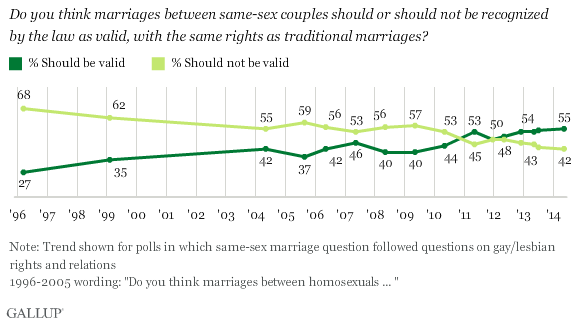
Support for marriage equality continues to increase:
y0ffodnhgeejsgoevfw40w

Lemieux argues that marriage equality’s success demonstrates the importance of court victories:

There’s no evidence that the public responds to judicial opinions differently than it responds to legislation.  … The lesson is that political conflict cannot be avoided merely by avoiding particular means of affecting social change. When proponents of social reform win, they will likely generate a backlash by supporters of the status quo — no matter what institution creates the policy change. The only way to avoid backlash is simply to not win.

At this point, the success of the gay marriage litigation campaign should be clear. Public opinion has trended in a remarkably positive direction, ultimately reaching the politically cautious occupant of the White House. Same-sex marriage rights have continued to advance at the state level, and such marriages now have federal recognition thanks to the Supreme Court’s Windsor decision last year. Arguments that the judicial decisions favoring same-sex marriage would be a major liability for the Democratic Party have proven to be unfounded.
Nanohazards

by Jonah Shepp

The first documented case of a nanotechnology-related workplace injury is raising questions about how little we understand the health risks of nanoparticles:

There is no requirement to label nano stuff as nano even though these extraordinarily small things have extraordinary properties which makes them useful and valuable. Nor are there nano-specific regulations about how to safely handle many of them. Within a week of simply measuring out the one or two grams of powder, the chemist’s throat became congested, her nose dripped and face became flushed. Then her skin began to react to her earrings and belt buckle. Her symptoms continued even after she stopped working with the material and moved to another floor. Once outside her workplace the symptoms improved.

“She can never work inside that building again,” said Dr. Shane Journeay, a medical doctor and nanotoxicologist at the University of Toronto. Journeay coauthored the case study with Dr Rose Goldman of the Harvard School of Public Health. It was just published in the American Journal of Industrial Medicine.

Andrew Maynard thinks the case study overstates its own significance:

For more than a decade now, there has been a massive global investment in research into the health and environmental impacts of engineered nanomaterials. Between 2004 and 2013 more than 6,000 academic papers were published on how these materials possibly cause harm, and how it might be averted. And for decades before this, researchers were studying the health impacts of nanoscale particles arising from natural processes, and as by-products of industrial processes. As a result, we now know quite a lot about how nanoscale materials behave in the human body and how to reduce the chances of harm occurring.

We know, for instance, that inhaled or injected nanoparticles can get to places in the body that larger particles cannot go; that the surface of nanoparticles is important in determining how harmful they are; and that nanoparticles are sometimes less harmful than the chemicals they’re made of. We also know that our bodies have evolved over millennia to handle nanoparticles, and that fine particles are integral to many biological and environmental systems. These studies have also indicated how much we don’t know, which is why research in this area remains a priority. And one area we know less about than many would like is: How dangerous is the stuff people are actually exposed to, as opposed to the pure materials that researchers often use in their studies?

The Rise Of Legal Highs

by Patrick Appel

Synthetic Drugs

Amar Toor flags a new report on it:

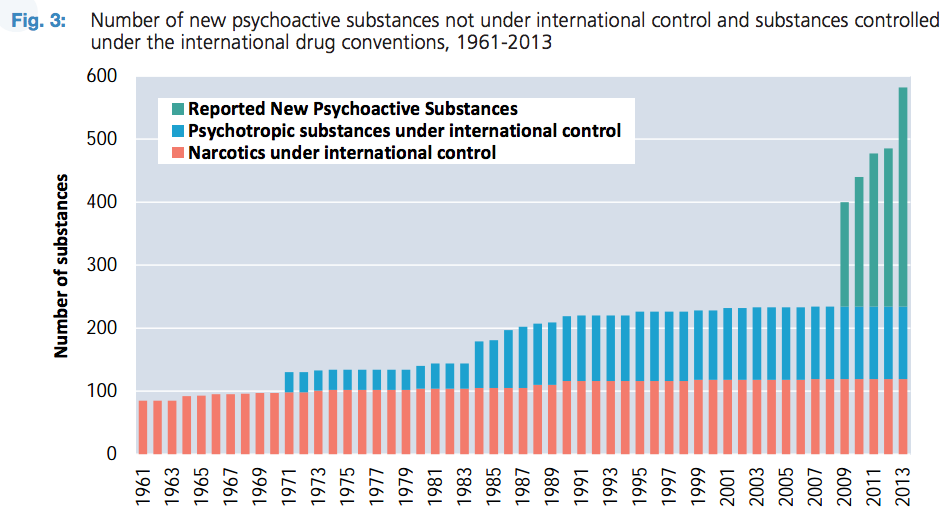
The world has seen an “unprecedented” surge in the production of new synthetic drugs, according to a report released [this week] by the United Nations Office on Drugs and Crime (UNODC). In its latest Global Synthetic Drugs Assessment, the agency says it identified 348 new synthetic drugs in 94 countries as of last year, with the majority emerging between 2008 and 2013. The UNODC received reports on 97 new synthetic drugs in 2013 alone, though it acknowledges that the true number of substances on the market could be much higher.

The agency defines new psychoactive substances as drugs that are not controlled under international conventions, but may pose public health risks. Synthetic cannabinoids — drugs designed to mimic the psychoactive effects of cannabis — comprised the majority (28 percent) of such substances reported to the UNODC between 2008 and 2013, followed by synthetic cathinones, including bath salts, at 25 percent.

Abby Haglage traces the origins of “Spice” aka “K2,” a form of synthetic marijuana. She also looks at how the DEA is cracking down these drugs:

In March 2011, the U.S. Department of Justice placed the five most widely abused synthetic cannabinoids—including Huffman and Pfizer’s—on its Schedule 1 List of banned substances.

The DEA is focusing on moving forward to try to curb the spead of Spice—not back at its origins. On May 7, 45 DEA agents armed with 200 search warrantslaunched a massive nationwide program to eradicate synthetic designer drugs like spice (called “Project Synergy.”) In a matter of hours, the agents had confiscated hundreds of thousands of packets of synthetic drugs and over $20 million in cash. “The chemical aspect of Spice is unique and new,” Rusty Payne, spokesperson for the DEA tells me. “We have to not only establish that someone is trafficking something but we have to go undercover and get it so we can test it. Sometimes it’s a game of whack-a-mole.”

Jacob Sullum expects this strategy to backfire:

As [Dallas ABC station WFAA] explains, “K2 is difficult to regulate because manufacturers switch up the ingredients frequently.” And why do they do that? To stay ahead of the law. The upshot is that a relatively benign ingredient may be replaced on the sly with something less fun or more toxic. And as the DEA implicitly admits, legal restrictions on marijuana—a well-researched drug that humans have been consuming for thousands of years, a drug that the president of the United States correctly calls safer than alcohol—are encouraging people to experiment with novel chemicals that may prove far more dangerous.

The Punishing 18th Century

by Tracy R. Walsh

Reviewing Leo Damrosch’s Jonathan Swift: His Life and His World, James Ward considers the misanthropic writer as a product of his times:

This [biography’s] dual perspective helps avoid a pathologizing mode, something which is very easy to slip into when writing about Swift: if some features of the life look unusually mordant or morbid by our standards, they were not out of place in that world. A Modest Proposal’s baby-eating humor still has the capacity to shock, but in the week of its publication, one Dublin shop made a window display of a mummified corpse to attract passers-by, likening the skin’s texture to a freshly-baked cake of puff pastry. On a similarly gruesome note, Damrosch informs us that the original of the Tale’s flayed woman may have been the desiccated corpse of a convict displayed under glass in the library of Trinity College during the time Swift studied there. When its face was eaten by rats, a new one was duly peeled from another more recently executed body and mounted on the faceless cadaver. We tend to think of grotesque fascination with bodily degradation and its public display as peculiarly Swiftian, but perhaps he just used the materials that came to hand around him. He seems to have been an early adopter of the mantras of modern creative writing – “write what you know” and “show, don’t tell” – and they led him to some interesting places.

Lab Meat For Locavores

by Jonah Shepp

Scientists have proposed a way to make lab-grown meat commercially viable:

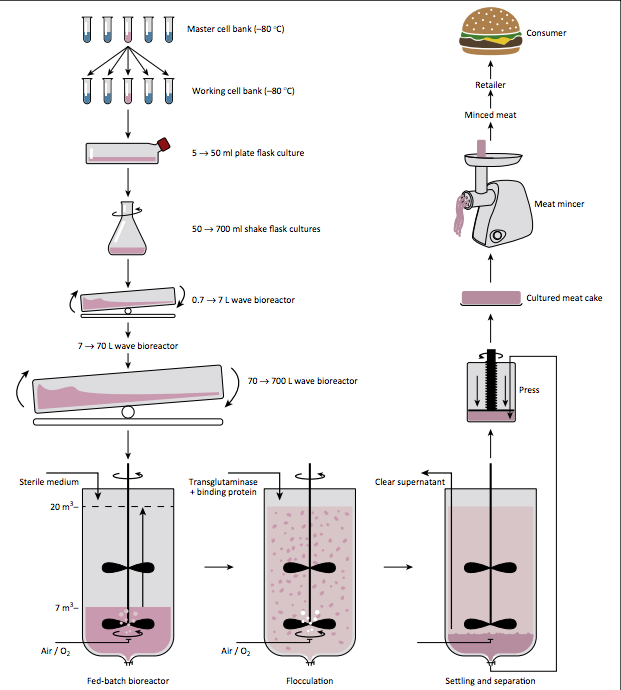
1400604327774477As noted, it’s already possible to make meat from stem cells. The technique was devised by Maastricht University physiologist Mark Post, who assembled a 5-oz beef patty from thousands of tiny meat strips cultured from the stem cells of a single cow. It’s a technological advance that ScienceNow‘s Kai Kupferschmidt believes could kickstart “the biggest agricultural revolution since the domestication of livestock.”

But according to biologists Cor van der Weele and Johannes Tramper in a new Science & Society paper, though the potential advantages of cultured meat are clear, there’s no guarantee that people will want to eat it. The mode of production, they argue, makes a difference for appreciation. To that end, they’ve developed an eco-friendly model for producing greener, ethical meat — one that involves small-scale local factories that are not only technologically feasible, but also socially acceptable. As per the title of their paper, they’re hoping to see “every village [with] its own factory.”

Jason Koebler would eat that meat:

Tramper estimates that a normal 20-cubic meter bioreactor, which is the standard for growing cultured animal cells, could easily supply a village of roughly 2,560 people with meat for a year. But creating and selling the meat at the Netherlands’ price of about €5 per kilogram would only yield €128,000 a year “hardly enough to pay the salary of one ‘butcher’ and his/her assistant.” Adding in costs of of growth medium and lab equipment, the price for cultured minced meat would go up to at least €8 per kilogram, which complicates things further.

But at the end of the day, you’re looking at paying roughly $5 a pound for hamburger meat—that’s not totally insane, and that’s with current technology. Cultivating and growing animal muscle cells is a well-understood process, and the technical challenges have been mostly surmounted. It’s also a far superior option to factory-farmed meat, morally speaken. Given all that that, is there any doubt that someone in Brooklyn sets up a lab-grown meat club in the next couple years? I’d be down, and I’d bet that 2,500 other New Yorkers would be, too.

Not everyone is on board with the lab-meat movement, though:

Some critics of industrial livestock operations are intensely skeptical that cultured meat is the solution. Food activist Danielle Nierenberg thinks the “huge yuck factor” is going to limit the future of “petri dish meat.”

“People who wouldn’t eat tofu a few years ago, now they’re going to eat meat grown in a lab?” she asks. A better future, Nierenberg and others argue, would require some degree of returning to the past—eating less meat, as we used to, and producing it in a less intensive way, on farms rather than feedlots.

Taking Climate Politics’s Temperature

by Patrick Appel

Chait acknowledges “where the politics of climate change stand at the outset of Obama’s new climate offensive”:

The scientific consensus is stronger and more urgent than ever, while the political consensus is weaker than ever. Republicans are not even considering the notion of asking Americans to spend money to mitigate climate change, and are increasingly uncertain about the notion of even saving money to mitigate climate change. And into this simmering pot of reflexive opposition and anti-empiricism Obama will plop a highly ambitious and not very cuddly scheme to clean up the power-plant sector. It has already drawn strong opposition from the major business lobbies. It is likely to become the major point of conflagration of Obama’s second term.

He compares the climate fight to Obamacare:

The grimmest contrast between power-plant regulation and health care is that regulating carbon emissions creates almost no winners. There will be no equivalent of the millions of people newly granted access to medical care, no heartwarming stories of long-suffering patients seeing a doctor for the first time in years. Climate regulation doesn’t create a benefit. It doesn’t even prevent a loss. Its only goal is to mitigate the extent of the damage.

And this is why, unlike carefully selected election-year issues like the minimum wage or equal pay, Obama is not picking this issue to help his party save Senate seats. He is doing this because, given the enormity of the stakes for centuries to come, there is no morally defensible alternative.

But Nate Cohn notes that El Niño could change the political calculus somewhat:

The return of El Niño is likely to increase global temperatures. [Kevin Trenberth, a climate scientist at the National Center for Atmospheric Research] believes it is “reasonable” to expect that 2015 will be the warmest year on record if this fall’s El Niño event is strong and long enough.

That could make a difference in the battle for public opinion. One-third of Americans don’t trust climate scientists, according to Jon Krosnick of Stanford University, and they make their decisions about climate change “based on very recent trends in warming.” Belief in warming jumps when global temperatures hit record highs; it drops in cooler years.

Wrestling With History

by Tracy R. Walsh

In a review of David Shoemaker’s The Squared Circle: Life, Death, and Professional Wrestling, Miles Wray evaluates the early years of the sport:

Professional wrestling is a beautifully American invention, and a reflection of a beautifully American impulse: wrestling matches at carnivals and fairs of the early 1900s were simply WWE_Legends_of_Wrestling_Andre_Giant_&_Iron_Sheik_DVD_covertoo boring for audiences to watch – they were uninterrupted hours of stalemated, ground-bound grappling. Promoters discovered that a match with a preordained result can provide the sorts of thrills, spills, and mercifully abbreviated running time that an actual competition between two wrestlers simply cannot. Add in a few scheming entrepreneurs over the decades, themselves intoxicated by the possibilities of ever-ubiquitous television, and it’s not too hard to see how wrestling evolved into the colorful, brash, heavy-metal spectacle that it is today.

Reading The Squared Circle, it’s obvious that there is at least one thing definitively superior about the early days of wrestling: the names. Up through the ’80s, wrestling was stuffed with whimsical nom de plumes that make Thomas Pynchon look like an unimaginative namer. A small but thrilling sample of superior wrestling aliases: Toots Mondt, Theobaud “Masked Wrestler” Bauer, The Mongolian Stomper, Stanislaus Zbyszko, Leaping Lanny Poffo, The Halitosis Kid, Big John Studd, Sputnik Monroe, The One Man Gang, Gorilla Monsoon, Burrhead Jones, Soul Train Jones, and Special Delivery Jones.

Update from a reader:

Back in the 1970s, I was walking through Cleveland Hopkins Airport and heard an announcement on the public address system: “Phone call for Mr. Butcher,” the voice said. “Phone call for Mr. Abdullah the Butcher…”

He had a colorful history.

We Don’t Need Your Thought Control

by Tracy R. Walsh

Cass Sunstein shares new evidence – sure to surprise very few teenagers  that high school really is a form of brainwashing. At least in China:

New research, from Davide Cantoni of the University of Munich and several co-authors, shows that recent curricular reforms in China, explicitly designed to transform students’ political views, have mostly worked. The findings offer remarkable evidence about the potential influence of the high school curriculum on what students end up thinking – and they give us some important insights into contemporary China as well.

Cantoni found that a 2001 curriculum change designed to “form in students a correct worldview, a correct view on life, and a correct value system” largely succeeded: Students who had been taught under the new curriculum were more likely to view China as a democracy and were more skeptical of free markets than those who hadn’t. (The curriculum was introduced to different provinces at different times, creating natural experimental and control groups.)

Dish Intern Wanted

by Andrew

[Re-posted from earlier today]

It’s that time of year again. Dish Publishing LLC is seeking an all-purpose intern to handle both administrative tasks and contribute to the editorial process. The admin side of the job will include: dealing with press inquiries and permissions, helping with support emails, managing the staff calendar, taking notes during meetings, making travel arrangements, and generally assisting the executive editors and me with sundry tasks. Strong organizational skills and attention to detail are musts. You need to be self-starting and pro-active in getting shit done.

The editorial side of the job will consist of ransacking the web for smart and entertaining nuggets, maintaining our social media presence, working on larger research projects, and helping the team guest-blog when yours truly takes a vacation. We prefer individuals who can challenge me and howler beaglemy assumptions, find stuff online we might have missed, and shape the Dish with his or her own personal passions. Reporting experience is also a big plus as we try to deepen our coverage. Someone with a background in web entrepreneurialism could catch our eye too.

The full-time internship pays $10 an hour, includes health insurance, and lasts for six months. The position is based in New York City. Since the Dish doesn’t have an office, most of the work will be done from home, but the staff meets regularly for lunch and coffee meetings and social gatherings.  I want to emphasize that this is an intense job for the intensely motivated, and one that can get a little isolating at times. But it’s a pretty unbeatable chance to learn what independent online journalism can be as an integral part a close-knit team. We’ve decided to pare down to one intern to keep our lean budget under control, which means the one individual really does have to be special. You have to already know what we do here and care deeply about the Dish. And a sense of humor is a real asset.

We are hoping to hire very soon, so don’t delay if you’re interested. The cutoff for applications is next Friday, May 30, at midnight. The start date is July 7, but we are flexible. To apply, please e-mail your resumé and a (max 500-word) cover letter to apply@andrewsullivan.com.