Taking A Stand On The Can, Ctd

stalls

A helpful reader points out:

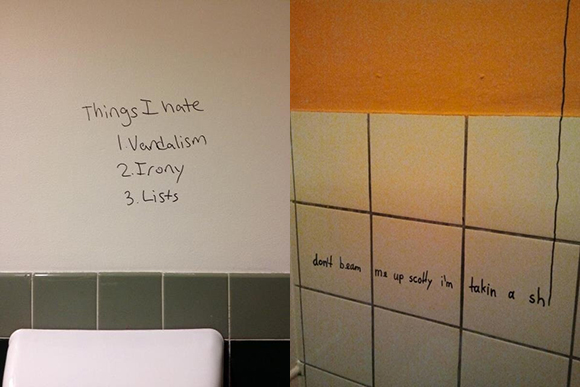
You omitted the web motherlode of bathroom graffiti: “notes from the stall

A few photos from that tumblr are above. A dozen more readers submit their own examples of latrinalia:

My very favorite bathroom graffiti was seen in a women’s room in a bar on 6th street in Austin in about 1976 or so.  Someone wrote “My mother made me a lesbian.”  Below that, in another ink and hand: “If I get her the material, will she make me one too?”

I laughed then and I laugh now.

Another:

I’m so glad to have a Dish thread to share this with. It’s one of my fondest memories of my time at UCLA when I was working on my MS in Computer Science. This was written on one of the stalls in the women’s restroom in Boelter Hall, the engineering building:

A mathematician named Paul
Had a hexadronical ball.
The cube of its weight
Plus his pecker times eight
Is his phone number, give him a call.

Equally nerdy:

My favorite piece of graffiti yet: “I’ll see you in the Eighth Circle of Hell, Counselor!” From the bathrooms of the Law School of the University of Chicago. (The Eighth Circle is the Circle of Fraud, of course.)

Well of course. Back to the peckers:

Found in the bathroom of Strawbridge&Clothiers, Neshaminey Mall, early 1970s:

I’m nine inches long and four inches round. Are you interested?
Fascinated. How big is your dick?

And another:

Seen above a urinal in a Jr. High 60 years ago: “The future of America is in your hands.”

Heh. Another updates a previous example:

In response to one of your readers: no, no, NO! The correct verse is “Here I am all broken hearted, tried to shit but only farted!”

It’s all downhill from there:

Here’s my all-time favorite, which appeared as a critique below a long string of back-and-forth commentary when I was an undergraduate:

Men who write on bathroom walls roll their turds in little balls.
And those who read these bits of wit can go and eat these balls of shit.

Another:

From a rest area in Oklahoma, ten years ago: “here I sit, cheeks a flexin’, just gave birth to another Texan.”

Oh snap. Another:

I was living in Grunge-era Seattle when I went to a bar in town called The Comet. Written on the bathroom wall: “Smells like teen urine.”

And another:

From an Irish-American ginmill in the Bronx, many years ago: “Paddy, how many times do I have to tell you? Cunnilingus is not the name of an airline”.

Another:

Here’s something I read decades ago:

She offered her honor
I honored her offer
And all night long
It was honor and offer.

One more for now:

Seen at the Connor Byrne Pub in Seattle: “I fucked your mother”.  Underneath, in different handwriting: “You’re drunk, Dad. Go home.”

The Long Legacy Of Laying Down The Law

David Carpenter, who recently published a new translation of the Magna Cartareflects on its 800th anniversary:

In 1215 Magna Carta was an elitist document, yet by the end of the 13th century it had become known across society, dish_magnacarta and all sections of society, legitimately or not, were laying claim to its benefits. … Already in 1215 itself the Charter had been translated from Latin into French, the vernacular language of the nobility. By the end of the 13th century the Charter was being proclaimed in English, the language of everyone else.

In around 1300, the peasants of Bocking in Essex … appealed to Magna Carta in a struggle against their lord’s bailiff. In the 1350s, legislation defined the “no free man” as “no man of whatever condition”. The Charter seemed increasingly to have a universal application. It had established the base from which it would go around the world. Its appeal lay not in its precise details, but in its assertion of the rule of law. Everything is of its own time, but only some ideas are taken up and spread. When human rights are still trampled on in many parts of the world, what happened in a meadow by the Thames 800 years ago retains its significance. Let us hope Magna Carta will still be celebrated 100 years from now.

Nick Higham also pays tribute to the document:

As to all the modern-day brouhaha around the anniversary – that rests particularly on another principle bequeathed by the charter to subsequent generations, a principle fundamental to British law and the law of many other nations, including the United States.

Magna Carta’s most famous clauses forbid the king to sell, deny or delay justice, and protect any free man from arbitrary imprisonment “save by the lawful judgement of his peers or by the law of the land”.

“Free men” in 1215 accounted for less than half the population – the rest were serfs, to whom the charter did not apply. And “men” meant men – women, except for widows, merit barely a mention in Magna Carta. But the principle was established. The law could serve as a bulwark against tyranny. And once established, it has never been revoked.

(Image of Magna carta cum statutis angliae (Great Charter with English Statutes), early 14th-century, via Wikimedia Commons)

Do Cops Treat Blacks And Whites Equally? Ctd

Many readers are pouncing on this email from a white police officer:

While off duty, I’ve been pulled over at gunpoint and have been treated like crap and yelled at for no reason by cops. Every time it was my fault because I had committed a traffic violation.

WHAT?!  Since when is it normal/acceptable for a routine traffic violation to turn into a drawn gun? If a cop thinks that is normal, there may be a bigger issue with policing then profiling.

Another reader on that quote:

Look, I know cops are people too, and can have a bad day like the rest of us. But the entire reason basis for entrusting police officers with the power of the state to threaten and inflict violence, even lethal force, is because we trust and train them to be professionals and act that way. What the reader describes is nothing more than state-sanctioned thuggery.

Several more sound off:

Perhaps those accusing the cop of racism have had the experience of being pulled over, stopped or frisked so many times they start to suspect every time. It’s human nature. The reader’s experience only confirms that these men have been overwhelmed with bad experiences with cops.

I’m a white male. I’ve only been pulled over for no reason once in my 50 years, while I was driving my brother’s red Porsche. I’ve never been followed in a store. But my 13-year-old black adopted daughter, a straight-A student who is honest to a fault, has been followed in stores, stopped by police or questioned by strangers at least a dozen times, almost all of them for no reason whatsoever. One time I watched a store manager follow her around for 15 minutes while all the white kids in the store went unnoticed. These would be all anecdotes except that the data supports the anecdotes, including the one you just posted about off duty black cops.

A lot of white people just need to wake up and develop a bit of empathy.

This reader did:

The latest post from the cop who got accused of being store security reminded me of an incident that happened almost exactly ten years ago. I was waiting for my wife to get off work at the Macy’s at the local mall so we could do some Christmas shopping, so I was wandering the departments. After about half an hour, a black woman confronted me and asked if she could help me. Lost in thought, I mistook her for a sales associate at first and said no. I don’t remember what she said next (okay, I admit, I was a little stoned at the time), but I do remember her gathering up her kids and exiting the store, leaving a basket behind with some items in it.

When I asked my wife later, she figured the lady had mistaken me for security. Apparently that store was locally notorious for their “Loss Prevention” tactics and would follow and sometimes harass people. I’m 6’6″, white, and at the time was recently discharged from the Navy and still sported a relatively fresh military haircut. I was probably wearing my Navy Exchange boots at the time. I probably looked just like a cop trying to blend in.

Anyway, I really felt for that lady. She was having a bad day and I made it worse without even realizing what was going on.

P.S. I guess an alternate explanation is she didn’t want to be in a store with an enormous stoned guy. But I was keeping to myself!

One more reader excerpts another quote from the cop:

Re: “The truth is, people perceive racism when there is none in order to avoid taking responsibility for their actions” … this is part of the poison of racism. It makes it difficult for everyone, of any race, to perceive situations as race-free. If you’re accustomed to you and friends and family members being racially harassed by cops, then you perceive cops as engaging in racial harassment even when they’re not. It may have nothing to do with whether or not you’re willing to take responsibility for your actions.

As Lord Chief Justice Hewart put it, “Not only must Justice be done; it must also be seen to be done.” The purpose of a justice system isn’t merely to settle affairs of private conduct; it’s also to assure the public that the government is fair. Racism corrodes that assurance, even when the government is trying to be fair.

Update from the white cop who wrote in:

To clarify, it’s not normal or acceptable for a routine traffic violation to turn into a drawn gun, but not every traffic stop is routine. Out of the thousands of stops I’ve done, I may have drawn my gun 10 times. The point I was trying to make wasn’t that it’s normal for a stop to go that way; it was that when they do, it’s rarely a result of race. Perhaps I should have went into more detail in my story.

It happened around 2 or 3 am and I was driving home from my parents, half asleep (no I wasn’t drinking). When the cop turned on his lights to pull me over, I looked down and realized I was speeding. At the time I was driving a car that had really dark tint on the rear window. The tint made it extremely difficult to see into my car from behind. I reached down for my wallet and suddenly I hear the cop ordering me out of my car with my hands in the air. I get out and see I have a gun drawn on me. I identify myself and show my badge. The cop then approaches me and explains he couldn’t see through my rear window very well and saw me reaching for something. He was worried I was reaching for a gun and took precautions to protect himself.

At the end of the day it was my actions that led to the encounter. If I had left for my house earlier or slept at my parents, I would have been better rested and perhaps been more cognizant of my speed and not pulled over. Also, if I waited until the officer approached me to retrieve my wallet, I would have never been ordered out of my car.

Personally, I understand why the cop did what he did, but realize some (most?) people are going to read that and think the cop overreacted. In the cop’s defense, yes I was only reaching for a wallet, but what if I had been reaching for a gun? It’s easy to judge a cop’s decision in hindsight, but the question is what would a similar person do in the same situation.

Admittedly, 99% percent of the time a cop draws his weapon, it turns out to be unnecessary. The problem is we have no way of knowing which time will be the 1% when it is necessary. People often say we knew what we were getting into when we took the job. The thing is we agreed to risk our lives, not sacrifice them. As cops we do what we can to minimize the risk to ourselves.
The Second Man On The Moon

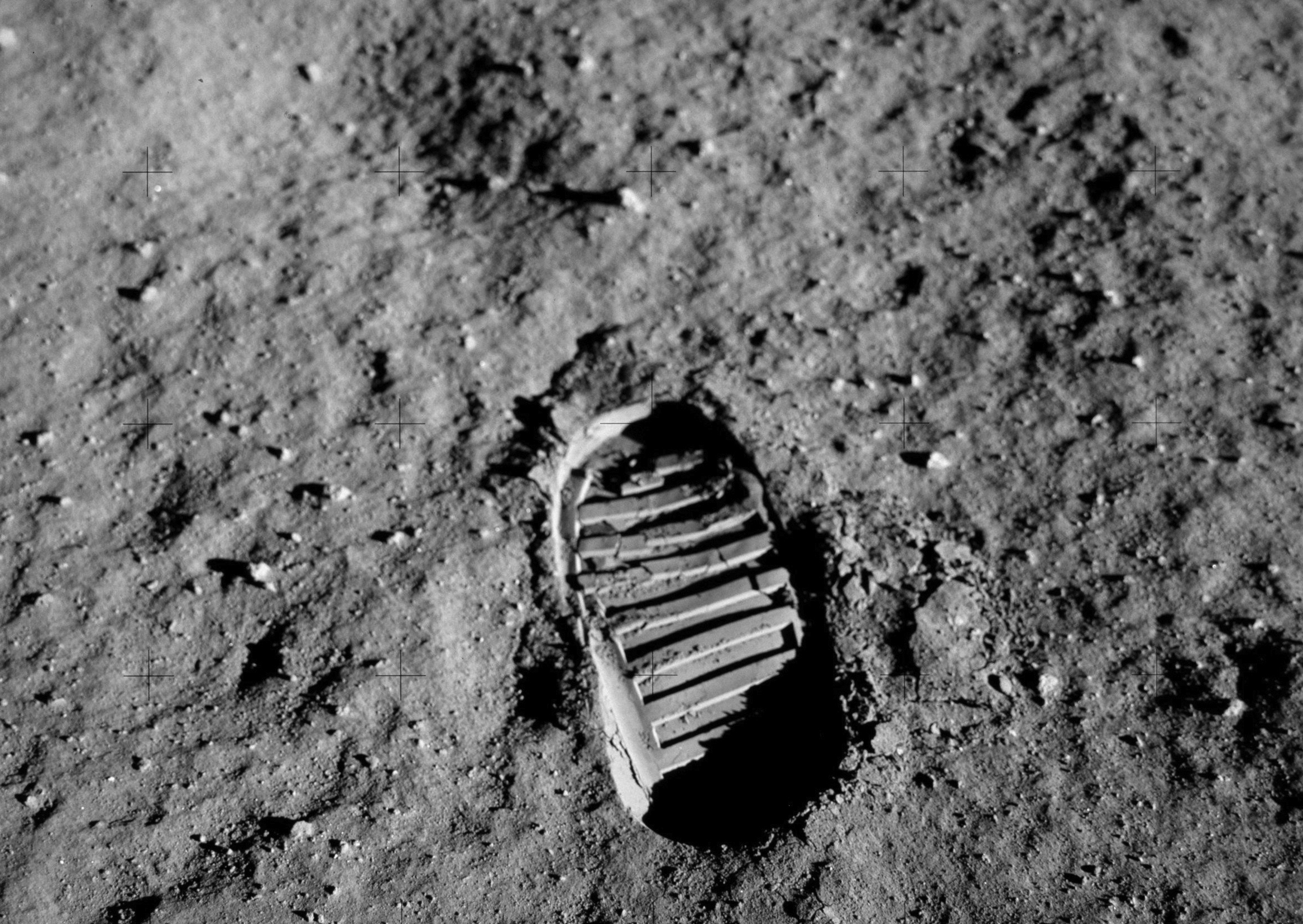
Apollo_11_bootprint

Jeanne Marie Laskas profiles the former astronaut Buzz Aldrin, including details about the depression and difficulties he struggled with after his historic journey:

After the moon, Buzz cracked up. There was nothing left to do. The media frenzy was worldwide; twenty-four countries in forty-five days—and that was just the beginning. NASA clearly had no further use for him in space; now he was just supposed to be some kind of NASA PR flack.

He resigned from NASA in 1971 and returned to the Air Force. It didn’t seem like the Air Force knew what to do with someone who had been to the moon. He was an outsider, the egghead from academia who’d just tumbled off the speakers’ circuit. He drank a lot. His marriage to the mother of his three children fell apart, and he retired from the Air Force. He went to rehab. He got married again, but that lasted a year. He drank a lot more, fell in love a lot more. His Air Force pension wasn’t much. That was when he started at the Cadillac dealership. He sucked at selling cars. Rehab was the first time he ever really talked about feelings. It turned out he had so many feelings. An emptiness so deep. He discovered the melancholy of all things done.

He was in his forties, a conqueror with nothing left to conquer but his own demons. The second man to walk on the moon. Number two.

His father never accepted the fact that Buzz was not number one. Grasping, his father waged an unsuccessful one-man campaign to get the U.S. Postal Service to change its Neil Armstrong “First Man on the Moon” commemorative stamp to one that said “First Men on the Moon” so it could include Buzz. As for Buzz’s mental breakdown, his depression and alcoholism, his father never accepted that, either. Or if he did, he blamed the moon, the absence of gravity, the unknown physical properties of space. The moon must have ruined Buzz.

(Image of Aldrin’s photograph of his own bootprint on the moon via NASA)

Lessons In Listening

Win Bassett, a seminarian at Yale Divinity School, looks back at what he learned as a hospital chaplain this past summer. Avoiding phrases like “everything happens for a reason” is among the lessons that mattered the most:

Instead of trafficking in speculations about why a person experiences pain or becomes ill, I found it far more helpful to ask the question “What now?”

Reynolds Price wrote that after his cancer diagnosis “the kindest thing anyone could have done for me…would have been to look me square in the eye and say this clearly, ‘Reynolds Price is dead. Who will you be now?’” I once presented this passage from Price at a conference, and a participant who had survived breast cancer told me that, years ago, she playfully added “2.0” at the end of her name.

Nevertheless, I bet she sometimes heard the wrong words at the wrong times during her recovery. We’ve all said them, and we don’t do it because we fail to understand that these responses are theologically indefensible. We utter these words because they seem to be the only things that might give momentary comfort. Because these dubious phrases have become our default expression of consolation, we need God’s help to put them aside, to remain silent until we have something truer and therefore more helpful to say. Sometimes the words never come, and silence itself is enough. With or without words, chaplains are there to offer another loving presence, sometimes the only loving presence. As the Episcopal priest and poet Spencer Reece writes in a poem about his own experience in a hospital chaplaincy, “It is correct to love even at the wrong time.”

Does Jealousy Make The World Go Round?

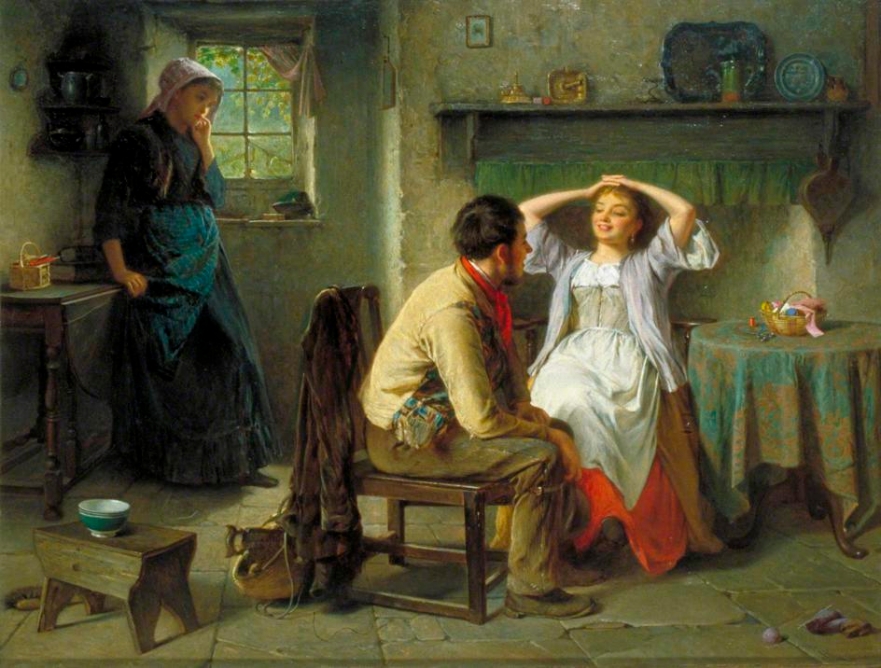
Jealousy_and_Flirtation

Peter Toohey’s new book, Jealousy, puts it at the center of our emotional lives. Musing over his arguments, Diane Johnson runs down the many ways it’s informed art, especially in the last few centuries:

Toohey tells us that beginning in the late nineteenth century, painting and literature would see an “explosion” of treatments of the subject, with obsessively jealous characters like Tolstoy’s Pozdnyshev in The Kreutzer Sonata, or, later, Dickens’s Bradley Headstone—the reader will think of dozens of instances—Emma, or la cousine Bette, or the hero of Trollope’s He Knew He Was Right, who dies of it, or Così Fan Tutte, much of Verdi, “Frankie and Johnny”—jealousy is all over the place.

In painting and sculpture there’s a whole iconography of jealousy—ears, husbands listening behind doors, cats with their big green eyes, the color yellow. As the twentieth century approaches, artists begin reaching for means to express what jealousy feels like; here he points to the paintings of Edvard Munch and of August Strindberg, the playwright, who seems to have found painting to be more directly expressive of his jealous state of mind.

Toohey examines the discoveries of late-nineteenth and early-twentieth-century psychology by Freud and his colleagues. He doesn’t mention but we might think of Freud’s friend Arthur Schnitzler’s Dream Novel, the inspiration for the Stanley Kubrick film Eyes Wide Shut, which details the psychic revenge fantasies of a husband whose jealousy in all its Freudian complexity is aroused by his wife’s erotic fantasies. One of Toohey’s more interesting findings is that a morbidly jealous person (as opposed to “normally” jealous) is especially zealous in seeking “visual evidence to confirm the truth of the way they are feeling”; Othello must see Desdemona’s handkerchief. This visual element makes film a particularly suitable medium for expressing jealousy. He suggests that stalking also arises from the visual need.

(Image: Jealousy and Flirtation by the 19th century French artist Haynes King, via Wikimedia Commons)

First Chapters, Then Verse

We’ve featured reviews of James Booth’s new biography, Philip Larkin: Life, Art, Love, over the last few months. Now, Dana Gioia notices an interesting wrinkle in the poet’s story – it was only after Larkin wrote two early novels, Jill and A Girl in Winter, that he devoted himself to verse:

As his dreams of being a great novelist expired, Larkin poured his full talent into poetry. He discarded his lofty, early models, Yeats and Auden, and studied instead the homely genius of Thomas Hardy (another novelist-turned-poet). Larkin then brought a novelistic sensibility into his verse. Emphasizing the prosaic virtues of plot, setting, character, and narrative voice—the building blocks of fiction—he crafted a new sort of lyric poem, one firmly placed in the everyday world and yet charged with evocative power. His new poems also had personality; they were simultaneously savage and yet compassionate, very depressing and very funny. His language grew commonplace without losing its musicality, and he displayed a gift for using complicated verse forms in ways that sounded utterly conversational, as in the opening lines of “Annus Mirabilis”:

Sexual intercourse began
In nineteen sixty-three
(Which was rather late for me)—
Between the end of the Chatterly ban
And the Beatles’ first LP.

The change happened during his years in Belfast (1950–1955).

Always a good poet, Larkin suddenly became a great one, producing a series of works in quick succession that were destined for the anthologies—“Lines on a Young Lady’s Photograph Album,” “I Remember, I Remember,” “For Sidney Bechet,” “Poetry of Departures,” “Toads,” and “Church Going.” Although these poems would become signature pieces of contemporary British literature, Larkin initially couldn’t find a publisher for them. After repeated rejections, the despairing poet sent his breakthrough volume, The Less Deceived, to George Hartley, a friend in Hull, who wanted to start a press. Larkin would regret the decision, but the small, unpublicized collection proved an immediate success with great reviews and steady sales. Larkin soon found himself named the central figure of “The Movement,” a celebrated group of young writers. To his own astonishment, he was famous.

“Taking The Edge Off Vulnerability”

Todd May questions what he calls “invulnerabilism,” the approach of philosophies like Buddhism, Taoism, and Stoicism that teach, in his words, that “we can, and we should, make ourselves immune to the world’s vicissitudes.” He argues instead for a particular type of engagement:

As far as I can tell, the way to think about these things has less to do with the invulnerability promoted by the official doctrines, and more to do with, one might say, using these doctrines to take the edge off of vulnerability, to allow one to experience life without becoming overwhelmed or depressed or resentful or bitter, except perhaps at the extremity of loss. There is some combination of embedding oneself in the world in a vulnerable way and not being completely undone by that vulnerability that is pointed at, if not directly endorsed, by the official doctrines.

It seems to me that Taoism, Buddhism, Stoicism, etc. work not by making one invulnerable but rather by allowing one to step back from the immediacy of the situation so that the experience of pain or suffering is seen for what it is, precisely as part of a contingent process, a process that could have yielded a very different present but just happened to yield this one. This, of course, is not the official doctrine either, especially for Stoicism, for which the unfolding of the cosmos is a rational one. (Buddhists will periodically refer to the contingency of the cosmos’ unfolding; however, the concept of nirvana bends that contingency toward something more nearly rational, or at least just.) But it does seem to me to capture their common insight that there is so much about the world that we cannot control; seeking to master it is an illusion. We must learn instead to live with the process in all its contingency, even where we hope to change it for the better.

And we must understand that for most of us suffering is inevitable. We can recognize all this and take solace from it without having to take the step of removing ourselves from the desires that lead to suffering.

Face Of The Day

Ivy-Barn-Owl-406x524

For her series Prey, Leila Jeffreys photographs the predatory birds of Australia. From an interview:

There is just so much diversity in Australian birds. Some birds of prey are typically stern and formidable, while others are shy and affectionate. … This series does have some colourful characters like Pepper, a gorgeous Southern Boobook Owl who was rescued and rehabilitated, yet continues to return to Broadwings every time she is released; a cheeky Kestrel called Bandit with a penchant for stealing tea bags; and a rescued Goshawk called Trinity, a victim of habitat destruction as a result of land clearing; plus many more.

I photographed the series with a large format Phase One camera so the detail captured is stunning and I print my artworks at human size so that they can be appreciated as equals. I think that if you stare into the eyes of a regal bird of prey you begin to feel a deeper connection and understanding of the species.

See more of her work here and here.

(Photo of “‘Ivy’, Eastern Barn Owl” by Jeffreys. Hat tip: Jobson)