Going After China’s Cyber-Spies

by Jonah Shepp

The Justice Department has indicted five Chinese military officers on charges of cyber-espionage, accusing them of stealing American companies’ trade secrets:

The five members of the People’s Liberation Army — Wang Dong, Sun Kailiang, Wen Xinyu, Huang Zhenyu and Gu Chunhui — belong to Unit 61398 of the 3rd Department of the People’s Liberation Army, based out of a building in Shanghai. All of them have been accused of conspiring to hack into the computers of six American entities. The companies identified as victims of the hacking are Westinghouse Electric; U.S. subsidiaries of SolarWorld; U.S. Steel; Allegheny Technologies; the United Steel, Paper and Forestry, Rubber, Manufacturing, Energy, Allied Industrial and Service Workers International Union; and Alcoa.

There’s no chance that they’ll ever appear in court, but the diplomatic consequences are obvious. Jacob Siegel and Josh Rogin note that the move comes at an awkward time in US-China relations:

The decision to expose Unit 61398 comes less than a week after a top Chinese general toured the U.S. on what many believed was a diplomatic trip intended to give U.S. officials the chance to deescalate tensions in China’s territorial disputes with its neighbors. But the visit failed to produce the hoped-for deescalation. Instead, Defense Secretary Chuck Hagel sparred publicly with Chinese Defense Minister Gen. Chang Wanquan over Chinese actions in the East China Sea, including China’s recent declaration of an air defense zone that spans disputed territories. Hagel was reportedly rebuffed in his plea to the Chinese military for greater transparency during a visit there last month.

Brian Merchant situates Unit 61398 within China’s massive cyber-spying operation:

Unit 61398 has in the past been tied to a hacking group the Comment Crew, most decisively by a 2013 Mandiant cyber security report. The New York Times explained that, according to the research, the Comment Crew “has drained terabytes of data from companies like Coca-Cola” but that “increasingly its focus is on companies involved in the critical infrastructure of the United States — its electrical power grid, gas lines and waterworks. According to the security researchers, one target was a company with remote access to more than 60 percent of oil and gas pipelines in North America.”

P.W. Singer explains what China’s cyber-spies are after:

[T]he targets of it range from across the spectrum: everything from jet fighter designs to oil company equipment designs to the designs of chairs made by small furniture makers. Or the theft of negotiating strategies: what everything from oil companies to soft drink companies were going to bid in competition with Chinese companies. Its been going after academic and scientific research; going even after personal cell phones. They’ve gone after journalists, [as in] the famous New York Times affair where a Chinese military-linked unit entered into the Times. It wasn’t after the secret recipe for New York Times newspaper ink, it wasn’t after readers’ credit card numbers, it was after who inside China was speaking to New York Times editors about corruption in China.

Adam Taylor notes that the Chinese are citing Snowden to dismiss the charges as hypocritical:

Monday’s statement [from the Chinese Foreign Ministry] appeared to make direct reference to Snowden’s revelation again. “It is a fact known to all that relevant US institutions have long been involved in large-scale and organized cyber theft as well as wiretapping and surveillance activities against foreign political leaders, companies and individuals,” the statement read. “China is a victim of severe US cyber theft, wiretapping and surveillance activities. Large amounts of publicly disclosed information show that relevant US institutions have been conducting cyber intrusion, wiretapping and surveillance activities against Chinese government departments, institutions, companies, universities and individuals.”

But Ambers distinguishes our espionage operations from what China has been doing:

The U.S. does not steal proprietary secrets to help U.S. corporations compete in the world. It does steal secrets to help the U.S., broadly, compete in the world. …

The U.S. does invade the internet servers and computers of foreign countries, looking to collect intelligence that will add value to American policy-makers’ decisions about trade deals, sanctions, counter-narcotics, counter-trafficking, and counter-terrorism. It does so with the help of American countries. It does not, at least explicitly, steal secrets from, say, Chinese companies in order to directly benefit American companies working with the same technology. But it does create backdoors into state-owned or operated companies in order to spy. Maybe it is a distinction without a difference, at least in terms of how the world perceives U.S. spying.

The editors at Bloomberg applaud the indictment:

Cybercrime targeting trade secrets and intellectual property is a booming business, one that costs U.S. companies billions each year. It’s been called the greatest transfer of wealth in human history. And China’s legions of cyberspies are, by general consensus, the world’s worst offenders. The U.S. has now signaled that it will protect companies against such intrusions after years of private warnings to the Chinese. And, more important, the indictment will hopefully remind China that curtailing this kind of abuse is in its own economic interest. On the first score, the indictment amounts to a defense of a long-established principle of espionage: While governments can spy to protect national security, as the U.S. does, they shouldn’t steal corporate secrets to benefit their own businesses. The Chinese government has been ostentatiously flouting this norm for years.

Color me unpersuaded on this point. Would we somehow be more OK with Chinese agents hacking the DoD because they could claim they were protecting their national security interests? I doubt it. Face it, guys: we’re a lot cooler with us spying on them than with them spying on us. That’s just national loyalty talking—don’t try and chalk it up to general principle. Gwynn Guilford also isn’t so sure this “long-established principle of espionage” argument will fly in other countries, especially since, y’know, we violate it too:

[T]he push to define the relative degrees of cyberspying nefariousness might not be all that persuasive abroad, says Adam Segal, a senior fellow at Council on Foreign Relations. “[US Attorney General Eric] Holder tried in his introductory statements to say ‘we’re going after economic espionage,’ and the US continually says we don’t engage in that,” Segal tells Quartz. “But Huawei and Petrobras [foreign companies the US government’s been caught spying on] are clearly economic targets. So I don’t see [this latest effort] gaining traction internationally.”

It certainly hasn’t convinced many in China:

On the Chinese web, users largely dismissed the U.S. accusations as a case of “a thief crying ‘stop the thief!’” and wondered whether China shouldn’t pursue charges of its own against U.S. officials for government-sponsored cyber spying.” So this means China can just charge U.S. military officers in the same way,” wrote one user on the Weibo microblogging platform. Another called the accusations “ridiculous; the United States has the whole world in its fist, but it’s not okay for others to want to listen in on what you’re doing.” Many also wondered aloud whether Beijing shouldn’t charge the U.S. National Security Agency for spying on Chinese telecommunications giant Huawei.

Meanwhile, Daniel Ikenson is unsympathetic to the affected companies:

[L]et’s not let the victims off the hook so easily.  Under the doctrine of “fool me once shame on you, fool me twice shame on me,” how is it possible for profit-maximizing U.S. companies to be so reckless and cavalier about protecting their assets, especially when these alleged losses accrued over a period of time? Theft – including intellectual property theft – is a fact of life, and it is the responsibility of property owners to do their parts to reduce the incidence of theft.  If that means incurring greater private costs to make illegal downloading or duplication more difficult, so be it.  If it means investing in extra cybersecurity measures to protect trade secrets, do it.  If it means taking executive communications off the main server and onto a dedicated, impenetrable network without access to the internet, c’est la vie.
Lazy, Happy Americans

by Jonah Shepp

exceptionalism-02

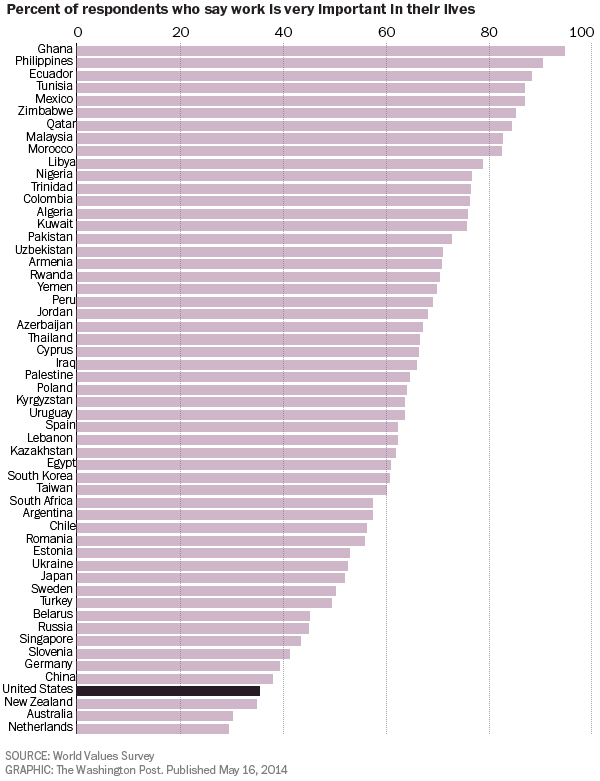
Perusing the latest World Values Survey, Christopher Ingraham highlights some of the findings about how Americans compare to the rest of the world. One shocker:

While we have a reputation for being a country of workaholics, we actually rank the importance of work quite low (36 percent) compared to other countries. Ghanians, Filipinos and Ecuadorians are the biggest workaholics, while again the Dutch are at the bottom of the list. The most important thing, according to Americans? Family. Sure, we may not fully trust that one sketchy uncle, but we love him anyway.

Charles Kenny points to another somewhat surprising finding: most Americans say they are happy:

Americans still report themselves happy, if not quite as much as in the past. The proportion reporting that they are either very happy or rather happy was 91 percent in 1981, climbed to 93 percent in 1999, and fell back to 89 percent in 2011.  In some ways, this suggests remarkable resilience in the face of stagnant incomes and an unemployment rate that almost doubled between the second and third surveys. Unemployment and the related uncertainty has a strong relationship with lower reported wellbeing across the rich world.

On the whole, the global average for people living in surveyed countries has risen. Among the global sample whose data goes back to the early 1980s, the proportion saying they are rather happy or very happy climbed from 71 percent to 84 percent. In the larger sample using data from the early 2000s, the global average reporting happiness climbed from 75 percent to 83 percent.

Zach Beauchamp notices that Germany, Japan, Ukraine, and Taiwan stand out for their citizens’ relative lack of pride, with fewer than 70 percent saying they were proud of their country and fewer than 30 percent saying they were very proud:

Each of those four countries where pride was unusually low has something interesting to it. For Germany and Japan, it suggests that the post-World War II hangups about nationalism may have not quite gone away. Since their defeats, both countries have developed a much more complicated relationship with national pride — in some ways, German and Japanese nationalism run amok were responsible for the whole thing. This sense of national guilt, or at least a wariness of too much national pride, might be making it harder for German and Japanese folk to feel immense amounts of national pride.

In Ukraine, the issue may be the country’s ethno-linguistic divides. … Then there’s Taiwan, whose results are almost certainly about tension with mainland China. 20 percent of Taiwanese outright favor reunification with China, and 43.5 percent of Taiwanese also identify as Chinese (“Zhongguo ren,” which could mean Taiwanese, mainland Chinese, or both). This complicated relationship with the People’s Republic probably explains why Taiwanese people aren’t quite as proud of their country as other peoples are.

Is Marriage Equality In Oregon Here To Stay?

by Patrick Appel

Mark Joseph Stern believes so:

Oregon’s attorney general has already refused to defend the law—and it’s unclear whether the state’s liberal governor, John Kitzhaber, is willing to spend state funds to defend a law he deems unconstitutional. If the state refuses to defend the ban in any capacity, McShane’s ruling might simply be unappealable: The Supreme Court has already stated that a group of private citizens (like NOM) has no standing to defend gay marriage bans in court.

Even if the state does hire private counsel to defend the ban, it’s in for some rough sledding. Marriage opponents will be keen to stay McShane’s order, thus halting any further gay marriages in the state. But they’ll be appealing McShane’s ruling to the Ninth Circuit, which recently elevated gays to a constitutionally protected class and will almost certainly refuse to suspend marriage. … That leaves the Supreme Court as marriage opponents’ last resort. And though the justices may well stay McShane’s ruling, thousands of gay couples will already have obtained their marriage licenses by that point—creating the kind of facts on the ground that Justice Anthony Kennedy won’t be able to ignore.

But Jim Burroway doesn’t see the Oregon ruling as having wider implications nationally:

[S]ince state and county officials have already said that they have no plans to appeal the decision, McShane’s ruling will remain strictly an Oregon matter, and will likely have little bearing on case law as the other cases move their way through the appeals process. So I guess one can argue that the Oregon decision is relatively unimportant in the greater scheme of things, [although] I have a feeling that many thousands of same-sex couples in Oregon today would be justified in strongly disagreeing with that.

Judge Michael McShane, who wrote the ruling, is one of just nine openly gay federal judges. Dale Carpenter sees that experience reflected in the opinion:

What really distinguishes the decision from many others is the personal terms in which Judge McShane, who has a son and is in a same-sex relationship, concluded it:

Generations of Americans, my own included, were raised in a world in which homosexuality was believed to be a moral perversion, a mental disorder, or a mortal sin. I remember that one of the more popular playground games of my childhood was called “smear the queer” [footnote omitted] and it was played with great zeal and without a moment’s thought to today’s political correctness. On a darker level, that same worldview led to an environment of cruelty, violence, and self-loathing. … I believe that if we can look for a moment past gender and sexuality, we can see in these plaintiffs nothing more or less than our own families. Families who we would expect our Constitution to protect, if not exalt, in equal measure. With discernment we see not shadows lurking in closets or the stereotypes of what was once believed; rather, we see families committed to the common purpose of love, devotion, and service to the greater community.

Yesterday’s tweets marking the news are here.

The Hole In The Safety Net

by Jonah Shepp

140516_$BOX_Transfers.png.CROP.promovar-mediumlarge

Weissmann looks at how welfare benefits for the very poor have shrunk over the past 30 years:

Looked at as a whole, the entire safety net has clearly gotten wider, even when you remove programs like Social Security retirement benefits, Medicare, and Medicaid from the equation. [Robert] Moffitt shows that per-capita spending on means-tested programs, such as food stamps, Supplemental Security Income, and the Earned Income Tax Credit, increased 89 percent between 1986 and 2007.

But Moffitt shows how that overall expansion masks key changes that have cut benefits for families with incomes that amount to less than 50 percent of the poverty line. Most important was the end of welfare as America knew it. In order to encourage more single mothers to enter the workforce, the Clinton administration eliminated the old Aid to Families With Dependent Children, which had served as an open-ended federal commitment to help poor parents. Its replacement, Temporary Assistance for Needy Families, includes work requirements, and only gives states annual grants that don’t grow with inflation. As a result, welfare spending, which traditionally reached the poorest of America’s poor, has plummeted, and has been redirected to mothers who are employed.

How College Divides Us

by Tracy R. Walsh

Paul Tough observes that an American student’s likelihood of graduating from college “seems to depend today almost entirely on just one factor – how much money his or her parents make”:

To put it in blunt terms: Rich kids graduate; poor and working-class kids don’t. Or to put it more statistically: About a quarter of college freshmen born into the bottom half of the income distribution will manage to collect a bachelor’s degree by age 24, while almost 90 percent of freshmen born into families in the top income quartile will go on to finish their degree. When you read about those gaps, you might assume that they mostly have to do with ability. Rich kids do better on the SAT, so of course they do better in college. But ability turns out to be a relatively minor factor behind this divide. If you compare college students with the same standardized-test scores who come from different family backgrounds, you find that their educational outcomes reflect their parents’ income, not their test scores.

Suzanne Mettler, author of Degrees of Inequality: How Higher Education Politics Sabotaged the American Dream, argues that current higher education policy only exacerbates the problem:

[A]t the federal level, we’re spending more than ever on student aid. But we also see that a lot of our new forms of spending help families in which the kids would be going to college anyway. Take the American Opportunity Tax Credit, a part of the tax code, which is a big piece of education policy. That tax credit actually goes mostly to families who are just below the income cap of $180,000 in household income. So that’s an extra perk for those families for sure, but it’s not going to expand who goes to college.

At the same time, [higher education] costs have grown dramatically over time, and the funds and programs that still exist don’t go as far as they once did. The purchasing power of Pell grants has dropped dramatically. In the 1970s when they were created, they covered nearly 80 percent of the cost of tuition and room and board for an average public, four-year university. Today they cover just over 30 percent.

She also raises concerns about for-profit schools:

[W]e’re now spending one quarter of federal student aid dollars on for-profit colleges (though only one in 10 students attend these schools). And these schools have a very poor record in serving students. And they serve predominantly low-income students. These are exactly the people we’d like to see succeeding in getting a college degree. Yet the graduation rates are 22 percent on average in these schools. Nearly all students who attend borrow large amounts in student loans and if they start and don’t finish, which is endemic in these schools, or they get a degree that’s not respected by employers and they can’t get a job, those students actually end up worse than if they never went to college in the first place.

Gay Geography

by Patrick Appel

Gays Settle Down

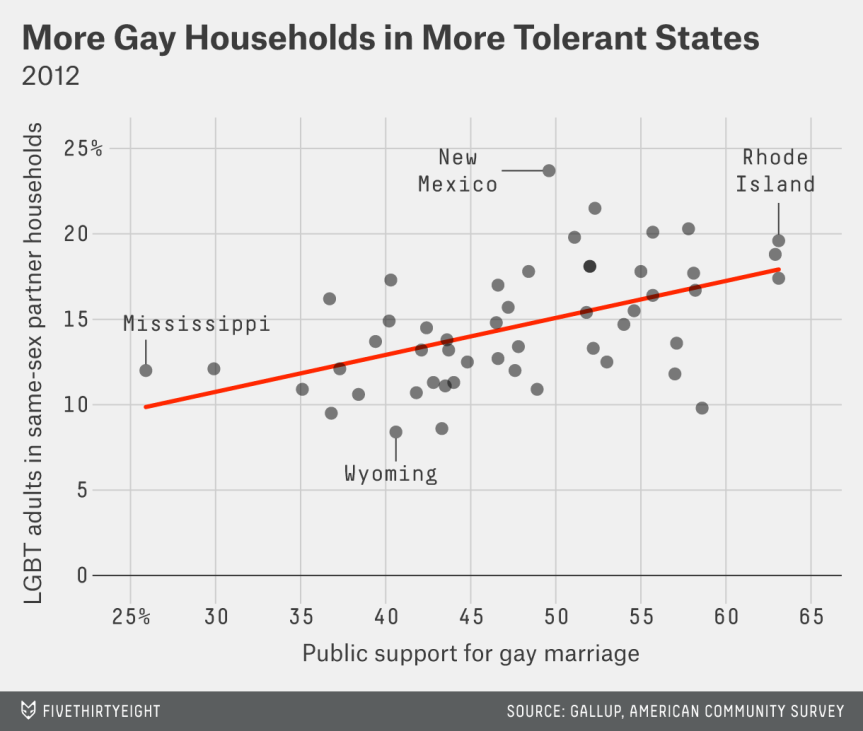
Silver finds that gays tend to settle down in more gay-friendly states:

The regression line in the chart implies that, in a state where 30 percent of the adult population supports gay marriage, about 11 percent of LGBT adults will live together as couples. By comparison, in a state where support for gay marriage is 60 percent, 17 percent will.

These results probably should not be surprising: forming a household with a same-sex partner is a fairly visible and public act, if not quite as public as marriage. By comparison, disclosing one’s LGBT identity to a pollster in an anonymous survey is more private and might depend less on perceived support from one’s community. There are also some LGBT Americans who are so closeted that they won’t tell pollsters about it.

Meanwhile, below is a GIF that shows the progress marriage equality has made over the past ten years (it’s already out of date because it was created before the Oregon news):

same-sex_marriage_gif

Lastly, for a perspective on the state of gay rights around the world, check out this interactive Guardian graphic.

A Push For Gender Equality In The Lab

by Jonah Shepp

No, not the scientists: the animals. Francie Diep explains:

The U.S. National Institutes of Health—one of the biggest funders of biomedical research in the U.S. and the world—will now require the studies it funds to have equal numbers of male and female lab animals. It’s even requiring gender balance in studies done in cells in petri dishes. Yep, that means female and male lab rats will now have equal opportunity to die for science.

All kidding aside, this is actually an important moment for the way medicines are developed in America. All new drugs and treatments are first tested in cells in a petri dish, as well as lab mice, rats, monkeys and other animals. If those studies go well, then they’re tested in people. Late-stage human studies of medicines in the U.S. are now required to recruit at least some women. (This wasn’t always true and, on the whole, it’s still not 50-50.) Gender parity in clinical trials is important because men and women are known to react differently to some medications. Just check out this example, or this one, or all these ones.

Marcotte adds:

That you shouldn’t exclude half a species in your testing seems obvious, but there are understandable, if not really defensible, reasons that scientists have typically stuck to male-only studies.

Roni Caryn Rabin at the New York Times explains: “Researchers avoided using female animals for fear that their reproductive cycles and hormone fluctuations would confound the results of delicately calibrated experiments.” But while this tradition makes it easier to come up with clean results, the long-term effect is that drugs are being released that women are going to take without researchers always knowing exactly how those drugs will work on them. (After all, human females have reproductive cycles and hormone fluctuations, too.)

Feminists in science have long been advocating for an end to the habit of male-only studies for just this reason. That’s part of why the University of Wisconsin started a feminist biology program to help critique and improve biology by targeting some of the unquestioned gender bias that sadly continues to flourish in the field.

A Human Zoo

by Jessie Roberts

European Attraction Limited, a project by artists Mohamed Ali Fadlabi and Lars Cuzner, seeks to re-enact a human zoo that Norway hosted in 1914:

Three years ago we stumbled upon information about a human zoo that had taken place in the heart of Oslo in 1914. Not being from this country, naturally, we assumed that this was common knowledge among natives, so, in an interest to learn more about the general consent on the exhibition, we started asking around. As it turned out pretty much no one we talked to had ever heard about it (even if they had heard of human zoos in other countries). Given how popular the exhibition was (1.4 million visitors saw it at a time when the population of Norway was 2 million) the widespread absence of at least a general knowledge was surprising. It is hard to understand the mechanisms of how something could be wiped from the collective memory.

The original zoo was explicitly racist:

[F]or five months, 80 people of African origin (Senegalese) lived in “the Congo village” in Oslo, surrounded by “indigenous African artefacts”. More than half of the Norwegian population at the time paid to visit the exhibition and gawp at the “traditionally dressed Africans”, living in palm-roof cabins and going about their daily routine of cooking, eating and making handicrafts. The king of Norway officiated at the opening of the exhibition.

Bwesigye bwa Mwesigire notes that some are taking offense to the restaging:

Muauke B Munfocol, who lives in Norway and is originally from DRC, thinks that the project does not recognise the “racial order and systems of privilege in the country”. She says: “One might wonder why at such a time, rather than putting its efforts to acknowledge the existence of racism, paying reparations, and changing the historical-political and cultural relationship to other non-white countries, the Norwegian government chooses to finance a project that reaffirms their part in a global white domination system where black people are dehumanised spiritually, economically, socially and culturally.”

Muauke’s argument is that the re-enactment of the human zoo as exactly as how it was presented in 1914 means “a re-enactment of the fantasies about exoticism and bestiality that have been historically linked to the black body in the colonial mind”. The re-enactment will be a living reality for her, as an African living in Norway. … Muauke is not alone in her indignation. Rune Berglund, head of Norway’s Anti-Racism Centre says: “The only people who will like this are those with racist views. This is something children with African ancestry will hear about and will find degrading. I find it difficult to see how this project could be done in a dignified manner.”

Jillian Steinhauer also has doubts about what the new zoo will achieve:

For their contemporary update … Fadlabi and Cuzner have altered things slightly but significantly: participants are not limited to one race or nationality. “We chose volunteers based on the texts they submit as their application to participate,” Fadlabi told Hyperallergic; the volunteer form is posted online and includes an invitation — “We welcome anybody from anywhere in the world who believes in the importance of the discussion about colonialism, the evolution of racism, equality” — as well as caveats like “You will most likely be asked to defend your participation.” …

On one hand, it’s a relief that the artists have omitted the horrific racism of the original exhibit — it’s hard to imagine how a restaging of those stereotypes could advance a productive conversation of any kind. On the other, it’s hard not to wonder if the change renders the whole project too vague to achieve the intended effect. What will the takeaway be — that putting humans in zoos is bad? …

When I asked [the artists] specifically about the races, nationalities, and/or ethnicities of the zoo volunteers, Fadlabi turned the query on me: “The question itself poses another question – is it different for you if all the volunteers are black? Is it different for you if 2 out of 80 are white?” My response was that if we’re attempting to talk about racial dynamics and prejudices, then yes, these things do matter. I do not wish for Fadlabi and Cuzner to recruit 80 Norwegian residents of African descent and build a zoo for them in the name of art and a wished-for national conversation; but I am uncertain, and curious, about how “European Attraction Limited” will inspire thoughtful conversation of any kind.

(Video: Footage from the 1914 exhibition)


Calling In Female

by Patrick Appel

Emily Matchar points out that “in several, mostly East Asian, countries, so-called ‘menstrual leave’ is a legally enshrined right for female workers.” She considers the appeal of such policies:

[E]ven in countries with well-intentioned menstrual leave policies, many women don’t feel comfortable taking it. They’re understandably embarrassed to tell their superiors they have their period, and they worry they’ll be viewed as weak for taking time off.

The fact is, menstruation is not debilitating for most women. But for up to 20 percent of women, period pain interferes with daily activities just as surely as a nasty cold or flu. Ample paid sick leave would seem to take care of the problem just as well without forcing women to share their lunar cycles with their bosses. It’s no coincidence that several of the countries with menstrual leave also have lackluster sick leave policies—neither Japan nor Korea mandate paid sick leave for non-serious illness.

But then again, neither does the United States. Perhaps we should start agitating for the Boxer-McConnell American Menstrual Leave Act after all?

Katy Waldman dislikes the idea:

Matchar is more fair-minded than I, weighing whether period leave amounts to “reverse sexism or a reasonable human rights move.” Does the time off have to perpetuate weird myths about our traumatic, crazy cycles—or can it just cut us some slack when we feel drained and low?

The problem is that it does both, and whether or not we deserve the extra slack (we don’t), we definitely don’t deserve the added attention to—or annoyingly reverent theorizing around—our ovaries. They will be fine! Nor is menstrual leave analogous to maternity leave, as Matchar suggests. While the first addresses a real need to care for a living person you have expelled from your body, and care for your own body out of which a living person was just expelled, the second recasts cramps and crankiness as mysterious ailments beyond the therapeutic powers of aspirin. One moment your boss is giving you days off to menstruate, the next he’s hiring a witch doctor to bless your uterus thrice upon the full moon.

Napoleon: Complex

by Tracy R. Walsh

Jacques_Louis_David_-_Bonaparte_franchissant_le_Grand_Saint-Bernard,_20_mai_1800_-_Google_Art_Project

Brian Eads notes that “200 years on, the French still cannot agree on whether Napoleon was a hero or a villain”:

“The divide is generally down political party lines,” says professor Peter Hicks, a British historian with the Napoléon Foundation in Paris. “On the left, there’s the ’black legend’ of Bonaparte as an ogre. On the right, there is the ’golden legend’ of a strong leader who created durable institutions.”

French politicians and institutions in particular appear nervous about marking the 200th anniversary of Napoleon’s exile. … While the 200th anniversary of the French Revolution that toppled the monarchy and delivered thousands to death by guillotine was officially celebrated in 1989, Napoleonic anniversaries are neither officially marked nor celebrated. For example, a decade ago, the president and prime minister – at the time, Jacques Chirac and Dominque de Villepin – boycotted a ceremony marking the 200th anniversary of the battle of Austerlitz,Napoleon’s greatest military victory. “It’s almost as if Napoleon Bonaparte is not part of the national story,” Hicks tells Newsweek.