A Better Way To Talk About Hell

Damon Linker laments that “the way many American Christians think and talk about hell” keeps those who might otherwise embrace the faith, especially young people, from doing so:

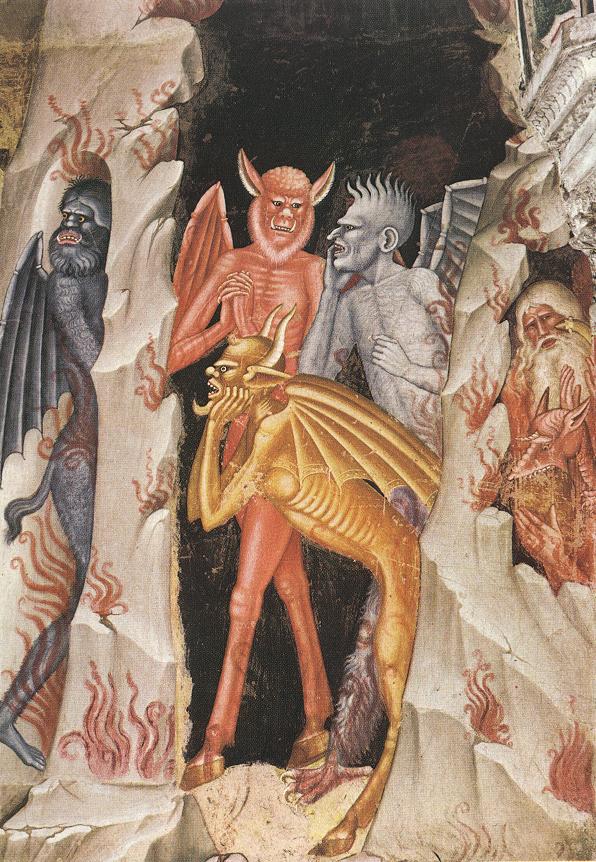
[T]he most theologically cogent view of hell found in classical Christianity maintains that it is the state Andrea_di_bonaiuto,_cappellone_degli_spagnoli_05of mind (or soul) of someone who is alienated from God. Living a life that is out of harmony with God is painful, and to die and be confronted so decisively with the error of your ways — to be made to see that you made a wreck of your life by separating yourself from God, and to have to learn to shatter your pride by reforming yourself in his divine presence — is, one imagines, excruciating. But it is intrinsically painful, not externally imposed by torturers in some fire-and-brimstone-filled dungeon.

Or in the words of theologian David Bentley Hart, “What we call hell is nothing but the rage and remorse of the soul that will not yield itself to love.” In refusing to “open itself to the mercy and glory of God, the wrathful soul experiences the transfiguring and deifying fire of love not as bliss but as chastisement and despair.”

This is what hell must be if God is truly good.

I, for one, find this far more plausible than the popular vision of hell as a torture chamber run by sadistic demons. And I suspect that at least some young religious skeptics might, too, if only committed Christians would rise to the challenge of making the case.
Jonathan Merritt finds that some shifts already are underway, claiming that “many Christians have begun to refine their message to attract new followers and not repel skeptics,” and so downplaying the idea of a literal hell. One reason why:

[One reason] people are hesitant to discuss hell, [pastor Brian] Jones says, is because the only people who talk about it are hateful Christians like those associated with Westboro Baptist Church and “creepy Christians that no one wants to hang out with.” By contrast, he says, most modern believers want to be perceived as kind, loving, and gracious.

“There aren’t very many models out there for how to talk about hell winsomely, so Christians are frozen in their tracks. It’s hard to do something when you haven’t seen it modeled well,” says Jones.

Jason Boyett, author of “Pocket Guide to the Afterlife.” Echoes Jones’s sentiment: “I think some people hesitate to talk about hell because they don’t want to continue to deliver only bad news instead of something that is encouraging and inspiring. The existence of hell is difficult and a challenging part of Christian theology. If you think too much about it, it is really kind of frightening.”

(Image: Andrea di Bonaiuto’s “Descent of Christ to Limbo” via Wikimedia Commons)
Quote For The Day

“Our tragedy today is a general and universal physical fear so long sustained by now that we can even bear it. There are no longer problems of the spirit. There is only the question: When will I be blown up? Because of this, the young man or woman writing today has forgotten the problems of the human heart in conflict with itself which alone can make good writing because only that is worth writing about, worth the agony and the sweat.

He must learn them again. He must teach himself that the basest of all things is to be afraid; and, teaching himself that, forget it forever, leaving no room in his workshop for anything but the old verities and truths of the heart, the old universal truths lacking which any story is ephemeral and doomed – love and honor and pity and pride and compassion and sacrifice. Until he does so, he labors under a curse. He writes not of love but of lust, of defeats in which nobody loses anything of value, of victories without hope and, worst of all, without pity or compassion. His griefs grieve on no universal bones, leaving no scars. He writes not of the heart but of the glands.

Until he relearns these things, he will write as though he stood among and watched the end of man. I decline to accept the end of man. It is easy enough to say that man is immortal simply because he will endure: that when the last dingdong of doom has clanged and faded from the last worthless rock hanging tideless in the last red and dying evening, that even then there will still be one more sound: that of his puny inexhaustible voice, still talking.

I refuse to accept this. I believe that man will not merely endure: he will prevail. He is immortal, not because he alone among creatures has an inexhaustible voice, but because he has a soul, a spirit capable of compassion and sacrifice and endurance. The poet’s, the writer’s, duty is to write about these things. It is his privilege to help man endure by lifting his heart, by reminding him of the courage and honor and hope and pride and compassion and pity and sacrifice which have been the glory of his past. The poet’s voice need not merely be the record of man, it can be one of the props, the pillars to help him endure and prevail,” – William Faulkner, in his 1949 Nobel Prize speech.

How Many Atheist Kids Convert To Belief?

dish_chart

Dylan Matthews investigates whether the children of atheists rebel against their unbelieving parents by seeking out religion:

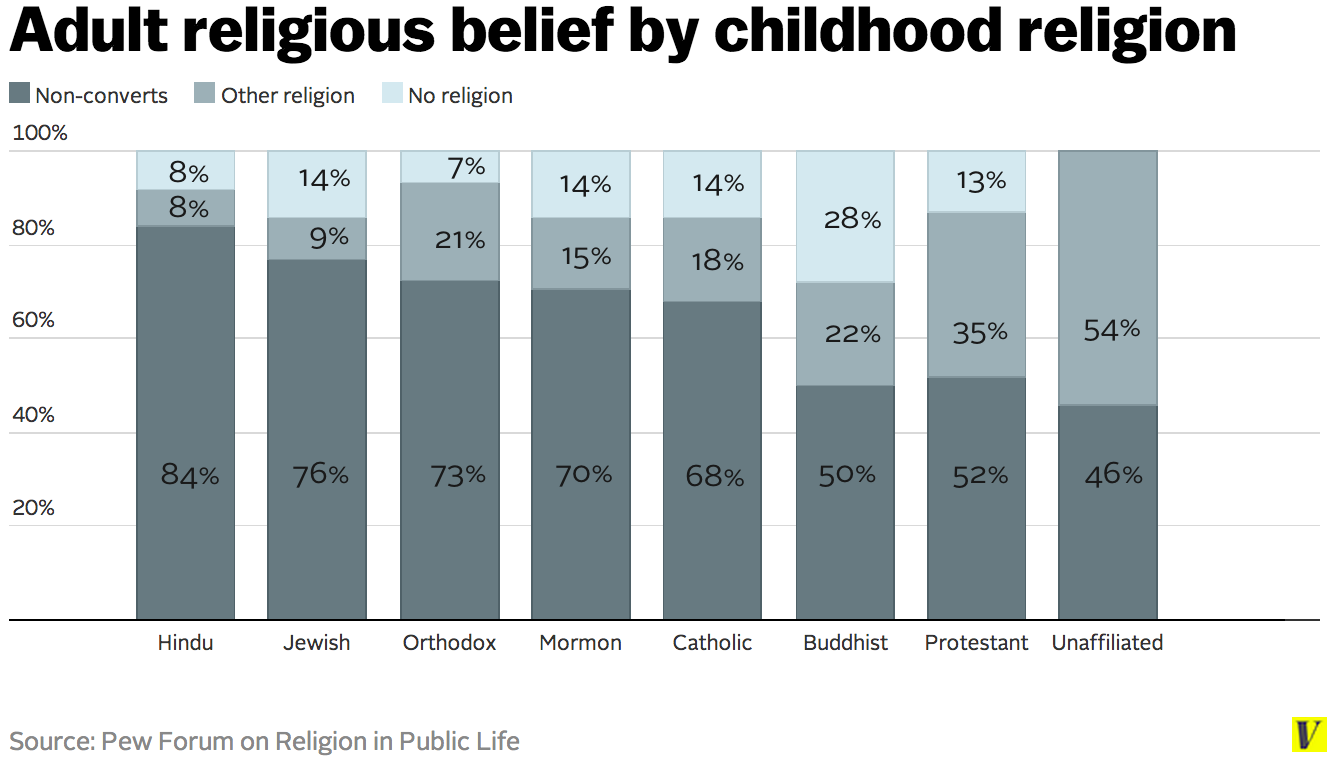
As it turns out, yes. The most recent data on this that I’ve come across comes from Pew’s 2008 Religious Landscape Survey, which finds that only 46 percent of people who are raised religiously unaffiliated (which includes atheists, agnostics, and those who say they’re “nothing in particular”) remain unaffiliated as adults. By contrast, 68 percent of Catholics and 52 percent of Protestant stay with their childhood religion, and only 14 percent and 13 percent (respectively) stop subscribing to any religion at all.

Sarah Posner casts doubt on Matthews’s data:

Matthews admits the data he uses is imperfect, but that it “does suggest that religion has a somewhat easier time transmitting across generations than irreligion does.”

This struck me as a bit off the mark, so I posed the question to Phil Zuckerman, a professor of sociology at Pitzer College, founder of that institution’s unique Department of Secular Studies, and author of, among others, the forthcoming book, Living the Secular Life. Zuckerman told me he found the data “sort of bizarre” and that it “runs counter to all that I know on the topic.”

In the upcoming book, Zuckerman notes that while there is a paucity of research on secular parenting, there are longitudinal studies on the future impact of a secular childhood on adult religiosity are out there, and they show that retention rates of irreligiosity are very high.

Prayer And The Penitentiary

Aaron Griffith analyzes the evangelical desire to convert prisoners and the mainline Protestant desire for prison reform:

One commonality in how American Protestants from across the theological spectrum think about prisons is their reliance on Jesus’ discussion of “the least of these” in Matt. 25:31–46. These verses have been and continue to be everywhere in prison ministry rhetoric. They were quoted in a statement in the 1787 constitution of the Philadelphia Society for Alleviating the Miseries of Public Prisons. In recent years mainliners have used the passage to justify their broader social justice outlook, while evangelicals take it more literally to validate their in-prison proselytization.

But both those interpretations may be off target.

The general consensus of many in biblical studies circles as well as most of the Church Fathers is that “the least of these” are not the oppressed, hungry, or imprisoned masses that the church goes out and helps. Instead, the phrase refers simply to Christians. Those who are being judged before the throne of God are non-Christians, evaluated by how they treated Christians living among them.

Why have both mainliners and evangelicals in America missed this insight? Probably in part because this reading requires a relatively technical understanding of Greek phrases at work in the passage. But perhaps it also has something to do with the fact that evangelicals and mainliners, despite their differences, both understand their prison work as bringing something badly needed to prisoners. Yet they hesitate to see the convict and prison as a person and place that are close to the heart of the crucified God.

Face Of The Day

Eighteen

Natan Dvir photographs Arab-Israeli teenagers, who are exempt from the compulsory military service their Jewish peers enter at age 18. Among his subjects is Dina, above:

“I was born to a Jewish Ukranian mother and a Muslim Israeli father in Ukraine. … I am now living in Jaffa in a collective of Arab and Jewish human rights activists and volunteer in various organizations. I don’t really care if I live with Arabs or Jews. I guess I kind of did that all my life anyhow. I appreciate people for who they are and have little regard for that kind of categorization. I am both Jewish and Muslim, both Ukrainian and Israeli. I can be defined any way that makes you feel comfortable, but if you ask me, I would prefer not to be called any of the above—I am a human rights activist.”

See more of Dvir’s work here.

How Islam Defines Hell

Qasim Rashid outlines seven arguments for his claim that “Islam does not teach eternal damnation for anyone.” One of them? “Islam does not monopolize salvation”:

It is not for humans to say how God will judge. Indeed, no guarantee or promise exists that every Muslim will go directly to paradise after death or that every non-Muslim is automatically hell-bound. Islam is the only ancient religion that does not monopolize salvation exclusively to its adherents. Instead, Islam teaches that non-Muslims can and shall attain paradise.

The Qur’an declares in 2:62, “Surely, the Believers, and the Jews, and the Christians and the Sabians — whichever party from among these truly believes in Allah and the Last Day and does good deeds — shall have their reward with their Lord, and no fear shall come upon them, nor shall they grieve.”

Islam also teaches that hell is not designed for torment, but reform. All must first be cleansed of sin before entering paradise. This cleansing may be of incorrect beliefs — held by non-Muslims and misguided Muslims — or for sinful actions. Hell is the reformatory abode for purification after death. Qur’an 101:9-10 declares, “But as for him whose scales are light [upon judgment], hell will be his nursing mother.” This verse makes no distinction between a believer and a nonbeliever. Yes, Islam teaches that hell is a painful experience, but Islam defines hell as a nursing mother designed to purge sin before admitting a soul to paradise.

Shakespeare, Skeptic?

In an excerpt from his new book, The Science of Shakespeare: A New Look at the Playwright’s Universe, which connects the Bard to the emerging worldview of the Scientific Revolution, Dan Falk claims that “just as his works hint at the beginnings of science, so, too, do they hint at the possibility of unbelief.” The evidence he finds for this in King Lear:

In this most somber of Shakespeare’s plays, the gods are often called upon—by the king and Gloucester and others—but they do not respond. In their absence, justice cannot be guaranteed; indeed, it becomes fragile in the extreme. Lear, in desperation, hopes that events will “show the heavens more just,” but it is a lost cause. The play ends, as William Elton puts it, “with the death of the good at the hands of the evil.” In one of the play’s most famous—and darkest—lines, Gloucester laments, “As flies to wanton boys are we to th’ gods/ They kill us for their sport.” …

In King Lear and the Gods, Elton presents a kind of checklist of what makes a “Renaissance skeptic”—denying divine providence, denying the immortality of the soul, placing mankind among the beasts, denying God’s role as creator of the universe, attributing to nature what is properly the work of God—and then shows that Lear, over the course of the play, develops into precisely such a skeptic. It is a gradual process, but it is relentless: “Lear’s disillusionment, once begun, sweeps all before it, toppling the analogical edifices of God and man, divine and human justice.” As [Shakespeare scholar Eric] Mallin put it in our interview, King Lear is “essentially a godless document”; it describes a world “emptied of divinity.”

Previous Dish on Shakespeare and religion here. Our round-up celebrating the anniversary of his birth here.

(Video: The Royal Shakespeare Company performs Act 5, Scene 3 of King Lear)

Into The Void

In a review of the new collection Simone Weil and Theology, John Caruana describes how the Christian philosopher connected divinity to denial:

One of the most fascinating themes in Weil’s philosophy — and here the [editors’] commentary truly shines — centers on the emptiness or void of reality. This void is the indelible mark that is left behind in God’s own self-voiding, in the very unfolding of creation itself. In order to make room for a finite universe, God dispossesses himself of his infinite powers. For Weil, that process is most evident in Christ. Following Paul, she sees Christ as the eikon, or visible image of the invisible God. Weil takes seriously Paul’s claim that whatever we can know about God can be only gleaned from the figure of Christ. Paul deploys the term kenosis to flag what he takes to be fundamental to Jesus’s nature: he is God emptying himself out. In a gesture of love, God denies himself his transcendent status for the sake of some other. The created order thus bears the mark of this divine self-abnegation.

For Weil, this is the only way to make sense of the Biblical passages that show a God suffering along with his creatures. In this way, Weil fuses divinity, love, and affliction. To love truly requires attentiveness and openness to the fissures of reality, and although our inclination is to take flight before these pockets of emptiness, this diminishes us. In our attempt to flee the void, we frequently give in to the temptation of deflecting our own suffering by hurting others.