Floating Nuclear Power

It could happen:

There are many things people do not want to be built in their backyard, and nuclear power stations are high on the list. But what if floating reactors could be moored offshore, out of sight? There is plenty of water to keep them cool and the electricity they produce can easily be carried onshore by undersea cables. Moreover, once the nuclear plant has reached the end of its life it can be towed away to be decommissioned. Unusual as it might seem, such an idea is gaining supporters in America and Russia. …

The American researchers think there is no particular limit to the size of a floating nuclear power station and that even a 1,000MW one—the size of some of today’s largest terrestrial nuclear plants—could be built. They believe the floating versions could be designed to meet all regulatory and security requirements, which would include protecting the structure from underwater attack, says Dr [Neil] Todreas.

The View From Your Obamacare: Mental Health

A few readers coalesce around a new theme:

My husband and I are both self-employed and work from home, and for the first time, our entire family has health insurance – thanks to Obamacare. My husband was uninsured for years, because he just couldn’t get health President Obama Visits Boston To Talk About Health Careinsurance that wasn’t exorbitant. In 2012, he tried to get health insurance from three different health insurance companies and got turned down from each one for minor health issues. The reason for his last rejection was – I kid you not – “impending fatherhood.” When a health insurance company declared that my pregnancy (which was covered under my insurance) somehow became a pre-existing condition for him, we gave up on the whole Kafka-esque scenario and just waited for 2014.

But I mostly want to highlight another Obamacare benefit that hasn’t been mentioned much: mental health coverage. I have PTSD, which my pre-Obamacare policy didn’t cover. As a result, I could get 10 group or individual therapy sessions per calendar year, and I could see a shrink once every two months for ten minutes for medication management, and that was it. I could never switch policies because no one else would cover me. (Put PTSD on a health insurance application and they couldn’t write the denial letter fast enough.)

I spent $18,000 out of pocket to treat my PTSD (and four years after completing therapy, I’m STILL paying off the resulting credit card debt.) EMDR was worth every damn penny, because while I still have some remaining symptoms, I can actually sleep through the night, I don’t have to manage multiple flashbacks a day, and I’m not crawling out of my skin with anxiety twice a day. I’m grateful that my therapist offered a no-interest payment plan and that I had the resource of a high credit limit, but not having health coverage for my PTSD treatment was a huge financial hit at a time when I was already struggling to get by.

Like a lot of people with a mental illness, I don’t broadcast my PTSD diagnosis – mostly because I don’t necessarily want to discuss my abusive childhood in public. But access to mental health treatment is a big deal for a lot of people like me, and I’m grateful that I have options now that I didn’t have before.

Another also touches on mental illness:

I love this thread, and I thought I’d chime in because the policy has meant a lot to me and my family. My mom is very well employed and well insured. However, prior to Obamacare her coverage only covered her 7 children if they were under 18 or in school full time and under 25. This was without a doubt a luxury plan in comparison to the vast majority of Americans.

Cue disaster 1. My brother had to drop out of college after a suicide attempt and diagnosis of bipolar disorder. He was in inpatient care for weeks, and then seeing multiple doctors to find the right treatment plan to manage the illness. For years.

Now, again, my family was in a relatively secure position prior to this. But the fact that the Obamacare clause for children 26 and under came into effect just six months before this disaster means that my mother didn’t have to make a choice between bankruptcy or leaving one of her children to homelessness or death. Because that’s what the options were pre-Obamacare. And I’d like to point out that no matter how well you raise your kids, no matter how much money you have or how hard you work, you can’t prevent bipolar disorder. You don’t get a choice as an individual to have a mental illness (or cancer, or asthma, or allergies …). How can anyone want to go back to a world where your financial security depends on the luck of the genetic draw?

Once that had (mostly) settled down, we hit disaster 2. My other brother graduated from college, unemployed, and came home to work. He was working three jobs to make ends meet when he got in a motorcycle crash that left him inches from death. He was in the hospital for the better part of a day before they were even able to identify my mother and call her. He woke up two days later and but for the grace of god was not just alive but didn’t lose any brain damage. He spent weeks in inpatient rehab, several more in outpatient rehab, and a year later had the final surgery to fix his hip.

To be clear, my brother was working three jobs and none of them offered insurance. He is the epitome of a the “hard working American.” And once again, if it weren’t for Obamacare, he would have spent decades of his life trying to come back from financial ruin. Or my family would have gone bankrupt.

If there’s anything I learned from my family’s story, it’s the crushing economic impact of not having health insurance. Without that one clause, my family would have gone from gone from solidly upper middle class to near-poverty in a single generation. We would have gone from drivers of the economy – spending money on restaurants, vacations, college, homes – to the paycheck to paycheck existence that too many Americans endure. I am aware of just how lucky we are, and I wish other people who think Obamacare is only the rich subsidizing the lazy poor would realize just how much security and wellbeing Obamacare has brought all Americans.

Read the whole thread here.

(Photo by Yoon S. Byun/The Boston Globe via Getty Images)

Finnegans Headache

Andrew McGarth considers the difficulties of translating Joyce’s byzantine final novel into Chinese:

Dai Congrong started translating the book in 2006, but didn’t publish the first part of her translation until early 2013. Part of the reason it took so long is that Finnegans Wake, while challenging enough to read in English, is even more difficult to translate, owing to James Joyce’s puns, allusions, and multi-layered meanings which baffle most native English speakers and often lose their meaning in translation. The novel has been deemed “untranslatable” and the translations that are successful tend to be consuming: the Polish version took 10 years to finish, the French version 30 years, and the Japanese version took three separate translators after the first disappeared and the second went mad.  …

Dai’s translation only covers the first third of the book and clocks in at 775 pages; for comparison, the full English text is 676 pages long. Most of the extra pages can be attributed to footnotes and annotations, which were needed to make sense of the novel. According to the Wall Street Journal, the first sentence of Dai’s translation is accompanied by two definitions, five footnotes, and seven asides that explain the possible intended meanings for the word “riverrun” and the allusions to an 18th century academic named Giovanni Battista Vico, and for later sentences in the book Dai had to create new Chinese characters to capture sounds from the novel. Talking to Reuters after the book’s release, she said she started having doubts early on, when after two years of work she had yet to translate one word.

Relatedly, illustrator Stephen Crowe, who is translating Finnegans Wake into images for his project Wake In Progressdiscusses how the book has changed his approach to reading:

Most books develop their themes through the plot and the way the characters change over time. Finnegans Wake uses those techniques to some extent, but mostly [Joyce] uses others. The most important one is probably the leitmotif. He marks out different ideas with certain words, letters, numbers or rhythms, so you can trace the development of each idea according to the way he develops the motif. Like in music. Repetition is what powers the whole thing. But reading the Wake teaches you to read in a Wakean way. After a while, you find yourself reading conventional books with half an ear for all the words they repeat and the images they reuse. After all, any story is basically a collection of themes organized in a certain way. That’s one thing that you can definitely take from reading the Wake: it makes you re-evaluate everything you think about reading and writing.

Previous Dish on Joyce here, here, and here.

When Politics Runs In The Family

Dynasties

A well-connected family helps if you want to be in Congress:

Across all Congresses — House and Senate — from 1789 to 1986, nearly nine percent of legislators came from families that had previously sent a member to Congress. The prevalence of these dynastic legislators has decreased over time. “While 11 percent of legislators were dynastic between 1789 and 1858, only 7 percent were dynastic after 1966,” the authors write. And that number has been mostly flat, according to an October 2013 analysis by Chris Wilson of Time, who found that 6.9 percent of current House and Senate members — 37 in total — come from dynastic families.

As for senators, 13.5 percent have come from dynastic families, versus only 7.7 percent of representatives. One of the key findings of the dynasty paper is that political power is self-perpetuating: “Legislators who hold power for longer become more likely to have relatives entering Congress in the future. Thus, in politics, power begets power.”

Aaron Blake notes that ” for everyone who professes to be disgusted with the idea of another Bush or another Clinton inhabiting the White House, there are many more people who are quite fond of the predictability and ease of voting for a name they know”:

Case in point: The new Washington Post-ABC News poll. The poll shows both the Bush and Clinton political dynasties are viewed in quite positive lights, though the Clinton family reigns superior for now. While 64 percent of registered voters have a favorable view of the Clinton family, 56 percent say the same about the Bushes. And in an age in which it’s hard to get a majority of Americans to agree on anything and especially any politician, that level of support is striking.

Amy Davidson is troubled by American support of political dynasties:

We talk so much about the role of money in politics. Why isn’t all that investment yielding us any truly interesting products in the candidacy sector? It is as if our entire political portfolio were put into the same few stocks that had been there forever. Maybe it is money that, perversely or purposefully, stifles political entrepreneurship and innovation; maybe other factors are at work. In either case, the current situation can’t be for the best, if it serves to make politics seem like a deadened realm rather than a place to bring and work out grievances. We are stretched out, paralyzed, in the polls. What hurts the most is that we may be suffering from a national failure of political imagination.

Budding Books

Tania Unsworth considers the joys of “reading like a kid”:

[A]lthough I love books almost more than anything else in the world, there are probably only a handful I have read as an adult that I would say changed my life. And even then – speaking honestly – the changes to my life have been fairly modest. Reading A Room of One’s Own by Virginia Woolf at the age of 22, for example, certainly challenged my way of thinking, but did it do more than that? If I had missed out on Ishiguro’s Never Let Me Go, to take another example, my life would definitely have been the poorer. But would it have really mattered that much?

I know there are plenty of people who will disagree with this, pointing to books that profoundly and demonstrably altered the course of their adult lives, but speaking personally, the books that had the greatest and most lasting impact on me were all read before the age of fifteen. Am I the only one who feels this? … There was an intensity to reading then, a kind of total involvement in story that is hard to reproduce as an adult. I know too much now about tired plots and clichés. I am always comparing one thing to another, recognizing devices, identifying styles. No matter how good or bad I find something, I’m always aware of my response, slightly detached, consciously enjoying or not enjoying. That’s how it should be. I’m an adult after all. But I do sometimes long to read the way I used to.

Trucking Gets A Flat

Trucking Wages

Lydia DePillis checks in on the industry:

[Miguel] Tigre came to America from Ecuador 30 years ago, started driving for one of the hundreds of small trucking companies that serve the port and, by 1993, had saved enough to buy a truck. It seemed like a fair trade: As an owner-operator working on contract, he gave up some stability in exchange for the freedom of working whenever he wanted.

But then, the bargain broke down. Prices started rising, and Tigre’s pay rate didn’t keep up. Diesel used to be 87 cents a gallon; now it’s $3.99. Tolls on some roads are now more than $100 for truckers. There are anti-terrorism identity cards and stricter emissions requirements, and any traffic infraction could send his insurance through the roof.

That’s a great deal for the trucking companies. Unlike employees, owner-operators aren’t entitled to benefits like workers compensation, Social Security contributions, unemployment insurance or the same level of protection by safety and health regulation. And it’s not just the trucking industry: Contractors have emerged all over the economy, from cheerleaders to construction workers.

The White House Takes On College Rape, Ctd

Rachel Cohen questions why the national conversation has come to focus specifically on college campuses:

There is an indisputable and often cyclical connection between poverty and sexual violence. The Bureau of Justice Statistics found that individuals with household incomes under $7,500 are twice as likely as those in the general population to become victims of sexual assault. Ninety-two percent of homeless mothers experience severe physical and/or sexual assault at some point in their lives. Sexual assault is hardly a problem limited to university campuses.

Twenty percent of college women being sexually assaulted is unacceptable. But other groups are at even greater risk. Immigrants, refugeesmigrants, those suffering from addictions, minorities, LGBTQ individuals, sex workers, prisoners, the homeless, and the impoverished all experience high rates of sexual assault. And, unlike college students, these groups very often lack the knowledge, credibility, resources, and federal protections to do anything about their attacks.

And Hanna Rosin doesn’t want the conversation to ignore male victims:

Last year the National Crime Victimization Survey turned up a remarkable statistic. In asking 40,000 households about rape and sexual violence, the survey uncovered that 38 percent of incidents were against men.

The number seemed so high that it prompted researcher Lara Stemple to call the Bureau of Justice Statistics to see if it maybe it had made a mistake, or changed its terminology. After all, in years past men had accounted for somewhere between 5 and 14 percent of rape and sexual violence victims. But no, it wasn’t a mistake, officials told her, although they couldn’t explain the rise beyond guessing that maybe it had something to do with the publicity surrounding former football coach Jerry Sandusky and the Penn State sex abuse scandal. Stemple, who works with the Health and Human Rights Project at UCLA, had often wondered whether incidents of sexual violence against men were under-reported. …

So why are men suddenly showing up as victims? Every comedian has a prison rape joke and prosecutions of sexual crimes against men are still rare. But gender norms are shaking loose in a way that allows men to identify themselves—if the survey is sensitive and specific enough—as vulnerable. A recent analysis of BJS data, for example, turned up that 46 percent of male victims reported a female perpetrator.

The final outrage in Stemple and Meyer’s paper involves inmates, who aren’t counted in the general statistics at all.

The Best Of The Dish Today

You may remember the rather refreshing position of Rand Paul that he wanted to cut the billions of dollars in aid we give to Egypt and Israel. Well, guess what? As David Corn notes, Paul has now changed his tune. He’s dropped the idea of ending aid to Israel and is now urging an end to aid to the Palestinians unless they don’t only recognize Israel but recognize it as a Jewish state. The idea of cutting off aid to Israel has now disappeared from his website. I’m unaware of any ideological epiphanies Paul has had on the question of foreign aid, so, if you want to find an explanation for the sudden swerve to neoconservatism, you’d have to look at the process by which a candidate gets the money and support to run for president.

Meanwhile, a reader responds to our latest indie Dish update:

Lookin’ good, team. But just tryna make sure I understand all this correctly: What is “affiliate income”? And how much revenue has come in from 1/1/2014 to current?

“Affiliate income” is the money we get from the Amazon links for any book mentioned on the Dish. When a person buys a book, or any other item on the site within a 24-hour session, we get a tiny percentage of the purchase price. (More on the Dish’s approach to affiliate revenue here.) In the first four months of 2014, we generated $10,417. But in the month of April alone, with the advent of our Book Club, we made $5,245 in affiliate revenue. It’s not much compared to our subscription revenue, but over the course of the year it definitely adds up. Last year, our $25,000 in affiliate revenue basically paid for an intern’s salary and healthcare benefits. So thank you to all the Book Clubbers for your help on that front.

Today I failed to do my homework on the alleged smoking gun Benghazi email from Ben Rhodes. It is, when viewed in context, merely spin in a confusing time. Quite why it took so long to be released is another matter. I tried to give an assessment of the paradox of Obama’s popular yet unpopular foreign policy; wondered if I sound gay; and gawked at the unreconstructed racism of Donald Sterling.

The most popular post of the day remained Sarah Palin: Anti-Christian, followed by my response to David Harsanyi about Israel’s intransigence on settlements. That Palin post has had an extended life on Facebook. But Palin has always been a traffic-booster.

One last thought from Oakeshott’s Notebooks, which I’ve been gulping:

In love is our existence made intelligible. For in love are all contraries reconciled.

That’s quite a statement from a philosopher. But he was always much more than that.

See you in the morning.

How Long Do You Go? Ctd

According to Harry Fisch, author of The New Naked: The Ultimate Sex Education for Grown-Ups, the average hetero “sex session” lasts less than eight minutes:

There have been studies in which couples consented to be scientifically observed having sex, and one of 2-minute-timerthe observers timed each session with a stopwatch to make a fairly accurate assessment about the length of the coupling. Not surprisingly, there is an extremely large variation in the time it takes a couple to have sex, ranging from the excessively short (about two minutes or less, which famed sex researcher Alfred Kinsey dryly noted was a “frequent source of marital conflict”) to the “Are you done yet?” (over forty minutes).

An astonishing 45 percent of men finish the sex act too quickly, which is to say, within Kinsey’s conflicted two minutes. That’s pretty speedy. Way too speedy for the average woman to be able to have an orgasm through vaginal penetration alone. At least five minutes, and more like seven, is usually what’s needed for a woman to be able to achieve orgasm. And even though the average length of the average inter-vaginal sex session is about 7.3 minutes, that’s still not particularly long, especially for women who usually take much longer than men to become aroused enough to have an orgasm.

But Alice Robb cautions readers not to conclude that the discrepancy “simply represents more evidence of a male-dominated society’s inherent pleasure inequality”:

As it happens, men may be more bothered by it than women.

For a 2004 paper in the Journal of Sex Research, University of New Brunswick researchers S. Andrea Miller and E. Sandra Byers interviewed 152 heterosexual couples on their “actual and desired duration of foreplay and of intercourse.” Their subjects spanned a wide range of ages—21 to 77 years old—and relationship type—from 6-month to 50-year partnerships. Miller and Byers found that men reported a much longer ideal duration than did their partners.

It’s true that for both sexes, the “ideal” length of both foreplay and intercourse was much longer than the actual. But the New Brunswick results at least suggest that the men are not happy with this status quo.

Previous Dish on sexy time here.

The Case For Eating Bugs

Screen_Shot_2014-04-29_at_1.56.17_PM

Joseph Stromberg makes it:

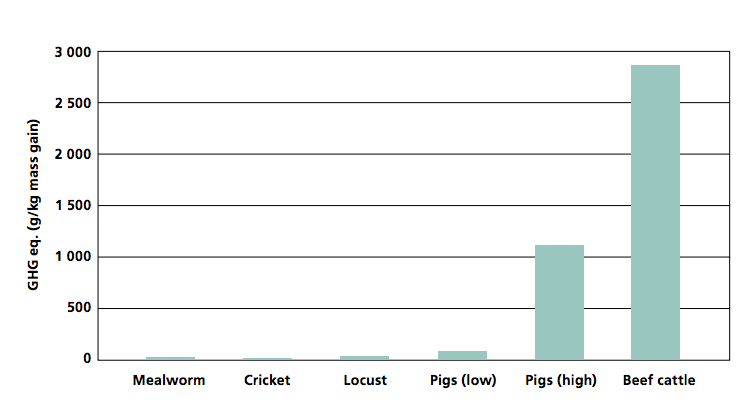
This graph [above], from the UN report, shows the greenhouse gas emissions that result from producing a kilogram of pork and beef, compared to a kilogram of insect meat … Because demand for meat is rising around the world, livestock production is going to become an increasingly big reason why the planet is warming — unless we find an alternative.

Then there’s the matter of ethics. Obviously, smart people disagree about the ethics of eating meat, and many argue that the pleasure we derive from eating meat outweighs the pain and suffering experienced by a cow or pig in captivity. But few argue that these animals experience no suffering at all. Many scientists who’ve studied the insect nervous system, though, believe that they don’t feel pain. Raising these insects for meat — instead of cows, pigs, and chickens — would reduce the total amount of suffering that results from our appetite for meat.

But just how does one get Americans on board with entomophagy? Nick Cox interviews the young founders of Six Foods, who are looking to do just that:

[Laura] D’Asaro, who was an African Studies major, says she first “caught the bug” after eating a caterpillar on the side of the street while traveling in Tanzania. A lifelong on-and-off vegetarian who enjoyed meat but struggled with the ethical and environmental issues that came with it, she found insects to be a perfect compromise. She told [Rose]Wang, who was then her roommate, about her discovery.

“I never thought she’d be into it, because she’s more traditional,” said D’Asaro. “[But] she’d just been in China and had eaten a scorpion, and said it tasted a little bit like shrimp without the fishy flavor.”

So Wang and D’Asaro started ordering live insects and experimenting with them. They knew they were onto something when they made a box of fifty green caterpillar tacos for a pitch competition and left them in the Harvard Innovation Lab fridge. “We didn’t think to label them,” she said. “We got back from our pitch competition half an hour later… and there were only five of them left, because people had eaten them, not knowing they were insects, and had loved them, and just kept going back for more.”

And Daniella Martin talks to a nutritionist who is trying to market a cricket-based protein powder:

Bodybuilders and extreme athletes tend to be early adopters of nutrition trends. That’s why they are precisely the demographic Dianne Guilfoyle, a school nutrition supervisor in Southern California, hopes to capture with BugMuscle, a protein powder made up entirely of ground insects.

“If people see bodybuilders taking it, they might accept it more willingly,” says Dianne, whose son Daniel is a cage fighter.

There are many benefits to using insects as a base for protein powder. For one, the main existing sources are soybeans and milk whey, both of which cause health concerns for some people. While insect protein might not be a perfect alternative for those with shellfish allergies, for others it could present an alternative that’s healthier for their bodies and the planet than some of the existing options. Previously, whey protein was the only protein powder source to supply a complete amino acid profile: all nine of the essential amino acids required for human nutrition. But guess what else is a great source of these amino acids? That’s right, insects.

Previous Dish on eating bugs here.