To See What Is In Front Of One’s Nose …

UKRAINE-UNREST-RUSSIA-CRISIS-POLITICS-EAST

Some things now seem to me increasingly clear in Russia-Ukraine crisis. The deal last week has not held, because Russia has failed to live up to its agreements. The rhetoric on both sides has acquired the kind of frenetic and extreme statements that can very easily escalate into full-scale conflict. Here’s the Ukrainian acting prime minister, Arseniy P. Yatsenyuk:

“The world has not yet forgotten World War II, but Russia already wants to start World War III.”

Here’s Lavrov:

“The West wants to take control of Ukraine while exclusively putting its geopolitical interests, not the interests of the Ukrainian people, at the forefront.”

The Ukrainian government is not letting up in its legitimate attempt to rid Eastern Ukraine of Russian undercover forces and pro-Russian separatists. Those separatists have just detained some European military observers. Then this:

In another ominous sign of escalating tensions, Russian fighter jets have made about a half-dozen incursions back and forth across the Ukrainian border over the past 24 hours, the Pentagon said late Friday.

The odds of an outright, imminent war between Russia and Ukraine are now, it seems to me, pretty high.

(Photo: A pro-Russian armed man in military fatigues stands guard outside the security service (SBU) regional building which was seized by pro-Russian separatists in the eastern Ukrainian city of Slavyansk, on April 25, 2014. Seven members of an OSCE observer mission in Ukraine were seized by rebels today and being held in the eastern flashpoint town of Slavyansk, the interior ministry in Kiev said. By Kirill Kudryavtsev  AFP/Getty Images)

Communicating With The Comatose

It’s an awful lot like mind-reading:

[Neuroscientists Adrian] Owen and [Steven] Laureys were trying to find a reliable way to communicate with patients in a vegetative state, including Gillian*. In July 2005, this 23-year-old had been crossing a road, chatting on her mobile phone. She was struck by two cars. … Five months later, a strange stroke of serendipity allowed Gillian to unlock her box.

The key arose from a systematic study Owen started with Laureys in 2005. They had asked healthy volunteers to imagine doing different things, such as singing songs or conjuring up the face of their mother. Then Owen had another idea.“I just had a hunch,” he says. “I asked a healthy control to imagine playing tennis. Then I asked her to imagine walking through the rooms of her house.” Imagining tennis activates part of the cortex, called the supplementary motor area, involved in the mental simulation of movements. But imagining walking around the house activates the parahippocampal gyrus in the core of the brain, the posterior parietal lobe, and the lateral premotor cortex. The two patterns of activity were as distinct as a ‘yes’ and a ‘no’. So, if people were asked to imagine tennis for ‘yes’ and walking around the house for ‘no’, they could answer questions via fMRI.

Gazing into Gillian’s ‘vegetative’ brain with the brain scanner, he asked her to imagine the same things – and saw strikingly similar activation patterns to the healthy volunteers. It was an electric moment. Owen could read her mind.

Save The Environmentalists

Dead Environmentalists

Will Potter warns that it’s an increasingly deadly world for them:

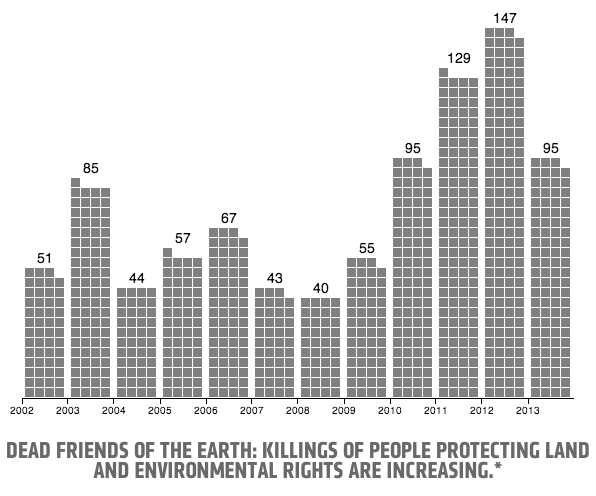
Between 2002 and 2013, at least 908 people were killed because of their environmental advocacy, according to “Deadly Environment,” a new report from the investigative nonprofit Global Witness. That’s an average of at least one environmentalist murdered every week, and in the last four years, the rate of the murders has doubled. In 2012, the deadliest year on record, 147 deaths were recorded, three times more than a decade earlier. “There were almost certainly more cases,” the report says, “but the nature of the problem makes information hard to find, and even harder to verify.”

In places like Myanmar, China, and parts of Central Asia, human rights monitoring is simply prohibited. In African countries like Nigeria, the Democratic Republic of the Congo, and Zimbabwe, where clashes over resources have escalated, researchers say it is impossible to track the violence without in-depth field investigations, because governments haven’t documented the killings. The most vulnerable activists are those in indigenous communities in remote, rural areas who are facing off against much more powerful business interests in industries like mining and logging. Much of the world never hears about their struggles, or their deaths. In other words, where environmental advocates are most at risk they are least visible.

Keating adds:

The most dangerous country in the world for environmentalists is Brazil, with 448 killings over the last 10 years. According to the report, “this can be attributed to Brazil’s land ownership patterns, which are among the most concentrated and unequal in the world.” The country’s rapid economic growth has frequently brought powerful business interests into conflict with small and medium-sized farms as well as indigenous groups, often with deadly consequences.

To be fair, the high totals from Brazil may also be a result of the fact that the country has a relatively robust civil society and media sector, so killings in the context of land and environmental disputes are more likely to be reported.

Putin vs The Internet

Michael Kelley explains why Russia is looking to assert more control over the Internet, which Putin said on Thursday was “a CIA project” and “is still developing as such”:

Today, Russia is leading the charge for breaking up the Internet as it currently functions by running Web traffic through servers in each respective country. “In two years we may get a completely different Internet,” Russian investigative journalist Andrei Soldatov told BI in January. “It might be a collection of Intranets instead of one Internet. Actually I think it’s very possible.”

Earlier this week, Russia’s parliament passed a law requiring foreign Internet services such as Gmail and Skype to keep their servers in Russia and save all information about their users for at least half a year. This would create a Russian ‘Intranet’ that would be separate from the globally-interconnected Web, much like social media website VKontakte now serves as Russia’s Kremlin-allied Facebook outside of Facebook.

Bershidsky focuses on the Kremlin’s attempt to censor blogs:

bill passed by the Russian parliament on Tuesday says that any blogger read by at least 3,000 people a day has to register with the government telecom watchdog and follow the same rules as those imposed by Russian law on mass media. These include privacy safeguards, the obligation to check all facts, silent days before elections and loose but threatening injunctions against “abetting terrorism” and “extremism.” This signals to bloggers that they will be closely watched and that Russia’s tough slander and anti-terrorist laws will be applied when the authorities think it appropriate. Bloggers who fail to register as media face fines of up to $900.

There was no international outcry as in the case of the Turkish Twitter ban. Only Dunja Mijatovic, the media freedom representative of the Organization for Security and Cooperation in Europe, called on Russian President Vladimir Putin to veto the bill, which he is unlikely to do because it fits in well with his recent oppressive policies. Perhaps Russia has already been written off as a rogue state because of its heavy involvement in the Ukraine crisis, and more curbs on its media freedoms are no longer an issue for the international community. For Russian bloggers, however, the bill – which will come into effect from August assuming that Putin signs it – is a sign that the government is coming for them.

Pavel Durov, the founder of VKontakte, Russia’s answer to Facebook, fled the country earlier this week, saying his company had been taken over by Putin cronies:

Durov explained that after seven years of relative social media freedom in Russia, his refusal to share user data with Russian law enforcement has set him at odds with the Kremlin, which has recently been trying to tighten its grip on the internet, according to The Moscow Times. VK’s former CEO says that despite his multiple refusals of Kremlin requests to censor his site in a similar fashion to how it filters print and TV news, the site — which boasts 143 million registered users globally, 88 million of whom are based in Russia — is now effectively under state control.

Keating takes a closer look at the “Internet sovereignty” movement:

Russia is one of a number of countries pushing the idea of “Internet sovereignty”: the notion that governments—rather than multinational corporations based in the United States or U.S.-founded agencies like the ICANN, which is responsible for the Internet’s global domain name system—should have control over their own internal cyberspaces. …

Internet sovereignty might be a little easier to take seriously as a concept if many of the governments that are most enthusiastic about it weren’t so blatantly interested in policing their citizens’ Internet use. Iran, for instance, has been for years been pushing a “national Internet” project aimed at keeping unwelcome outside influences from reaching its citizens.

Face Of The Day

INDONESIA-FRANCE-CRIME-DRUGS

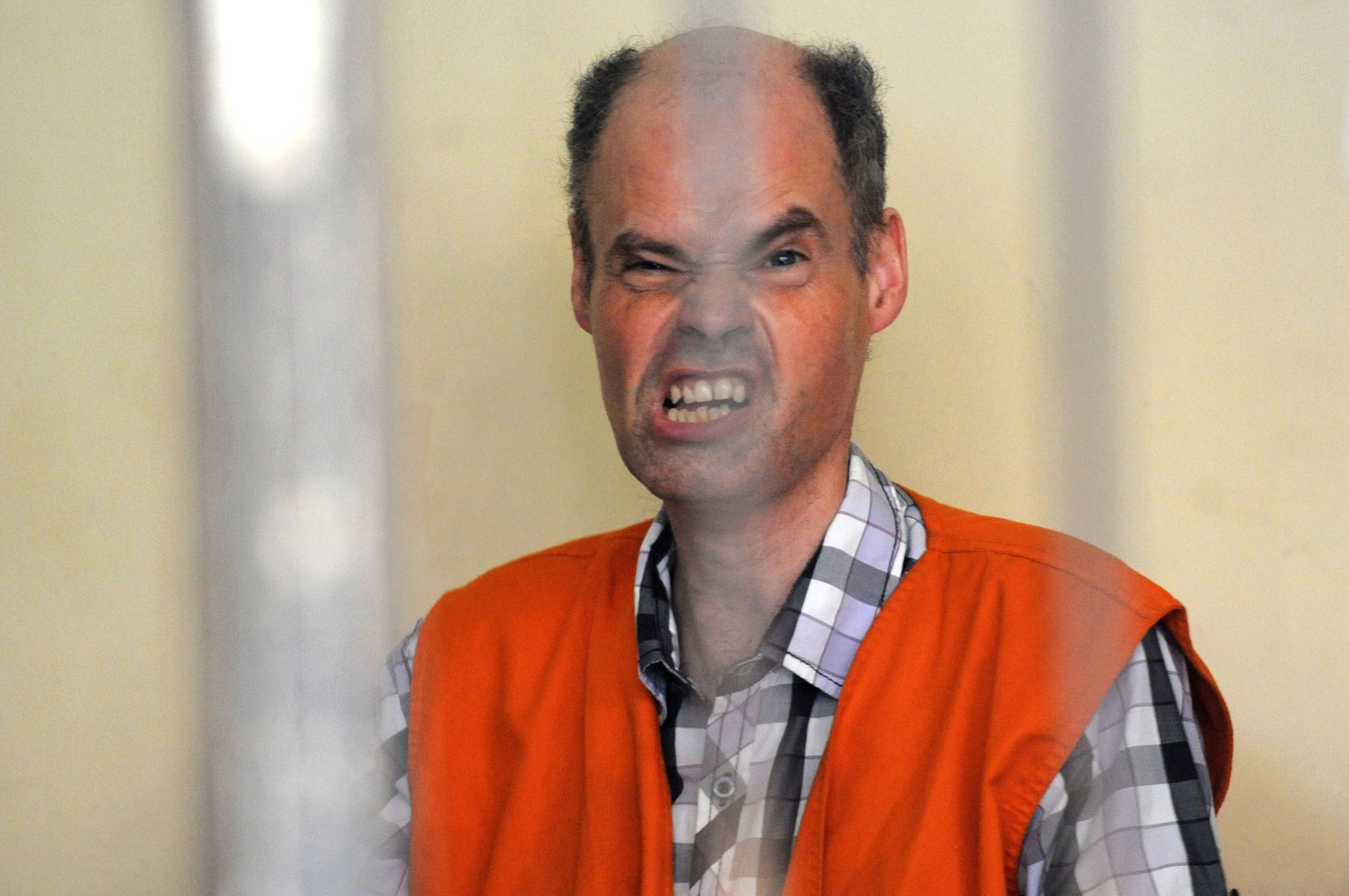
Francois Giuily of France reacts as he waits in a holding cell in Denpasar court, on Indonesia’s resort island of Bali. Giuily was arrested on January 19 carrying 3.083 kilos of methamphetamine in his luggage at Bali International Airport in Indonesia, an offence punishable by death. By Sonny Tumbelaka/AFP/Getty Images.

Palestinians Come Together, Peace Talks Come Apart, Ctd

Noah Feldman calls the unity deal signed between Fatah and Hamas a positive development:

A Palestinian national unity government could make sacrifices that a partial government never could. Fatah activist Marwan Barghouti, in Israeli jail since 2002, could potentially become a bridge between the Palestinian parties. No one is describing such an outcome as likely. But certainly Fatah without Hamas can’t make a meaningful deal.

So the Hamas-Fatah reconciliation is a good thing for the possibility of meaningful peace. You can’t make peace with half a people: You need all of them represented at the table. If the Palestinians can present a united front and willingness to negotiate, Israelis may well move toward political reconciliation over the possibility of a deal. The prospects for that may look bleak at the moment, but in the past, the Israeli public has been able to elect governments with a mandate to negotiate whenever the Palestinians managed to look like serious partners. We probably have no more than a decade to go in which a two-state solution remains possible. Palestinian reconciliation is a precondition for peace. Here’s hoping it sticks.

Jonathan Schanzer disagrees:

After the death of Yasser Arafat in 2004, the new Palestinian president, Mahmoud Abbas, brought an end to the intifada. Since then, to Abbas’ full credit, Fatah has maintained a course of nonviolence, and security cooperation with Israel has reached at an all-time high. To his discredit, however, incitement has continued, including the glorification of terrorists in the media. Fatah, in other words, has been wrestling with its demons. In fact, a controversy erupted recently when the Palestinian Minister of Religious Affairs, Mahmoud al-Habbash, came under fire by Fatah activists for condemning a terrorist attack against Israelis.

Yesterday’s reconciliation deal appears to have interrupted, or even ended, this important tug-of-war. Hamas’ embrace of terrorism is full-throated, and so is its rejection of Israel. So, while Fatah’s embrace of Hamas may lead to national unity, it bodes poorly for peace. It also portends poorly for the Palestinian nationalist movement as it takes its first steps into what appears to be a post-Oslo world.

Paul Pillar objects to Israel “invoking a label or slogan as if it were an acceptable substitute for policy”:

The Israeli prime minister says Hamas is “dedicated to the destruction of Israel.” Actually, Hamas leaders have repeatedly made clear a much different posture, one that involves indefinite peaceful coexistence with Israel even if they officially term it only a hudna or truce. It would be more accurate to say that Israel is dedicated to the destruction of Hamas, an objective that Israel has demonstrated with not just its words but its deeds, including prolonged collective punishment of the population of the Gaza Strip in an effort to strangle the group. Such efforts have included large-scale violence that—although carried out overtly by military forces and thus not termed terrorism—has been every bit as lethal to innocent civilians. In such circumstances, why should Hamas be expected to be the first to go beyond the vocabulary of hudna and mouth some alternative words about the status of its adversary?

The Israeli and U.S. reactions do not seem to take account of the fact that the terms of the announced Hamas-PLO reconciliation are undetermined and still under negotiation. The agreement can involve Hamas moving much more toward the posture of Abbas and the PLO than the other way around.

Avi Issacharoff points out that the outcry over Hamas’s inclusion has obscured the details of the reconciliation deal:

[I]f Netanyahu weren’t so busy looking for excuses to not talk to the Palestinians, he would discover a few interesting things about the agreement.

First, Abbas has potentially brought Netanyahu and the international community what they were demanding: a government, with no Hamas representatives, made up only of technocrats, without politicians and with Abbas himself at its head. The government is supposed to deal not only with the West Bank, but also with the Gaza Strip.

And maybe that is what is making Netanyahu nervous. If the agreement does go into effect, if a government presiding over the Gaza Strip and West Bank is created, and if elections are held, Netanyahu could find himself facing a real partner in the person of Abbas. All the “no partner” claims, citing the fact that Abbas doesn’t rule the Gaza Strip, will cease to be relevant.

Goldblog gets why Netanyahu pulled out of peace talks, given Hamas’s nastiness, but calls the decision myopic nonetheless:

Israel doesn’t get to pick its enemies. It has to make peace with the ones it has. Hamas is one of those enemies. And Netanyahu’s argument doesn’t take into consideration that, theoretically at least, the Palestinian Authority could, over time, help moderate Hamas and bring it more into the two-state fold.

But who am I kidding? Maybe both of Netanyahu’s superficially contradictory beliefs are true. Maybe he can’t make peace with a divided Palestinian entity. And maybe he can’t make peace with a unified Palestinian entity. Maybe he can’t make peace with any Palestinian entity because members of his own political coalition are uninterested in taking the steps necessary for compromise.

Arguing that the “peace process” has become a charade, Ami Ayalon urges Israel to pursue a policy of “constructive unilateralism” in preparation for more substantive peace negotiations when the facts on the ground have improved:

Israel could also take steps that move it closer to its goal of securing its future as a Jewish democracy: declaring it has no sovereignty claims over areas east of the security fence, enacting a voluntary evacuation and compensation law for settlers who reside in these areas (while the Israel Defense Forces remain in those areas until an Israeli-Palestinian agreement is reached) and planning the absorption of these settlers back in Israel proper.

The next constructive step should be the Palestinian admission into the United Nations in September provided the Palestinians accept the international community’s conditions to renounce terror, recognize Israel and recognize previous agreements. The United States has a key role in facilitating this step.

Once progress is made in creating the reality of two states, negotiations can be restarted from a point much closer to a real Israeli-Palestinian agreement.

The Greatest Year In Film? Ctd

A reader adds to a previous pick:

1994 also feature two of the greatest documentaries of the 20th Century, Crumb and Hoop Dreams (both of which were controversially omitted from the Best Documentary and Picture categories of the Oscars). It was also the year that Wong Kar-Wai broke through with Chungking Express, and Peter Jackson made waves with Heavenly Creatures. And of course, Jackie Chan released his penultimate film, Drunken Master IIKevin Smith also made his debut with Clerks, triggering the next wave of DIY filmmakers that would produce and market films (and themselves) outside the studio system, and setting the stage for the next generation of filmmakers, comics and showrunners that would grow up with the Internet. It really was a killer year.

Another begs to differ:

1996? Ugh. I’ll never forgive that year for foisting Vince Vaughn AND Owen Wilson upon us. The greatest year for film was 1984, hands down:

Beverly Hills Cop, Ghostbusters, Indiana Jones and the Temple of Doom, Gremlins, Karate Kid, Footloose, Romancing The Stone, Splash, Purple Rain, Amadeus, The Natural, Bachelor Party, The Terminator, The Gods Must Be Crazy, Starman, The Last Starfighter, Muppets Take Manhattan, Sixteen Candles, This Is Spinal Tap, Top Secret!, The Neverending Story, Body Double, Star Trek III: The Search For Spock, Revenge of the Nerds, Once Upon A Time In America, Dune, Police Academy, Against All Odds, Repo Man, Night of the Comet, Toxic Avenger, Red Dawn 

Even Jason had his arguably best turn (Friday The 13th: The Final Chapter) and Freddy was born (A Nightmare On Elm Street). Suck on that, 1939.

Another fan of 1984:

Now, these aren’t “Oscar” caliber films by any stretch of the imagination – in fact it was an incredibly weak Academy Awards year – but the deep impact of these movies, for a generation who grew up in the ’80s at least, is almost beyond the reach of any statues or honors. Almost each one of these films was a genre defining, cinema shattering event (not to mention providing about three-fifths of all movies airing on cable between 1-6 PM on any given weekend).

Update from a reader:

Since some readers are treating the subject of the greatest year in film as My Favorite Hollywood Popcorn Flicks of My Youth, maybe it’s time for us film snobs to set the record straight.

While 1939 and 1974 have their partisans, I’d have to say film’s greatest year was 1959.

1959 saw the emergence of the French New Wave, with Francois Truffaut’s The 400 Blows and Alain Resnais’ Hiroshima, Mon Amour.  It also featured John Cassavetes’ landmark independent film Shadows, which inspired countless young filmmakers to see what they could do with a 16mm camera and a shoestring budget.  It saw Robert Bresson’s classic Pickpocket and Tony Richardson’s Look Back in Anger, which is one of the greatest, if not the greatest, of the British postwar social realist films.  Less often mentioned is Kon Ichikawa’s harrowing Fires on the Plain, which I consider one of the very few genuinely anti-war films ever made (most get too caught up in the machinery and the “shock and awe” of war – Exhibit A is the “Ride of the Valkyries” scene from Apocalypse Now.)

Hollywood was no slouch either, in 1959, releasing perennial favorites Some Like It Hot, Ben-Hur, and North by Northwest.  It also saw the release of Otto Preminger’s Anatomy of a Murder, with its frank and theretofore unheard-of discussions of semen, penetration, and that famous pair of torn panties.  Preminger had been fighting against the Production Code his whole career, and Anatomy of a Murder may have represented his final victory: the Code by that point was so weakened that it gave his film the green light anyway, sealing its own obsolescence.

Of course, my favorite youthful year for popcorn flicks was 1986, but that’s a totally different subject.  ;-)

One more:

I’m surprised more readers haven’t posted about the ’70s. I really think it was the last legitimately great decade for American film. Don’t get me wrong, there have been some great gems since then, but the ’70s had a combination of revolutionary dramas, blockbusters, horror films, and comedies that I don’t think any decade since can match.

Take 1974: The Godfather Part II, Chinatown, Blazing Saddles, Young Frankenstein, and Texas Chainsaw Massacre. My favorite year might be 1975 though: Jaws, One Flew Over the Cuckoo’s Nest, Barry Lyndon, Return of the Pink Panther, Monty Python and the Holy Grail, Dog Day Afternoon. All amazing movies that blow pretty much the decades of the ’80s, ’90s, and certainly the 2000s out of the water.