Will Obamacare Help Democrats?

Senate ACA

Sam Stein and Sabrina Siddiqui examined the websites “for 186 House Democrats up for reelection (we didn’t count those who’ve announced retirements), as well as 20 Democrats running for Senate (including three current House members and a few clear frontrunners who don’t currently hold federal office)”:

The results tell the story of a party still skeptical of the law’s political benefits, but overwhelmingly committed to upholding President Barack Obama’s signature piece of legislation. House Democrats are far more excited about Obamacare, with many members overstating the critical role they played in its passage. Senate Democrats seem more inclined to whitewash the entire bill from the public’s memory — the majority of Senate candidates avoid mentioning Obamacare at all. Only three candidates among the 206 whose websites we checked had an overtly anti-Obamacare message — and even those three don’t advocate repealing the law outright.

Josh Green expects Democrats to benefit from Obamacare in the long run:

I think the health-care law will still prove to be a net plus for Democrats in many races—a few this fall, and many more in future elections. The reason why is easier to understand if you flip the issue around and look at it from the Republican side.

Conservative orthodoxy still holds that Obamacare is a socialist abomination, and this requires Republican candidates to continue to advocate its repeal. It’s true that the law’s repeal is a strong motivator for Republican voters, and that does carry electoral advantages. But in practice, repealing Obamacare would entail dissolving popular state plans such as [Kentucky’s health care exchange] Kynect. Voters are bound to notice and make the connection.

Kentucky’s Democratic governor, Steve Beshear, on Tuesday declared the law an “indisputable success” and said 413,000 Kentuckians had gained private or Medicaid coverage through Kynect. As the Washington Post’s Greg Sargent notes, Beshear has a 56-29 approval rating. But Senator Mitch McConnell, the Kentucky Republican running for reelection, remains wedded to the notion of repeal. Now, Democrats in the state are going after him for wanting to abolish not Obamacare, but Kynect.

Jonathan Bernstein’s view:

If you ask people whether government should “do more” or “do less” on health care, the liberal argument is going to come out on top with everyone except a small group of seriously ideological conservatives.

Making Obamacare the central issue in health care tends to obscure that Democratic advantage. That may be why Republicans would want to continue to keep the debate going. It also appears that Obamacare motivates Republican voters, for now at least. I’ve always believed this is arbitrary. Republican voters will always be motivated by whatever issue that Republican politicians, opinion leaders, and party-aligned media choose to emphasize. If the focus switched to Common Core, for example, Republican voters would follow. It’s difficult to see them moving away from Obamacare anytime soon, however, given their investment.

Cillizza, on the other hand, argues that Obamacare is still a problem for Democrats:

Republicans HATE the law. Democrats like it.  That’s why, in Louisiana, almost six in ten registered voters said that they would not vote for a candidate who did not share their views on the law. While some of that number is surely Democrats who wouldn’t vote for a candidate who was against Obamacare, all of the other data out there about the law suggests that the energy on the issue is with the folks adamantly opposed to it.

Given that, the gap between those saying they wouldn’t vote for a candidate who disagreed with them on the Affordable Care Act and those who said they would is another way to gauge intensity around the law. And while the 30-point gap between “wouldn’t vote” and “would” is widest in Louisiana, it’s still quite large in North Carolina (18 points) and Arkansas (17 points). In Kentucky, where the state-run insurance exchange is working as well as any in the country, there appears to be less political heat around the law, with those who wouldn’t vote for a candidate who shared their  view on the ACA running only seven points ahead of those who said they could vote for a candidate who disagreed with their view.


The Right’s Blindness To Race

Beutler was not shocked by Bundy’s racist remarks:

It’s hard to put this delicately, but a tax-protesting, government-rejecting, gun-toting white rancher from the Old West is fairly liable to say and believe some pretty uncouth things, including about race. I didn’t know Bundy was a racist until Thursday, but I was utterly unsurprised by the revelation. I doubt many liberals were terribly shocked either.

His explanation for why “many, many conservatives—even conservatives with presidential ambition—were caught completely flatfooted”:

When certain conservatives object to liberal characterizations of the American right, and when they bristle at suggestions that conservative policies draw some of their political vitality from unreconstructed racists, or resentful white voters, or anything other than ideologically pure freedom fighters, they aren’t playacting. At some point, to those conservatives, willful blindness to the political power of white conservative populism became unwillful. As far as they were concerned, anyone arguing that welfare-state opposition (or tenth-amendment fetishism or any other conservative hobbyhorses) derived any political support from racist whites was trafficking in racial McCarthyism. Perhaps at some point they had assumed a defensive crouch to protect themselves and their tribe from an uncomfortable reality, but eventually they grew comfortable in it.

Relatedly, Barro finds that Bundy’s big-government grievances resonate most strongly among whites:

The rush to stand with Mr. Bundy against the Bureau of Land Management is the latest incarnation of conservative antigovernment messaging. And nonwhites are not interested, because a gut-level aversion to the government is almost exclusively a white phenomenon. A 2011 National Journal poll found that 42 percent of white respondents agreed with the statement, “Government is not the solution to our problems; government is the problem.” Just 17 percent of blacks, 16 percent of Asians and 25 percent of Hispanics agreed.

And Weigel explains why Bundy’s downfall matters:

Bundy had the potential to become a galvanizing figure for a cause that’s hard to get people excited about. For a very long time, conservatives have been campaigning to take back federal lands, give them to the states, and let businesses or farms—or whatever—develop them. Having spent many hours inside the air-conditioned ballrooms of conservative conferences like AFP’s “Defending the American Dream Summit,” I’ve seen presentations about the government’s choke-hold on usable land. Other reporters, who’ve tracked legislation in Western states, have watched Arizona and Utah pass bills demanding the feds turn over tens of millions of acres to the states.

The problem, as Jessica Goad and Tom Kenworthy noted, was that Western voters didn’t care.* By at least a 2–1 margin in a recent Colorado College State of the Rockies survey, they did not think “having too much public land” was a problem. Enter Cliven Bundy. His years-long battle with the feds came to a head last month, and conservatives from Arizona Rep. Paul Gosar to Kentucky Sen. Rand Paul to likely next governor of Texas Greg Abbott rallied to him.

Sponsored Content Watch

Screen Shot 2014-04-24 at 12.20.12 PM

Alex Mayyasi wonders why that those “recommended links” you see appended to so many stories on legitimate news sites seem to have gotten a pass in the sponsored-content debate:

On one hand, that might be understandable. Taboola links don’t seem nearly as deceptive as a full article. Over email, Taboola CEO Adam Singolda pointed out that companies like Facebook and Google host links or advertisements from Moneynews and the Aftershock Survival Summit. This author’s daily e-mail from The New York Times includes ads for financial products and mortgage sites just as scammy. Is Taboola sponsored content any different from trashy ads?

But in the case of scammy ads, the difference between an ad and a sponsored link is crucial. The illusion of journalistic integrity provided by the news publishers that host these “headlines” is key to the sale of these useless financial products, scam diet pills, and shady mortgage deals. “With Outbrain Amplify,” Outbrain tells customers, “links to your content appear as recommendations on the web’s largest content publishers including sites like Wall Street Journal, Reuters & People.com.” Bloomberg NewsThe Atlantic, and the other publications hosting sponsored links are not just hosting advertising for these deceptive sales pitches; they are enabling them.

And the beat goes on.

(Image from Politico)

Book Club: Did Jesus Know He Was God?

Thousands Meet For  2nd Ecumenical Kirchentag

Readers get the conversation started:

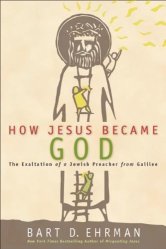
I find Ehrman too reductive in his search for what’s true. The same lens of critique that he applies to the literalist – that a certain passage is contradicted, or impossibly out of context – can also be applied to his own conclusions.

For instance: So Jesus is not quoted as explicitly stating that he is God. Does that mean that he himself didn’t believe it? We know that the gospels can’t be trusted as a source of word-for-word quotation – that’s a central part of the author’s set-up. That means finding a lack of such clear self-proclamation doesn’t mean that in Jesus’s own mind, or in his private conversations, he didn’t expressly believe in his own divinity. Perhaps there are rhetorical reasons for why the authors of the gospels withhold such an explicit declaration? Perhaps it’s more powerful and compelling for how it is revealed?

Similarly, we’re left with a problematic assertion if we see Jesus primarily as how-jesus-became-godan apocalyptic preacher: He was wrong, unless you interpret his “prophesy” as being epochal in time span rather than immediate (in the mind of God a generation could last thousands of years, one supposes). But isn’t it equally possible that this clear assertion of his apocalyptic preaching are also examples of rhetorical flourish on the part of the writers – to convince people through fear to change their fundamental belief system?


In the end, what do we know? I think you should consider staying clear of words like “truth,” and instead position the gospels and religion as sources of “meaning.”

These are two sharp points. I’d summarize them this way: The very limits of what these texts can tell us about what actually happened not only leaves the possibility that Jesus had no idea he was God, but for that very reason also leaves the possibility that he did. Both are in the texts. And when you zoom out a little, the very limits of our understanding of this man – filtered through the game of telephone of repeated oral memories – leave a span of possibilities open. The Gospels themselves offer us a variety of contradictory interpretations and factual accounts of many aspects of Jesus’ life and teaching. Maybe instead of trying to make them all make sense, we should let go a little, and accept that we will never fully know and never fully understand. Jesus, to borrow a phrase, is a known unknown and also an unknown unknown. And the very fallibility of the texts make this an unavoidable conclusion.

The Incarnation itself is, of course, utterly baffling. Ehrman shows this by charting an exhaustive survey of how early Christians tried and kept failing to understand it. A human who was exalted to divine status at his death? At his baptism? At his birth? Before his birth? From the beginning of time? You can watch the Christian imagination expand as the years go by when grappling with the ineffable concept of a person both fully human and fully divine. And at every resting point, the idea eludes any rational understanding.

To wit: If Jesus were divine, he would know everything, including his future resurrection, right?

And yet he is clearly racked with fear and agony and doubt throughout the Gospels – sometimes because, we infer, he knows what is about to happen (as in the Garden of Gethsemane), but sometimes also because he appears not to know what is about to happen (did he let Lazarus die by mistake or by design?). How, for that matter, could an omniscient God cry on the cross at his hour of death: “My God, my God, why have you forsaken me?” The narrative of Jesus makes no sense if he is merely a divine omniscience inhabiting a human shell. And it makes even less sense if he is a fallible human being completely bewildered by what is happening to him.

book-club-cartoonSo for me, over the years, as I have thought and prayed and simply wondered about this, I’ve come simply to the conclusion that it makes sense only to God, to a consciousness far greater than a human one, and that if we are to believe, we have to believe in this doctrine as essentially a mystery. I know agnostic and atheist readers will find this a cop-out, and it is, rationally speaking. All I can say is that my own experience of Jesus as a living God in my own life forces me to this unsatisfactory position. I cannot rationally reconcile the divine and the human as single concept. But my faith, my personal experience of Jesus, forces me to accept it.

But if I cannot rationally accept it, what do I mean by accept? I mean an embrace of wonderment at what the force behind all things can be beyond any human understanding. And I mean the sacrament of the Mass which, far from attempting to explain Jesus’ divinity in human form, merely claims to demonstrate it in ritual. I mean the sacrament of nature, where what is absolutely subject to rational understanding, from the viewpoint of science, nonetheless escapes those parameters when one simply regards it with awe. I mean an afternoon in early autumn at the end of Cape Cod, where light and water congregate and commune in something I can only call transcendent. We live in a universe both material and wondrous – and neither denies the other. That is how I have come to accept the incarnation as mystery and as necessity – both in Jesus and in the world.

(Please email any responses to bookclub@andrewsullivan.com rather than the main account. Unfiltered thoughts from readers on Facebook here.)

(Photo: The monumental main cross, symbolizing the Christian faith, is silhouetted in a puddle at the Theresienwiese during dusk of day 1 of the 2nd Ecumenical Church Day in Munich, Germany on May 12, 2010. By Johannes Simon/Getty Images. The original post contained the rather English term “Chinese whispers”, which confused many readers, so I’ve change that phrase to “game of telephone” which is the American equivalent. )

The Payoff From Vaccination

Vaccination Numbers

It’s massive:

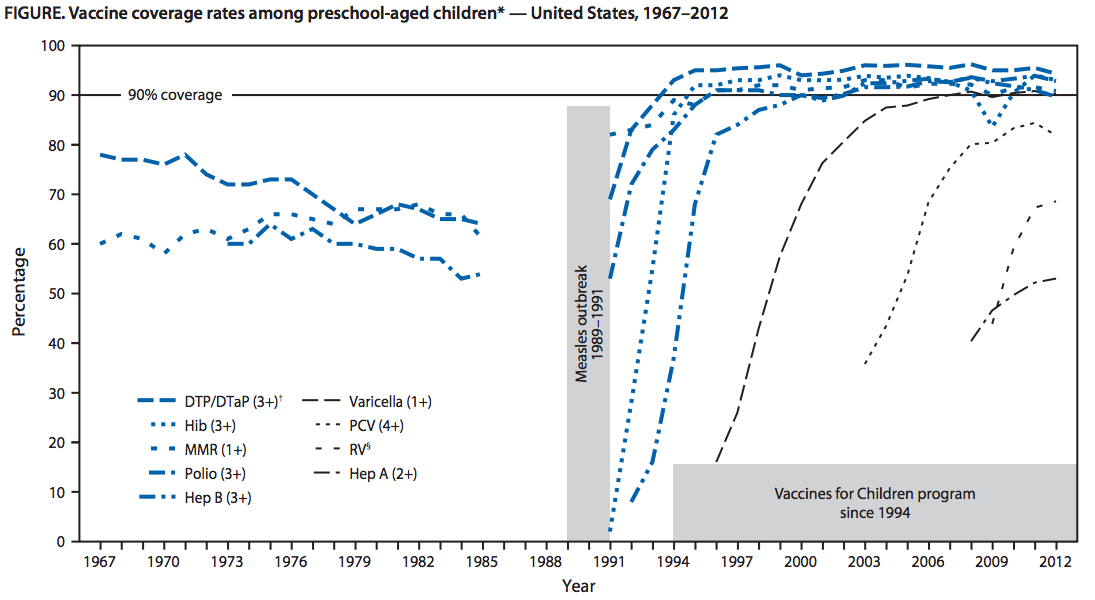
In 1994, the United States, fresh off a measles epidemic, instituted the Vaccines for Children program to ensure that all children, regardless of income, could get vaccinated. … [T]he Centers for Disease Control says that the program, which is funded through Medicare and Medicaid, has had a staggering effect. You can see it in the vaccination rate alone: In the late 1980s, roughly 70 percent of children were vaccinated for common childhood illnesses—after the program was started, that number jumped well over 90 percent. Take a look:

The vaccines will prevent, according to the CDC,

  • 322 million illnesses
  • 21 million hospitalizations
  • 731,700 deaths

Those reductions will save roughly $295 billion in direct hospitalization and other costs associated with disease and will save $1.38 trillion in total society costs, the organization says.

Puff, Puff … Pass

Legalization activists are waiting for 2016:

To be sure, this fall there may end up being only a couple of marijuana initiatives on the ballot. Florida voters will decide on a constitutional amendment providing for medical marijuana, and a full legalization initiative could make it to the ballot in Alaska. Advocates are also trying to put a measure on the ballot in Oregon.

But if you’re a legalization advocate, you actually shouldn’t want to have an initiative on the ballot this year. In state after state, advocates have decided to wait until 2016, when they know more of Democrats and young people will be going to the polls to vote for president, to put the question to the voters. Advocates in California considered mounting a push this year, then put it off until 2016. That presidential year could also see initiatives in Arizona, Maine, Massachusetts, Montana, and Nevada, and possibly other states as well.

DC could be an exception:

In order to put Initiative 71, the “Legalization of Possession of Marijuana for Personal Use Act of 2014,” on the November ballot, they will need to collect 23,000 signatures by July 7, which shouldn’t be too hard to do in an extremely liberal city of 600,000 people. A Washington Post poll from January found that 63 percent of the city’s residents favor legalization.

Jon Walker believes that Alaska’s initiative could help Democrats keep the Senate:

According to a new analysis by the New York Times, Alaska is the most competitive Senate race this year with Democrats and Republicans having exactly a 50 percent chance of winning. More importantly, it is also currently projected to be the tipping point election which will decide control of the Senate. On November 4th the nation could easily be up late waiting for result from Alaska to tell us if Democrats end up with a 50 senator majority (plus the Vice President who is the tie breaker) or 49 seat minority.

This one recently moved marijuana legalization initiative may just prove to be the small edge Begich, and by extension the entire Democratic party, needs for a close win.

The Roots Of Resegregation

Razib Khan asks why discussions of resegregation focus on the South:

The South has a particular history with race, and that is an important history. But the continuous focus on this region of the country is I think driven in part by the reality that the cultural elites, often white progressives, are not keen on shining a light on the segregation which they themselves have passively accepted in their own lives.

In fact the worst segregation of blacks and whites is in major urban areas of the Great Lakes. According to the Census the most segregated cities are Detroit, Milwaukie, New York, Newark, and Chicago. But for some reason there are fewer exposes on how upper middle class, usually white, couples in major “Blue America” urban areas flee racially diverse public schools for the suburbs or private schools. The reasons for these actions are defensible in my opinion, but one should probably admit that these are likely the major causes of resegregation in the South as well.

To further his argument, Khan cites Reihan Salam’s recent piece on interracial dating. Reihan argues that intermarriage is an important social good:

There are good reasons to question the moral appropriateness of strong same-race preferences and their close cousin, in-group favoritism.

In The American Non-Dilemma, Nancy DiTomaso argues that persistent racial inequality in the United States is not solely or even primarily a reflection of racism and discrimination. Rather, it reflects the fact that whites tend to help other whites without ever discriminating against or behaving cruelly toward blacks and other nonwhites. As long as whites tend to dominate prestigious occupations, and as long as they control access to valuable social resources like access to good schools, the fact that whites, like all people, will do more to help family, friends, and acquaintances than strangers will tend to entrench racial inequality, provided that white people choose to associate primarily with other whites. DiTomaso observes that while Americans place very high value on the idea of equal opportunity, virtually all of us seek “unequal opportunity” in our own lives by leveraging our intimate relationships to achieve our goals, including our professional goals. Yet most of us don’t see the help of family and friends as an unfair leg up. This kind of “opportunity hoarding” is accepted as par for the course.

We could make an effort to eliminate in-group favoritism, but such an effort would inevitably fail, as in-group favoritism is a powerful human impulse. A more sensible course of action would be to do our part to expand the boundaries of the in-group.

Khan adds:

What if in fact most racial inequality is a function of social-cultural racism, rather than institutional racism?

Recent Dish on resegregation here and here.

Go, Go, Fight, Fight, Pay Us A Living Wage, Alright?

Emily Shire lists the grievances of the former Buffalo Bills cheerleaders who are suing the franchise for minimum wage violations and a host of other indignities:

[T]he alleged exploitation was more than just unpaid labor. The Buffalo Jills allege that Stejon [Productions Corp]  and Citadel [Communications Co.] essentially ran a racket, forcing the women to buy calendars and other Bills-related items out of pocket and then sell them on their own time. They even imposed damages if they failed to sell their quotas, according to the suit. Each woman was required to buy 50 to 75 Buffalo Jills swimsuit calendars at $10 each and sell them. If she did not sell them, she was left in the red and “subject to further penalties at the discretion of defendants.” The same went for Jills golf tournament tickets and gift baskets, which could cost each woman $590. Other out-of-pocket expenses included travel and hotel accommodations for the events they had to attend and $650 in uniform costs, the suit says.

That’s not all. From exposure to sexual harassment to menstrual hygiene instructions, the alleged physical appearance rules paint a deeply disturbing picture of archaic, invasive, and manipulative requirements. According to the lawsuit, the Buffalo Jills were given a list of 17 rules governing “general hygiene and body maintenance.” They included “how to properly wash ’intimate areas’ and how often to change tampons.”

Noting that the Jills’ lawsuit comes on the heels of similar actions by the Oakland Raiderettes and Cincinnati Ben-Gals, Amanda Hess asks why these women’s poor pay and exploitation are only just now coming into the spotlight:

Professional cheerleaders have always presented a dilemma for the traditional feminist movement. On the one hand, feminism is committed to fighting for fair pay for women in all areas where they are discriminated against because of their gender. On the other hand, this particular kind of labor—one where women, not men, are enlisted to jiggle their assets at the local golf tournament—suggests another kind of gendered exploitation, and one that’s hard for some feminists to rush to defend. (Headlines about the recent spate of cheerleader lawsuits may focus on the scandalous details, but looking sexy for men is a feature of the job, not a bug.) Lately, it seems the feminist movement has caught up to the cause; it’s no longer particularly controversial to stand up for the legal rights of the women who perform work that nevertheless fails to reflect the ideal, gender-equitable society.

Back in January, Billy Haisley also covered the mistreatment of cheerleaders. He spoke with a former Ravens cheerleader:

For cheerleaders, the real money comes from appearances. It’s still not all that great. If the appearance is for charity, the team will charge $175 per cheerleader per hour; otherwise, it’s $300 per hour. Of that money, our tipster explains, each cheerleader takes home around $50 an hour. Sounds good, but in an average season, a cheerleader will make only 30 or so appearances, and many of those don’t pay at all. For certain charity events, like those set up in the NFL’s or the team’s own name, cheerleaders are expected to attend without compensation, and rules require them to attend charity events at least twice monthly, depending on availability.

Terrorism Works

After investigating the role of terrorism in civil wars in Africa, Jakana Thomas comes away with the sobering conclusion that it’s often a successful tactic:

The popular adage that governments “do not negotiate with terrorists” appears to be untrue, at least in civil war. In a new study published in the American Journal of Political Science, I find that governments embroiled in domestic conflicts in Africa between 1989 and 2010 are more likely to hold negotiations with rebel groups when they engage in more acts of terrorism. Rebels are also likely to gain more concessions from their governments when they execute more terror attacks. …

Instead of asking whether terrorism is effective, we should be concentrating on when and for what purpose is terrorism effective, especially since the empirical record shows that terrorism has both hurt and helped the causes of violent organizations that have employed the tactic. Very little extant research, however, helps us understand this variation.

Reed Wood, co-author of a similar study, makes related points:

Attacks on civilians, we argue, hurt the state more than the rebels — even where the rebels are the ones committing most of the violence. In part, this occurs because maintaining order is central to the state’s victory whereas disorder, instability, and the erosion of state control directly benefit insurgents. When insurgents rely on civilian victimization, they impose significant costs on the state and send credible signals about their willingness to continue fighting a long, costly, and brutal war. The effect is that governments are increasingly likely to make concessions to violent groups, thus permitting the group to attain some of its political goals.