Syria’s Gritted Teeth Compliance

Some decent news from a dipl0matic initiative that many once decried as doomed:

The delivery of chemical agents to the Syrian port of Latakia, completed on Sunday, was the second in three days. It raised the share of Syrian chemical agents handed over for destruction to slightly more than 65 percent, the Organization for the Prohibition of Chemical Weapons said in a statement from its headquarters in The Hague. The country has now delivered a bit more than 57 percent of its most dangerous, so-called priority one, chemicals, and 82 percent of less toxic, priority two chemicals, said Michael Luhan, a spokesman for the organization.

They’re late and there’s still some compliance issues. But it would be churlish to deny that we are indeed approaching the goal set last autumn – to rid the Assad regime of chemical weapons, none of which have been used since the deal was reached. This strikes me as another issue – the ACA, for example – in which the Obama administration is routinely assailed, but where actual tangible progress continues.
How We See Our Overseers

dish_surveillancemetaphors

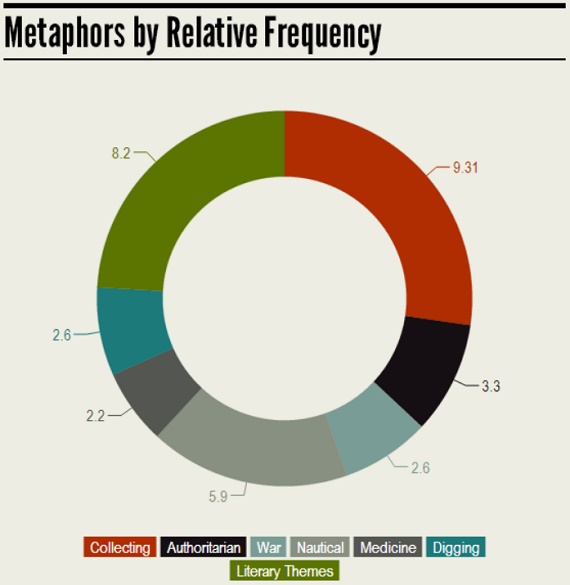
In a study of how news media talks about surveillance, PEN found evidence of “rich thematic diversity in the types of metaphors that are used, but … also a failure of imagination in using literature to describe surveillance”:

[S]cholars and activists have observed that relating U.S. government surveillance regimes to Big Brother overstates the case, because the U.S. is a more open society than the one 1984 describes and, despite the NSA’s overreach, the country should not be labeled authoritarian. Scholar Daniel J. Solove, for example, pointed out in a seminal article that Kafka’s novella The Trial is probably better suited:

We are not heading toward a world of Big Brother or one composed of Little Brothers, but toward a more mindless process — of bureaucratic indifference, arbitrary errors, and dehumanization — a world that is beginning to resemble Kafka’s vision in The Trial.

Other activists prefer to use Jeremy Bentham’s notion of the panopticon, an institution that allows those with power to create the perception that their subjects are under surveillance at all times. But for journalists and bloggers, the rich variety of literature that has tackled surveillance — from science fiction to modern novels — is rarely invoked. Orwell is the reigning king of the surveillance state.

What do these results mean? The fact that 91 percent of articles contain metaphors suggest that writers will continue to use metaphors to help us understand advances in technology. They also use a diverse range of metaphors. However, as advocates develop new messaging on surveillance and look to literature for inspiration, they should not stop at Orwell: there are many more literary treasures to be explored. … Aaron Santesso and David Rosen, for example, have shown that the Eye of Sauron in J.R.R. Tolkien’s Lord of the Rings better captures the current surveillance state, but so too do plays by Shakespeare, such as The Tempest.

Hunger Habits

“When it comes to what we eat,” advises Konnikova, “we should be far less concerned with how we feel and far more focussed on—and wary of—when, where, and how we eat”:

In 2011, Mark Bouton, a psychologist at the University of Vermont, conducted a review of the types of conditional and operant stimuli that increase a craving for a specific food or our desire to eat more generally. He found that two types of cues play an important role. On the one hand, there are food-specific cues: a certain packaging or color associated with a preferred food (say, the distinctive red and orange of a Doritos logo and bag), a certain sound (someone opening the bag), a certain smell (the scent of the chips), or a certain taste (a hint of saltiness). But equally important are environmental cues that seem unrelated to food: the couch on which you typically watch movies while eating popcorn, a social gathering like a Super Bowl party, a sporting event, a shopping mall. These cues, in turn, are very difficult to unlearn. If you have a habit of snacking on Oreos while watching “Mad Men,” it will be tough to get through an episode without craving your cookie.

Social Mobility And The Single Mom

houseofdebt_20140409_11

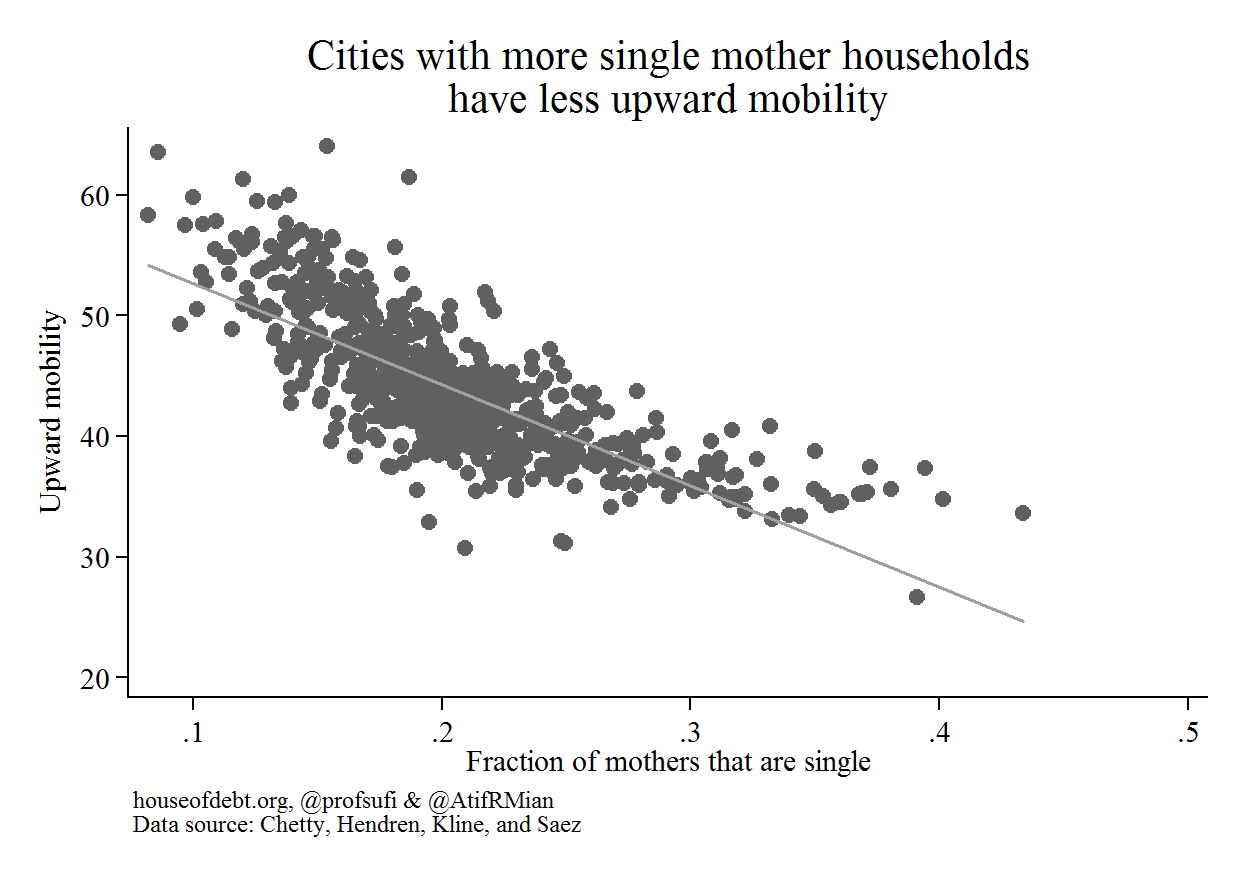
Emily Badger complicates the relationship between single motherhood and poverty, pointing out that it’s not at all clear which is the cause and which the effect:

That chart could easily be embraced by those convinced that “culture” is the problem here, that we should blame the prevalence of single mothers — or the absence of fathers — for the fact that poor children have little chance to move up in the world in some communities.

But that argument ignores what marriage might actually look like to a woman living in a neighborhood with high rates of poverty, unemployment and incarceration. It’s true that marriage can bring stability and emotional benefits to the children of middle- and upper-class families. But that’s not because the institution of marriage itself is universally beneficial. It’s because certain kinds of marriages are beneficial, such as those between adults who don’t have to worry about getting evicted, who can afford to pay their medical bills, who don’t contend with the surrounding stresses of violence or joblessless or having to get to work without a car.

The Politics Of Sprawl

Richard Florida compared “rankings of sprawling and compact development to voting patterns, as well as other significant economic and demographic variables”:

In recent decades, America’s politics have exhibited a new trend, where Red America finds its home base in some of the country’s most sprawling places, while Blue America is centered in denser, more compact metros and cities. … The connection between sprawl and conservatism come through loud and clear in our analysis of more than 200 of America’s metro areas. Our correlations suggest that sprawled America is Red America, while Blue America takes on a much more compact geography. The Sprawl Index was negatively associated with the share of voters in a metro who voted for Mitt Romney in 2012 (with a correlation of -.44); and it was positively associated with the percentage who voted for Barack Obama (.43). These were among the strongest correlations in our analysis.

This is in line with other research that connects sprawl or density and political affiliation. Researchers have identified a tipping point of roughly 800 people per square mile where counties shift from Red to Blue, as I noted in the weeks following Barack Obama’s reelection. Princeton historian Kevin Kruse similarly explained this spatial link between a spread-out landscape and Republican political positions to the New Republic. “There are certain things in which the physical nature of a city, the fact the people are piled on top of each other, requires some notion of the public good,” he said. “Conservative ideology works beautifully in the suburbs, because it makes sense spatially.”

Recent Dish on sprawl here. More from the archives here and here.

Walk This Way

Following in the steps of Monty Python, the art collective Kreativiteket has set up a “silly walk” traffic sign in the village of Ørje, Norway:

While a government grant wasn’t obtained to help them develop it, the crosswalk’s street sign–which features the outline of a man in a bowler hat walking all silly-like–makes it clear that crossing this street must be done in a silly manner. Residents seem to be fine with this, and so do the authorities–while a news report explains that the sign is technically illegal, the village’s mayor has a hard time not laughing when she insists that “This kind of fun should be allowed.” Even motorists stopping at the intersection for silly-walking pedestrians seem to be having a good time. Who can argue with anything that makes drivers feel generous toward slow-moving pedestrians?

Embrace The Boredom

Shane Parrish challenges the notion of idleness as a moral failing, quoting from Andrew Smart’s Autopilot: The Art And Science Of Doing Nothing:

Our brain, much like an airplane, has an autopilot, which we enter when resting and “relinquishing manual control.”

The autopilot knows where you really want to go, and what you really want to do. But the only way to find out what your autopilot knows is to stop flying the plane, and let your autopilot guide you. Just as pilots become dangerously fatigued while flying airplanes manually, all of us need to take a break and let our autopilots fly our planes more of the time.

Yet we hate idleness don’t we? Isn’t that just a waste?

Our contradictory fear of being idle, together with our preference for sloth, may be a vestige from our evolutionary history. For most of our evolution, conserving energy was our number one priority because simply getting enough to eat was a monumental physical challenge. Today, survival does not require much (if any) physical exertion, so we have invented all kinds of futile busyness. Given the slightest or even a specious reason to do something, people will become busy. People with too much time on their hands tend to become unhappy or bored.

Yet, Smart agues, boredom is the key to self-knowledge.

What comes into your consciousness when you are idle can often be reports from the depths of your unconscious self— and this information may not always be pleasant. Nonetheless, your brain is likely bringing it to your attention for a good reason. Through idleness, great ideas buried in your unconsciousness have the chance to enter your awareness.

Meanwhile, researchers recently found that “procrastination and impulsiveness are both at least moderately heritable.”

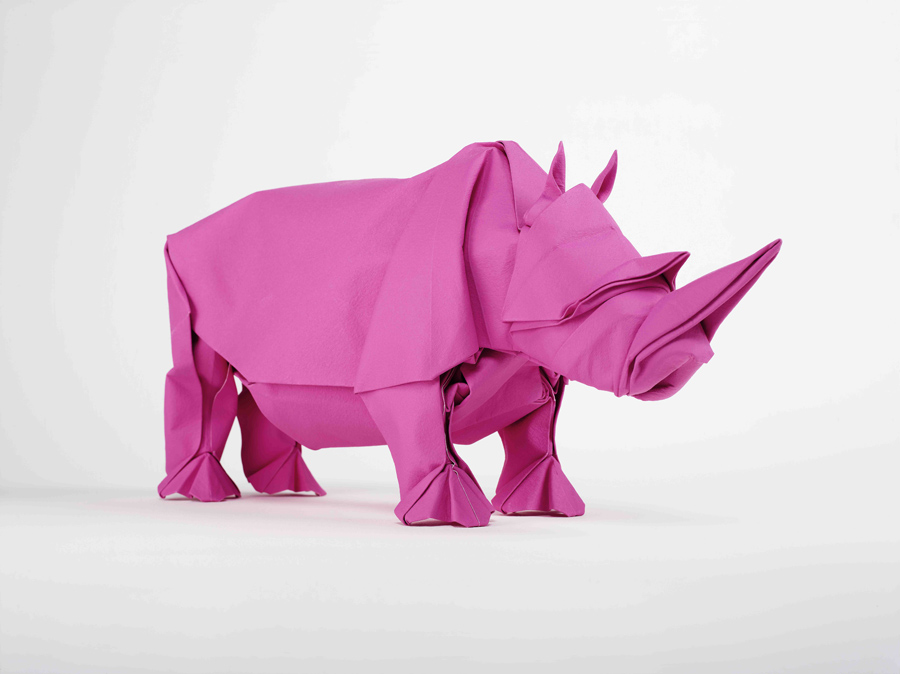
Life-Sized Origami, Ctd

rhino_magenta

A reader adds to this post, which went pretty viral on Facebook:

I certainly agree that Sipho Mabona’s work is fantastic. He is extremely intelligent, as you can see in this YouTube video. However, what Dish readers may not realize is that we are in the middle of a huge revolution inorigami, as new techniques are allowing origami artists to create ever more sophisticated creatures. Dr. Robert Lang, a Cal Tech Ph.D who left physics to do origami as a living, has been at the forefront of many of these new techniques, many of which come out of mathematics or computers. The result is a life-like depiction of animals and insects that are uncanny: it could be a bull moose, or a panther, a red-tailed hawk or a life-sized pteranodon – they are all made from just one piece of paper, with no cuts. Origami is considered to be a Japanese art form, but it has gone world-wide in the last 25 years, as Mr. Mabona and Dr. Lang show.

The rhino seen above is by Mabona as well. See more of his amazing work here. Update from a reader:

I watched Between the Folds on Netflix about a year ago and was fascinated by the many different techniques, styles, etc. It’s several years old, but really good. I’ll always love the paper swans I made in 3rd grade, but there’s a whole world of origami out there that I knew nothing about.

The whole documentary is also available on YouTube:

What’s The World’s Favorite Number?

That’s the question Alex Bellos, a math blogger for The Guardian, set out to answer:

Bellos set up the website http://favouritenumber.net and asked people to cast votes for their favorite numbers and explain why they liked them. More than 44,000 people did. Along the way, Bellos noticed lots of patterns. “Definitely, non-mathematical reasons were more frequent than mathematical ones,” he says. “Dates and birthdays are the most common.” Odd numbers do better, in general, than even ones. In China, 8 is popular because it sounds like “prosperity,” and 4 is unpopular because it sounds like “death.” English has sound-alikes, too: one voter said his favorite was 11, because “it sounds like lovin’.”

Dana Mackenzie counts down the results:

The bronze medal goes to the number 8. Hey, all those Chinese people can’t be wrong!

The silver medal goes to the number 3. That should go over well with fans of the Three Musketeers, the Three Stooges, and the Three Little Pigs.

But the number cited most often as a favorite number is (drum roll, please)

7.

To be honest, this is hardly a shock. If you go to Las Vegas, you can’t miss the 7’s all around you. “People’s strongest emotional reaction is to the number 7, and this has been true throughout history,” says Bellos. But strangely enough, no one really knows why. “The argument most frequently given, which I think is not credible, is that there are seven visible planets or seven days in the week,” Bellos says. He thinks that we like 7 because it’s the only number between 2 and 10 that is neither a multiple nor a factor of any other. It somehow stands apart from the others.

The Best Of The Dish This Weekend

Washington's Famed Cherry Blossoms Mark Advent Of Spring

At the start of Holy Week – a miracle in the form of a spinal cord implant, letting the paralyzed feel again. A reflection – Auden, of course – on God as Father. A visit to the monks at Athos over a bottle of ouzo. And a pertinent question: why does Mary have such perfect toenails?

A wedding at the end of a life – and a smile breaking into tears. A love affair – between two people who look like twins. An obscene version of “Let It Go” – “Fuck It All!” – just in time for finals. And the stories that inspired Wes Anderson’s Grand Budapest Hotel.

Plus: Butt Sex! Ya can’t beat it.

The most popular post of the weekend was “Why Aren’t Gay Men On The Pill?” Runner-up: “Where The Hard Left Says No.

My favorite quote of the day is from Mike Kinsley:

“Native advertising” is the delightful but bewildering euphemism for advertising that looks like editorial content. Its main effect is to make editorial content look like advertising.

See you in the morning.

(Photo: Cherry blossoms bloom near the Tidal Basin April 9, 2014 in Washington, DC. Peak bloom for the cherry blossoms is predicted to be around April 11-13. By Drew Angerer/Getty Images.)