A Conservative Minority

A recent study found that white people get more conservative when they’re told they are becoming a minority:

The authors, Maureen Craig and Jennifer Richeson of Northwestern, use data from two main experiments. In one, a group of survey respondents was told that California had become a majority-minority state, and the other group was told that the Hispanic population was now equal in size to the black population in the US. Then, all respondents were asked what their political ideology was. The group that was told whites were in the minority in California identified as more conservative than the second group.

In another experiment, one group of respondents read a press release saying that whites would soon become a minority nationally in 2042, while a second group read a release that didn’t mention race. The group primed by race then endorsed more conservative policy positions.

Bouie worries about the finding:

[E]ven if there’s no minority-majority it’s still true that the United States is becoming browner, with whites making up a declining share of the population. And if this Northwestern study is any indication, that could lead to a stronger, deeper conservatism among white Americans. The racial polarization of the 2012 election—where the large majority of whites voted for Republicans, while the overwhelming majority of minorities voted for Democrats—could continue for decades.

That would be great for Democratic partisans excited at the prospect of winning national elections in perpetuity, but terrible for our democracy, which is still adjusting to our new multiracial reality, where minority groups are equal partners in political life. To accomplish anything—to the meet the challenges of our present and future—we’ll need a measure of civic solidarity, a common belief that we’re all Americans, with legitimate claims on the bounty of the country.

With extreme racial polarization—and not the routine identity politics of the present—this goes out the window.
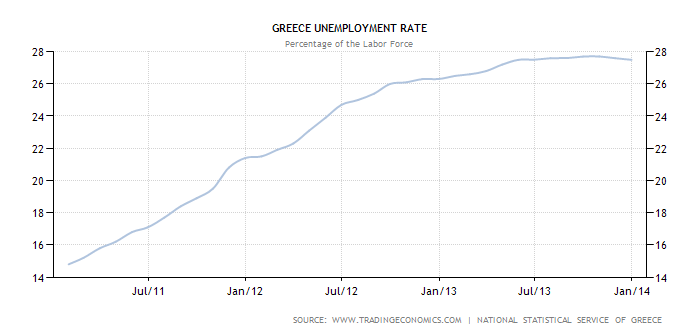
A Greek Rebound?

test

Greece issued its first new bonds since its restructuring this morning, raising 3 billion euros. Mark Gilbert, however, discourages celebration:

The front page of today’s Financial Times newspaper heralds today’s sale as Greece coming “out of bond exile,” and describes it as “a sign of growing confidence in the region’s weakest economies.” I beg to differ. First, the sale is evidence that yield-starved bondholders staring at record-low returns on even Italian and Spanish debt holdings are growing more desperate with every lurch lower in bond rates. Second, it shows that investor faith in European Central Bank President Mario Draghi’s pledge to do “whatever it takes” to secure the future of the euro remains unshaken, even though that July 2012 promise has never been tested.

Pointing to the chart above, Ryan Cooper thinks it’s very premature to talk about a recovery:

Indeed, I rather fear this could be the worst of all worlds.

 Moving off the Euro would have been awful, but at least held the prospect of returning to growth and full employment within a couple years (from a much lower base). By contrast, the bank Natixis recently estimated that, given very generous assumptions, it will take Spain (which is in similarly dire straits) 25 years to return to 2007-era employment. A nation can do a great deal of catch-up growth in that time.

Realistically, I’d guess this means that Spain, Greece, Italy, Portugal, Ireland, etc., will never recover fully, and instead we’re witnessing the birth of a crummy, tattered Franco-German empire with a permanently depressed periphery.

Sam Ro describes just how crippling the country’s unemployment rate still is:

According to new data from the Hellenic Statistical Authority, Greece’s unemployment was at a staggering 26.7% in January. This is up from 26.5% a year ago, but down from 27.2% in December. In January 2009, the unemployment rate was at 8.9%. The economic crisis has been particularly harsh for young workers. The unemployment rate among 15-24-year-olds and 25-34-year-olds were at 56.8% and 35.5%, respectively.

Face Of The Day

Hannover Messe Industrial Trade Fair

A robot is pictured at the Morsettitalia stand at the Hannover Messe industrial trade fair  in Hanover, Germany on April 10, 2014. The Netherlands is the official partner country of this year’s fair with more than 5000 companies showcasing their latest industrial products and solutions. The Hannover Fair will run from April 07-11. By Nigel Treblin/Getty Images.

Poseur Alert

“69 confronts us with an unfortunate truth: it is a distinctly capitalistic, efficiency-emphasizing endeavor that erases the unique personhood of each participant by relying on a crude approximation of how human bodies fit together if human bodies are conceived of as identical, two-dimensional figures like the numbers of its name. … The position also echoes the service economy in its demand (mainly on women) of a convincing performance of pleasure. It’s not enough to simply be present and to competently do the job that’s asked of you by your lover, you must also appear to simultaneously enjoy said lover’s ministrations, regardless of the delicate balancing requiring to keep from suffocating him or breaking his nose. This is a form of emotional labor like that demanded from baristas, servers, and sex workers; not only do you have to do a good job, you have to like it,” – Susan Elizabeth Shepard and Charlotte Shane

Dan Savage suspects the piece is a parody. But several of his commenters are taking it seriously.

I don’t think it’s parody so much as whimsy. This paragraph convinces me:

We will be silenced by your sexual hubris no longer. There can be no freedom without an end to the tyrannical mediocrity of 69. Let us commit to a new world where this vision can be realized. Working together – but not at exactly the same time – we can achieve it.

I would call this “tongue-in-cheek” in any context less charged.

Heh.

Is The Israeli-Palestinian Conflict Intractable?

Damon Linker thinks so:

The Palestinians hope that a growing chorus of global condemnation will eventually drive Israel either to pull back from the West Bank, thereby allowing the establishment of a fully independent Palestinian state, or to grant full political rights within Israel to the Palestinian people — a move that would turn Israel into a binational state.

Neither has any chance of happening.

Which means that the Israeli-Palestinian conflict has reached a condition that the ancient Greek philosophers would have described with the term “aporia” — meaning “to be at a loss” or “impassable.” There is no peace process. No way forward. This might change down the road. But for now it is our lamentable but unsurpassable reality.

But Judis argues that the Obama administration could still make progress if it got on board with the Palestinians joining the UN:

The U.S. could exert leverage on its own, but it may not want to act like Israel’s overlord, and there are other things that the  U.N. could do that might prod the Israeli government to negotiate an end to the occupation.

If the United States had not threatened a veto, the Security Council could have made Palestine a member state. After having to helped to found the state of Israel in 1947—when negotiations had failed between Palestine’s Jews and Arabs—the  U.N. would be doing likewise for the Palestinians. As a more extreme step—if U.N. disapproval failed to budge the Israelis—the Security Council could also vote sanctions against Israel, directed specifically at goods from settlements in the occupied territories, to get it to adhere to Resolution 242, which was passed in the wake of the Six-Day War in 1967, and which requires Israel to “withdraw from territories occupied in the recent conflict.”

Akiva Eldar agrees:

In order to end the occupation and save the negotiations, Kerry must present the sides with an accelerated timetable for the acceptance of Palestine as a full-fledged member of the UN. Until then, the sides will have to reach agreements about land swaps, arrangements in Jerusalem and the refugee problem based on the Arab Peace Initiative. If Israel keeps barricading itself behind unfounded demands such as Palestinian recognition of a Jewish state and opts to expand settlements, it will become the occupier of a UN member state. From there, the road to the International Criminal Court in The Hague will be very short. On the other hand, if we continue the traditional dance — one step forward and two steps back — we will all fall flat on our faces.

When Losing A Ton Of Weight Can Kill Your Career

Thomas Golianopoulos profiles Varsity Blues star Ron Lester, who shed 300 pounds after duodenal switch surgery:

Since he realized in the third grade that his massive girth could draw laughs, Lester knew his fate was as the funny fat guy. When he moved to Hollywood – a town where funny fat guys can become millionaires – he was an overnight success. There was one problem, though: His moneymaker was slowly killing him. With a family history of heart problems, the 500-pound Lester wasn’t long for this world. Surgery saved his life. It also ended his career.

A shrinking man with loose skin greeted casting directors expecting the funny fat guy, and Lester struggled to score roles post-op. Now living in Dallas nearly 15 years after his glory days, he is left to ponder whether choosing life was the right decision. “Am I alive? Yes. Am I happy? No. Did I throw away my career to be skinny? Yes,” he says. “I wouldn’t do [the surgery] again. I would much rather have died happy, rich, and kept my status and gone out on top.”

See recent photos of Lester here. Our reader thread on serious weight loss is here.

A New Phase In The Torture Debate?

As the Senate Intelligence Committee Report on the war crimes of the last administration nears publication (if the CIA doesn’t censor it to shreds), you can begin to hear the stirrings of some kind of reckoning with the past. As the years have gone by, the incontestable fact that the Bush administration tore up the Geneva Conventions, brazenly broke domestic and international law, and unleashed a wave of abuse and torture and mistreatment of prisoners, has been harder and harder to deny. Even the protestations of a man like Jose Rodriguez – “It worked!” – merely underline the point. The law against torture is absolute. There is never any defense of it because of perceived utility. Dick Cheney keeps boasting and bragging of the torture program he invented for the first time in American history, publicly admitting a war crime for which there is no statute of limitations in domestic and international law.

But the one place where the debate has not really broken out is in the political party that embraced those war crimes – the GOP. Yes, John McCain took on the torture crowd in 2008 and won the nomination. But his successor, Mitt Romney, pledged to “double Gitmo” and bring torture back. Very few Republican writers want to confront the topic; Charles Krauthammer actually favors the setting up of a specific torture unit, without pondering whether its shirts should be brown. Torture enthusiasts, like Marc Thiessen, are given perches at the Washington Post, while war criminals like Cheney and Hayden are given endless platforms on the Sunday morning talk shows.

But if Rand Paul runs for president, a debate will surely have to break out. David Corn – is David trying to kill off Paul’s candidacy or trumpet it? – digs not so deep again to discover unequivocal hostility to the torture of the Bush-Cheney years in some interviews Paul did in 2009. Encouragingly, Paul won’t have any truck with the newspeak echoed by the craven New York Times. Interviewed by Friend Of The Dish Scott Horton, Paul was clear when answering the question “What’s your position on torture and war crimes prosecutions for the many torturers in the previous administration?”:

I am opposed to torture, and I think our country should have a higher ideal than that …Torture is always wrong and shouldn’t be performed.

On a subsequent radio show, Paul stated:

If Republicans want Dick Cheney to be sort of the representative of our party, still defending torture, which is not something America stands for, it’s just another way to shrink the Republican Party.

The good thing about this stance – and the real promise of a Rand Paul candidacy – is that it will force an honest debate in the GOP. No more denialist bullshit about “EIT”s; no more pussy-footing around the fact that of course what was done was torture; and a demand for clarity about whether a future Republican president would seek to finally consign the Geneva Conventions in the trash-heap of history or whether he or she will return to the traditions of George Washington and the civilized world. We may get the wrong answer from the GOP nominee. But at least we will know where we are. And whether Americans care any more about an embrace of the barbarism so often exhibited by our enemies.

Malkin Award Nominee

“CBS has just declared war on the heartland of America. No longer is comedy going to be a covert assault on traditional American values [and] conservatives. Now, it’s just wide out in the open. What this hire means is a redefinition of what is funny and a redefinition of what is comedy,” – Rush Limbaugh, losing his shit over a practicing Catholic and Sunday school teacher taking over from David Letterman.