Patriot Act

A very incisive critique of the McCain campaign’s constant disavowal of the notion that they are questioning Obama’s patriotism, and constant insistence in other statements that he is a traitor to his country, seeking to legislate defeat in Iraq, because it would allegedly help his domestic political fortunes.

Some readers have cited McCain’s support for the surge as evidence of his capacity to "put country first" even if it were politically disadvantageous. What this analysis misses, to my mind, is that opposing the surge was never a possibility for McCain. He had staked his position on a more aggressive campaign in Iraq long before the primaries, and had every reason to use the surge as his differentiating marker in the campaign. It was his big bet which he had no real choice but to hope would pay dividends. And it did.

But in this, his own political interest and the interest of advancing a policy that deepened US involvement in Iraq were one and the same. He made no real choice for country over his personal political fortunes. In the narrow window of salvaging catastrophe in Iraq, the two were inextricable. And historians may well one day debate whether the decision to double-down in Iraq was the moment when the US succeeded in Iraq or the moment when the entrapment became too deep to escape from.

Acrobatics

Poulos gets meta on Kristol:

For Kristol to win the day, he must convince Republicans that Joe Lieberman both is and is not a Republican, or that he is not a Republican yet ‘actually’ is. Because it’s impossible to convince anyone that Joe Lieberman is a Republican, period, unless he switches parties, at which point it will be impossible to convince anyone that he is, full stop, a conservative. In order to do this, Kristol must create an ontological crisis in the Republican identity.

The point of Lieberman is the Middle East: a clear sign that neoconservatism’s worldview will not just survive the last eight years but actually become even more ascendant. A Lieberman pick would be a way of ensuring that the US never withdraw from Iraq and use it as a base from which to attack Iran. It would also be an indication that the next administration will treat Russia as a global enemy, as if there were any doubt about the new Cold War that McCain is eager to start. And China, of course. The Chinese are enemies as well.

Kristol understood a long time ago that the social issues are critical to bringing evangelicals into a grand alliance with neoconservative foreign policy machers. Issues such as abortion and gay rights are instrumental to neoconservatism. They are domestic means to foreign policy ends. The end is war – and the restoration of national greatness to a great, and always extending, neo-empire.

Quote For The Day II

"I will be telling my delegates that I will vote for Barack Obama. How they vote is a more personal decision. They want to have their chance to vote for me. That is what traditionally happens … some people are having to make up their minds because there are arguments pulling them both ways," – Hillary Rodham Clinton, preparing for 2012.

Why It’s Close

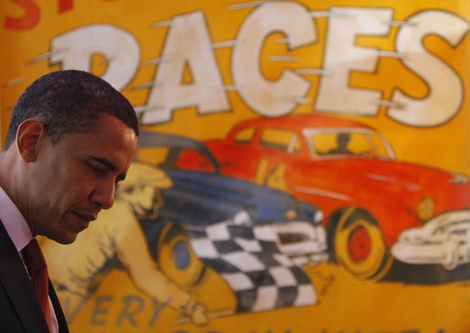
Obamaracesemmanueldunandafpgetty

Jake Weisberg argues that only race can explain why Obama’s still neck and neck with McCain. I don’t want to deny that race may play a role in this election – particularly among older, white voters. But the reason for the close race is surely over-determined. Yes, this is a change election – 80 percent believe the country is on the wrong track. But McCain is not an incumbent vice-president, and rightly boasts a record that isn’t – at least until the past few years – a Bush-Cheney Republican wet dream. He’s in favor of tackling climate change, for example, something the Bushies have adamantly resisted. He opposed the Medicare prescription drug coverage and the first Bush tax cuts. His campaign has not mentioned these – but they’re there and people remember them. He was Bush’s nemesis in 2000. That helps in trying to distance himself from the Bush legacy. In fact how the campaign uses Bush and Cheney at next week’s convention will be far trickier than Obama’s dealings with the Clintons this week.

And, yes, experience is an issue. It should be.

It is not unreasonable or unfair for the GOP to target Obama’s relative youth and inexperience. Sure: McCain hasn’t had any real executive experience either. But he’s been around a long, long time and he was right about the surge. America is a center-right country and doesn’t like to face defeat or failure (even when, as in Iraq, it has to). McCain’s appeal not to see Iraq as a failure appeals to Americans’ sense of pride and optimism, even as reality still nags at their psyches. For all these reasons, it’s perfectly predictable that this should be a close race for president. It may well not be for the Congress. But that too undercuts Obama’s change theme: with Democrats in the Congress, voters won’t have a repeat of 2002 or 2004.

What Obama has to do is pretty simple: he has to explain that he alone will cut middle class taxes while raising them on the wealthy to Clinton era levels; that he alone will give everyone who wants it access to health insurance; and that he alone will extricate the US from Iraq and that McCain is itching for a deeper longer war in the Middle East and another Cold War with Russia and China.

If you believe that we can tackle domestic problems and the rising debt without raising any taxes, then vote for McCain. If you believe that the problem with the last eight years has been an insufficient use of military force and an insufficiently aggressive hostility to other great powers, McCain is your man. If not, Obama is the right choice. In the end, there’s a big question domestically and a big question internationally. Both matter. And Obama’s argument will have to be more than usually persuasive if he is to overcome the experience question.

(Photo: Emmanuel Dunand/AFP/Getty.)

Goldberg v. Goldberg

He hasn’t always despised "bon mots from Balzac." From a 2002 Jonah Goldberg article titled "In Defense Of Elitism: We Need It":

In America, "elitist," "snobbish," and "aristocratic" have become largely synonymous. That’s a shame. "Elite" derives from the Latin for "elect," though not necessarily in the democratic "electoral" sense. It means those who — through efforts and talent — self-select themselves as qualified to lead, and teach, by example.

Wait, there’s more:

We talk of elite athletes, elite scientists, elite craftsmen, or elite soldiers, and everyone understands that these people are simply better, more expert at what they do than the rest of us. It is only when we get closer to those realms where experts have decided to bend every fact and twist every standard — in an effort to mend the bruised egos of backward nations and boutique domestic victim groups — that "elite" becomes pejorative. This is a tragedy, because conservatism will become meaningless if, in an effort to displace the current elite from its perch, we embrace the notion that nobody has a right to that perch.

But he’s a Democrat.

(Hat tip: John).

War With Russia

Max Boot thrills to the idea of re-arming Eastern Europe:

The U.S. can help, as we helped the Afghans in the 1980s and as the French helped the Poles in 1920. That will require a readjustment in our military assistance strategy, which has been to create in Eastern Europe miniature copies of our own armed forces. Our hope, largely realized, has been that these states will help us in our own military commitments in Afghanistan, Iraq and elsewhere. But in addition to developing NATO-style expeditionary capacity, these states need to be able to conduct a defense in depth.

That means having large reserves ready for fast call-up and plenty of defensive weapons — in particular portable missile systems such as the Stinger and Javelin capable of inflicting great damage on Russia’s lumbering air and armor forces. That’s more important than fielding their own tanks or fighter aircraft. We should offer to sell them these relatively inexpensive defensive systems, and to provide the advisory services to make the best use of them. But the first step has to be for the Eastern Europeans to make a larger commitment to their own defense.

Stoking Disunity

McCain’s other Hillary ad features Debra Bartoshevich:

Nate Silver wonders about a backlash backlash:

I could see the ad being very effective. But it also tosses a big softball to Hillary Clinton, who will speak to a national audience on Tuesday. The risk to the Republicans can be summarized in five words: "Shame on You, John McCain". A finger-wagging, how-dare-you moment by either of the Clintons at the convention — but especially Hillary — could be both effective and therapeutic, especially when coupled with a reminder that McCain voted against measures like SCHIP (and voted to impeach her husband).

A McCain Contradiction?

A reader points out something that had occurred to me too:

So I was wondering when people were going to start to take notice of the brazen contradiction in the latest ads released by McCain re: Biden. Ad #1 says that Joe Biden was a harsh critic of Barack Obama during the primaries. Ad #2 says that the reason Hillary Clinton was not tapped was because she was a harsh critic of Barack Obama during the primaries. Um… HUH? Whatever works I guess.

A lot of the McCain hyper-activity at this points strikes me as trying to out-psyche and rattle the Obama campaign, rather than to make coherent points.