Role Models

The Federalist Society hosted a debate about marriage equality with four law professors (two opposed, two for). Amy Wax argued that "we should be wary of extending marriage to a community with influential people who believe that sexual monogamy isn’t that important." Dale Carpenter’s response:

…there’s no reason to believe that heterosexual couples model their sexual lives on gay men. Against this, Professor Wax suggests that gays have some unusually large influence. For historical reasons alone, we should be wary and skeptical of claims that a small minority wields inordinate and insidious power.

Consider the numerical obstacle to such influence.

Male couples will be about 1% of all marriages. Some will commit to monogamy; others will be discreet about their non-monogamy. So we’re really talking about much less than 1% of marriages. That paltry number will undermine heterosexual morals? Undermine them more than our super-monogamous lesbian role models will reinforce them? Which is more likely: that the 0.5% of openly non-monogamous male couples will exert an irresistible gravitational pull on the morals of the 99.5%? Or that the 99.5% will put tremendous social pressure on the recalcitrant 0.5%?

My article on ‘My Big Fat Straight Wedding’ is here.

“Not Clinical, Cynical”

Mccainalexwonggetty

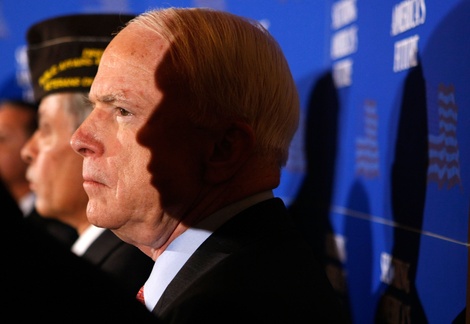
A reader writes on McCain’s POW refrain:

This morning you noted that McCain’s constant POW self-references have assumed clinical proportions; I don’t know if he’s clinical, but he’s certainly cynical. Real heroes don’t go on and on and on and on and on and on and on and on about their own heroism – particularly in order to satisfy personal ambition like this:

"I didn’t decide to run for president to start a national crusade for the political reforms I believed in or to run a campaign as if it were some grand act of patriotism. In truth, I wanted to be president because it had become my ambition to be president. . . . In truth, I’d had the ambition for a long time." – John McCain, "Worth the Fighting For”, 2002.

The heroes I knew in my youth – the guys who came back from WWII and Korea – never said a word about it. Our family friend Ernie, who had been a German POW for three years after being shot down; the only way I ever learned about that is that someone else told me – not Ernie. My dad – 100 missions over North Africa, Italy, France and Germany, three confirmed kills and the Distinguished Flying Cross – never a word about the war; no, I take that back: on his deathbed, when we were alone, he struggled up out of his delirium for a moment and looked at me and said “War is the stupidest thing human beings do.” Almost the last thing he ever said.

We’ve all spent years psychoanalyzing Bush and his oedipal drama, his need to out-do his old man – what about McCain and his 4-star admiral father and 4-star admiral grandfather: think there might be any oedipal ambition there? Do we need four more years of this?

("He is a striver and a combatant, often at war with himself", who has conducted a lifelong struggle "to prove to myself that I was the man I had always wanted to be," as he has written.)

McCain is obviously a decent man, and a strong one. He would hardly make the worst President in US history (that spot is already reserved). But let’s put the “hero” business in perspective: he is not a saint, and he is using – constantly using – his hero status to leverage himself past criticism that any other man would have to confront on the merits, and, if his ambition is fulfilled, into the Oval Office. I don’t buy it.

The heroes I remember were every bit the hero John McCain is – but they didn’t spend all their time for years afterward tooting their own horns and trying to trade on their status for personal political gain. In fact, that kind of immodesty used to be seen as inappropriate and unseemly, if not ridiculous.

(Photo: Alex Wong/Getty.)

Thatcher’s Mental Skills

In her prime, she was unbelievably well-informed, quick, with a prodigious memory. But her daughter is now confirming that since 2000, her mother declined:

In an extract serialised in a Sunday newspaper, she describes having to break the news of Denis Thatcher’s death to her mother more than once. He died in 2003 of pancreatic cancer. "Dementia meant she kept forgetting he was dead. I had to keep giving her the sad news over and over again. Every time it finally sank in that she had lost her husband of more than 50 years, she’d look at me sadly and say, ‘Oh’, as I struggled to compose myself. ‘Were we all there?’ she’d ask softly."

This brilliant woman started to lose acuity and suffered a series of small strokes at the age of 75.

“Surrender” By 2011?

Encouraging news from Maliki, details to come, and the details will be everything:

"There is an agreement actually reached, reached between the two parties on a fixed date which is the end of 2011 to end any foreign presence on Iraqi soil," Maliki said in a speech to tribal leaders in the Baghdad’s heavily fortified Green Zone.

"Any foreign presence"? It seems as if Bush and McCain have signed "surrender," as they have so often described it.  Good for them.

On Women Priests

A great – and somewhat more erudite – counter-point to the K-Lo defense of male-only priests is in the current Commonweal. Money quote:

The church cannot remain exempt from the principles of its own social teaching. Catholics cannot bear witness to principles of justice, equality, subsidiarity, and participation, and claim exceptions for themselves. The question is this: Has the tradition of excluding women from the diaconate, presbyterate, and episcopacy really been faithful to the teaching and practice of Jesus? Or has it been part of a mostly unexamined and partially unconscious bias for subjecting women to men’s authority and power? Which is the more believable interpretation of our history as a people?

This is a very important question, one that urgently needs and deserves an open, prayerful, learned, patient, and discerning conversation among Catholics today.

And yet it does not happen. And so the crisis deepens.