None Is More

A viral cancer-awareness campaign of #nomakeup selfies raised 8 million euros. Many participants were caught off-guard by the positive response to their bare faces, something that Alex Jones (not that Alex Jones) found encouraging:

[A] recent paper of mine, in press at the Quarterly Journal of Experimental Psychology, and carried at Bangor University, examined just this question. I wondered whether makeup use, like dieting or gym workout behaviours, affected perceptions of attractiveness from same and opposite sex peers. An ideal way of testing this was to examine how much makeup is considered optimally attractive. After all, if women’s ideas of what looks good to others is accurate, then everyone should find their makeup optimally attractive, right? …

The results were clear. Both women and men found faces with up to 40% less makeup than the models applied themselves the most attractive, showing a clear agreement on their opinions for cosmetics. Less was simply better. However, when they considered the preferences of others, the women and men in our study indicated that they thought other people found more cosmetics more attractive, and this was especially true when considering the preferences of other men. However, this couldn’t be further from the truth. The sample of men in our study consistently chose less makeup as more attractive, while at the same time indicating that they thought their peers would find more makeup more attractive.

Do Animals Laugh?

For researchers, the question is no joke:

Marc Bekoff, University of Colorado–Boulder professor of ecology and evolutionary biology and author of The Emotional Lives of Animals, believes [animals do have a funny bone]. In fact, he thinks we’re on the cusp of discovering that many animals have a sense of humor, maybe even all mammals. The idea that animals can appreciate comedy isn’t as far-fetched as it sounds, considering some of the other groundbreaking discoveries scientists like Bekoff are making about animal behavior: They have found dogs that understand unfairness, spiders that display different temperaments, and bees that can be trained to be pessimistic.

As Bekoff points out, Darwin argued that the difference between human and animal intelligence is a matter of degree, not of kind. Or as Bekoff put it, “If we have a sense of humor, then nonhuman animals should have a sense of humor, too.”

A similar sentiment inspired psychologist Jaak Panksepp to enter his lab at Bowling Green State University in Ohio one day in 1997 and tell undergrad Jeffrey Burgdorf, “Let’s go tickle some rats.” The lab had already discovered that its rats would emit unique ultrasonic chirps in the 50 kilohertz range when they were chasing one another and engaging in play fighting. Now the researchers wondered if they could prompt this chirping through tickling. Sure enough, when the researchers began poking at the bellies of the rats in their lab, their ultrasonic recording devices picked up the same 50 kilohertz sounds. The rats eagerly chased their fingers for more. Soon, as the news media trumpeted the existence of rat laughter, people the world over were opening up their rat cages and engaging Pinky and Mr. Pickles in full-scale tickle wars.

Flaunting Failure?

Kevin Roose observes that “Silicon Valley has managed to turn failure into a bragging right”:

Why talk about failure at all? In part, the trend may be a concession to Silicon Valley’s messy reality. Even during a historic tech boom, the fact remains that the vast majority of start-ups die in their infancy. (Shikhar Ghosh, a senior lecturer at Harvard Business School, studied more than 2,000 venture-­­backed start-ups and found that roughly 75 percent of them failed to return investors’ capital.) But these missteps, numerous as they are, are rarely KOs. At many failed start-ups, defeated founders and engineers quickly move on to other ventures, investors write off their losses, and the tech world absorbs the hit without cascading into an industry­wide crisis. Given the gentle funeral that awaits many start-up deaths, the postmortem trend can also be seen as a psychological prophylactic, a clever way to shrink the stigma around failure and ensure that entrepreneurs keep gambling on crazy ideas, despite the likelihood that they’ll lose. It’s also a hopeful reminder that what starts as failure can morph into success. After all, Steve Jobs ran NeXT before he built Apple into a colossus, and Twitter was spun out of a DOA podcasting start-up called Odeo. If they kept going, the pep talk goes, so should you.

At its best, the start-up postmortem offers a founder the chance to self-reflect and apologize for mistakes made along the way. At worst, it’s a job application in disguise. Some tech retrospectives are so filled with humble-brags and hubris (if only we hadn’t been so far ahead of the curve!) that they don’t read like failure stories at all. “We built a world-class team of engineers, designers, marketers, and operations specialists,” wrote the Outbox founders, while eulogizing their mail-scanning start-up earlier this year. “Together, we made a product that was as beautiful as it was complex, and overcame nearly every obstacle in our path.”

What’s Next For Afghanistan? Ctd

Jeffrey Stern notes that Afghan presidential candidate Ashraf Ghani’s running mate is a “brutal warlord” who boasts “one of the worst records of human rights abuses in all of Afghanistan”:

General Abdul Rashid Dostum tends to slip under the American radar because recently his interests have aligned with ours; his abuses have tended to be against people the US considers enemies, most recently, the Taliban. But he’s been responsible for massacres of prisoners, accused repeatedly of using mass rape as a weapon of war, and has a long list of other war crimes on his resume. And though some of the stories about Dostum are surely myths – it’s said that he eats 12 chickens and two quarts of vodka in every sitting – the war crimes allegations are serious, repeated, and furnished by multiple international organizations.

When news of the Dostum choice came out, casual Afghanistan observers in America who know and respect Ghani were confused; people I spoke to on the streets of Kabul were disappointed, and Ghani seemed to go from a new kind of candidate whose intelligence and commitment were unquestioned to a man on top of a ticket that didn’t look that much different from the other ones. There was, however, one obvious reason for Ghani to bring the warlord on board: Dostum is a figurehead for the Uzbeks, a small minority in Afghanistan, but one that tends to vote as a bloc. Including Dostum effectively guaranteed about a million votes.

Previous Dish on Ghani and the Afghan elections here.

Our Obsession With Economic Growth

Kate Raworth challenges it:

She argues that “inequality is really, quite extraordinarily at the heart of the way economies are growing.” Lane Kenworthy parses research on income inequality:

As best I can tell from the available data, income inequality hasn’t reduced economic growth. It hasn’t hindered employment. It may or may not have played a role in fostering economic crises, including the Great Recession. It hasn’t reduced income growth for poor households. It may or may not have contributed to the weakening of household balance sheets by encouraging too much borrowing. It may or may not have reduced equality of opportunity. It hasn’t slowed the growth of college completion. It either hasn’t reduced the increase in life expectancy or the decrease in infant mortality or, if it has, the impact has been small. It looks unlikely to have contributed to the rise in obesity. It hasn’t slowed the fall in teen births or homicides since the early 1990s. It may or may not have weakened trust. It doesn’t appear to have affected average happiness. In the United States it has had little or no impact on trust in political institutions, on voter turnout, or on party polarization. And while it may have boosted inequality of political influence, we lack solid evidence that it’s done so.

On the other hand, income inequality has reduced middle-class household income growth. It very likely has increased disparities in education, health, and happiness in the United States. And it has reduced residential mixing in the U.S.

Bring Back The Firing Squad?

Physician Matt McCarthy considers it:

I am against capital punishment, but I understand that it’s not going away anytime soon and we must figure out a way to minimize suffering as long as it continues. … A compelling case can be made that based on efficacy, diffusion of responsibility, and inexpensiveness, death by firing squad is a better option [than lethal injection]. (Or perhaps the guillotine.) Some organs would remain intact for donation, and although it might appear grisly, it’s quick, and it is the only method of execution for which we already train people. Interestingly, in states that have offered both shooting and hanging—which also fulfills many of the above criteria—inmates usually opt for the firing squad. One could argue that if properly done, lethal injection would be more humane than either of these methods, but we can no longer expect that it will be properly done.

Previous Dish on the contemporary use of firing squads here.

[Note: the original version of this posted incorrectly suggested that McCarthy was in favor of physicians becoming involved in executions, in order to minimize botched lethal injections.]

A Poem For Friday

???????????????????????????????????????????????????????????????????????????????????

A third set of landays, or folk coupletsfrom the women of Afghanistan:

May God make you into a riverbank flower
so I may smell you when I go to gather water.

*

Of water I can’t have even a taste.
My lover’s name, written on my heart, would be erased.

*

I could have tasted death for a taste of your tongue
watching you eat ice cream when we were young.

Earlier landays on the Dish here and here.

(From I Am the Beggar of the World: Landays from Contemporary Afghanistan, translated and presented by Eliza Griswold, photographs by Seamus Murphy, to be published in April 2014 by Farrar, Straus and Giroux. LLC. Text copyright © 2014 by Eliza Griswold. Photographs copyright © 2014 by Seamus Murphy. All rights reserved.)

It’s Not Easy Being Grün

One country is learning the hard way:

Germany is in the middle of one of the most audacious and ambitious experiments a major industrial economy has ever attempted: To swear off nuclear power and run Europe’s largest economy essentially on wind and solar power.

There’s just one problem – it’s not really working.

The energy transformation, known as “Energiewende,” was meant to give Germany an energy sector that would be cleaner and more competitive, fueling an export-driven economy and helping to slash greenhouse-gas emissions. On that count, the policy has floundered: German emissions are rising, not falling, because the country is burning increasing amounts of dirty coal. And electricity costs, already high, have kept rising, making life difficult for small and medium-sized businesses that compete against rivals with cheaper energy. …

Business groups representing small and medium firms wring their hands over Germany’s high energy costs while Brussels frets that Berlin is subsidizing big German industry with rebates on inflated energy bills. Foreign leaders, and plenty of pundits, blame the Energiewende for Europe’s inability to answer Russia’s invasion of Ukraine. Utilities, meanwhile, are bleeding money, slashing investments, and shutting down power plants.

Keating has more on the country’s troubles:

Despite Angela Merkel’s government’s focus on green energy, the country’s coal use actually hit its highest level since 1990 last year. With no conventionally extractable natural gas on its own, some are also recommending that the government consider hydraulic fracturing in Germany, which the government currently opposes on environmental grounds.

All of Merkel’s government’s goals—shifting to renewable energy, weaning the country off Russian gas, reducing the risk of nuclear accidents—have been admirable, but doing them all at once raises some questions about how exactly the country plans to keep the lights on in the medium-to-long term. It would be an unfortunate irony if coal and fracking ended up being the beneficiaries of Merkel’s green energy push.

Our Best Weapon Against Climate Change?

Coal Emissions

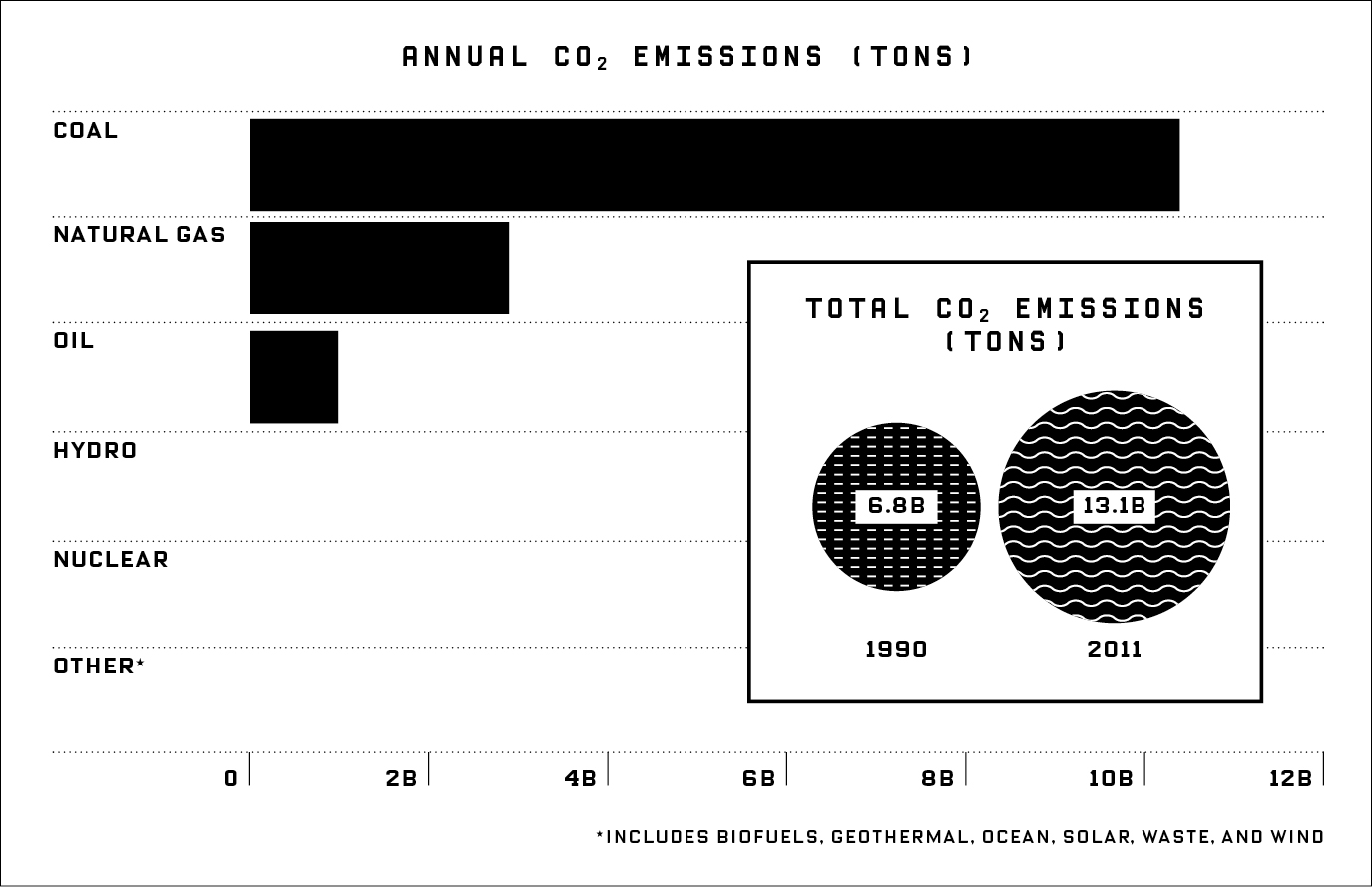
Charles C. Mann argues that developing carbon capture and storage (CCS) technology – or “clean coal” – is more important than developing renewables:

Conceptually speaking, CCS is simple: Industries burn just as much coal as before but remove all the pollutants. In addition to scrubbing out ash and soot, now standard practice at many big plants, they separate out the carbon dioxide and pump it underground, where it can be stored for thousands of years.

Many energy and climate researchers believe that CCS is vital to avoiding a climate catastrophe. Because it could allow the globe to keep burning its most abundant fuel source while drastically reducing carbon dioxide and soot, it may be more important—though much less publicized—than any renewable-energy technology for decades to come. No less than Steven Chu, the Nobel-winning physicist who was US secretary of energy until last year, has declared CCS essential. “I don’t see how we go forward without it,” he says.

Unfortunately, taking that step will be incredibly difficult. Even though most of the basic concepts are well understood, developing reliable, large-scale CCS facilities will be time-consuming, unglamorous, and breathtakingly costly. Engineers will need to lavish time and money on painstaking calculations, minor adjustments, and cautious experiments. At the end, the world will have several thousand giant edifices that everyone regards as eyesores. Meanwhile, environmentalists have lobbied hard against the technology, convinced that it represents a sop to the coal industry at the expense of cleaner alternatives like solar and wind. As a consequence, CCS is widely regarded as both critical to the future and a quagmire.