Posts vs Essays?

A good point:

A blog post is all about getting new ideas and news out there in a timely or spontaneous fashion to kick-start conversations. The writing should be as clear and stylish as possible under the the quick turnaround timeframe that goes hand in hand with posting five days a week. And of course facts should be accurate. But beyond a perfunctory breaking news report, an an article is something that one could think of as growing out of a blog post — a piece of work that involves more long, hard thinking, in-depth and/or wide-ranging interviews and perspectives, and a refined style.

Some readers have noted a contrast in tone and style between posts on this blog and my columns or essays. You bet. It’s a question of different platforms, idioms and ways of writing. I have found that blogging and long-form writing, while distinct, can nonetheless catalyze one another. Many columns have emerged from a week of blogging. And some essays come out of months of blogging. Long-form pieces are deliberately more mellow, considered and less inflammatory than blog posts. But I’m not schizophrenic – just adjusting to the newly varied ways in which a writer can express himself.

McCain And Hamas II

A reader writes:

You wrote:

McCain was once in favor of Obama’s position.

Actually, that’s wrong!  Both Clinton and Obama have said we should not negotiate with Hamas until they recognize Israel’s right to exist.  McCain actually supported a position more extreme than Obama.  By accepting the incorrect Republican talking point about Obama on Hamas, you actually do Obama a disservice.

I stand corrected. I was thinking of Obama’s willingness to talk to Tehran’s leadership. But I’m with McCain then. I do believe that Hamas has some legitimacy as the winner of a democratic election and at some point we will need to talk to them.

Thinking Through California

In re-reading and pondering the decision, I keep coming back to this:

In contrast to earlier times, our state now recognizes that an individual’s capacity to establish a loving and long-term committed relationship with another person and responsibly to care for and raise children does not depend upon the individual’s sexual orientation, and, more generally, that an individual’s sexual orientation — like a person’s race or gender — does not constitute a legitimate basis upon which to deny or withhold legal rights.

People can talk about activist liberal judges all they want. But the simple truth is that what has changed these past twenty years is not the nature of judges, but our collective understanding of what sexual orientation is. Behind all this is a deep, deep shift in our consciousness from thinking of gay people as defective straight people who perform certain sexual acts to their being the moral equivalent of heterosexuals, capable of Vn Anthology2 forming relationships and building families as well as anyone. This is at the core of the generational divide: not that young people are more "liberal" or "progressive" than their parents. On an issue like abortion, they’re not. It is simply that the next generation has grown up with a different definition of who gay people are. They see gay people as interchangeable with straight people. They don’t think we’re inferior to them. Because they know us.
Once you alter that basic understanding, then re-fitting the law to account for it may, at first blush, look liberal or activist, but in fact, it’s just removing what now appears a massive anachronism and anomaly. Yes: this means that the court is dong something the first Californians would have regarded as outrageous. But that goes for so many other issues as well, especially race and gender, where our core definitions have shifted with time and knowledge.

Is this shift an ideological one? I don’t believe so. It’s an empirical one, based on increased knowledge of who gay people are. Once you absorb this knowledge, this evidence, this truth, legislative schemes which arbitrarily separate gay people from straight people – and put gay relationships in a separate and unequal box – seem grossly unfair, and certainly a violation of the equality promised in various state constitutions. I think that’s what has really happened in the two decades I’ve been arguing about this. We have altered our view of homosexuality. And the alteration is not one of degree but of kind. And so the law must adapt. Maybe it has happened too quickly for easy cultural digestion. But it is inevitable if we are not now to replace knowledge with fear, and inclusion with, yes, prejudice.

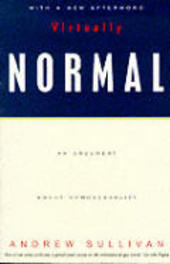
(Shameless plug: My first book, Virtually Normal, the first extended case for equal marriage rights, can be bought here. My recently updated anthology on all the various aspects of the marriage equality debate can be bought here. My 2000 TNR essay on why civil unions are not enough can be read here.)

Invade Burma, Please

George Packer ponders intervention:

Forcing the regime to let the rest of the world save its people would have a devastating effect on morale. Burma’s leaders are so isolated and irrational that they actually believe their own propaganda about being the only group that can hold the country together. It’s possible that the junta would collapse out of sheer humiliation. It’s also possible, though it seems unlikely to me, that Burmese military units would be ordered to engage the foreigners. Shots might be fired, people might be killed. No one knows what will happen if British sailors and American airmen arrive on soggy Burmese soil. Hanging over the question is, of course, Iraq. No one expects an intervention to go smoothly anymore; now we expect it to go terribly wrong. I doubt the American, British, French, Australian, and other governments, with or without U.N. consent, will decide to invade Burma with boxes of oral rehydration kits and high-energy biscuits. But if the fear of Baghdad and Falluja is what keeps foreign powers from saving huge numbers of Burmese from their own government’s callousness, that will be one more tragic consequence of the Iraq.

On the other hand, if it’s going to be done, it should be done quickly. I know all the arguments why we shouldn’t. But there are at least a million counterarguments why we should.

A brief, decisive international effort to reach the starving and sick seems important to me. If it helps demystify this vile regime, great. But in its demonstration of humanity, it is also a great way for the US to enhance its soft power in the developing world. People remember who saved them. And sometimes, a bottle of water can mean a lifetime of gratitude. Bonus Burma blog here.

Too Few Calories Or Too Many

Bee Wilson considers the world food crisis. Money quote:

Even now, there is no over-all food shortage when measured by global subsistence needs. Despite the current food crisis, last year’s worldwide grain harvest was colossal, five per cent above the previous year’s. We are not yet living on Cormac McCarthy’s scorched earth. Yet demand is increasing ever faster. As of 2006, there were eight hundred million people on the planet who were hungry, but they were outnumbered by the billion who were overweight. Our current food predicament resembles a Malthusian scenario—misery and famine—but one largely created by overproduction rather than underproduction. Our ability to produce vastly too many calories for our basic needs has skewed the concept of demand, and generated a wildly dysfunctional market.

Why California Matters

Marty Lederman grasps its significance:

Wholly apart from the particular holding on same-sex marriage — which is plenty important in and of itself — it strikes me that the most significant legal development in the Court’s decision is that it is (to my knowledge) the first time any state or federal court of last resort has held that discrimination on the basis of sexual orientation is suspect and thus subject to strict scrutiny under a constitutional equal protection clause.