Judicial “Activism”?

As usual, the lazy critics are uninformed. The California court has not over-ruled the legislature: in fact, the legislature has voted for full marriage equality twice already. And the court has not "created" a right to marriage for gay couples. It has argued that if the state has conceded that domestic partners should have, under state law, all the benefits and responsibilities of married couples, the designation of a separate and distinct category must be suspect, under strict scrutiny, to the inference that the designation is based on a desire to deny gay couples equal dignity and recognition. This is the same point I’ve made in the past; isn’t constructing a separate and distinct category an example of pure animus? You have conceded the substance, but cannot concede the name. Since no heterosexual couple’s rights would be affected in any way, what exactly is the rationale for maintaining the distinction? Except bias?

One other political note: the Republican governor of the state, Arnold, has already come out against the ballot initiative designed to reverse this ruling. And the initiative will not be able to affect the thousands of marriage licenses that will be granted before then. So the legislature, the governor and the court have all now supported equality. So back to the people … for one last chance to keep the stigma in place.

The Key Points

Camarriagejustinsullivangetty

Two early passages in the California decision stand out. First: this is a technical question about whether the separate-but-equal domestic partnership law violates California’s constitution, not about enacting civil marriage itself:

It also is important to understand at the outset that our task in this proceeding is not to decide whether we believe, as a matter of policy, that the officially recognized relationship of a same-sex couple should be designated a marriage rather than a domestic partnership (or some other term), but instead only to determine whether the difference in the official names of the relationships violates the California Constitution…

Those are the court’s italics, not mine. But on the deeper question, the court is unequivocal in arguing that our modern understanding of sexual orientation – that it is an orientation, not a choice, an identity and not an act – makes the equal protection of gay families a core value:

In contrast to earlier times, our state now recognizes that an individual’s capacity to establish a loving and long-term committed relationship with another person and responsibly to care for and raise children does not depend upon the individual’s sexual orientation, and, more generally, that an individual’s sexual orientation — like a person’s race or gender — does not constitute a legitimate basis upon which to deny or withhold legal rights.  We therefore conclude that in view of the substance and significance of the fundamental constitutional right to form a family relationship, the California Constitution properly must be interpreted to guarantee this basic civil right to all Californians, whether gay or heterosexual, and to same-sex couples as well as to opposite-sex couples.

The Court also argues that the strict scrutiny standard should apply. Why?

Although we do not agree with the claim advanced by the parties challenging the validity of the current statutory scheme that the applicable statutes properly should be viewed as an instance of discrimination on the basis of the suspect characteristic of sex or gender and should be subjected to strict scrutiny on that ground, we conclude that strict scrutiny nonetheless is applicable here because (1)  the statutes in question properly must be understood as classifying or discriminating on the basis of sexual orientation, a characteristic that we conclude represents — like gender, race, and religion —a constitutionally suspect basis upon which to impose differential treatment, and (2) the differential treatment at issue impinges upon a same-sex couple’s fundamental interest in having their family relationship accorded the same respect and dignity enjoyed by an opposite-sex couple.

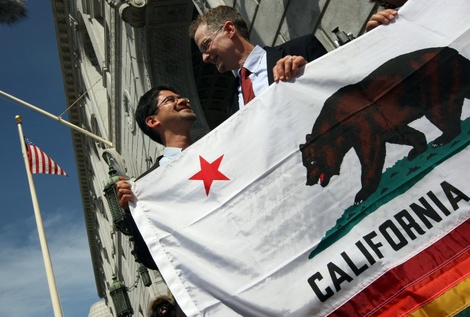
(Photo: Stuart Gaffney (L) and his partner John Lewis hold a California flag in front of the California Supreme Court May 15, 2008 in San Francisco, California. The California Supreme Court voted 4-3 to overturn a ban on gay marriage in California making it the second state where gays and lesbians can marry. By Justin Sullivan/Getty Images.)

Equality In California

Yes: the court just ruled for it – sixty years after California’s court was the first to strike down miscegenation bans. The most populous state now joins much of the rest of the Western world in bringing gay couples into the civic and human family as equals. More soon on the decision itself. One key fact: the ruling takes effect in 30 days – which means thousands of couples will be able to marry long before any initiative attempts to reverse it. So the initiative question becomes: do you want to divorce thousands of already-married couples? Or do you want to keep things as they now are? That’s a big advantage for the pro-equality forces. Money quote:

Ed Harrington, the general manager of the city’s Public Utilities Commission, was one of the staff members in the mayor’s office shortly after the decision was released. Harrington has lived with his partner for 35 years and in 2004 Harrington married about 40 same-sex couples.

"You wait for this your whole life," said Harrington, who said he planned to call his partner and say, "I love you. What more do you say on a day like this?"

Rainbows On The Mind

This is for you, Jon Stewart. A high school principal banned any clothing that could imply support for gays and lesbians. Including, er, rainbows. A student sued:

During the trial, which was held in Panama City yesterday and today, Ponce de Leon High School’s principal David Davis admitted under oath that he had banned students from wearing any clothing or symbols supporting equal rights for gay people. Davis also testified that he believed rainbows were "sexually suggestive" and would make students unable to study because they’d be picturing gay sex acts in their mind. The principal went on to admit that while censoring rainbows and gay pride messages he allowed students to wear other symbols many find controversial, such as the Confederate flag.

He lost the case. Many in Panama City conceded that the Confederate flag also gave them a boner.

Taking Some Smart Drugs

Johann Hari experiments with Provigil:

A week later, the little white pills arrived in the post. I sat down and took one 200mg tablet with a glass of water. It didn’t seem odd: for years, I took an anti-depressant. Then I pottered about the flat for an hour, listening to music and tidying up, before sitting down on the settee. I picked up a book about quantum physics and super-string theory I have been meaning to read for ages, for a column I’m thinking of writing. It had been hanging over me, daring me to read it. Five hours later, I realised I had hit the last page. I looked up. It was getting dark outside. I was hungry. I hadn’t noticed anything, except the words I was reading, and they came in cool, clear passages; I didn’t stop or stumble once.

Perplexed, I got up, made a sandwich – and I was overcome with the urge to write an article that had been kicking around my subconscious for months. It rushed out of me in a few hours, and it was better than usual. My mood wasn’t any different; I wasn’t high. My heart wasn’t beating any faster. I was just able to glide into a state of concentration – deep, cool, effortless concentration. It was like I had opened a window in my brain and all the stuffy air had seeped out, to be replaced by a calm breeze.

Once that article was finished, I wanted to do more. I wrote another article, all of it springing out of my mind effortlessly. Then I go to dinner with a few friends, and I decide not to tell them, to see if they notice anything. At the end of the dinner, my mate Jess turns to me and says, “You seem very thoughtful tonight.”

That night, I lay in bed, and I couldn’t sleep.

An Obama-Edwards Ticket?

Count me underwhelmed. Taegen Goddard makes the case and I fisk it:

1. He’s already been tested on the national stage and not likely to cause a distracting scandal.

You mean he lost one vice-presidential election already? And , er, it’s four years later.

2. He appeals to the same working class white voters that back Clinton.

He didn’t win many over in 2004.

3. He favors Obama’s new brand of politics.

So why didn’t he do it himself?

4. He could put North Carolina and possibly other Southern states in play.

Yes, but others could do the same.

5. Clinton would probably support him. With more than 1,700 delegates in Clinton’s pocket, Obama needs to at least get her tacit approval if he wants to have a unified party.
 
I can’t see how picking the third place over her makes her happy.

Apart from that, great idea.