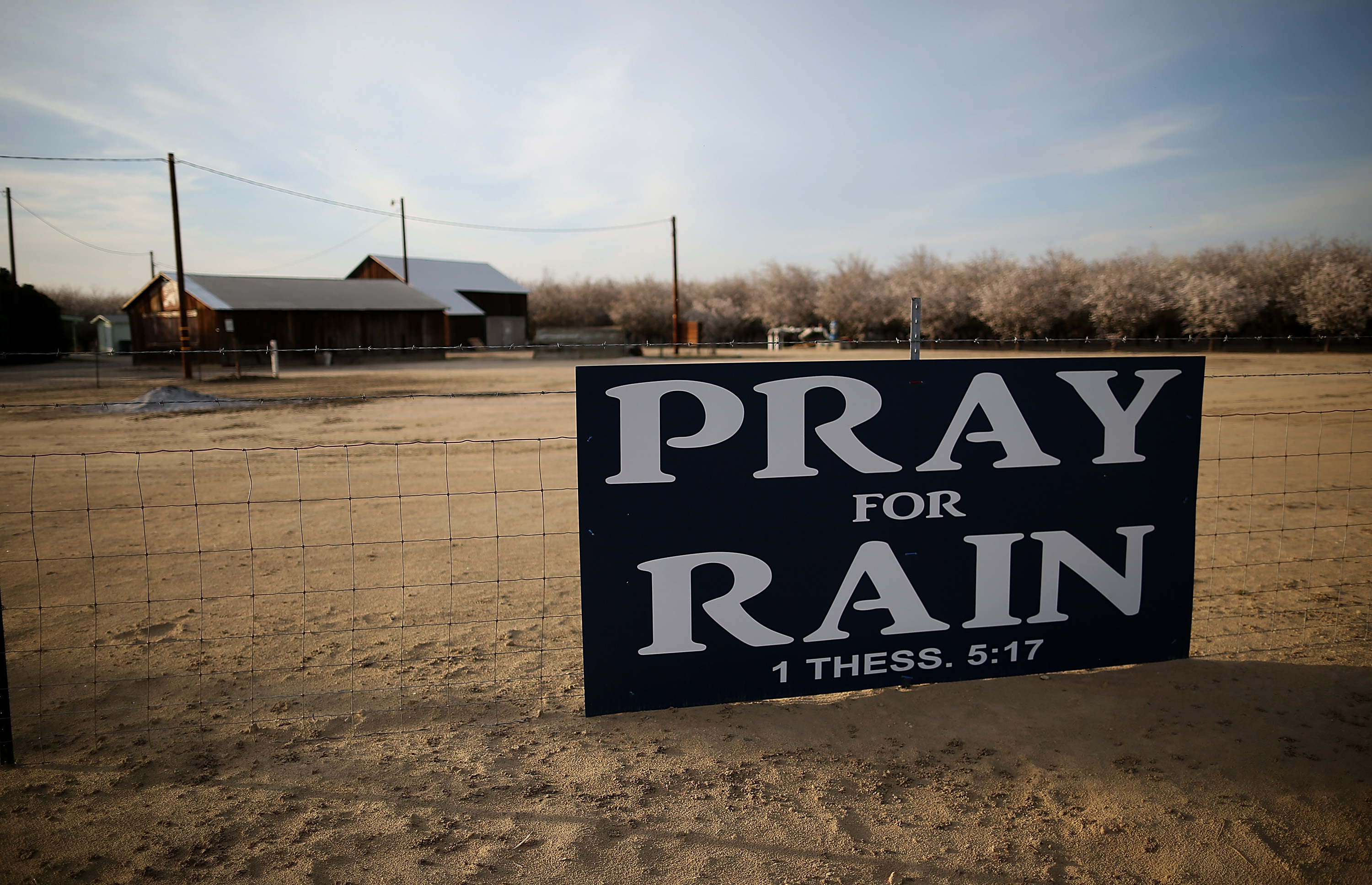
Eric Holthaus checks in on the Sin City’s water supply:
The driest city in America still uses more water per capita than just about any other city in the country. This despite years of steady efficiency improvements and the resounding success of its “cash for grass” program that pays residents for each square foot of lawn they rip out and replace with rocks. Front lawns are now illegal in Las Vegas, yet verdant golf courses are still commonplace. About 70 percent of the city’s nearly maxed-out water diversion from Lake Mead still goes to landscaping.
Don’t get me wrong: The city has made major improvements in water efficiency, using about 40 percent less water per person over the past 25 years or so. The problem is the city’s population has tripled over that same time, and total water usage is up (though down from its peak about a decade ago—an improvement due at least partially to the economic downturn). It’s like a one-ton man patting himself on the back for losing 400 pounds. Great news, but there’s still a long way to go.
(Photo: A sign is posted near an almond farm on February 25, 2014 in Turlock, California. By Justin Sullivan/Getty Images)
Megan Neal summarizes a study on the spread of fake news through Facebook:
[A] team of researchers at Northeastern University, led by Walter Quattrociocchi, decided to study how it is that erroneous information jumps the credibility fence and becomes widely believed to be true. Their theory, published on the arXiv preprint server last week and unearthed by MIT Technology Review, is that it has something to do with the kind of people who read “alternative” news, because they’re generally mistrustful of the mainstream media. …
Logically enough, the folks who were more prone to reading alternative websites (defined as “pages which disseminate controversial information, most often lacking supporting evidence and sometimes contradictory of the official news”) were also more likely to buy into a conspiracy theory. The thinking goes that those radical readers are A) less adept at parsing accurate information and B) already skeptical of mainstream journalism, and looking for an different take.
Relatedly, Mary Elizabeth Williams flags a “a new study from the University of Chicago that reveals that nearly half of all Americans believe medical conspiracy theories”:
The findings, published this week in JAMA Internal Medicine, are culled from a study of 1,351 adults who were polled about their beliefs on six popular theories: “The CIA deliberately infected large numbers of African Americans with HIV under the guise of a hepatitis inoculation program,” “Doctors and government still want to vaccinate children even though they know these vaccines cause autism and other psychological disorders,” “The FDA is deliberately preventing the public from getting natural cures for cancer and other disorders because of pressure from drug companies,” “Health officials know that cell phones cause cancer but are doing nothing to stop it because large corporations won’t let them,” “Public water fluoridation is really just a secret way for chemical companies to dump the dangerous byproducts of phosphate mines into the environment,” and “The global dissemination of genetically modified foods by Monsanto is part of a secret program launched by the Rockefeller and Ford foundation to shrink the world’s population.” As the study’s authors write, “49% of Americans agree with at least one medical conspiracy theory and 18% agree with three or more.”
Cass Sunstein lists reasons individuals believe in conspiracy theories:
Here’s an excellent predictor of whether people will accept a particular conspiracy theory: Do they accept other conspiracy theories? If you tend to think that the Apollo moon landings were faked, you are more likely to believe that the U.S. was behind the 9/11 attacks. (With a little introspection, many of us know, almost immediately, whether we are inclined to accept conspiracy theories.)
Remarkably, people who accept one conspiracy theory tend to accept another conspiracy theory that is logically inconsistent with it. People who believe that Princess Diana faked her own death are more likely to think that she was murdered. People who believe that Osama bin Laden was already dead when U.S. forces invaded his compound are more likely to believe that he is still alive.
The second set of explanations points to the close relationship between conspiracy theories and social networks, especially close-knit or isolated ones. Few of us have personal or direct knowledge about the causes of some terrible event — a missing plane, a terrorist attack, an assassination, an outbreak of disease. If one person within a network insists that a conspiracy was at work, others within that network might well believe it.
Fourteen-week-old twin polar bear cubs play during their first presentation to the media in Hellabrunn Zoo in Munich, Germany on March 19, 2014. The male and female twins were born in the zoo on December 9, 2013. By Alexandra Beier/Getty Images.
Researchers have finally scored some weed to test it as a treatment for PTSD:
As more states move to legalize all or some marijuana use, reform has remained stalled not just by outright federal prohibition, but also by federal policies that have suppressed research on cannabis. On Friday, the federal government took a potentially momentous step back from this position, granting researchers who have for years borne the brunt of this policy access to a legal supply of marijuana. The decision means a psychiatry professor at the University of Arizona who specializes in treating veterans may for the first time be able to perform a triple-blind study on marijuana and post-traumatic stress disorder.
We’d need $15 or $20 million to make marijuana into a prescription medicine, approved by the FDA. That will probably take five to seven years. What does that $15 to $20 million go toward? This is just a Phase II pilot study, an exploratory study. We’re figuring out what the doses are, whether CBD helps, whether THC is effective on its own, what are the side effects. The money would go then to what is called the Phase III study, and those are the ones that are used to prove safety and efficacy. With that we’ll probably have to treat 400-500 people or more.
This study will give us results and we’ll see how clear the signals that we get are. Is there marijuana helpful a lot or a little? If it’s helpful a lot, then you need fewer people for the bigger study.
Erwin Chemerinsky begs Justice Ginsburg to retire this year:
So long as the Democrats control the Senate, President Obama can have virtually anyone he wants confirmed for the Supreme Court. There has been only one filibuster against a Supreme Court nominee, and that was to block Justice Abe Fortas’ elevation to chief justice, not to block his initial appointment. There were 48 votes against Thomas and 42 against Alito, but Democrats filibustered neither. Besides, if Democrats have control of the Senate, they could change the rules to eliminate the filibuster for Supreme Court nominees, just as they did for lower federal court judges and presidential appointments to executive positions.
In the end, the only way to ensure that President Obama can pick someone who will carry on in Justice Ginsburg’s tradition is for the vacancy to occur this summer. Indeed, Justice Stephen G. Breyer, who will turn 76 this summer, should also carefully consider the possibility of stepping down this year.
Bernstein agrees. Garrett Epps suspects that Supreme Court Justices “just don’t see the issue the way the rest of us do, as a straightforward matter of presidential elections and judicial votes”:
Since the retirement of Justice John Paul Stevens in 2010, she has been the senior justice on the liberal side of the Court. This is an important job—when the Court’s conservatives vote together as a five-member bloc, the senior liberal justice assigns the task of preparing the liberal dissent. The purpose of such a dissent is to discredit the majority’s reasoning and offer future courts grounds to distinguish or overrule the case. Ginsburg often assigns that duty to herself; her major dissents are masterpieces of the genre.
If she were to retire at the end of this term, that leadership role would, for the next few years, fall to Justice Stephen Breyer, 75. (Chemerinsky also suggests that Breyer “consider” stepping down.) Though Ginsburg and Breyer are both “liberals” on this Court’s spectrum, they are a study in contrasts. Where Ginsburg fights, Breyer dithers; where her ideas are clear, his are mercurial; where she draws lines, he wanders across them; where her dissents are straightforward, his tend to be—well—incomprehensible. In the showdown over the Affordable Care Act, Breyer, along with Justice Elena Kagan, crossed the aisle to support Chief Justice John Roberts in limiting Congress’s Spending Power; Ginsburg’s s opinion dripped contempt for this newly minted limit on a crucial federal power. I wouldn’t be surprised if she thought that her departure would leave the liberal wing without real leadership.
Whatever Justice Ginsburg’s reasoning for resisting the chorus—maybe she expects Hillary to win the White House in 2016, and would like to have her replacement appointed by a President Clinton, just as she was—Emily Bazelon is right that she “has made it more than clear that she isn’t going to retire because columnists and law professors think she should.” There is something strange and unseemly about public calls for a vigorous justice to retire. Does anyone really think the justice has yet to think through her decision? Isn’t the doomsday scenario of a 6- or 7-justice conservative bloc screamingly obvious to her? Should any of us really counsel Justice Ginsburg on her major life decisions?
Mona Chalabi presents the evidence against toilet seat covers:
Public health professionals are continually emphasizing that it is virtually impossible to catch an STI from a toilet seat.
It would require the perfect storm of bacteria (i.e. you would have to sit down on the exact place where the virus was deposited, immediately after it was deposited, and it would have to be a super virus that could survive outside the body).
That improbability is highlighted by a blog post on the Centers for Disease Control and Prevention’s website, which suggests that “if someone has an open, draining wound (MRSA [Methicillin-resistant Staphylococcus aureus] positive) and sits on the toilet seat and does not wipe it, someone else can sit on the toilet seat and if they have an open wound contract MRSA, also.” The number of people with open wounds on the part of their bums that hits the seat is likely to be low. And of those people, the number with MRSA-positive wounds will be even lower.
Despite that, demand is high. One U.S. company that sells automatically dispensing toilet seat covers has 2,000 accounts in the Americas and takes in $5 million a year.
Mark Harris is out with a new book, Five Came Back, which chronicles the wartime service of the great American directors Frank Capra, John Ford, John Huston, William Wyler, and George Stevens. Tom Carson suspects that “movie buffs will never think of any of these filmmakers in quite the same way again”:
[T]he mind boggles at imagining Steven Spielberg, Clint Eastwood, Ron Howard, Martin Scorsese, and Quentin Tarantino all donning uniform for the duration to make films championing the Iraq war’s righteousness. That their very approximate 1940s equivalents did just that—generally for a fraction of their peacetime pay—is a trenchant reminder that World War II was different. …
Despite the constant tension between their essential function as propagandists and their new responsibilities as documentarians, all five directors certainly managed to keep busy and even do good work. Peppy as ever, Capra oversaw the Why We Fight series and rode herd on those of his fellow filmmakers who were also attached to the U.S. Army’s Signal Corps. Ford, the lone exception, joined the Navy and got a shrapnel wound while filming the battle of Midway. His waywardness undimmed by working for the Pentagon, Huston shot three documentaries—Report From The Aleutians, San Pietro and Let There Be Light—uncompromising enough to horrify the brass, the reason the last of them, about the rehabilitation of shellshocked GIs, was suppressed for decades.
David Denby focuses on San Pietro (scene embedded above, full version here):
In early 1944, John Huston made a film about an infantry unit’s tortuous struggle to clear the Germans out of San Pietro, a small town northwest of Naples, and the surrounding countryside. When “The Battle of San Pietro” came out, in 1945, it was hailed for the power and the grit of its combat scenes and for its portrait of civilian misery, and Huston was praised for his courage. The film has been honored in those terms many times since.
Yet, as Harris reports, the scenes in “The Battle of San Pietro” were largely re-created after the town had been taken from the Germans.
Huston had access to official accounts of the struggle, culled from interviews with soldiers who had fought in it, and he used maps and a pointer to keep the American tactics and the chronology straight. But the bloody progress of the G.I.s across fields and along a stony ridge outside the town was staged; Huston’s actors were soldiers whom the Army assigned to the project. The men certainly look the part, their faces fatigued and worried. Huston asked them to stare into the camera now and then, as people do in newsreel footage. At times, the camera jerks wildly, as Ford’s camera had in Midway. Huston turned the signatures of authenticity into artifact.
But Denby doesn’t seem to mind much:
Huston not only presents the physical hardships of battle; he creates the war as a cultural and moral catastrophe. The sense of desolation is broken only at the end of the movie, by a scene of children playing in the street, their innocent faces making a minimal claim against despair. Even if the images are mostly contrived, “San Pietro” is aesthetically of a piece—and magnificent.
Philip French touches upon the post-war side of Five Came Back:
Hollywood was in transition when they returned, the major studios being broken up by order of the supreme court. None, however, made a real success as an independent producer, and this excellent book is ultimately a tale of disappointment and disillusionment. But there is a heartening moment in 1950 at the height of the McCarthy era, as vindictive rightwing investigators descended on Hollywood. The deeply conservative Cecil B DeMille and his reactionary cronies from the Motion Picture Alliance for the Preservation of American Ideals attempted to depose the liberal Joseph L Mankiewicz as president of the Screen Writers Guild and impose a loyalty oath on all members. Wyler, Ford, Huston, Stevens and Capra came together in a grand reunion to oppose the move and they carried the day.
Nigerian-American journalist Dayo Olopade spent two years traveling through 17 African countries. But it’s still difficult for her to talk about the continent[:] 800 million people live in Africa, most of whom she has not met. Nonetheless Olopade, author of The Bright Continent: Breaking Rules and Making Change in Modern Africa, is trying to reorient Western views of the continent. Six of the world’s 10 fastest growing economies are located in sub-Saharan Africa. Twenty-three African countries are now middle-income, she said, with their feet on the first rung of the ladder toward posterity. And over 300 million people make up Africa’s emerging middle class. They earn 10 times the poverty benchmark of $2 per day. Right now, unbeknownst to the West, Africa is incredibly dynamic and energetic. It is young—70 percent of the population is under 30 years old—and increasingly urban, with 50 cities of more than a million people and more than half the continent living in urban, cosmopolitan settings.
Dayo believes one of the reasons that Africa’s progress often goes unnoticed is because of “poverty porn”:
Many of the images that come out of Africa—from commercials featuring celebrities speaking on behalf of hungry children to Toms shoes—come from sources with business models that rely on people feeling badly about Africa. Poverty porn also exists at an institutional, global level. Olopade was shocked to see a poster that won a United Nations-sponsored contest depicting the torsos of leaders of the G-8 nations as skinny, African kids waiting in line at a refugee camp from the waist down.
The caption: “‘Dear World leaders. We are still waiting.’” But in Africa, “people, in my experience, wait for no one,” said Olopade, recounting the astonishing amount of commerce that takes place in the middle of traffic on the roads of Lagos, Nigeria. From your car, you can buy everything from mobile phone airtime to live animals. Congested roads aren’t an opportunity for self-pity but for marketing.
Let us know what you think we should ask Dayo via the survey below (if you are reading on a mobile device, click here):
Moira Weigel, an American, spent a month working at a Shanghai TV station “to learn how rising China spins its story to itself”:
The Department of Propaganda may not have had any mysterious purpose in renaming itself a Department of Publicity. It had become an association of what were effectively PR companies, like ICS, making advertisements—if not for individual products, then for the high life available in China’s booming coastal cities. Slicker than CNN, more aggressively confident than CNBC, it was our own publicity apparatus refracted back to us—in a country where largesse and wealth still carried the scent of overall growth, rather than sour, curdled privilege. … What I found was not propaganda in the grim midcentury sense. Rather than apparatchiks, we had presenters in miniskirts, faces dewy with an aerosol spray that held their makeup and made them all smell like flour. The scripts I read were not injunctions to follow Mao Zedong Thought but ejaculations of positivity about new products.
Like Red Bull, perhaps:
Christopher Beam, the very white American seen in the video, talks about his performance:
When I signed up for “You Can,” I figured I would dance so badly that it would expose the singular awfulness of Chinese television. Not that it needed my help: Flip through the channels at any given moment and you’ll see a predictable combination of World War II epics (Chinese good, Japanese bad), Korean soap operas, Korean-inspired Chinese soap operas, plus a slew of identical-looking talk/dating/talent shows, the most popular of which are Chinese copies of foreign programs. While most networks run like businesses, the party still has final say over content—a system that discourages risk-taking. And when foreigners go on television, it’s often as the proverbial “trained monkey,” the strange Other to be gawked at. I thought that by embracing that role and pushing it to the extreme, I could somehow transcend it.
He didn’t; he lost; his dance never aired. But it’s YouTube gold.