In an excerpt from his new book Caffeinated, Murray Carpenter reveals how military researchers are developing various alternatives to coffee:
One of the buildings at Natick has a brightly lit room called the Warfighter Cafe. That’s where Betty Davis, who leads the Performance Optimization Research Team, showed me a small table covered with snack foods – applesauce, beef jerky, energy bars, and nutritious “tube foods,” which taste like pudding but come in a package that looks like a large tube of Crest. The products have two things in common. They are formulated for soldiers (“warfighters” in the current Department of Defense lexicon). And they all contain added caffeine.
Davis showed me a plastic-wrapped ration, about the size of a small hardcover book. It’s called a First Strike ration, a concentrated package of nutrition designed for soldiers moving quickly with minimal gear. The First Strike rations include plenty of caffeine. For starters, there is Stay Alert gum, with five pieces per pack, each piece containing 100 milligrams. This was originally developed by a subsidiary of Wrigley, working with researchers at the Walter Reed Army Institute of Research. And there is Zapplesauce, caffeinated applesauce. It comes in a plastic pouch and packs 110 milligrams of caffeine. There is a mocha-flavored First Strike Nutritious Energy Bar, also packing 110 milligrams of caffeine. Some of the rations also include instant coffee (which soldiers sometimes put between their cheek and gum, like a dip of Skoal, a sort of do-it-yourself version of the Grinds Coffee Pouches) or caffeinated mints.
Steven Miller ponders the success of NYC’s Citi Bike:
Even when adjusted for its size, Citi Bike’s ridership numbers have quickly surpassed comparable systems. While there are many factors shaping Citi Bike’s success, a new report from NYU argues that the program’s connections to transit could be a key to its strikingly high ridership. … One in 10 Citi Bike stations is within 100 feet of a subway stop, more than half are within 750 feet and nearly three-quarters are within a quarter-mile. In the other two cities, both rail transit and bike-share stations are spaced farther apart, and their ridership numbers have lagged behind Citi Bike’s.
Meanwhile, J. Green finds that DC’s busiest bikeshares aren’t necessarily giving their neighbors an economic boost:
Some 66 percent of bikeshare users traveled to a destination where they expected to spend money. Of those, 63 percent planned to spend $10-$49 and 30 percent planned to spend more than $50. The researchers found that most users would spend money at businesses near CaBi stations, with 39 percent reporting spending would occur within 2 blocks of the station and an additional 40 percent indicating spending would occur within 4 blocks. According to the research, about 16 percent said they wouldn’t have made the trip had a CaBi station not been nearby. (While interesting, these figures would have been made more useful had they been compared to the amounts pedestrians, regular bicyclists, and car users expected to spend near the same stores).
As for the 140 businesses surveyed, the vast majority didn’t know whether CaBi had any effect on customer traffic levels, just 10 percent perceived an increase. About 20 percent thought that CaBi had directly and positively impacted sales, while the rest were unsure or neutral. The good news may be none thought CaBi hurt their sales. The vast majority of businesses (70 percent) also thought CaBi had a positive effect on the neighborhood. The rest weren’t sure or neutral. Again, no negative perceptions.
Previous Dish on bikeshare programs here and here.
Marking Open Borders Day yesterday, Ilya Somin argues for liberalizing immigration policy:
Hundreds of millions of people live in countries where their probable fate is a life of poverty and oppression. Many of them could escape that terrible fate if only First World governments would allow them to immigrate. Economist Michael Clemens estimates that the economic gains from worldwide open borders are large enough to double world GDP. Enormous numbers of people currently live in poverty not because they are unable to be productive workers, but merely because they are forcibly prevented from working for First World employers who would be willing to hire them. In addition to harming potential migrants, these restrictions also inflict losses on First world employers, landlords, and consumers who would like to hire immigrants, rent to them, or purchase goods and services they produce.
But the benefits of open borders go far beyond purely material gains, great as they are.
Bryan Caplan takes a critical look at the arguments against immigration:
Most arguments for immigration restriction are equally good arguments for government regulation of natives’ fertility. But I see that almost everyone favors immigration restrictions, and almost no one favors fertility restrictions.
I see that almost everything immigrants do makes their critics angry. The critics are angry when immigrants work, and angry when they’re on welfare. The critics are angry if immigrants are visible, and angry if immigrants keep to themselves. The critics are angry if immigrants increase housing prices and angry if immigrants reduce housing prices.
The Syrian conflict turned three on Saturday. Marc Lynch wishes the #WithSyria activists had clearer goals:
The premise of the “With Syria” campaigns is that the United States hasn’t acted to resolve the conflict in Syria because people aren’t aware of its horrors. But that’s probably wrong. To get a sense of how Americans think about Syria, I looked at every Syria question in the public opinion surveys collected in the Roper Center for Public Opinion Research database since January 2011 – 281 questions in all. Those surveys paint a pretty clear picture of an American public that knew perfectly well what was happening in Syria and whom to blame, and generally wanted to help, but absolutely rejected anything that smelled like military intervention. The activist campaigns might have more success translating a stand “with Syria” into meaningful action if they proposed specific ways for concerned individuals to make a difference without supporting war.
Borzou Daragahi expects the war to continue for the foreseeable future:
As the Syria war enters its fourth year, no question is perhaps more pertinent to the calculations of combatants inside the country and policy makers abroad than who is winning. Ominously for the prospects of ending the conflict that has left up to 140,000 people dead and displaced more than 9m in what the UN describes as the worst humanitarian catastrophe since the second world war, both sides claim they are.
“The fact that we’re in this intermediate situation where both sides can hope to win, but it’s not clear that they will, is the worst of all worlds,” says Jean-Marie Guehenno, former UN and Arab League deputy envoy to Syria. “Because all sides have an interest in continuing the fight rather than going for a political solution, all sides believe they can win.”
Vice is embedded with Syria’s rebels. Their first video dispatch is here.
RT America, by the accounts of the former and current employees with whom BuzzFeed spoke, has a strategy of hiring very young reporters who are eager to break out of small markets and want to cover international news. And the channel pays relatively well, more than most 22- or 23-year-olds expect to make in journalism. One former employee said a correspondent starting out could make as much as $50,000 or $60,000. “They’ll hire really young people and you almost feel like you’re working in a mini-CNN-type situation,” the former reporter said. “You’re not covering snowstorms or the puppy parade. You’re doing stories that are a lot bigger and meatier.”
And in Rosie Gray’s telling, it doesn’t take long for disillusionment to set in:
Soon after joining the network, the current and former employees said, they realized they were not covering news, but producing Russian propaganda. Some employees go in clear-eyed, looking for the experience above all else. Others don’t realize what RT really wants until they’re already there. Still others are chosen for already having displayed views amenable to the Kremlin. Anti-American language is injected into TV scripts by editors, and stories that don’t toe the editorial line regularly get killed.
A tragically large number of left-wing Westerners in the 20th century deluded themselves about the horrors of Soviet communism. As awful and unforgivable as it was, the process by which they made themselves into dupes was at least explicable:
They loved socialism, and one country in the world was implementing socialism, so they persuaded themselves, and for a while, it was working.
Today’s Russia dupes are a smaller, more pathetic lot. Above all they are just plain weirder, because they lack a clear ideological motive for their stoogery. Soviet Russia not only commanded a vast propaganda network, but embodied a doctrine with international appeal (and which had originated outside of Russia). Vladimir Putin’s Russia follows no model except Russian nationalism. To the extent it employs a non-nationalist philosophy, its main idea is that gays have weakened Europe. And yet the dupes still come.
Meanwhile, Weigel wonders how the network will find guests:
After [Alyona] Minkovski left the network, I saw fewer credible pundits make the walk to RT studios. I know of at least one magazine that warned its staffers not to go on anymore. Without sitting and auditing all of RT’s coverage, it seems like the network’s American opinion took more cues from the fringe.
This is where Abby Martin, a 9/11 truth activist and artist came in. In 2010 RT was getting exclusives with Rand Paul; in 2012 Martin was ambushing Paul to challenge his endorsement of Mitt Romney – a “Goldman Sachs, Bilderberg puppet.” It was Martin’s on-air denunciation of the Ukraine incursion [seen above] that woke up the media, again, to the strangeness of RT. It was anchor Liz Wahl’s on-air resignation and Martin’s quick back-peddling that deepened the strangeness, and brought new media attention, and will probably make it even harder for RT to book top guests. No secret here: D.C. (and New York) are in ready supply of pundits who want to go on TV shows and collect clips of themselves to show bookers for other TV shows. RT was a possible stop along the way, but some tanks in Crimea might have ended that.
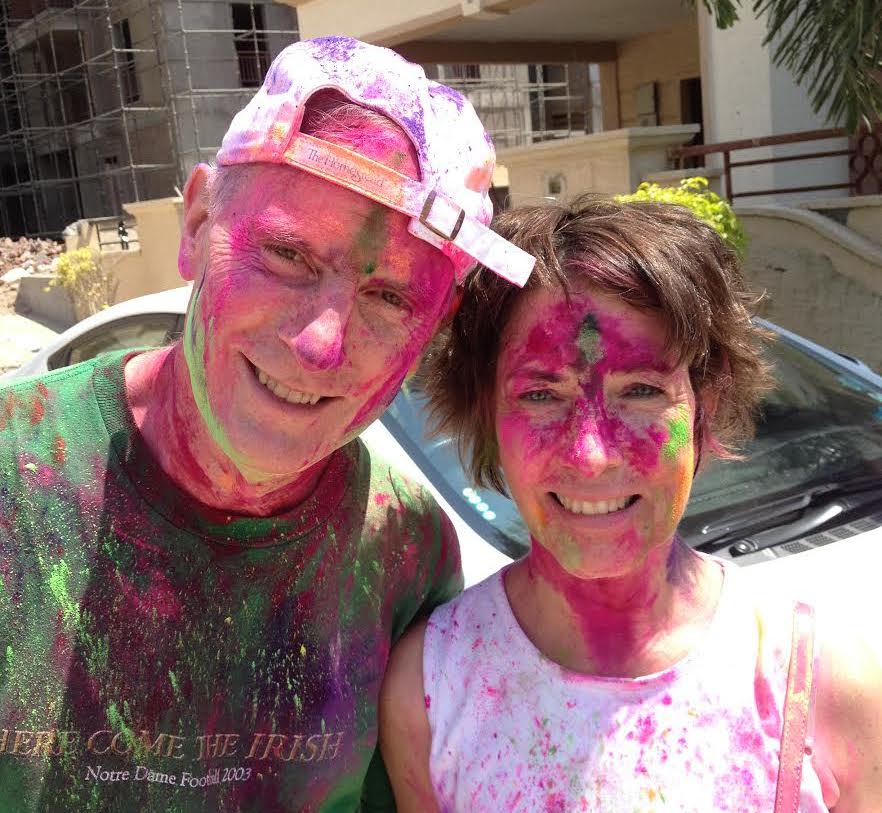
This year St. Patrick’s Day and the Hindu festival of Holi fall on the same day, so what better way to commemorate the coincidence than two Irish-looking Dishheads in Hyderabad?
Zadie Smith contemplates the ways we talk about climate change:
Although many harsh words are said about the childlike response of the public to the coming emergency, the response doesn’t seem to me very surprising, either. It’s hard to keep apocalypse consistently in mind, especially if you want to get out of bed in the morning. What’s missing from the account is how much of our reaction is emotional. If it weren’t, the whole landscape of debate would be different. We can easily imagine, for example, a world in which the deniers were not deniers at all, but simple ruthless pragmatists, the kind of people who say: “I understand very well what’s coming, but I am not concerned with my grandchildren; I am concerned with myself, my shareholders, and the Chinese competition.” And there are indeed a few who say this, but not as many as it might be reasonable to expect.
Another response that would seem natural aligns a deep religious feeling with environmental concern, for those who consider the land a beauteous gift of the Lord should, surely, rationally, be among the most keen to protect it. There are a few of these knocking around, too, but again, not half as many as I would have assumed. Instead the evidence is to be “believed” or “denied” as if the scientific papers are so many Lutheran creeds pinned to a door. In America, a curious loophole has even been discovered in God’s creation, concerning hierarchy.
It’s argued that because He placed humans above “things”—above animals and plants and the ocean—we can, with a clean conscience, let all those things go to hell. (In England, traditional Christian love of the land has been more easily converted into environmental consciousness, notably among the country aristocrats who own so much of it.)
But I don’t think we have made matters of science into questions of belief out of sheer stupidity. Belief usually has an emotional component; it’s desire, disguised. Of course, on the part of our leaders much of the politicization is cynical bad faith, and economically motivated, but down here on the ground, the desire for innocence is what’s driving us. For both “sides” are full of guilt, full of self-disgust—what Martin Amis once called “species shame”—and we project it outward. This is what fuels the petty fury of our debates, even in the midst of crisis.
The breadth of our coverage will be much clearer at this new version of FiveThirtyEight, which is launching Monday under the auspices of ESPN. We’ve expanded our staff from two full-time journalists to 20 and counting. Few of them will focus on politics exclusively; instead, our coverage will span five major subject areas — politics, economics, science, life and sports.
Our team also has a broad set of skills and experience in methods that fall under the rubric of data journalism. These include statistical analysis, but also data visualization, computer programming and data-literate reporting. So in addition to written stories, we’ll have interactive graphics and features. Within a couple of months we’ll launch a podcast, and we’ll be collaborating with ESPN Films and Grantland to produce original documentary films.
The site won’t be all data all the time:
We’re not planning to abandon the story form at FiveThirtyEight. In fact, sometimes our stories will highlight individual cases, anecdotes. When we provide these examples, however, we want to be sure that we’ve contextualized them in the right way. Sometimes it can be extraordinarily valuable to explore an outlier in some detail. But the premise of the story should be to explain why the outlier is an outlier, rather than indicating some broader trend. To classify these stories appropriately, we’ll have to do a lot of work in the background before we publish them.
All of this takes time. That’s why we’ve elected to sacrifice something else as opposed to accuracy or accessibility. The sacrifice is speed — we’re rarely going to be the first organization to break news or to comment on a story.
Emily Greenhouse wants more attention paid to suicide:
In the United States, suicide rates have risen, particularly among middle-aged people: between 1999 and 2010, the number of Americans between the ages of thirty-five and sixty-four who took their own lives rose by almost thirty per cent. Among young people in the U.S., suicide is the third most common cause of death; among all Americans, suicide claims more lives than car accidents, which were previously the leading cause of injury-related death. …
Alan Berman, the executive director of the American Association of Suicidology and the president of the International Association of Suicide Prevention, has said that in the developed world ninety per cent of those who attempt suicide suffer from psychological ailments. “We have effective treatments for most of these,” Berman said last year. “But the tragedy is, people die from temporary feelings of helplessness—things we can help with.” The relentless intensity of those feelings has always been difficult to convey to those who have not experienced them: William Styron, in his powerful memoir, “Darkness Visible,” lamented the insufficiency of “depression” as a label for “the veritable howling tempest in the brain.” Styron, who checked himself into the affective-illness unit at Yale-New Haven hospital, lived to write an account of his suffering, but many others lack the wherewithal, or the capacity, to seek such help.