About Last Night …

by Jonah Shepp

https://twitter.com/shaunwalker7/status/445308236867325953

Leonid Bershidsky summarizes how yesterday’s referendum in Crimea went down:

According to preliminary results, 96.6 percent of Crimea’s population voted in a hastily arranged referendum on Sunday for their territory’s secession from Ukraine and inclusion in Russia. The plebiscite was, predictably, a farce, with the votes counted behind closed doors in the absence of observers or the press, and with almost the entire indigenous population of Crimean tatars failing to turn out.

There were, however, fireworks on Sunday night, and locals celebrated in the streets. Most of them do want Crimea to be part of Russia, and it’s anybody’s guess why Russia and the pro-Russian authorities on the peninsula decided against arranging a real, honest, transparent vote. For some reason, Russia appears to be full of resolve to become an international pariah or expose the cynicism of Western politicians if they do not confer that status on Moscow. The Russian parliament is promising to act quickly to make Crimea part of Russia. The die is cast, and the Kremlin is now waiting to see what the costs will be, pretending as best it can that it does not care one way or another.

Oliver Bullough examines how this “unconstitutional sham” was orchestrated:

Some polling stations—such as the one in the village of Arpat—have helpfully laid out campaign literature. One leaflet had a BuzzFeed-style list of “10 reasons to be together with Russia.” These ranged from the spiritual (“In our many centuries of history, tens of thousands of sons of Russia have sacrificed their heads to give [Crimea] freedom”) to the practical (“Pensions in Russia are almost twice as high as in Ukraine”) to the rhetorical (“Today the people of Crimea have the chance to restore historical justice”).

There were no leaflets supportive of the constitution of 1992, incidentally.

The presence of international observers was also, of course, a joke:

[T]hey’re a very select group of about 30 international observers authorized by the Crimean government, who were paraded to the press at a news conference yesterday. “Speaking near-flawless Russian and repeating Russian talking points on the Ukrainian crisis word for word, a motley team of foreign election observers lined up to praise the referendum at a press conference Saturday evening,” Buzzfeed’s Max Seddon reported from the scene. The OSCE tried to get a team of 40 observers into Crimea, but warning shots were fired when the group tried to pass through a checkpoint last week. Crimea has since “invited” OSCE observers to attend the referendum.

Eric Posner passes along an e-mail from a Ukrainian reader highlighting even more brazen abuses:

If you follow the Russian and Ukrainian language press as well as Crimean groups on social-networking sites (such as SOS_Krym), you already realize that large scale attempts at voter fraud are under way. Several of my friends in Crimea (this has been verified by reports throughout the peninsula) have been visited by unidentified individuals who either make off with their passports or damage them. This just so happens to coincide with an announcement by Sevastopol city authorities that any form of photo ID will be accepted during the referendum, given what has been happening to passports. This is a clear invitation to “Russian tourists”, many of whom have already created problems in Donetsk and Kharkov.

Morrissey doubts any western countries will recognize the outcome:

The [Crimean] parliament has formally requested recognition for its new status at the UN and with Western nations, but they’re not going to get it — and that will extend the diplomatic issues with Russia. If Putin and Russia’s Duma annex Crimea, it will technically be a seizure rather than a legitimate annexation in the paradigm of self-determination. No Western nation is going to recognize the legitimacy of a plebescite held under occupation by foreign troops, no matter how many ethnic Russians live on the Crimean peninsula.

But Posner writes off the peninsula as lost:

It doesn’t matter that the referendum did not allow voters to express a preference for the status quo, that many of the 90+ percent who favor annexation by Russia (according to (possibly questionable) exit polls) may have been trucked in, that international election monitors were not used, that ballot boxes may have been stuffed, that Tatar groups refused to participate, that the public debate was drowned out by pro-Russian propaganda, and that Russian soldiers and/or pro-Russia militias roamed the streets. It is sufficient that there wasn’t violence, that western journalists were free to move about and interviewed plenty of ordinary people who strongly favored annexation, that there were enthusiastic public demonstrations in favor of annexation and celebrations after the result was announced, and that the outcome is consistent with demographic realities and what seems plausibly (to us ill-informed westerners) the preference of most Crimeans. Unless large groups of Tatars and ethnic Ukrainians take to the streets to protest the referendum and are clubbed by riot police, any western effort at this point to try to rescue Crimea from the invaders it embraces will be not only pointless but ludicrous.
The Dark Ages Of E-Books

by Tracy R. Walsh

Revisiting the early days of the form, Alison Flood finds that its pioneers weren’t exactly well-received:

When Peter James published his thriller Host on two floppy disks, in 1993, it was billed as the “world’s first electronic novel,” and attacked as a harbinger of the apocalypse which would destroy literature as we knew it. Now it has been accepted into the [London] Science Museum’s collection as one of the earliest examples of the form, as the spotlight of academia begins to shine on the history of digital publishing.

“I got absolutely pilloried,” says James. “I was on Today accused of killing the novel, I was a front-page headline on papers in Italy – 99 percent of the press was negative … one journalist even took his computer on a wheelbarrow to the beach, along with a generator, to read Host in his deckchair.” The digital version of the novel (it was also published physically) went on to sell 12,000 copies, according to James, and two years later, he was speaking on a panel on the future of the novel at the University of Southern California, together with Apple founder Steve Jobs. “I said e-books would catch on when they became more convenient to read than the printed novel,” said James. “It was astonishing the amount of outrage it caused.”

Previous Dish on e-books here, here, and here.

What’s The Best Way To Combat Military Rape? Ctd

by Chris Bodenner

A reader goes in-depth on the issue:

First off, I want to say that military sexual assault (MSA) is a scourge within our military and we must weigh every available option in seeking to eliminate it. That being said, I believe that Sen. Gillibrand’s legislation (and broader campaign) fails in three critical ways: substantively, technically, and stylistically.

1) Substantively – There is really nothing beyond anecdotal evidence backing up Sen. Gillibrand’s claim that the chain of command serves as the main deterrent to reporting. The 2012 SAPRO Report (DoD’s office responsible for collecting data on sexual assault within the military and for developing strategies to curb and combat MSA), 73% of women and 85% of men believe that their leadership does well to create an environment where they would feel comfortable reporting. Those numbers need to be closer to 100% and the gulf between male and female servicemembers is alarming, but that data does not suggest that lack of confidence in command is the central driver of underreporting.

SAPRO reported that the top three reasons why women failed to report sexual assault were:

-They did not want anyone to know (70%)

-They felt uncomfortable making a report (66%)

-Did not think the report would be kept confidential (51%)

Likewise, the top three reasons why men failed to report were:

-They believed they or others would be punished for other infractions or violations, such as -underage drinking (22%)

-They would not be believed (17%)

-Their performance evaluations or chances for promotion would suffer (16%)

The data seems to suggest that the chief barrier to reporting is not the chain of command, but the comfort of the individual victim. An appropriate response would demand much more emphasis on supporting the victims of MSA as opposed to tweaking the justice system. Sen. Gillibrand’s legislation does not provide any additional supports for victims at the individual level. Ultimately, it’s a big, unwieldy bureaucratic revamp.

Lastly, the military has wielded the chain of command to affect cultural transformation. Racial desegregation, repeal of Don’t Ask, Don’t Tell, and today’s integration of women into combat forces have all been implemented through – not in spite – of the chain of command. The chain is a means of holding commanders accountable for the actions of their subordinates; now, more than ever before, that includes sexual harassment and all forms of unwanted sexual contact.

2) Technically – Gillibrand’s legislation would create a special office of prosecutors within each Service Secretary’s office to dispose of reported alleged offenses. Prosecutors eligible for assignment to this office would have to be grade O-6 (Colonel-equivalent) or higher. In the Army, for example, there are somewhere around 140 O-6 Judge Advocates. These officers commonly serve as staff Judge Advocates for commanders of larger units (think Brigades, Divisions, sometimes Corps). According to the the SAPRO report, the Army fielded 1122 unrestricted reports of sexual assault/harassment last year. How many Judge Advocates would be tasked with referring these cases? While many public defenders may juggle somewhere around 400 cases a year, that’d be high inadvisable to base a staffing model around; these incidents vary wildly in severity (offensive comments to brutal rapes), geographical location, and cross-jurisdictional concerns. Additionally, the UCMJ requires trials to commence within 120 days of charges being filed. Taking this all together, let’s assume that these O-6s are given 100 cases a year, bringing the number of attorneys in this office to 11.

Sen. Gillibrand’s central claim is that MSA reporting is so low because victims are mistrustful of the chain of command. Consequently, we could expect reporting to increase if we removed disposition of these cases from the chain. Following that logic, a greater reporting level would demand a greater number of these limited O-6 prosecutors. Pulling these prosecutors from the units that they are assigned to into this newly created office would materially degrade the military’s ability to competently and expediently dispense with justice with regards to UCMJ offenses not covered by Sen. Gillibrand’s bill. This would create a situation where the services are forced to rapidly promote junior officers to fill positions typically held by more experienced individuals. Moreover, there are significant concerns about the quality of prosecution that victims would receive under this system. Most O-6s within the services’ respective Judge Advocate corps spend more time behind a desk than before a courtroom and many of these individuals have not argued a case for years.

3) Stylistically – The debate over Sen. Gillibrand’s legislation became all too acrimonious, and I largely blame her for that. While her passion undoubtedly brought much-needed attention to the matter, it also created an unfortunate narrative of “Gillibrand or Nothing” with regards to Congressional action. That could not be further from the truth. The FY14 NDAA contained dozens of provisions addressing MSA and represents the single largest step towards combating the issue. There is still far more work to be done, but it is disingenuous to say that Congress failed to act on the matter. Yeah, this is a historically shitty Congress, deserving of much of the contempt directed at it, but when it comes to MSA, the body shapes up rather well.

Tragically, a lot of these victims were used as pawns by either side of the debate. That’s unconscionable. But on the balance, the attention directed at this issue, one that had reared its gut-wrenching head over and over and over again across the past several decades, was positive and proof that our legislature and nation benefits from a greater number of women filling its halls. If there’s an enduring vision to be had from this whole episode, it’s of the women of the Senate Armed Services Committee grilling the shit out of the Joint Chiefs. That’s why this time is different – the advocates are not only more numerous, but much, much, much more powerful.

Finally, thank you providing a unique and compelling forum for discussing so many diverse, important, and sometimes not-so-important issues. The Dish is definitely one of the better corners of the Internet.

Previous Dish on efforts to combat military rape here.

The Newest Voters Lean Right? Ctd

by Patrick Appel

Last week, John Sides claimed that the youngest millennial voters in 2012 skewed Republican. Daniel Berman casts doubt on this analysis:

When one recognizes that 18 year olds were only 55% white in 2012, that implies either a large shift among younger minorities, or a percentage in excess of 75%-80% among whites.

A more plausible outcome is that the Exit Poll collection method is fundamentally flawed when collecting this data, as its owns creators have claimed, noting their own (ANES) estimate that Obama won 71% of 18-20 year olds. Polls are not collected at all polling stations, but rather at a selection. While efforts are made both to gain representative samples of certain groups, and to weight them accurately, the numbers for groups that were not targeted for representative samples, say 19 year olds, are likely to be off, with margin of errors meaningless.

The One-Armed, Three-Handed Drummer

by Jonah Shepp

Drummer Jason Barnes, who lost his right arm two years ago, gets an assist from a robotic prosthesis:

[T]hings got more interesting when [founding director of the Georgia Tech Center for Music Technology Gil] Weinberg added a second drum stick into the mix. Now Barnes can play with one stick in his human hand, with a second stick following along to the rhythm, while a third can fill in with computer-improvisation that’s computed based on the rhythm of the other two sticks. In essence, Weinberg helped turn Barnes into a three-handed drummer.

“I think [the potential] is limitless,” Weinberg told me. “I’m very excited about actually helping someone with a disability to become actually better than his teacher.”

Correction Of The Day

by Chris Bodenner

“An earlier version of this article misquoted a comment from Malachy McCourt on St. Patrick.  Mr. McCourt said, ‘My attitude is, St. Patrick banished the snakes from Ireland and they all came here and they became conservatives.’ He did not say St. Patrick banished the slaves from Ireland,” – the New York Times.

Political Biology

by Jonah Shepp

Chris Mooney reviews John R. Hibbing, Kevin B. Smith, and John R. Alford’s Predisposed: Liberals, Conservatives, and the Biology of Political Differences:

As Hibbing et al. explain, the evidence suggests that around 40 percent of the variation in political beliefs is ultimately rooted in DNA. The studies that form the basis for this conclusion use a simple but powerful paradigm: they examine the differences between pairs of monozygotic (“identical”) twins and pairs of dizygotic (“fraternal”) twins when it comes to political views. Again and again, the identical twins, who share 100 percent of their DNA, also share much more of their politics.

In other words, politics runs in families and is passed on to offspring. Hibbing and his coauthors suspect that what is ultimately being inherited is a set of core dispositions about how societies should resolve recurring problems: how to distribute resources (should we be individualistic or collectivist?); how to deal with outsiders and out-groups (are they threatening or enticing?); how to structure power relationships (should we be hierarchical or egalitarian?); and so on. These are, of course, problems that all human societies have had to grapple with; they are ancient. And inheriting a core disposition on how to resolve them would naturally predispose one to a variety of specific issue stances in a given political context.

He also looks at Avi Tuschman’s Our Political Nature, which takes the same argument further:

Tuschman doesn’t hold back. Conservatives, he suggests in one of three interrelated evolutionary accounts of the origins of politics, are a modern reflection of an evolutionary impulse that leads some of us to seek to control sexual reproduction and keep it within a relatively homogenous group. This naturally makes today’s conservatives more tribal and in-group oriented; if tribalism does anything, it makes it clear who you are and aren’t supposed to mate with.

Tuschman’s liberals, in contrast, are a modern reflection of an evolutionary impulse to take risks, and thereby pull in more genetic diversity through outbreeding. This naturally makes today’s liberals more exploratory and cosmopolitan, just as the personality tests always suggest. Ultimately, Tuschman bluntly writes, it all comes down to “different attitudes toward the transmission of DNA.” And if you want to set these two groups at absolute war with one another, all you need is something like the 1960s.

Arnold Kling thinks this type of scholarship is overhyped:

Mooney leaves readers with the impression that psychologists explain a larger share of political differences than they themselves claim to explain. In contrast, my guess is that they explain less. These are the sorts of studies that tend to suffer from publication bias (20 studies are tried, one out of 20 passes the “significance test” of having a 5 percent probability of being true by chance, and that study gets published). In these sorts of studies, attempts at replication sometimes fail completely, and even when successful the effects are smaller than in the original published study.

In fact, my guess is that we are approaching peak political psychology. I would bet that ten years from now the links between political beliefs and psychological traits will be regarded as a very minor field of inquiry.

In his own review, Kling panned Our Political Nature:

Overall, the pattern is that for Tuschman, every evil of conservatives is essential, by which I mean that it follows directly from the conservative point of view. On the other hand, every evil of the left is accidental, meaning that it occurs in spite of what leftists believe.

And yet, Tuschman declares early on that he will not take an ideological position, but instead he will speak objectively. To me, this lowers his credibility. It would have been more persuasive had he simply said at the outset, “I think that conservatives are racist, authoritarian, and warmongering, and here is some psychological research that supports my point of view.”

Overturning Politics With Art

by Jessie Roberts

Erica R. Hendry spotlights Los Encargados (Those in Charge), a striking 2012 short film by Spanish artists Santiago Sierra and Jorge Galindo:

Their 2012 return [to Madrid] came unannounced mid-day in August in the form of a live performance piece: An unauthorized parade along the Gran Vía, Madrid’s central thoroughfare, of black Mercedes-Benz sedans carrying upended portraits of Juan Carlos I, the sovereign who began Spain’s transition to democracy after the 1975 death of the dictator Francisco Franco, and the country’s six subsequent prime ministers. … Using 12 cameras, the artists captured the procession in black and white as it made its way around the city on unusually empty streets (by chance, there was another demonstration across the city, Gordon says).

The event—which was nearly halted by police, Gordon says—caused a viral sensation after bystanders posted photos and videos online. The beauty of the film—and the editing—is it lets the artists play with perception. In some shots, the portraits, which were created by Galindo, are righted while the cars roll upside down, or backwards, down the streets. In the film, as the procession of cars passed museums, old cinemas and other landmarks, the editors added the populist Polish song “Warszawianka”—the signature anthem of the Spanish Civil War. The screen is split into three as cameras zoom in to the whites of the leaders’ eyes, and an ominous police siren swells and fades as the piece comes to a close.

Quote For The Day

by Chris Bodenner

“The honest system of advertising should be but a simple announcement of the offer of goods for the information of those who desire to purchase, in such a manner that they may by seeking find. But in advertising as it now exists, exaggeration is piled on exaggeration, and falsehood is added to falsehood. The world is filled with monstrous lies, and they are thrust upon attention by every possible means. When a man opens his mail in the morning the letter of his friend is buried among these advertising monstrosities. They are thrust under street-doors, and they are offered as you walk the streets. When you read the morning and evening papers, they are spread before you with typographic display; they are placed among the items you desire to read, and they are given false headings, and they begin with decoy paragraphs. … [T]he whole civilized world is placarded with lies, and the moral atmosphere of the world reeks with the foul breath of this monster of antagonistic competition,” – John Wesley Powell, “Competition as a Factor in Human Evolution,” American Anthropologist 1, no. 4 (October 1, 1888): 297–323. Italics mine. Thanks to a reader for flagging. Previous Dish on the early history of sponsored content here.

The PRC According To Autocomplete

by Jonah Shepp

finalbaidumap

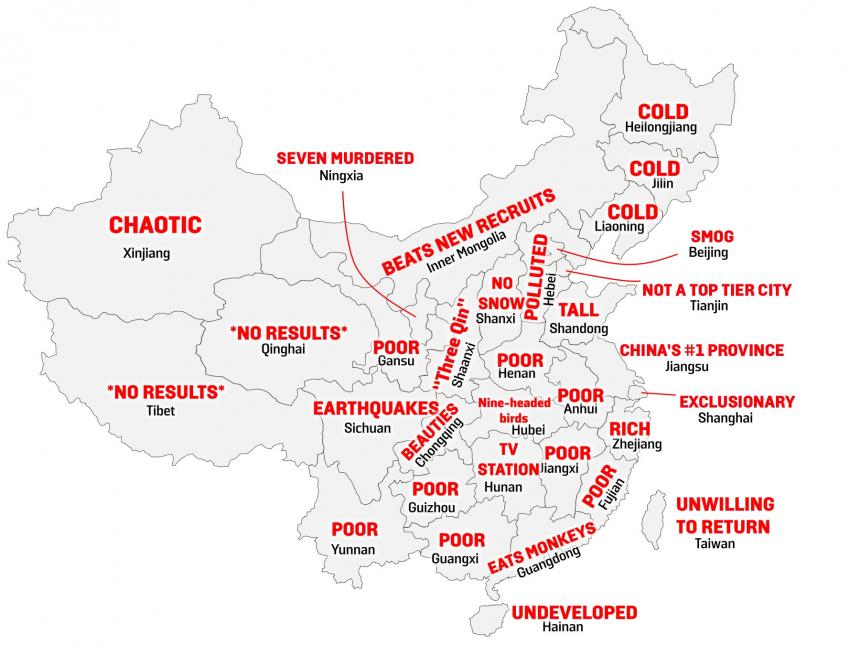
Warner Brown mapped China’s regional stereotypes according to Baidu autocomplete:

Why is the northwestern Chinese region of Xinjiang “so chaotic?” Why are many from the southern metropolis of Shanghai “unfit to lead”? And do people from central Henan Province really steal manhole covers? These are just some of the questions — ranging from the provocative, to the offensive, to the downright ridiculous — that Chinese people ask about themselves and each other on Baidu, the country’s top search engine, which says it processes about 5 billion queries each day.

In the West, amateur sociologists use Google’s voluminous search history to finish half-written questions about different regions. They then plot the stereotypes onto maps such as this one of the United States, which The Atlantic called “The U.S. According to Autocomplete.” China, with its long history of regional stereotyping, is ripe for similar treatment.

Christopher Beam explores what else the search engine reveals about Chinese web users:

Sex questions are popular—understandably so, given the relative dearth of sex education in China. (Plus, asking the Internet is less awkward than asking your teacher or mom.) The top “why” question among Googlers may be “why is the sky blue,” but Baidu users have a different primary concern: “Why is my semen yellow?” Runners up include “Why do I ejaculate so quickly?” and “Why don’t I have any semen?” They also pose questions they might be too shy to ask their partners, such as, “Why do girls go to the bathroom after sex?” You may have noticed these are all dude questions. It’s hard to say whether that’s because Chinese men have a disproportionately large number of sexual hang-ups, or because Baidu users are disproportionately male, or because China itself is disproportionately male. Evidence points to the latter two explanations: If you type in “I’m looking for,” “a wife” makes the list of top suggestions, but “a husband” does not.