Clinton’s Lobbyist

From CQ:

A small number of lobbyists are super insiders. They don’t just donate money to their favorite congressional causes — they serve as treasurers of the lawmakers’ campaign committees. One of them is Janice Enright, a registered lobbyist who is also treasurer of HillPAC, one of the political committees of Sen. Hillary Rodham Clinton… Enright is the lobbying partner of Harold Ickes, a Clinton presidential campaign adviser, and they both worked in the Clinton White House. The Senate Appropriations Committee listed Clinton as having jointly requested, with Sen. Charles E. Schumer , D-N.Y., hundreds of millions of dollars that the spending law earmarks for New York projects. About $4 million of that funding went to clients of Enright and Ickes, including $292,000 designated for a United Auto Workers training program that is a part of an umbrella group, Consortium for Worker Education, that Enright represents.

(Hat tip: Ken Silverstein)

What Didn’t Work

Peggy Noonan has been on a roll lately. She represents to me the kind of Reagan Democrat who is able and willing to hear a black Democratic candidate out – even if on some policies he isn’t as conservative as she (or I) would like – and who understands that most Americans, whatever the consultants say, are still interested in intelligent, educated, thoughtful discourse. Her take on Obama’s historic speech this week is excellent, and its critique is sharp:

Near the end of the speech, Mr. Obama painted an America that didn’t summon thoughts of Faulkner but of William Blake. The bankruptcies, the dark satanic mills, the job loss and corporate corruptions. There is of course some truth in his portrait, but why do appeals to the Democratic base have to be so unrelievedly, so unrealistically, bleak?

This connected in my mind to the persistent feeling one has — the fear one has, actually — that the Obamas, he and she, may not actually know all that much about America. They are bright, accomplished, decent, they know all about the yuppie experience, the buppie experience, Ivy League ways, networking. But they bring along with all this — perhaps defensively, to keep their ideological views from being refuted by the evidence of their own lives, or so as not to be embarrassed about how nice fame, success, and power are — habitual reversions to how tough it is to be in America, and to be black in America, and how everyone since the Reagan days has been dying of nothing to eat, and of exploding untreated diseases. America is always coming to them on crutches.

But most people didn’t experience the past 25 years that way. Because it wasn’t that way. Do the Obamas know it?

That’s why I think Pennsylvania is an opportunity for him. The most tired element, and the least refreshing aspect, of his message so far is a resort to left bromides about the grim facts of American life in the last twenty years or so. There are problems, real problems. Inequality, fostered by globalization, has left many Americans treading water at best. But the vitality of the economy, the astonishing creativity of American industry, especially in tech and pharmaceuticals, the miracle of the Internet, the relative cheapness of items like food and clothing that once consumed far more of the average American’s expenses – these are also integral to the picture. Obama hasn’t conveyed this complicated picture – perhaps because of the primary season. But he should. America needs hope. But it is not currently hopeless. And its recent past, despite the disasters of the past eight years, has had as many highs as lows.

Strategizing Against al Qaeda

Increasingly I hear that even if it were in the West’s interests to leave Iraq, al Qaeda would consider it a victory, be emboldened and grow stronger. This is a core part of McCain’s message, as if a complicated war against a Wahhabist terror franchise, a Shiite regional power and a myriad other, constantly shifting cross-currents can be reduced in this fashion with any great enlightenment. Obviously, the morale of the enemy matters; and bin Laden himself has cited Iraq as a key battle ground. But it is important not to have our strategy actually dictated by bin Laden. Matt makes a similar point today:

This business about al-Qaeda securing a recruiting boon from us leaving Iraq is bizarre. According to MNF-Iraq, the occupation of Iraq is the main fact driving recruits to join AQI. Absent the occupation, there’s no recruiting pitch. Pearl Harbor was a boon to U.S. military recruiting, VJ Day wasn’t. And what’s this business about them acquiring "an even greater determination to dominate the region and harm America." Does Bush really think they lack determination now?

It’s striking how much of conservative thinking about national security these days centers around subjective factors — determination, emboldening, "claiming victory" — rather than on objective assessments. Objectively speaking, withdrawing from Iraq would cut off a major line of recruiting for al-Qaeda while simultaneously freeing up vast quantities of American manpower and other resources.

I’m not as sanguine as Matt about the consequences of withdrawal. But I do think there is one force Sunni al Qaeda may hate as much as the West: Shiite Iran. And vice-versa. One classic way to advance our interests in a situation like this is to let them fight each other and get out of the way. Al Qaeda has tended to lose support when it targets other Muslim Arabs. And the Iraq-Iran war kept two monstrous regimes busy with their own battle for quite a long time. Why not fly-trap themselves?

Clinton’s February Fundraising

She claimed $35 million. Here’s how Ben Smith reported it:

Hillary Clinton’s campaign is set to announce later today that she’s on track to raise roughly $35 million in the month of February, a huge month by any standard measure of political fundraising and her best of the campaign.

ABC News:

Sen. Hillary Clinton said Thursday she was incredibly gratified to learn her campaign hauled in a record 35 million dollars in the month of February, despite losing 11 contests during that time.

The Field has doubts.

[I amended this post because although there does appear to be some discrepancies, I don’t think it’s completely clear that the Clinton campaign did lie about this – but it’s a complicated matter. I apologize for jumping to that conclusion.]

The American Forests

An Atlantic classic:

The forests of America, however slighted by man, must have been a great delight to God; for they were the best he ever planted. The whole continent was a garden, and from the beginning it seemed to be favored above all the other wild parks and gardens of the globe. To prepare the ground, it was rolled and sifted in seas with infinite loving deliberation and forethought, lifted into the light, submerged and warmed over and over again, pressed and crumpled into folds and ridges, mountains and hills, subsoiled with heaving volcanic fires, ploughed and ground and sculptured into scenery and soil with glaciers and rivers,—every feature growing and changing from beauty to beauty, higher and higher. And in the fullness of time it was planted in groves, and belts, and broad, exuberant, mantling forests, with the largest, most varied, most fruitful, and most beautiful trees in the world. Bright seas made its border with wave embroidery and icebergs; gray deserts were outspread in the middle of it, mossy tundras on the north, savannas on the south, and blooming prairies and plains; while lakes and rivers shone through all the vast forests and openings, and happy birds and beasts gave delightful animation. Everywhere, everywhere over all the blessed continent, there were beauty, and melody, and kindly, wholesome, foodful abundance.

What I Got Wrong About Iraq

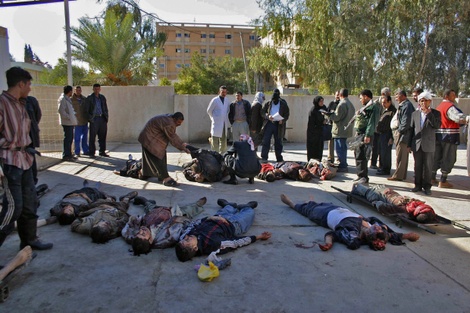
Baqubaaliyussefafpgetty

Slate asked me to reflect on my own failings of judgment on the fifth year of the war. Maybe the day we Christans are called to atonement is a good day for publishing it. It’s cross-posted here. I think I committed four cardinal sins. Historical Narcissism. I was distracted by the internal American debate to the occlusion of the reality of Iraq. For most of my adult lifetime, I had heard those on the left decry American military power, constantly warn of quagmires, excuse what I regarded as inexcusable tyrannies and fail to grasp that the nature of certain regimes makes their removal a moral objective. As a child of the Cold War, and a proud Reaganite and Thatcherite, I regarded 1989 as almost eternal proof of the notion that the walls of tyranny could fall if we had the will to bring them down and the gumption to use military power when we could. I had also been marinated in neoconservative thought for much of the 1990s, and seen the moral power of Western intervention in Bosnia and Kosovo. All of this primed me for an ideological battle which was, in retrospect, largely irrelevant to the much more complex post-Cold War realities we were about to confront. When I heard the usual complaints from the left about how we had no right to intervene, how Bush was the real terrorist, how war was always wrong, my trained ears heard the same cries that I had heard in the 1980s. So I saw the opposition to the war as another example of a faulty Vietnam Syndrome, associated it with the far left, or boomer nostalgia, and was revolted by the anti-war marches I saw in Washington. I became much too concerned with fighting that old internal ideological battle, and failed to think freshly or realistically about what the consequences of intervention could be. I allowed myself to be distracted by an ideological battle when what was required was clear-eyed prudence. Narrow Moralism I recall very clearly one night before the war began. I made myself write down the reasons for and against the war and realized that if there were question marks on both sides, the deciding factor for me in the end was that I could never be ashamed of removing someone as evil as Saddam from power. I became enamored of my own morality and this single moral act. And he was a monster, as we discovered. But what I failed to grasp is that war is also a monster, and that unless one weighs all the possibly evil consequences of an abstractly moral act, one hasn’t really engaged in anything much but self-righteousness. I saw war’s unknowable consequences far too glibly. Unconservatism. I heard and read about ancient Sunni and Shiite divisions, knew of the awful time the British had in running Iraq but had never properly absorbed the lesson. I bought the argument by many neoconservatives that Iraq was one of the more secular and modern of Arab societies, that these divisions were not so deep, that all those pictures of men in suits and mustaches and women in Western clothing were the deeper truth about this rare, modern Arab society; and believed that it could, if we worked at it, be a model for the rest of the Arab Muslim world. I should add I don’t believe that these ancient divides were necessarily as deep as they subsequently became in the chaos that the invasion unleashed. But I greatly under-estimated them – and as someone who liked to think of myself as a conservative, I pathetically failed to appreciate how those divides never truly go away and certainly cannot be abolished by a Western magic wand. In that sense I was not conservative enough. I let my hope – the hope that had been vindicated by the fall of the Soviet Union – get the better of my skepticism. There are times when that is a good thing. The Iraq war wasn’t one of them. Misreading Bush Yes, the incompetence and arrogance were beyond anything I imagined. In 2000, my support for Bush was not deep. I thought he was an okay, unifying, moderate Republican who would be fine for a time of peace and prosperity. I was concerned – ha! – that Gore would spend too much. I was reassured by the experience and intelligence and pedigree of Cheney and Rumsfeld and Powell. Two of them had already fought and won a war in the Gulf. The bitter election battle hardened my loyalty. And once 9/11 happened, my support intensified as I hoped for the best. His early speeches were magnificent. The Afghanistan invasion was defter than I expected. I got lulled. I wanted him to succeed – too much, in retrospect.

But my biggest misreading was not about competence. Wars are often marked by incompetence. It was a fatal misjudgment of Bush’s sense of morality.

I had no idea he was so complacent – even glib – about the evil that men with good intentions can enable. I truly did not believe that Bush would use 9/11 to tear up the Geneva Conventions. When I first heard of abuses at Gitmo, I dismissed them as enemy propaganda. I certainly never believed that a conservative would embrace torture as the central thrust of an anti-terror strategy, and lie about it, and scapegoat underlings for it, and give us the indelible stain of Bagram and Camp Cropper and Abu Ghraib and all the other secret torture and interrogation sites that he created and oversaw. I certainly never believed that a war I supported for the sake of freedom would actually use as its central weapon the deepest antithesis of freedom – the destruction of human autonomy and dignity and will that is torture. To distort this by shredding the English language, by engaging in newspeak that I had long associated with totalitarian regimes, was a further insult. And for me, an epiphany about what American conservatism had come to mean.

I know our enemy is much worse. I have never doubted that. But I never believed that America would do what America has done. Never. My misjudgment at the deepest moral level of what Bush and Cheney and Rumsfeld were capable of – a misjudgment that violated the moral core of the enterprise  – was my worst mistake. What the war has done to what is left of Iraq – the lives lost, the families destroyed, the bodies tortured, the civilization trashed – was bad enough. But what was done to America – and the meaning of America – was unforgivable. And for that I will not and should not forgive myself either.

(Photo: sectarian killings in Baquba by Ali Yussef/AFP/Getty.)

For Good Friday

Jesus

"Any authenticity that we are going to have as persons of faith and any authority that we are going to have as witnesses to the gospel of Jesus Christ will come because of our exposure to bruises and scars. There is no other way to authenticity. There is a certain counterfeit pose that one may maintain, but as to an entrance into the full, the true authority, into the glorious liberty of the sons of God, that comes by exposure and by wounds. There is no other way. If one looks back at those who have deeply affected their generation, the discovery will be made that almost without exception they did it against some minus, some ache, some pain in their own lives …

At some time, who can say when, there will be a crown of thorns pressed down upon your head. It may be some private anguish. It may be some profoundly disturbing condition in your own family. One cannot detail the direction whence the affliction will come, but when it does, you will have every right to rail against it and to cry out against that kind of providence, even to argue with God, to withstand him to the face …

But do one other thing. Take it. Accept. For was it not our Lord’s word that the cup he looked into, the awful agony which waited for him, did not come from unfriendly hands: "The cup which my Father hath given, shall I not drink of it?"

I promise you this, if you can take whatever deep hurt that occurs in your life and hold it up before God and say to him, even in bitterness, of this which you despise and this which you hate, "If there is anything you can do with it, take, and use it."

I promise you, you will be utterly amazed at what will occur," – Gardner C. Taylor, sermon delivered February 1, 1978. A Charlie Rose interview can be seen with him here.

Wright In Context

This strikes me as worth a look. Here is Jeremiah Wright’s sermon from which one Hannity clip has been culled. After 9/11, Wright is making a classic pacifist case against what he calls "the insanity of the cycle of hatred." I don’t agree with it, and he clearly equates the death of innocents in American warfare with the deaths of innocents in 9/11. But it does fall within the boundaries of a certain kind of Christianity. It does not seem to me to be Chomsky so much as a left-wing Biblical pacifist message. He is also self-critical, which you don’t get from the edited version. He is calling Christians to examine "my own and your own relationship with God," in the wake of a moment when we all sought to fight back against the evil of al Qaeda. I don’t agree with his moral equivalence. But I do see the roots of this message in a version of liberation theology and Christianity, rather than hatred of America as such. He includes himself as someone who needs to examine his own conscience and consider what he regards as a cycle of violence. I think the cable news clips are a little distortive and make more sense in fuller context.

Let me add that I do not believe that patriotism means never criticizing one’s own country, especially if one criticizes one’s own complicity in its failings. That’s especially true for Christians who are sometimes called to make their fellows very uncomfortable in their loyalties. In the days after 9/11, I would have been furious about that sermon. But from a distance, I do not see it as political so much as a form of radical Christianity. Anyway, see for yourself and make your own mind up:

Here’s another piece of fuller context. It’s too long for cable news. But that’s what the web is for, right?