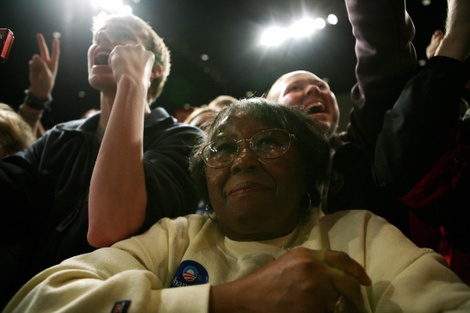
Today will be a crucial day. It will be a day when we will discover if America’s racial environment – and the emotions and feelings and anger and fears that it entails – can allow for a black man – with all that entails – to become president. Can a man like Obama both relate and belong to a congregation like Trinity UCC and be inspired by a man like Jeremiah Wright and still reach beyond race to white and Latino and Jewish and Muslim and other Americans who may find the specific racial context as impossible to understand as it is absurd to excuse? This is the argument that will come flying back at him:
If John McCain had spent twenty years hanging with Pat Robertson, describing him as his mentor, attending Robertson’s church, having his kids baptized by Robertson, having Robertson officiate at his wedding, giving him the inspiration for the title of his career-making autobiography, collaborating with him in political organizing, and then tried to dismiss criticism by calling Robertson his lovable uncle who sometimes goes too far, there is no way on God’s green earth Yglesias or his crowd would call this "trumped up."
Much of Wright’s worldview I find repugnant. But some of it I also find inspiring. And in trying to understand it in its totality, I do try to think about the racial context and history of America. And so there is a difference, pace Jonah, between a white charlatan like Robertson who chooses to demonize minorities in the name of Jesus and a pastor like Wright who vents rage against a majority that has, in the not-so-distant past, given African-Americans every reason to be angry. And there is a difference between a white politician (like Bush) who seeks to enjoy the support of a Robertson without ever challenging his ugly dimensions and a black politician who, while remaining in a congregation like Wright’s, nonetheless has written and spoken as movingly as anyone in my lifetime about the need for racial reconciliation and understanding.
Maybe this is a bridge too far. But in thinking about Obama for this past year, and reading the subtle critique of, say, Shelby Steele, as well as the palpable racial discomfort of some white conservatives, I have to say that it is precisely the wide span of Obama’s bridge that makes me admire him. He has refused to disown Wright, while also refusing to endorse all of his message. You can call that opportunistic or expedient or cynical. You can also call it intelligent and brave and principled. Obama could have chosen the Shelby Steele route or even the Alan Keyes or Condi Rice path. He could equally have chosen the Jesse Jackson and Al Sharpton path. But what is unique about Obama is that he tried and is trying to do much more than any of them have – to express all of these racial strategies and to transcend them. While being human. He isn’t a saint or a savior. But he is trying.
I think this is part of his appeal to the next generation. And maybe it’s appropriate for me at this point to express how he has inspired me as a gay man to keep trying to maintain the bridge over the gulfs of my own various identities rather than to burn it. It is possible in American public life to be defined as a gay person and to embrace every aspect of gay culture – the good, the bad and the ugly. It is also possible to be closeted or semi-closeted so that these questions do not easily arise. And it is possible to be a gay man completely divorced from gay culture, and to buy access to power and influence by simply adopting a relationship to the gay world that is indistinguishable from many straight people. I don’t think there’s any perfect solution to this terrible dilemma of identity – of belonging and transcending, of empathizing and maintaining a proper distance. I don’t blame any gay man or woman for failing to make all this work. We live in many worlds and not all of them fit. And there have been times in my life when the roughest edges of a gay subculture I do not want to disown and have been a full part of reach out and target me again. Whether it be an embarrassing online personal ad or sexual mishaps or a long night at the Black Party, I know that part of the straight world stands poised to attack and condemn, pigeon-hole and dismiss. So be it. I have no desire to disown much of gay culture that the straight world finds abhorrent. At the same time, I also know that not all of this subculture is healthy or good and I have an obligation to address and engage and reform those parts of it. That I have also tried to do – with uneven success. And I know, as I watch Obama, that these strains are not easy and those who have never had to walk this path do not fully know how hard it can be.
The ease of pure victimology is as phony as the release of complete assimilation. For an intelligent and principled person, the struggle lies in the interstices. What I have come to despise about much of the Republican party is its refusal even to empathize with this difficulty – or, worse, to choose to exploit these struggles for easy, cheap and callow political gain. And as I have grown older and felt the tug of all these identities more strongly, and understood more deeply the immense difficulty of resolving all of them, I can see few role models older than I am – and more, mercifully more, younger than I am.
But I see Obama as a pioneer on this path – a brave and principled pioneer. I would think much, much less of him if he disowned a spiritual guide because of that man’s explicable if inexcusable resort to paranoia and racial separatism and anger. And I would think much, much less of Obama if he had never opened himself to this subculture and its fears, hopes and resentments. That he has done all this – while still attempting to reform and explain it – is a remarkable achievement. Did he overlook too much? Did his white guilt prevent him from protesting black extremism? It’s hard for me to know, because this kind of judgment is very personal. I don’t think I would have been as passive as Obama confronted with some of this stuff. But he did not merely sit back; he also dedicated his career to racial integration and understanding. It was a wide bridge, perhaps too wide for the weight it is bearing. And maybe America is not ready for this bridge, for these contradictions, for this complexity. But the promise of Obama is that his campaign appears poised to show that America is ready for this – and the immense healing it would bring.
And so we are suspended between the old politics and the new, between a Clinton who believes in her heart that America is not ready and may never be ready for this leap and should therefore adopt a politics that assumes the ineradicability of this gulf and the need to disguise it and play cynical defense – and an Obama who offers all of us a chance to see that sometimes authentic identity requires an element of contradiction, a bridging of the resentful, angry past and a more complex, integrated future.
He may fail; and the Clintons may be proven right. But he may also succeed – and what a mighty success that would be. These things are never easy; and we were lulled perhaps into an illusion that they could be. So now the real struggle starts. And it will not end with an Obama presidency; it ends with a shift from below that makes an Obama presidency possible.
Or to put it in a phrase that is as true as it is wilfully misunderstood: We are the change we have been waiting for. And the waiting is now over.
(Photo: Emmanuel Dunand/AFP/Getty.)


