Quote For The Day II

"Iraq’s reconstruction will be as symbolically important as West Germany’s was after World War II, but it will be a much tougher project. With three vehement ethnic and religious groups within, and Islamic radicals in the hills nearby, it looks more like Yugoslavia than Germany. In that sense, Iraq predicts the complexities of Asia: the religions, cultures and traditions of governance are profoundly different from ours, the chances of lethal misunderstandings far greater than they were in Europe. President Bush seemed to dismiss this concern in a speech to the American Enterprise Institute on Feb. 26: "It is presumptuous and insulting to suggest that a whole region of the world…is somehow untouched by the most basic aspirations of life. Human cultures can be vastly different, yet the human heart desires the same good things everywhere on earth.

But surely it is not presumptuous to suggest that freedom isn’t easily imposed by outsiders, that it is nurtured slowly and indigenously and may develop in ways that we find strange," – Joe Klein, in his column on the eve of the Iraq war five years ago this week.

Quote For The Day

"In politics, as in religion, my tenets are few and simple; the leading one of which, and indeed that which embraces most others, is to be honest and just ourselves, and to exact it from others; meddling as little as possible in their affairs where our own are not involved. If this maxim was generally adopted, wars would cease and our swords would soon be converted into reap-hooks and our harvests be more peaceful, abundant and happy," – George Washington, cited in Steve Waldman’s new book, "Founding Faith," just published.

Doesn’t sound like a Christianist, does he?

Tibet News Reax

American Footprints wonders about the changing role of Dalai Lama:

The CCP will attack Tibetan dissent with a grim combination of determination, desperation, and relish, and deploy every police, military, political, propaganda informational, and diplomatic resource it possesses, even as the government struggles to maintain the smiley face China Rising facade for the Olympics and the international community.

The question that is roiling the Chinese government and, the Dalai Lama’s government in exile in Dharmsala, is whether this represents a change in tactics, a new upsurge in militancy, and/or a challenge to the leadership of the Dalai Lama in Tibetan affairs.

De Spiegel has a round-up of German reaction. An except from Financial Times Deutschland:

It’s certainly too early to decide on a boycott. But this cuts both ways: Politicians and athletes who now reject the idea out of hand are speaking prematurely. It’s arguable whether such threats will push Beijing to a different policy over Tibet. Nevertheless, a refusal by the West to take part in the Games is its most powerful weapon of protest. It would be a severe mistake to use it now — without knowing whether China will escalate the violence in Tibet, which is still a risk.

A Japanese blogger connects the Tibetan protests to the Taiwan independence movement:

On the 22nd of this month, presidential elections will take place in Taiwan. The uprising in Tibet and the elections in Taiwan will soon join together and come to a head. It is like a threat: if Taiwan tries to declare independence, this is the kind of thing that they will go through. Although the force of the appeal for self-government in Tibet is not directly supporting the elections in Taiwan, through a [common] undercurrent they are induced to join together.

Tibet From China

Fallows reports from inside China:

The propagandists black out news coverage and blame every problem in Tibet on what they call (when they speak in English) "hooligans" from "the Dalai clique." Most people in China assume that Tibet, like Taiwan, Inner Mongolia, or the Muslim Xinjiang region of the northwest, is an integral and inalienable part of its territory. That’s all they have ever heard from the media and in the schools. The threat of regional "splittism" raised by riots in Tibet is in this view a true threat to national security.

Thus conditions are set for the next stage of tragedy in Tibet, as Monday’s deadline for the end of protest draws near. The government is conditioned to be tough — and to have the support of its public, and not to care about objections from overseas. It has to care more, in this year of the Olympics. Soon we’ll see how much that tempers the policy.

Release The Tax Returns!

I’m going to keep making this very basic point until Senators Clinton and McCain provide the same transparency as Obama. It’s particularly important with the Clintons, whose massive increase in wealth in the last few years and past financial shenanigans demand a process of real vetting – a process they are unaccountably resisting. And not a few days before the next critical primary. Now. We need time to ask all the right questions and for the press to do its job. The returns are available unless they weren’t filed.

So where are they? And when will the press do its job and demand either the returns or a half-way credible account of why they’re being withheld? So far, the Clintons are stalling and doing their usual wagon-circling. Anyone who remembers the 1990s knows this is not a good sign. I think they’re hoping that Obama will be destroyed and then they can blame the Republicans for re-booting Ken Starr.

Bear Stearns

Clive Crook says bankruptcy would have been better for the stockholders:

Bankruptcy would surely have recovered more value for shareholders than this give-away-–but the Fed evidently feared that closure and disposal of Bear’s assets would have jeopardized other parts of the country’s teetering financial system. Preventing that was the Fed’s overriding goal. The firm had to be acquired in a hurry, shored up, and then run, so far as counterparties were concerned, as though nothing had happened. By any measure, Bear Stearns was not that big: it was surely not “too big to fail”.

Megan argues most everyone is to blame:

There’s a certain amount of moral outrage floating around in the punditocracy, looking for a solid target. The implication is that someone, or at least some small group of people, must have done this to us in the course of feeding their insatiable greed. I’m sure there will be a post-mortem in which some reporter will tell a very convincing story about how this could all have been averted if only someone had Made A Rule. It may be Bear’s managers who should have done it, or the Fed, or the SEC. I don’t know who the culprit will be, but I am very sure that everyone else will be very sure that Someone could have (and should have) prevented all this.

Before we enter into the orgy of blame, I’d suggest that that someone was everyone, almost. Crazy Asian people who thought America was some sort of Miracle Market sent us more money than we needed for investment, inflating an asset price bubble. The Federal Reserve, complacent after more than twenty years of tame inflation, added a little kerosene to an already blazing fire. Silly people decided that real estate prices would continue rocketing upwards forever, and took on ridiculous mortgages that they had no reasonable hope of paying off. Idiot bankers thought that their enormous brains, raffish good looks, and advanced computer models had enabled them to conquer risk.

Alone In Tibet

Tibetmananvatsyayanaafpgetty

The Economist is the only foreign news organisation with official approval to be in Tibet. The magazine’s correspondent writes from his perch in Lhasa:

So far, in this part of the city, the security forces appear to have acted with relative restraint. There are persistent but unsubstantiated reports of Tibetans killed by security forces during the rioting on Friday and Saturday. The Dalai Lama, Tibet’s exiled spiritual leader, has spoken of unconfirmed reports of up to 100 deaths. But there are no convincing accounts of the kind of bloodshed involved in the crushing of the Tiananmen Square protests in Beijing in 1989 or in the suppression of the last serious outbreak of anti-Chinese unrest in Tibet earlier that year. With the approach of a deadline on Monday for rioters to surrender themselves, however, some residents fear that widespread and indiscriminate arrests will follow. […] By Sunday, the authorities appear to have regained control of the streets. Occasional shots were still being fired by troops in the alleyways (whether in warning or at human targets is unclear). Few residents in this normally bustling part of Lhasa now dare to venture out.

In a sign that the government is feeling more confident that its security measures are working, two representatives of the Tibetan administration’s Foreign Affairs Office visited this hotel in the riot-torn area.

They offered to help arrange a flight out if needed, but gave no order to depart. The Economist remains the only foreign news organisation with official approval to be in Tibet—which was applied for and granted well before the unrest broke out.

If residents are not to starve or run out of that daily necessity, yak butter (used in the tea Tibetans drink), a signal will have to be given soon that it is safe to venture out to buy essential supplies. Even when they give this, the authorities will still want to maintain a conspicuous force in the alleyways. Tensions are unlikely to subside rapidly. There are numerous anti-Chinese protests in what China calls the Tibet Autonomous Region as well as in the adjoining ethnic-Tibetan areas of China. Some of the biggest have occurred around Labrang in Gansu Province, one of Tibetan Buddhism’s biggest and most important monasteries. Many Tibetans see the approach of the Olympic games in Beijing in August as an unmissable opportunity to draw attention to their plight.

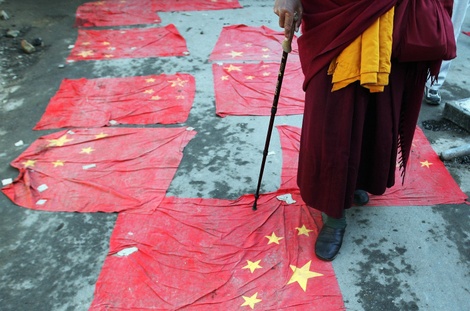
(Photo: Tibetan Buddhist monk in-exile walk over Chinese National flags as part of a protest in Dharamsala on March 16, 2008. The Dalai Lama condemned what he called China’s ‘rule of terror’ and ‘cultural genocide’ in Tibet, calling for an international probe into unrest in his homeland. By Manan Vatsyayana/AFP/Getty.)