As you look closer, the illusion of power gives way to the reality of pain. The world on which this woman sits, our world, is torn by war, destroyed by hate, decimated by despair, and devastated by distrust. The world on which she sits seems on the brink of destruction. Famine ravages millions of inhabitants in one hemisphere, while feasting and gluttony are enjoyed by inhabitants of another hemisphere. This world is a ticking time bomb, with apartheid in one hemisphere and apathy in the other. Scientists tell us there are enough nuclear warheads to wipe out all forms of life except cockroaches. That is the world on which the woman sits in Watt’s painting.
Our world cares more about bombs for the enemy than about bread for the hungry. This world is still more concerned about the color of skin than it is about the content of character—a world more finicky about what’s on the outside of your head than about the quality of your education or what’s inside your head. That is the world on which this woman sits.
You and I think of being on top of the world as being in heaven. When you look at the woman in Watt’s painting, you discover this woman is in hell. She is wearing rags. Her 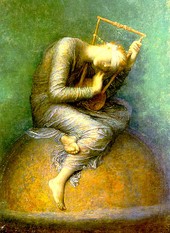 tattered clothes look as if the woman herself has come through Hiroshima or Nagasaki. Her head is bandaged, and blood seeps through the bandages. Scars and cuts are visible on her face, her arms, and her legs.
I. Illusion of Power vs. Reality of Pain
A closer look reveals all the harp strings but one are broken or ripped out. Even the instrument has been damaged by what she has been through, and she is the classic example of quiet despair. Yet the artist dares to entitle the painting Hope. The illusion of power—sitting on top of the world—gives way to the reality of pain.
And isn’t it that way with many of us? We give the illusion of being in an enviable position on top of the world. Look closer, and our lives reveal the reality of pain too deep for the tongue to tell. For the woman in the painting, what looks like being in heaven is actually an existence in a quiet hell.
I’ve been a pastor for seventeen years. I’ve seen too many of these cases not to know what I’m talking about. I’ve seen married couples where the husband has a girlfriend in addition to his wife. It’s something nobody talks about. The wife smiles and pretends not to hear the whispers and the gossip. She has the legal papers but knows he would rather try to buy Fort Knox than divorce her. That’s a living hell.
I’ve seen married couples where the wife had discovered that somebody else cares for her as a person and not just as cook, maid jitney service, and call girl all wrapped into one. But there’s the scandal: What would folks say? What about the children? That’s a living hell.
I’ve seen divorcees whose dreams have been blown to bits, families broken up beyond repair, and lives somehow slipping through their fingers. They’ve lost control. That’s a living hell.
I’ve seen college students who give the illusion of being on top of the world—designer clothes, all the sex that they want, all the cocaine or marijuana or drugs, all the trappings of having it all together on the outside—but empty and shallow and hurting and lonely and afraid on the inside. Many times what looks good on the outside—the illusion of being in power, of sitting on top of the world—with a closer look is actually existence in a quiet hell.
That is exactly where Hannah is in 1 Samuel 1 :1-18. Hannah is top dog in this three-way relationship between herself, Elkanah, and Peninnah. Her husband loves Hannah more than he loves his other wife and their children. Elkanah tells Hannah he loves her. A lot of husbands don’t do that. He shows Hannah that he loves her, and many husbands never get around to doing that. In fact, it is his attention and devotion to Hannah that causes Peninnah to be so angry and to stay on Hannah’s case constantly. Jealous! Jealousy will get hold of you, and you can’t let it go because it won’t let you go. Peninnah stayed on Hannah, like we say, "as white on rice." She constantly picked at Hannah, making her cry, taking her appetite away.
At first glance Hannah’s position seems enviable. She had all the rights and none of the responsibilities—no diapers to change, no beds to sit beside at night, no noses to wipe, nothing else to wipe either, no babies draining you of your milk and demanding feeding. Hannah was top dog. No baby portions to fix at meal times. Her man loved her; everybody knew he loved her. He loved her more than anything or anybody. That’s why Peninnah hated her so much.
Now, except for the second-wife bit, which was legal back then, Hannah was sitting on top of the world, until you look closer. When you look closer, what looked like being in heaven was actually existing in a quiet hell.
Hannah had the pain of a bitter woman to contend with, for verse 7 says that nonstop, Peninnah stayed with her. Hannah suffered the pain of living with a bitter woman. And she suffered another pain—the pain of a barren womb. You will remember the story of the widow in 2 Kings 4 who had no child. The story of a woman with no children was a story of deep pathos and despair in biblical days.
Do you remember the story of Sarah and what she did in Genesis 16 because of her barren womb—before the three heavenly visitors stopped by their tent? Do you remember the story of Elizabeth and her husband in Luke I? Back in Bible days, the story of a woman with a barren womb was a story of deep pathos. And Hannah was afflicted with the pain of a bitter woman on the one hand and the pain of a barren womb on the other.
Hannah’s world was flawed, flaky. Her garments of respectability were tattered and torn, and her heart was bruised and bleeding from the constant attacks of a jealous woman. The scars and scratches on her psyche are almost visible as you look at this passage, where she cries, refusing to eat anything. Just like the woman in Watt’s painting, what looks like being in heaven is actually existence in a quiet hell.
Now I want to share briefly with you about Hannah—the lady and the Lord. While I do so, I want you to be thinking about where you live and your own particular pain predicament. Think about it for a moment.
Dr. Sampson said he wanted to quarrel with the artist for having the gall to name that painting Hope when all he could see in the picture was hell—a quiet desperation. But then Dr. Sampson said he noticed that he had been looking only at the horizontal dimensions and relationships and how this woman was hooked up with that world on which she sat. He had failed to take into account her vertical relationships. He had not looked above her head. And when he looked over her head, he found some small notes of music moving joyfully and playfully toward heaven.
II. The Audacity to Hope
Then, Dr. Sampson began to understand why the artist titled the painting "Hope." In spite of being in a world torn by war, in spite of being on a world destroyed by hate and decimated by distrust, in spite of being on a world where famine and greed are uneasy bed partners, in spite of being on a world where apartheid and apathy feed the fires of racism and hatred, in spite of being on a world where nuclear nightmare draws closer with each second, in spite of being on a ticking time bomb, with her clothes in rags, her body scarred and bruised and bleeding, her harp all but destroyed and with only one string left, she had the audacity to make music and praise God. The vertical dimension balanced out what was going on in the horizontal dimension.
And that is what the audacity to hope will do for you. The apostle Paul said the same thing. "You have troubles? Glory in your trouble. We glory in tribulation." That’s the horizontal dimension. We glory in tribulation because, he says, "Tribulation works patience. And patience works experience. And experience works hope. (That’s the vertical dimension.) And hope makes us not ashamed." The vertical dimension balances out what is going on in the horizontal dimension. That is the real story here in the first chapter of 1 Samuel. Not the condition of Hannah’s body, but the condition of Hannah’s soul—her vertical dimension. She had the audacity to keep on hoping and praying when there was no visible sign on the horizontal level that what she was praying for, hoping for, and waiting for would ever be answered in the affirmative.
What Hannah wanted most out of life had been denied to her. Think about that. Yet in spite of that, she kept on hoping. The gloating of Peninnah did not make her bitter. She kept on hoping. When the family made its pilgrimage to the sanctuary at Shiloh, she renewed her petition there, pouring out her heart to God. She may have been barren, but that’s a horizontal dimension. She was fertile in her spirit, her vertical dimension. She prayed and she prayed and she prayed and she kept on praying year after year. With no answer, she kept on praying. She prayed so fervently in this passage that Eli thought she had to be drunk. There was no visible sign on the horizontal level to indicate to Hannah that her praying would ever be answered. Yet, she kept on praying.
And Paul said something about that, too. No visible sign? He says, "Hope is what saves us, for we are saved by hope. But hope that is seen is not hope. For what a man sees, why does he have hope for it? But if we hope for that which we see not (no visible sign), then do we with patience wait for it."
That’s almost an echo of what the prophet Isaiah said: "They that wait upon the Lord shall renew their strength." The vertical dimension balances out what is going on in the horizontal dimension.
There may not be any visible sign of a change in your individual situation, whatever your private hell is. But that’s just the horizontal level. Keep the vertical level intact, like Hannah. You may, like the African slaves, be able to sing, "Over my head I hear music in the air. Over my head I hear music in the air. Over my head I hear music in the air. There must be a God somewhere."
Keep the vertical dimension intact like Hannah. Have the audacity to hope for that child of yours. Have the audacity to hope for that home of yours. Have the audacity to hope for that church of yours. Whatever it is you’ve been praying for, keep on praying, and you may find, like my grandmother sings, "There’s a bright side somewhere; there is a bright side somewhere. Don’t you rest until you find it, for there is a bright side somewhere."
III. Persistence of Hope
The real lesson Hannah gives us from this chapter—the most important word God would have us hear—is how to hope when the love of God is not plainly evident. It’s easy to hope when there are evidences all around of how good God is. But to have the audacity to hope when that love is not evident—you don’t know where that somewhere is that my grandmother sang about, or if there will ever be that brighter day—that is a true test of a Hannah-type faith. To take the one string you have left and to have the audacity to hope—make music and praise God on and with whatever it is you’ve got left, even though you can’t see what God is going to do—that’s the real word God will have us hear from this passage and from Watt’s painting.
There’s a true-life illustration that demonstrates the principles portrayed so powerfully in this periscope. And I close with it. My mom and my dad used to sing a song that I’ve not been able to find in any of the published hymnals. It’s an old song out of the black religious tradition called "Thank you, Jesus." It’s a very simple song. Some of you have heard it. It’s simply goes, "Thank you Jesus. I thank you Jesus. I thank you Jesus. I thank you Lord." To me they always sang that song at the strangest times—when the money got low, or when the food was running out. When I was getting in trouble, they would start singing that song. And I never understood it, because as a child it seemed to me they were thanking God that we didn’t have any money, or thanking God that we had no food, or thanking God that I was making a fool out of myself as a kid.
Conclusion: Hope is What Saves Us
But I was only looking at the horizontal level. I did not understand nor could I see back then the vertical hookup that my mother and my father had. I did not know then that they were thanking him in advance for all they dared to hope he would do one day to their son, in their son, and through their son. That’s why they prayed. That’s why they hoped. That’s why they kept on praying with no visible sign on the horizon. And I thank God I had praying parents, because now some thirty-five years later, when I look at what God has done in my life, I understand clearly why Hannah had the audacity to hope. Why my parents had the audacity to hope.
And that’s why I say to you, hope is what saves us. Keep on hoping; keep on praying. God does hear and answer prayer.


