Why Run Against Obamacare?

Last week, Sargent flagged a poll finding that “Obamacare is mostly a wash” politically:

[B]arely more than a third (36 percent) say support for Obamacare would make it less likely they vote for a candidate, versus 34 percent who say “more likely.” This is overwhelmingly driven by Republicans: 70 percent of them say “less likely,” while only 35 percent of independents say the same, and moderates say they’d be marginally more likely by 35-31.

Beutler’s theory about why Republicans campaign strongly against the ACA regardless:

The Republicans are going to make gains in the Senate this cycle almost no matter what. If you’re a Republican and you know that in advance, the smart thing to do is treat a single issue as if it’s the decisive one of the campaign, everywhere, in every race. That way when it’s over you can argue that the voters vindicated your position, even if they didn’t. You can claim a mandate, even if one doesn’t exist. And you can safely bet that the political media will swallow it whole.

Red, White, And Halloo

Although “Hi!” may be “the quintessential American word,” it turns out that “Hello!” also has a distinctively American history:

The real ancestry of Hello is Halloo and its variants, a shout to get attention. The Oxford English Dictionary has an example from Daniel Defoe’s Journal of the Plague Year in 1722: “I halloo, and call to them till I make them hear.” Hello is just a milder form of Halloo. And we say it thanks to the sensational electronic innovation of the 1870s, the telephone, first demonstrated to the public by Alexander Graham Bell in 1876 at the Centennial Exhibition in Philadelphia. As telephones and telephone exchanges came into commercial use, the question arose: How do you get the operator’s attention? Alexander Graham Bell proposed Ahoy, but Thomas Edison, who set up the first telephone exchanges, had the last word. He wrote to a colleague in 1877, “I don’t think we shall need a call bell as Hello! can be heard 10 to 20 feet away. What do you think?” So Hello it was. That was just for telephones, of course, and at first few people had them. But by the end of the 19th century, telephones were everywhere, along with Hello.

Not Succumbing To The Spectrum

Ron Suskind’s son, Owen, was diagnosed with “regressive autism” after he stopped speaking at age 3. Years later, Ron used Iago, the parrot from Aladdin, to start a conversation:

I freeze here for a minute, trying to figure out my opening line; four or five sentences dance about, auditioning. Then, a thought: Be Iago. What would Iago say? I push the puppet up from the covers. “So, Owen, how ya doin’?” I say, doing my best Gilbert Gottfried. “I mean, how does it feel to be you?!” I can see him turn toward Iago. It’s as if he is bumping into an old friend. “I’m not happy. I don’t have friends. I can’t understand what people say.”

I have not heard this voice, natural and easy, with the traditional rhythm of common speech, since he was 2. I’m talking to my son for the first time in five years. Or Iago is. Stay in character. “So, Owen, when did yoooou and I become such good friends?”

Owen’s story continues in the must-see video above. And the rest of his dad’s moving essay is here. Meanwhile, Atlantic readers – spurred by Hanna Rosin’s story about her son Jacob – share their own stories about family members with autism spectrum disorder. Here’s Josh from London:

I feel like writing this article is a betrayal.

I feel like I will never truly be able to accurately represent [my brother’s] illness. Even calling it an “illness” is wrenching. He’s a regular person that cannot handle certain situations. The stigma attached to a permanent mental illness that affects sociability is a subtle sort of oppression to the person given it. I see my brother wrestle with his identity a lot. Some days he thinks he’s been over or misdiagnosed; other days he seems to know more than anyone else how much his illness affects him. I can’t even begin to imagine the pain that some interactions must cause him, though I can see it on his face.

“Small kids have small problems; big kids have big problems.” No phrase is truer when talking about a child on the autism scale. The anxieties and inflexibilities of a child are much simpler to deal with than the deep pits of despair and intractable problems of an adult. We are on the borderlands: My brother is just sick enough to be diagnosed, but not sick enough to differentiate himself from anyone else in society. He is always absolutely fine until the moment he’s not. We dragged him through school and university, but will we be able to drag him through the rest of his life?

Much more Dish on autism here.

Filling Up With Cheaper Gas

Gal Luft argues that America’s natural gas should go toward powering our vehicles rather than homes:

The best way to compare energy sources is to look at their cost per unit of heat, measured in British thermal units. The spot price of 1 million BTUs, expressed as mmbtu, derived from natural gas is about $4.30. The price of U.S. coal is more or less the same. At current oil prices, the price of 1 mmbtu derived from oil is roughly $17. That means that from a pure economic standpoint, the upside of replacing coal with natural gas is zero, while that of replacing oil with natural gas is $12.7 per mmbtu. Put differently, at current prices, the 3.5 trillion cubic feet of gas that the Energy Information Administration assumes the United States will be exporting annually starting next decade is valued at $15 billion. If this amount of gas stayed in the United States and were used to power cars and trucks, it would have displaced, depending on the technology, 3 million to 4 million barrels of oil a day, eliminating oil imports at the cost of $100 billion to $150 billion a year. Instead, the United States will be exporting this $15 billion worth of energy only to import an equivalent amount of energy at up to 10 times the cost.

The Anti-Barbie

Realistic Barbie

James Hamblin highlights a doll designed with the body measurements of a typical 19-year-old American woman:

Lammily is the forthcoming plastic doll whose motto is, “Average is beautiful.” Her body shape is based on averages of data from the U.S. Centers for Disease Control that is more often used to track the American obesity epidemic. She is not affiliated with Mattel’s Barbie.

Virginia Postrel sees problems:

Before embracing the reassuring claim that “average is beautiful,” consider the CDC statistics behind Lammily’s physique.

Based on a representative sample of 118 people, the agency reports that the average 19-year-old female American stands 5 feet 4 inches tall. She has a 33.6-inch waist and a 14.1-inch upper arm. She weighs 150 pounds, giving her a body mass index of 25.5. That indicates that she is overweight. BMI is, however, a crude and controversial measure. Better are the CDC’s direct body-fat measurements. They confirm the same bad news: The average 19-year-old’s body is about 32 percent fat, just at the threshold for obesity.

If Lammily were true to life, in other words, she’d have rolls of fat, not a firm plastic tummy. Her figure would turn off both beauty-minded girls and health-conscious parents.

Adrian Lee adds:

It doesn’t help, either, that there is only one race (in an increasingly diverse U.S., it’s tough to say instinctively that Caucasian remains the average), which is a bit intentional: Lamm has said that he wants the figure to have that “J. Crew look,” which is more than a little bit WASPy.

Amanda Hess doubts Lammily will solve anything:

The problem with Barbie is not that she’s the only doll on the block. If parents want their girls playing with dolls proportioned like normal humans, they already have the choice to buy Only Hearts Club dolls or Journey Girls. Enough parents buy these dolls that they continue to exist. Some of them are even sold in major toy stores. But way, way, way more parents buy Barbies, and her stranglehold over the doll market is the reason she gets so much flak. …

Barbie’s impossible frame will remain the impossible standard. And as long as it is, daughters of feminist mommies and daddies who hit daycare with a doll who looks exactly like all the other girls’ Barbiesonly shorter and fatter—may not end up learning the lesson of beauty-at-any-size that the doll was created to deliver.

The Best Of The Dish Today

The news cycle is so punishing these days you might be forgiven for thinking the Obama era is over. But it isn’t. It’s at its peak in terms of impact, because policies, especially economic ones, take some time to have effect. Five years in, we have enough data – so reading through the Economic Report from the Council of Economic Advisers is therefore a helpful exercise. And it seems to me to be a rather impressive record – and utterly alien from the picture of gloom and dysfunction the Republicans are currently concocting.

I’ll restrict myself to core facts that are not in dispute, rather than the arguments in the report. Take the economy. Despite unprecedented austerity at the state and local government level, it’s now clear that the US has recovered from the Great Recession better than any other economy:

Screen Shot 2014-03-10 at 7.37.56 PM

At least we can say with certainty that the stimulus didn’t fail, despite the silly denial in the GOP. The massive debt overhang – always the biggest drag on growth – has also been substantially reduced:

Screen Shot 2014-03-10 at 7.47.40 PM

The deficit has come down at a rapid pace, without tipping us back into recession. And a key indicator of future debt – the cost of healthcare – is looking much better than it once did (although the causes for it remain disputed):
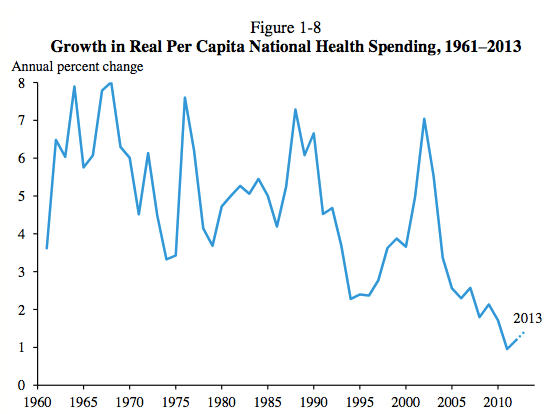
Screen Shot 2014-03-10 at 7.49.08 PM

Then this amazing chart:

Screen Shot 2014-03-10 at 7.35.11 PM

If someone had suggested to me in 2009 that by 2014, after the worst recession since the 1930s and after the huge debt pile-up in the Bush years that the US would be growing steadily, gaining energy independence, and cutting its deficit deeply, I’d have been amazed. We’ve so easily forgotten the extraordinary crisis Obama inherited. We shouldn’t. This presidency was always going to be judged on whether it could return the US to normal governance after the economic calamity of 2007, and after the disastrous wars that were far from over. I fail to see how Obama has failed in any critical respect. Not that it gets him much praise these days. For that we may have to wait for history’s judgment.

Today, I responded to Rod Dreher’s newfound victimhood; and I touted Rand Paul’s exclusive advantage among the GOP primary potentials: his appeal to Millennials. Palin earned a Hathos Red Alert; and we aired the concept of sub-atomic free will from a splendid essay by David Graeber. The window view made me want to visit France. Then two photographs: one pixellated, one GiFed. Check them both out.

The most popular post of the day was Hathos Red Alert; followed by The Christianist Closet?

See you in the morning.

The Life And Death Of Mountains

A beautiful short film on the subject:

In a 2012 interview, the filmmaker Temujin Doran offered this bit of advice:

Q: Your documentary filmmaker’s “Ten Commandments”:

Temujin Doran: I’ve only been doing it for just over a year – so I feel justified in offering only one: I don’t believe all those people who say that if you want to get into filmmaking, you have to want it more than anything else. I’ve heard so many people from the industry giving these lengthy speeches about how filmmaking requires extreme dedication, and how you must sacrifice all your other interests in order to do it.

In my opinion, a part of what makes one a good filmmaker is all the things they do outside of their filmmaking. Of course filmmaking require dedication, but any other creative or adventurous things you do will help to improve your films, be they documentary, narrative or experimental, infinitely more than just learning about filmmaking processes or camera settings.

(Hat tip: Kottke)

Ebert On Addiction

Ted Pillow admires the late critic not just for his movie reviews, but for his often piercing insights into the nature of addiction (in 2009, Ebert revealed that he was a recovering alcoholic). Pillow has assembled “The Unofficial Roger Ebert Reader On Addiction,” pieced together from reviews and blog posts. One snippet:

The story of every drunk or addict is different in the details but similar in the outlines: Their days revolve around finding and using a sufficient supply of their substance of choice to avoid acute mental and physical discomfort. Eventually it gets to the point where everything else—job, family, self-image—is secondary. They all feel the need for something … the natural sources of pleasure have been replaced with higher-octane substitutes, which have burnt out the ability to feel joy. Going through the motions of what once gave them escape, they feel curiously trapped.

Another:

Why do alcoholics begin down the same hazardous road day after day? Any alcoholic knows that life is not all bad, that there comes a moment between the morning’s hangover and the night’s oblivion when things are balanced very nicely, and the sun slants in through the bar windows, and there’s a good song on the jukebox, and the customers might even start dancing. Each day is a window that opens briefly after the hangover and before the blackout, and you can never tell what you’ll see through that window. The alcoholic’s day consists of trying to keep that window open.

More here. Tons of Dish on addiction here.

Face Of The Day

MALAYSIA-MALAYSIAAIRLINES-CHINA-TRANSPORT-ACCIDENT

A Malaysian mourner holds a candle during a vigil for missing Malaysia Airlines passengers at the Independence Square in Kuala Lumpur on March 10, 2014. Malaysia has expanded its search area for a missing jet after three days of scouring the sea failed to bring forth any confirmed sightings of wreckage, an official said. He added that besides searching in waters between Malaysia and Vietnam, authorities were also searching on land in Malaysia and off western Malaysia. By Manan Vatsyayana/AFP/Getty Images.