Clinton’s Rovian Gambit Against Obama

Rovemaskbillpuglianogetty

A reader writes:

Many of your recent posts on the Obama-Clinton contest are missing the forest for the trees. They are focusing on small annoyances from Camp Clinton. The big story of the last week is that the Clintons are trying to strip Obama of his rightful advantage on the Iraq war "judgment" issue and carry out the tactic from the Rove playbook that says, "Attack your opponent’s perceived strength." If that strength is merely "perceived" and not real, it’s a legitimate tactic, but Rove attacks even when the perception is justified, and the Clintons are now doing the same. 

Bill did this in New Hampshire when he contended that Obama was not really a consistent war opponent. Hillary put this tactic way out front on Meet the Press today. She said that Obama’s campaign is premised entirely on his October 2002 speech, and she said that Obama did nothing after that speech. This is just an out and out lie; there are no shades of gray here. Here are two examples of what Obama did after his October 2002 speech that I was able to find through a simple Nexis search:

On March 4, 2003, an AP story picked up by an Illinois newspaper, the Belleville News Democrat, states as follows: 

"Barack Obama  is criticizing the idea of war against Iraq and challenging his Democratic opponents in the U.S. Senate race to take a stand on the question….’What’s tempting is to take the path of least resistance and keep quiet on the issue, knowing that maybe in two or three or six months, at least the fighting will be over and you can see how it plays itself out,’ said Obama, a state senator from Chicago."

On March 17, 2003, the Chicago Sun Times reported this:

"Thousands of demonstrators packed Daley Center Plaza for a two- hour rally Sunday [two days before Bush issued his ultimatum against Saddam and four days before the invasion], then marched through downtown in Chicago’s largest protest to date against an Iraq  war. Crowd estimates from police and organizers ranged from 5,000 to 10,000….    State Sen. Barack Obama (D-Chicago) told the crowd, ‘It’s not too late’ to stop the war."

All of this is highly relevant, because Hillary’s account of her own actions in the October 2002 – March 20, 2003 period (March 20 being the day of the invasion) is that she voted, not to authorize war, but inspections, and that when the inspectors were there in March 2003, she, in her own mind, opposed the invasion and would not have carried it out had she been President.  A key point that has not been made is, if Hillary Clinton is telling the truth that she secretly opposed the invasion on March 20, 2003, then she cannot possibly claim the mantle of a leader, because she did not speak out against the prospect of invasion, even though she, due to her celebrity status, had one of the loudest megaphones to do so.

(Photo: Bill Pugliano/Getty.)

Clinton On MTP

I just watched the whole thing. I’d say this: the old pre-New Hampshire Clinton was back. I know I am a broken record, but bear with me. There were several moments when she could have said, even in a small way, that she misjudged the Iraq war. She could have conceded that, in fact, Obama’s judgment was actually better than hers at the outset. Heck, many of us have been able to say such a thing, and in the end, we take our lumps but move on. But she simply cannot.

If you want yet another president who cannot say he or she made a mistake, who can never cop to errors, and who uses everything as a political tool against his or her opponents, you have your candidate. And she is ready on Day One. Oh, so ready.

Yet Another Ad Hominem

They can’t help themselves. Here’s Clinton surrogate Robert Johnson:

"I am frankly insulted that the Obama campaign would imply that we are so stupid that we would think Hillary and Bill Clinton who have been deeply and emotionally involved in black issues when Barack Obama was doing something in the neighborhood that I won’t say what he was doing but he said it in his book."

I guess they’ve been told not to use the "cocaine" word any longer, but code will work just as well.

Quote For The Day

"Rhythmically, it’s quite alluring. It can make anything, even, for example, a simple chair, seem magnificent. Why vote for someone who says: ‘See that chair. You can sit on it’ when you can have someone like Obama say: ‘This chair can take your weight. This chair can hold your buttocks, 15 inches in the air. This chair, this wooden chair, can support the ass of the white man or the crack of the black man, take the downward pressure of a Jewish girl’s behind or the butt of a Buddhist adolescent, it can provide comfort for Muslim buns or Mormon backsides, the withered rump of an unemployed man in Nevada struggling to get his kids through high school and needful of a place to sit and think, the plump can of a single mum in Florida desperately struggling to make ends meet but who can no longer face standing, this chair, made from wood felled from the tallest redwood in Chicago, this chair, if only we believed in it, could sustain America’s huddled arse,’" – Armando Iannucci, the Guardian.

The Endorsement Race

The conventional wisdom is not to make too much of endorsements, and the CW is basically right. But Josh is also onto something when he notes how many serious, senior Democrats have chosen to back Obama in the wake of a Clinton come-back. Yes, they’re mainly from the conservative wing of the party, and from the more purple end of the blue states or in red states. And yes, I think many are just voicing a genuine desire for the Democrats to regain their soul again from the calculations of Penn and Blumenthal and McAuliffe. But they are also politicians, judging the impact of their decision. I think they believe that Obama has already shown he is the future of the Democratic party. And Clinton’s surprise come-back in New Hampshire is the exception to her eventual defeat, not the rule of her imminent victory. One good cry does not a campaign win. And some Democrats are looking to their party’s future, not a dynasty’s ambition.

The Surge Wins One

Baghdadjewelsamadafpgetty

For the past several months, those of us skeptical that the surge is big enough or powerful enough to put the genie of a unraveling sectarian Iraq back into the bottle have had little evidence to gainsay us. The reduction of violence to 2005 levels remains a great achievement, but it is not directly related to the professed point of the surge, which was national political reconciliation. In fact, in some ways, Petraeus’ pragmatic responses to local and regional forces have made greater calm more dependent on a fractured and decentralized Iraq, with various militias, tribes and politicians in various areas making their own deals with the US and one another to secure local control.

But the passage of the law allowing for more Sunnis and former Baathists to take part in the national government’s structure is new. It’s a genuine success of the kind we were once promised. It’s the first  actual data point that suggests some kind of reconciliation may be possible in Baghdad. Nonetheless, I don’t think it’s churlish to be cautious. There are many, many caveats in the press, let alone in the Byzantine and treacherous currents of Iraqi politics. There’s a chance that reigniting these issues at the center could spark more violence in the regions. Then there’s doubt about the actual law itself:

While the measure would reinstate many former Baathists, some political leaders said it would also force thousands of other former party members out of current government jobs and into retirement — especially in the security forces, where American military officials have worked hard to increase the role of Sunnis. One member of Iraq’s current de-Baathification committee said the law could even push 7,000 active Interior Ministry employees into retirement.

I guess we’ll find out soon enough what’s really there. Petraeus has wisely refrained from triumphalism of any kind and seemed to emphasize local, bottom-up efforts rather than national ones:

"Reconciliation is more than national legislation. It is also what we’re seeing in the provinces and around the country. There is more political activity. There is more cross-sectarian political activity."

What does all this mean? No one can know for sure. Except for this: if there is any indication of national reconciliation, even if it is fleeting and ephemeral and qualified, the argument for sinking more money and time into Iraq will, it seems to me, gain strength.

If the Congress couldn’t force withdrawal in the circumstances of last summer, I can’t see how it will do so in the future when the war’s objectives seem marginally less out-of-reach. In other words, I suspect that the fundamental quid-pro-quo offered to the anti-war forces – once we get calm, we can withdraw – is in fact the reverse of the truth. The more calm there is, the more the basic rationale of the neocons will revive: this is part of an empire we can keep. So why go anywhere?

Since the failure of nerve by the opposition last summer, the US has effectively decided to occupy Iraq for the rest of our lives. We had a choice: ten months or ten years, and by default we picked the latter – and, according to McCain, it’s more like a hundred years. This is very hard to undo, given the quicksand of a Muslim country that requires you either get out quickly or settle in for a looong occupation. Whether the Iraq that emerges is a meaningful state, or whether it is an effectively dismembered hodge-podge of regions held together by US troops and local forces, becomes less relevant once you accept Bush’s premise that the US has absorbed the area as a client state for the indefinite future. He has had five years to entrench this into the global order and American politics and, simply by not budging, he has changed the facts on the ground. Iraq, I suspect, is now America’s for ever – something Iraqis will always resent but never be able to reverse.

Some withdrawal of troops may well be possible in the years ahead, if we’re lucky. But the only real question will be the prudence and method of various ways to lighten the load. I doubt Bush will withdraw below the pre-surge level in the next year. A president McCain would be able to but seems unable to tolerate any indication that we’re cutting our losses. A president Clinton will be the most constrained: terrified of being tarnished as soft on terror, the Clintonites will retain their defensive crouch and be forced to keep more troops there to protect their right flank than even a Republican might. Obama? He’s a pragmatist. He won’t be able to get us out of there as quickly as he now seems to imply. Perhaps, he can negotiate a better deal. But he’s not a miracle worker, and six years of occupation make the interlocking destinies of both countries more and more hard to disentangle. 

Welcome to Empire: an endless, grueling slog in treacherous places where no one loves us, but which we cannot leave. Fewer casualties perhaps (and that, of course, is a wonderful thing); but more debt, more money, more treasure, more risk, more Muslim resentment and more blowback in the end. But marginally cheaper oil in the long run, perhaps. Lovely, isn’t it?

(Photo: A US soldier from the 2nd Squadron, 2nd Stryker Cavalry Regiment, is reflected on water logged on a street during a patrol at an area in Baghdad, 13 January 2008. By Jewel Samad/AFP/Getty Images.)

Medved vs Hewitt, Round 2

Hard to argue with this:

The unmistakable message from this national exercise (surveying 840 voters on January 9 and 10th) is that Mitt Romney unequivocally qualifies as the weakest candidate the G.O.P. could field.

In the head-to-head contest with Barack Obama he is utterly wiped out, losing by a margin of 22 points (59% to 37%). Against Hillary Clinton, Romney fares little better, falling 18 percentage points behind (58% to 40%).

The results for other candidates show that this is a Romney problem, not a Republican problem.

Obama Christ, Superstar?

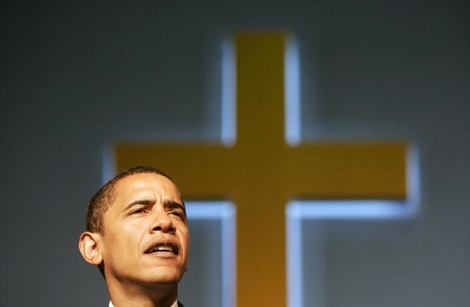
Obamajeffhaynesafp

Publius worries about and yet cannot resist this phenomenon:

Obama seems to be filling a spiritual void that many modern secular progressives (like all humans) tend to develop. Whether the enthusiasm stems from youth’s susceptibility to romantic idealism, or instead from the longing caused by the slow lonely grind of professional life, something is causing these people to see in Obama something more than politics. They’re seeing – and feeling – something higher.

There is nothing wrong with seeing in a future president a public discourse that could uplift us and perhaps mitigate the unnecessarily magnified ideological positions. But if a candidate is mere uplift, it’s a worry. I don’t think that’s what Obama is. He has detailed proposals on healthcare, climate change, taxes, and a clear position on withdrawing from Iraq as swiftly as prudently possible. But any candidate can get some policy wonks to fill in the blanks. The ability to execute such policies, to bring people together to debate and pass them, is what a president needs to have. On the critical question of the war, only McCain and Obama will be able to execute different strategies and still reach to those beyond their core support. I think that matters. I think having a capacity to transcend pure partisanship in wartime is a good thing.

Yes, there will be partisan scraps in many areas. The divides within America will not evaporate overnight. The roots of that divide are there for a reason. The point is simply this: who will best be able to work against rather than compound this often toxic dynamic? Clinton, Giuliani and Romney would be the worst. Obama and McCain the best.

(Photo: Jeff Haynes/AFP/Getty.)