1914, 2014, And Putin

A reader writes:

I am really struck this morning with the difference between 381px-Russian_Troops_NGM-v31-p379US and German newspapers in their handling of the situation in Ukraine. The reporting of the facts is the same, essentially. But the editorial voice couldn’t be more distinct. Echoing through the German papers is an admonition, during the centennial of the beginning of the Great War, to be mindful of the conditions that led to its launch: hysteria, rabid nationalism, thoughts of the pride and glory of great nations, elements of personal vanity, militarism. These are forces that have historically led to great misery for humanity and that have clouded the history of Europe. They are all also things that can be found in some measure in the current controversy.

The Germans find much frightening in Putin, and in particular they see in his dealings unpleasant echoes of the predatory practices of the Hitler regime. But they are also sharply critical of the US, of the hyperventilation coming out of the Beltway, and even of Kerry’s desire to push promptly to isolate Russia, when they sense that post-Putin Russia is more likely to be a responsible part of Europe and relaunching a Cold War would only tend to strengthen the reactionary elements in Russian society.

They favor a response that is more incremental, cautious, measured, and one that avoids absolutely demonizing Russia. They prefer one that will bolster over time the more positive elements in Russian society. They are focused on extending a strong helping hand to Ukraine.

But beyond this, there is both a lack of a clear prescription of what to do next and a strong distrust of America. Obama is a big improvement over his predecessor, they reason, but he is still far too beholden to the toxic voices of neo-conservatism that sound so loudly within the Beltway.

It says a lot that Germans see this current moment as redolent of the folly of 1914, while Americans see it through the prism of the 1930s. The Germans, it seems to me, are more on point. Yes, there are some tactics that Putin is using with respect to diaspora Russians the way Hitler did with diaspora Germans, but the parallel, like all such Godwin-like parallels, can be dangerously misleading. Putin does not have a massive, modern industrial state behind him, and a unified mobilized citizenry; he has a faltering petro-oligarchy, atop a fragile Potemkin “democracy”; Putin claims no global ideology except the preservation of Russian power in its sphere of influence; Putin could only fight or occupy Ukraine at huge costs to his own power and the stability of his regime. When you consider all this, he is a problem to be contained or, so far as is possible, ignored.

What worries me about some of the signals coming from the White House is that they are repeating some of the errors of the past. They seem to have a solid grip on a realist and sober foreign policy, and then they have a spasm of relapse: intervening in Libya, declaring a “red line” in Syria. Putin needs to be contained and there need to be costs if he doesn’t retreat from Crimea. But grandiose threats and polarizing rhetoric can be deeply counter-productive. He’s made a huge blunder. The core task right now is to ensure we don’t make an even bigger one.

(Photo: Russian troops awaiting a German attack, 1917)

Quote For The Day

“We were supposed to bring POW’s back to the base. But instead we gave them a cigarette to calm them down, and told them to get on their knees. One of our guys was 240 lbs, and he’d taken this shovel we’d been issued, and he’d sharpened one of the sides until it was like an axe, and he could take off somebody’s head with two hits,” – a “human of New York“.

“The Likeliest Republican Nominee”

Cillizza thinks it’s Rand Paul because “the establishment conservative field is packed with potential candidates while the movement conservative field is relatively sparse”:

Simply put, Paul is more likely to emerge victorious from the movement conservative primary than any of the potential candidates seeking the establishment conservative banner. At the start of the year, we would have said Christie would have had a leg up in that establishment primary — and hence an edge to be the nominee since the party’s pick traditionally comes from the establishment wing. But Christie’s struggles to get out from under the lane closures scandal that reaches high into his administration has reduced him to just another member of the pack. Walker and Kasich both have the potential to break out but first need to get by real reelection races this fall. Jeb Bush would quite clearly be the establishment frontrunner if he ran but no one has any idea if he wants to or will. Ditto Paul Ryan. And, while Jindal seems to be gaining a bit of steam, he remains second tier in this group.

But Weigel thinks the senator is overrated as a candidate:

As long as Paul’s in the Senate, as long as he’s a fascinating, quotable, and potentially successful libertarian iconoclast, stories about his associations and his movement will be relegated to the think-piece pile. If he’s a credible presidential candidate? The jackals run loose, and they know where to hunt. Years of experience and evidence tell us that Paul can be rattled by that. His potential opponents know this.

Henry Olsen points out that movement conservative candidates usually don’t appeal to the crucial “somewhat conservative” subset of Republicans:

This group is the most numerous nationally and in most states, comprising 35–40 percent of the national GOP electorate. While the numbers of moderates, very conservative and evangelical voters vary significantly by state, somewhat conservative voters are found in similar proportions in every state. They are not very vocal, but they form the bedrock base of the Republican Party.

They also have a significant distinction: they always back the winner. The candidate who garners their favor has won each of the last four open races. This tendency runs down to the state level as well. Look at the exit polls from virtually any state caucus or primary since 1996 and you will find that the winner received a plurality of or ran roughly even among the somewhat conservative voters.

Apathetic Atheism vs New Atheism, Ctd

A reader sighs:

Wow. These last few letters get to the heart I think of what drives so many of us non-believers crazy. Here we have Christians telling an atheist that he should make a mockery of the priest’s exhortation by essentially lying in a house of worship. Then we have another insinuating that non-believers aren’t welcome at church. I would remind those readers that it wasn’t the atheist who couldn’t handle the call for affirmation; it was the family who couldn’t handle his respectful honesty. The right answer here isn’t for the priest to change his tradition nor for the atheist to stay home or pretend he’s something he’s not. The right answer is for Christians like this reader’s in-laws to grow up and realize that atheists are everywhere, they’re not boogeymen, and being in the presence of one isn’t a reason to be upset. Ever.

Another assents:

What exactly did the brother-in-law do wrong? This isn’t a simple mid-week mass where it can be reasonably assumes that all attendees are Catholic. This was a funeral. Is it reasonable for the priest to think that all her friends and family share the same religion? Is it unreasonable to think that some non-coreligionists would want to pay their respects to the deceased or support her surviving family? It’s not okay for an atheist to skip the funeral of a loved one just because it’s held in a house of worship, and by the same token it’s not okay for the minister to ignore the fact that, at such times, not everyone will be members of their faith.

The story resonates for another reader:

Your readers’ less-than-sympathetic responses to the atheist who chose not to stand up to “affirm his belief” at his wife’s sister’s funeral reminds me of my mother’s experience with her church.

She is not very religious, but a believer of sorts, and someone who really enjoyed attending church at Christmas and Easter. (She liked the music and the singing and the space and time to get in touch with god.) But about five years ago at a Christmas service, during the hymn where the congregation sings “We will raise him up, we will raise him up, we will raise him up in the highest,” the priest gestured in such a way as to indicate that everyone should raise up their hands while singing. Most everyone did this, but my mother was uncomfortable with this kind of outward expression and chose not to participate. She mentioned her discomfort to the priest as she was walking out of the service, and, as she tells it, he icily smiled at her and said, “There are plenty of other churches in the neighborhood at which you would not have this problem.” Or something to that effect. “I’ve just been excommunicated from my local church,” she thought. And she hasn’t attended that – or any other – church since.

These kinds of public expressions feel very coercive, if not downright creepy. Not just to atheists like me, or wavering believers like my mother, but, I would think, to everyone. If you don’t participate, or participate fully, you might be looked down upon, ostracized. In the case of my mother, its practical effect was to weed out the less devoted members of the congregation. I can’t help but think this is part of the ritual’s appeal. The true believers would rather not have the less-than-true-believers and non-believers around – not even at a Christmas service, or at funerals of their close relations.

Update from the earlier reader who spurred backlash from the in-tray:

I’m the “dickhead” atheist who wrote about my experience at the Catholic funeral for my wife’s sister. You printed some critical responses, which I read with interest. However, a few remarks smacked of the kind of religious arrogance that turn non-believers like me into “dickhead” atheists. One wrote:

Perhaps one could argue that a funeral (or a marriage), bringing together many disparate friends and relatives of the deceased should be a more neutral occasion than a regular church service, but just how sensitive to the feelings of the irreligious do we need to be in our own houses of worship? Atheists who cannot deal with calls for affirmation of belief in a church probably need to think very hard about going into them in the first place.

Perhaps a funeral or marriage should be a more neutral occasion than a regular church service? Why “perhaps”? Is it vitally important in a house of worship that all who enter must believe and act accordingly? In a church I bow my head during prayers, I open the hymnal to the page of the song, I kneel when everyone else kneels. I do this out of respect, and every atheist I know does the same. Is respect in a house of worship a one-way street? All I asked was that when there are two ways to ask those in attendance to affirm their belief in Jesus’s love, pick the one that doesn’t offend or embarrass.

Many atheists are still in the closet for practical reasons. I find it offensive that religious folks suggest that maybe atheists should just stay away from weddings or funerals in houses of worship if we’re worried that the priest or minister might force us to out ourselves, or lie instead.

My wife needed me at that service. Even if I had known what was going to happen, I would have gone. By remaining seated I outed myself to people who didn’t need to know I’m an atheist any more than they need to know I’m uncircumcised. If I had stood I would have lied. There were other options that wouldn’t have put non-Christians on the spot, but then, as some assert, why should religious people give a damn about the irreligious in their house of worship?

To the writer who asked, “How would a better understanding and acceptance of atheism among the general populace have changed that moment?”, the “dickhead atheist” responds:

I don’t believe the priest in question meant to embarrass non-believers; he just lives in a religious bubble most of the time. A better understanding that there are a lot of atheists in the world, some of whom will likely attend funerals and weddings in his church might have spurred him to change how he asked people to show their love for his God.

Read the entire discussion thread here.

Shooting A Digital City

libertycitywalkabout051

Yannick LeJacq praises the work of Duncan Harris, who produces artistic “photographs” by taking screenshots from video games. His latest series, including the image above, is from Grand Theft Auto IV:

GTA IV is set in Liberty City, a lightly fictionalized version of New York. Fans of the series have always admired Rockstar’s unmatched ability to capture the mood of different American cities down an intensely granular level of detail. Looking at the new Dead End Thrills series, you can see why. Taking the color out of the cityscapes, Harris recasts Liberty City in a crystalline, nihilistic light. These don’t evoke the quirky humanism of street photographers Bill Cunningham or Henri Cartier-Bresson. Rather, they seem to channel the frenetic energy of the legendary crime photographer Weegee, who developed his signature style (and his pseudonym) by chasing ambulances and police cars around Manhattan throughout the 1930′s and 40′s.

(Image via Dead End Thrills)

The Creationist Won

Creation Museum founder Ken Ham claims he has raised the money he needs to build his “Ark Encounter” theme park, thanks in no small part to the publicity generated from his debate with Bill Nye last month:

Ham’s Ark project was in danger of collapsing without investor support of $29 million in municipal (or, as Slate described them, “junk”) bonds by February 6. The debate took place on February 4, which is great timing (Ham does not mention the possibility of raising funds for his Ark project in his column on why he decided to debate Nye). Now the project, which was announced in 2010 and will receive “generous tax incentives” from the state of Kentucky, is going forward. Ham told the AP that his widely-publicized debate “helped encourage more of our ministry friends to get involved in the past few weeks.” It will cost $73 million and take several years to build.

Jerry Coyne, who predicted this exact scenario, rips into the Science Guy:

Nye said he was “heartbroken and sickened for the Commonwealth of Kentucky” after learning that the project would move forward. He said the ark would eventually draw more attention to the beliefs of Ham’s ministry, which preaches that the Bible’s creation story is a true account, and as a result, “voters and taxpayers in Kentucky will eventually see that this is not in their best interest.”

Well, he’s heartbroken and sickened because of his own actions. By agreeing to show up and debate Ham—something I suspect Nye did (at least in part) to keep himself in the media spotlight—he’s allowed Ham to further his project. The result, even if you think Nye gained a transitory victory in the debate, is that Ham will build yet another popular tourist attraction, one designed to promulgate lies to kids. Nye, of course, devoted his career as The Science Guy to precisely the opposite: teaching and exciting kids about science. In other words, Nye scuppered himself.

The Dish covered the Nye/Ham debate here.

It Pays To Be Weird

dish_beuys

At least if you’re an artist:

A new study shows that because of this widely held stereotype [that creative people are eccentric], people infer that work made by an eccentric person is better and more valuable than work produced by a conventional character. …

Students rated the unconventional art of Joseph Beuys (“The Pack”) more positively if they were told that Beuys was eccentric in that he had a habit of carrying roadside stones on his head. However, the same yarn about Andrea del Verrocchio did not lead to higher ratings for his conventional art (“Lady of Flowers”). Similarly, seeing a photo of Lady Gaga crouching in an usual outfit (tight, all black, with shiny mask) led student participants to rate her as more highly skilled compared to seeing her seated in a conventional black dress; unless, that is, the students were told that Gaga’s eccentricity is fake and no more than a marketing ploy. In other words, eccentricity of the artist leads to more positive ratings of their work, unless that work is conventional, and/or the artist’s unusual behaviour is seen as contrived.

(Photo of “The Pack” by Joseph Beuys, 1969, by Jerzy Kociatkiewicz)

Light As A Feather, Stiff As A Board

Plucking a chicken yields a strong material:

One thing feathers have going for them are keratin, a tightly wound, crystal structured protein eight times stronger the cellulose. Feathers are packed with the stuff, but you have to work for it. First the feathers must be ground and then placed in a turbulent air flow separating machine that thrusts the quill segments to the base, blowing the barbs to the top. Then they can be softened with heat and molded into shapes. Often other bioplastics are added to optimize strength or flexibility and to make a lighter plastic. …

The list of things that the keratin-rich material has been used to make is vast: dishes and furniture, clothing, circuit boards, wall insulation, filters and planting pots (the feathers of one chicken makes three one-gallon containers). Feathers are used to make hurricane-proof roofing, shoe soles, and lightweight auto dashboards and glove compartments leading to fuel efficiency.

Austerity May Be Hazardous To Your Health

Screen Shot 2014-02-28 at 3.50.23 PM

In Greece at least:

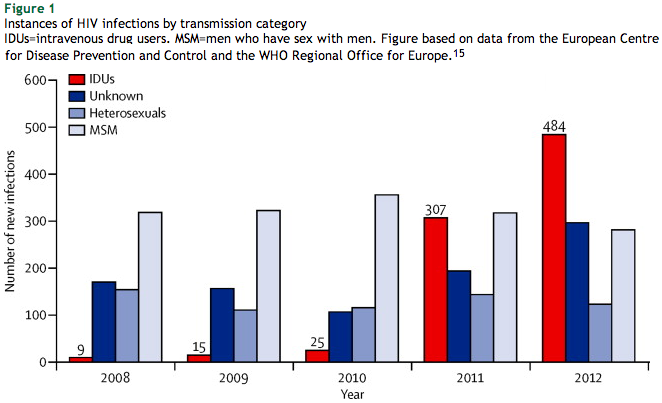
Following the country’s financial crash, Greece cut its hospital budget by 25 per cent cut and slashed funding for mental health problems by 55 per cent. An analysis of health statistics shows that as a result, suicides increased 45 per cent between 2007 and 2011 and, over roughly the same period, cases of depression more than doubled and infant mortality rose by 43 per cent. Needle-exchange schemes and free condoms for injecting drug users were also cut. By 2012, new HIV cases in this group were 32 times what they had been in 2009. The country has also had its first cases of locally spread malaria for 40 years.

(Chart: new HIV infections in Greece via The Lancet)

Unfriending Facebook, Ctd

Readers add to a recent thread:

I’ve been enjoying the discussion over Facebook, but I haven’t yet seen anyone point out the value of interaction with near-strangers or people with whom we greatly disagree. Some of the people in my “friends” list hold distinctly opposite political views. As a left-of-center liberal, I’ve got a nutty libertarian friend who knows vastly more than I do about fiscal policy and who is virulently pro-gun and anti-government. I’ve got a much-leftier SEC friend in NJ who alerted me to Cory Booker’s sketchiness well before the media did. These are all people with whom I, an introvert, would have trouble discussing politics in real life, but online, I can read their opinions and think about them and question my own.

In personal life as well, we benefit from our proximity to unlike people. Neither elders nor children are well-represented in my daily life, but through Facebook I get the benefit of their world views and experiences. I’m white, and I don’t have black friends, but I have black “friends,” and their daily experience is invaluable in helping me understand our places in society. I have religious friends and secular friends, straight and gay, married and single and widowed and divorced, local, national, international. I do not agree with them all. I do not look for agreement.

A few more readers:

I really like hearing positive news from my friends, near and far, about their kids’ achievements, their vacations, Screen Shot 2014-03-05 at 2.50.15 AMjob promotions, and so on. What I find difficult about Facebook is quite the opposite – the sudden, terrible, shocking news that comes out of the blue, jumping out of your news feed from the usual chatter.

I cannot count the number of times I’ve learned of a death on Facebook of someone I cared about. Then there is news of serious illness, difficult diagnoses, all kinds of overwhelming personal struggles, and even once (really) that a distant acquaintance who suffers from mental illness was in a Tijuana prison. Facebook puts us in slight touch with a lot of people who are not currently active participants in our lives, so we hear about and can respond to their personal tragedies immediately – news that might take years to filter down to us otherwise, or that we might not ever know.

You can make the case that all these reminders of how fragile it all is are a good thing, reminding us to live our lives fully and completely while we can. Most of the time I buy that – but sometimes it makes me want to stay in bed with the covers over my head, or at the very least never log into Facebook again.

Another:

I know I’m a bit late to this one, but I’m hoping you have room for one more. Back in 1999 I met this wonderfully smart and talented woman, the one all others would subsequently be compared to. But then she moved to Nashville, and I moved to New York. And then she moved to San Diego, and I married someone else (and divorced them too!). She became engaged and 11 years went by. I started my Facebook page in 2010 (I was 32) and immediately found her profile.

Two months later I was visiting her in San Diego. Three months after that she was pregnant and four months after that we were married. It’s four years later and we have two kids, a house, and a life that’s more than I deserve.

Other readers may want to de-friend, but Mark Zuckerberg is my friend for life.