Who Wants Another War?

Not Americans:

Asked whether the international community as a whole has a responsibility to get involved in resolving the situation in Ukraine, less than a third of Americans (30%) think that what is going on in Ukraine is the world’s business. 28% say that the world doesn’t have a responsibility to get involved, while 42% just aren’t sure.

Support for any US intervention to defend Ukraine against a Russian invasion is even lower. Only 18% say that the US has any responsibility to protect Ukraine, while 46% say that the US does not.

Ambers doubts that the Russians want war either:

I’m guessing that a full occupation of Ukraine is much too large for the appetite of the Russian people to stomach. A stalemate, or a process, is much preferable to war, a war that would doubtless exacerbate whatever tensions already exist. In Ukraine, Russian belligerence will alienate the world community much more indelibly, and Russians know that. The Crimea is gettable. Ukraine is not, without significant costs that Russians — who are getting whiffs of what it’s like to exercise global political leadership again (think Iran and Syria) — probably won’t let their technocratic oligarchical political system bear.

Ukraine On The Brink, Ctd

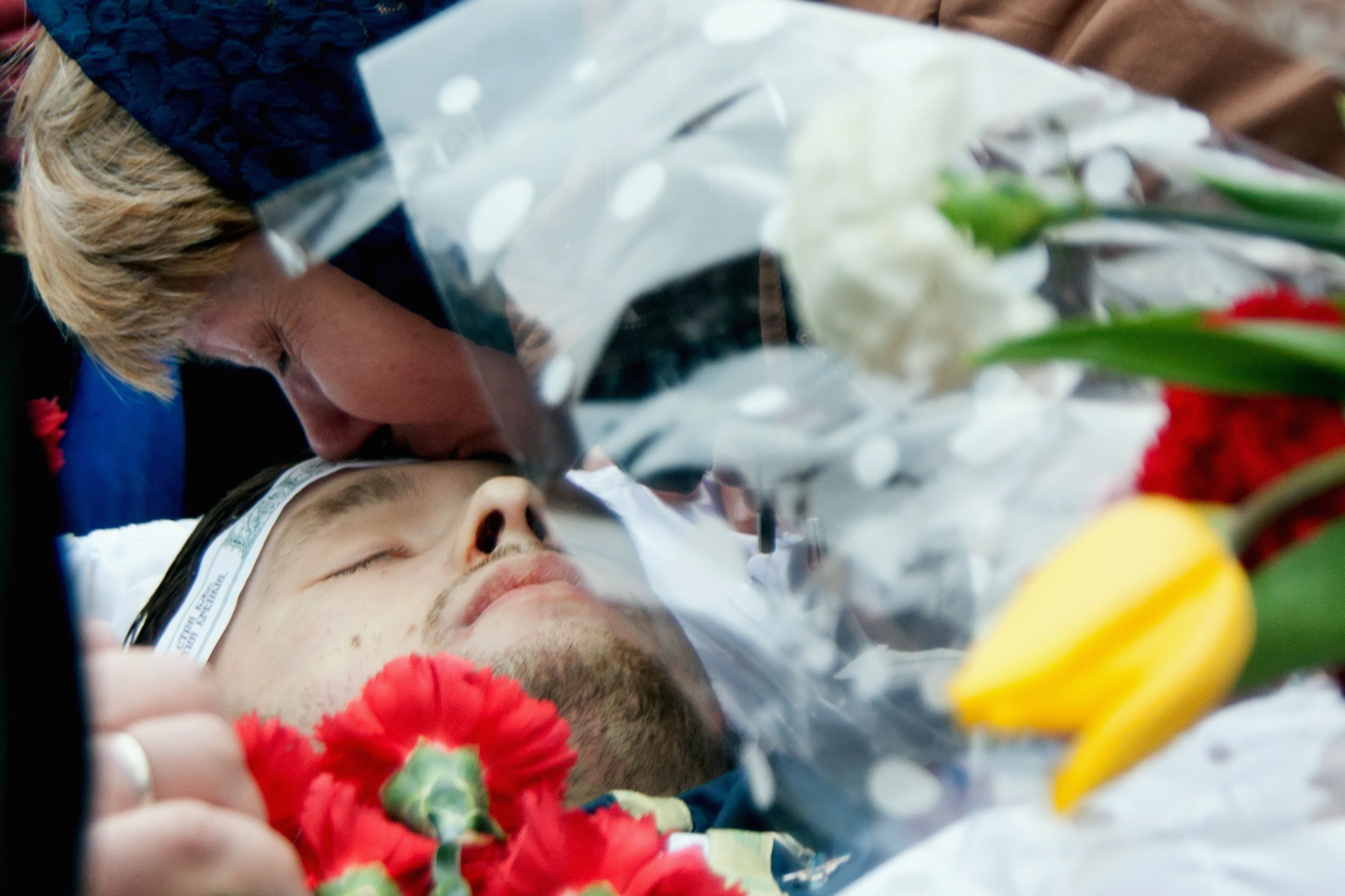
Funeral Ceremony in Kharkov

Readers comment on the ongoing crisis:

We have been failed deeply by the U.S. press on this conflict. If I single out the NYT, it is only because it is the newspaper I read most often, but the NYT has been uncritical in its coverage of the Maidan protests and obsessed with the personality of Putin and the question of Obama’s leadership. There has been very little attempt to explain Russia’s historical relationship with Ukraine; to critically evaluate Western political maneuvering in the region; or to analyze the actions taken by the Ukrainian interim government that have antagonized the population of eastern Ukraine. The French and British press are not much better (example here). This is not to excuse or exculpate Putin’s actions, but simple to insist that we have journalism that is critical and interested in facts, history and the ideological point of view of our putative adversaries rather than simply the pursuit of U.S. foreign policy goals.

In any case, I was very pleased to find your link to Anatol Lieven’s article, and your quote:

I fell prey to this myself, buoyed by obvious and instinctive support for any country resisting the boot of the Kremlin, and too blithe about the consequences of a revolution that overthrew a democratically elected president.

Thank you for including a fuller range of voices in this discussion. I really do believe that your ability to revise your judgment is why so many of us keep coming back to the Dish despite our disagreements with you.

Another isn’t as complimentary:

I don’t think your assessment of Putin is correct; I don’t think he is desperate or panicked. There are real reasons that Putin and Russia think the way they do and why they did what they did in Crimea. Think back to the beginning of the November protests.

They were instigated by a proposed trade union with Russia and fueled by a virulent strain of neo-Nazism and ultra nationalist sentiment. They toppled statues of Lenin, shouted anti-Russian slogans, and brought up memories of World War II. This sent a worrisome message to anyone who was Russian.

Then a deal was struck with Yanukovych, who admittedly did a poor job managing the crisis, and it was enough to keep him in power for another few months. But the right-wing protesters took objection to it, initiated some violence and, as often happens in these cases, it spiraled out of control. Yanukovych fled, and practically the first actions of the new parliament were to disband the Berkut (shades of Iraq circa 2003), vote to try Yanukovych in the ICC (which the Ukraine has not even acceded to), and outlaw the official use of Russian.

So what is Russia supposed to do? Whatever you might say about Putin or the Russian people, they are fiercely nationalistic. Putin’s first job is to protect the Russian people. An autocrat is nothing without his people, and if he isn’t going to do anything when there are visible and real threats to Russians in Crimea, then he isn’t worth anything as a president. What is happening in the Crimea is not the Sudetenland 1938; it is North Cyprus 1974. In fact, the parallels are eerily similar from the coup in Greece to the language used by Turkey and Russia.

Now the Turks were more blunt and direct in their confrontation than Russia, which is fortunate for Crimea, since no blood has been spilled. In fact, Russia’s language and actions have been very consistent – urging peaceful resolutions, not engaging in confrontations, etc. The only bellicose language is coming from the putsch regime in Kiev, which amounts to empty bluster.

President Obama has to be very careful not to misinterpret Russian actions here, which you seem to have done. Trying to “isolate” Russia is laughable: diplomatic impossible due to Russia’s seat on the Security Council, and even at the height of the Cold War American always kept an embassy in Moscow, and economically improbable given Europe’s reluctance to let go of Russian gas. Also, did you not write previously about how isolating an autocratic regime binds the people closer to that regime. This is your whole justification for talks with Iran, right?

Don’t fall into the Munich (Kagan, Kristol) Fallacy; not every international even is analogous to World War II. Let this scenario play out. Putin doesn’t want a war. I doubt he even wants the Ukraine now. What he wants is stability.

Another reader:

I appreciate that you don’t want to see us get militarily involved in the Ukraine (I don’t either), but your analysis seems to focus primarily on whether Russia was right or wrong to move in defense of the rights of ethnic Russians in the Ukraine. Take a step back: Russia has invaded a sovereign nation. We have treaties that recognize and protect the sovereignty of the Ukraine as its own country.  Whether Putin has his reasons for protecting people there or not, he’s still moved his army into the Crimea and ordered the Ukraine forces stationed in that area to disarm.

This was only okay in early 20th-century politics.  This is the kind of thing Iraq did with Kuwait, when it was run by someone who didn’t see how politics had changed since the end of the Cold War.  And it’s really weird to see Putin make a similar mistake; he should be smarter than that.

I really hope that this can be worked out diplomatically, or that coordinated economic sanctions will be the worst that comes out of it.  And we absolutely need to involve other countries and not act alone; we aren’t the only country that has recognized the Ukraine’s sovereignty and right to exist.  But the Crimea can’t be left to Russia.  If Putin is able to take advantage of turmoil in the Ukraine to swoop in and steal a part of their territory, it tells him (and other nations) that opportunistic military action against weaker countries is okay.

Just because we got away with it in Iraq (and we’re now regretting it) doesn’t mean we should ignore it when it happens now.  At least with Iraq we spent months beforehand spreading disinformation to justify our actions; Putin doesn’t even have that.

Another:

This eagerness to dismiss Putin as crazy and foolish worries me. Scary and wrong as he may be, isn’t it possible Putin is crazy like a fox? Isn’t it possible he knows he’s losing a lot in the short term – whether it’s influence in the future Ukraine (arguably minimal regardless, as long as it’s ruled by a Western-oriented Kiev), or popularity in Europe (arguably irrelevant, as long he has so much gas to sell them) – but he doesn’t care, because the world’s outrage (outrage I tell you!) only guarantees everyone will tread lightly around him for ten more years? Surely these limited military moves (so far) buy him major fear points versus all kinds of enemies and frenemies, internally and internationally. If he mounts a full scale invasion, then he’s nuts, but if it’s anything shy of that – I think we have to ask ourselves if he’s not a far better chess player than anyone wants to admit.

This guy lets oligarchs get rich mostly to gather more power to himself, not to build the Russian middle class. Same with foreign investment. If you’re building a modern power structure where fake democracy married to provocative foreign policy serves your one-man-rule purposes best – and let’s face it, he’s one of the world’s most durable leaders of one of the most powerful countries – then maybe he’s playing his game the smartest way it can be played.

Another addresses the nuclear question:

Claiming that the Russian invasion of the Ukraine sends the message that one should never give up one’s nukes is far too facile. Russia didn’t invade the Crimea because Ukraine gave up its nukes. The Russians invaded because the Ukraine couldn’t get their shit together and were descending into a civil war. Do you really think Russia would be less inclined to invade if a nuclear armed Ukraine were coming apart at the seams? More likely is that Russia would step in and “secure” Ukraine’s nuclear arsenal with Europe’s blessing.

The Khadaffi situation is similar. We didn’t invade Libya once Khadaffi gave up his nukes. He was executed by his own people after a popular revolt. Don’t fall for this neo-con nonsense. The arguments have a veneer of truth that fades away as soon as they are subjected to scrutiny.

One more reader:

My ex-husband is an ethnic Russian from Cherkassy (a small city on the Dnieper, about 100 miles outside of Kiev), so our 4-year old son is 1/2 Russian-Ukrainian (the term my ex uses to refer to himself) and our son’s grandparents live there. We don’t communicate much, and when I broached the subject two weeks ago (his parents are planning a trip here at the end of March, and I’m concerned that they either won’t make it here or won’t make it back) he downplayed it – conflicts in Kiev are localized, what is happening on Independence Square is far from the ideas of majority of “normal Ukrainians”. I haven’t been in touch since because I imagine he’s not happy about how things are going (he has praised Putin in the past, and he does consider himself a Russian before Ukrainian) and frankly I’d rather avoid him (we divorced for a reason!). But I do worry about his parents, who are sweet, lovely folks, and recent events make me aware just how little I understand about my son’s family’s complicated social and political background.

So thanks for putting the coverage where I’m guaranteed to see it. A founding subscriber, I check the Dish several times a day.

More reader commentary on our Facebook page.

(Photo: Around 3,000 people attend the funeral ceremony of Vlad Zubenko, who died during the anti-government protests at the Independence Square, on March 2, 2014. By Sofiya Bobok/Anadolu Agency/Getty Images)
The Rationale For Sanctioning Russia

Kimberly Marten explains it:

Sanctions would probably not do much to hurt direct Russian economic interests, given the dependence of many E.U. countries on Russian gas imports and the absence of any key economic levers in Europe or North America. Yet the sanctions threat could still have a negative impact on Russian President Vladimir Putin in an indirect way, by contributing to instability among the elite clans who vie for control over Kremlin policy.

Western pundits have a tendency to equate “Putin” with “Russia,” seeing their interests as one and the same.  But Putin does not rule alone.  Instead he sits at the top of competing informal network groups who vie against each other for political power, in a Kremlin game that Philip Hanson has likened (in an edited scholarly volume) to “dogfights under a carpet.” Putin’s political longevity is testament to his skill in balancing and managing this network competition, as Henry Hale recently argued.  Putin built his reputation on maintaining political and economic stability in Russia, replacing the chaos of the immediate post-Soviet years with order and predictability—and that means containing the dogfights.  If elite battles break out into the open it will be a sign of Putin’s weakness, and will likely lead contenders to emerge to challenge him.

Rosie Gray notes the EU’s reluctance to pursue sanctions:

“The basic issue is that it’s easy to talk about economic sanctions when you don’t really have an economic relationship with Russia, like the U.S.,” said Alex Kliment, director of emerging markets strategy for the Eurasia Group. “They [the EU] have a huge economic relationship with Russia and could inflict significant economic pain on Russia through sanctions.”

“But they also, by virtue of that economic relationship with Russia, are much more vulnerable,” Kliment said. Kliment said Germany, with its dependence on Russia’s vast oil reserves, would be a deciding factor.

Danny Vinik expects Germany to continue to resist sanctions:

Merkel is worried that Putin will cut off exports to the European Union. If that were to happen, it would cut off a huge energy source for Germany, and the rest of Europe, and cause gas prices to skyrocket. The United States would not be immune from higher gas prices, but European nations, particularly those like Germany that are highly reliant upon Russia’s energy exports, could also face shortages that upend their markets. Germany is looking to avoid that at all costs.

Keith Johnson predicts Putin won’t use Russia’s gas exports as a weapon:

Russia would almost certainly lose more in an energy war with Europe than it would gain. Fundamentally, energy trade between Russia and Europe is a two-way street. As much as European policymakers fret about dependence on Russian gas, Gazprom frets about dependence on the European market, which accounts for fully three-quarters of its export sales. More broadly, Moscow relies on oil and gas exports for one half of its federal budget. That makes a prolonged shut off of gas exports to Ukraine and the rest of Europe a dangerous proposition for Russian President Vladimir Putin.

On The Ground In Crimea

Vice reports on the standoff:

Natalia Antelava covers Crimea’s ethnic divisions:

“I don’t mind Ukrainians in principle, but events in Kiev showed their true Fascist face,” Valentina Nikolaeva, a seventy-two-year-old Russian Crimean, told me. “They want to exterminate us.” Every day, she joins pro-Kremlin demonstrators, who gather under a statue of Lenin in front of a local administration building. “Thank God for Putin,” she said. “He is the only one who will protect us.” Nikolaeva told me that she likes her Tatar neighbors, a comment that infuriated a man standing next to us, who shouted, in response, “Tatars are animals! They are waiting for a chance to kill us.” Nikolaeva argued back, but soon she and the man were surrounded by others, all of them shouting, and she was completely drowned out.

Previous Dish on the Tatars here. The second part of the Vice series is after the jump:

Arizona On A National Scale?

Gabriel Arana warns that a Supreme Court ruling in favor of the defendant in Sebelius v. Hobby Lobby could have the same effect as the Arizona bill Jan Brewer vetoed last week, but nationwide:

It’s easy to see how a win for social conservatives in Hobby Lobby could sanction the same sort of discrimination as the Arizona law. If a for-profit employer is allowed to opt out of the contraception mandate, it stands to reason that refusing to extend health benefits to gay couples would also be protected. “It’s a slippery slope,” [director of the Faith and Progressive Policy Initiative at the Center for American Progress Sally] Steenland says. … Sebelius vs. Hobby Lobby is poised to become the Citizens United of the culture wars. In fact, the question at the heart of the case bears a striking resemblance to the one the justices considered in Citizens: Do corporations have freedom-of-religion rights? If the Supreme Court finds that they do, then religious owners and employees of for-profit corporations have pretty good grounds for refusing to cover treatment for HIV or any health care related to the pregnancy of an unwed mother.

Ian Millhiser shares that concern:

Denying birth control to your workers because of your own religious objections to it superimposes your own personal beliefs about conscience and faith onto your employees. So does refusing to serve a gay person due to a religious objection to their sexual orientation. If the Supreme Court winds up holding that one person’s faith can impose itself on another, which is exactly what the plaintiffs in Hobby Lobby and Conestoga Wood want them to do, then all the nightmare scenarios imagined in the debate over the Arizona bill could become very real — at least at the federal level. Indeed, it is even possible that business owners who object to serving African Americans on religious grounds could challenge a 1983 Supreme Court decision holding that religious beliefs cannot justify racist discrimination.

But John McCormack suggests that neither the Arizona bill nor the Hobby Lobby case would grant for-profit businesses new rights:

“The irony about the Arizona law is that I actually think the law was quite unnecessary. But it certainly wasn’t dangerous,” Stanford law professor Michael W. McConnell told THE WEEKLY STANDARD. “I don’t know anything about politics in Arizona or why the legislature voted for it, but there was no pressing legal need for it.”

Putin-Envy

I described this sad phenomenon on the Cheney-esque right last night. But a reader is particularly sharp on the subject:

You and I were watching McCain at the same time and thinking essentially the same thing. McCain, GERMANY-CARNIVAL-ROSE-MONDAY-STREET-PARADElike Graham, Bolton and others of that ilk, watch the events in Ukraine and are filled with Putin-envy. Vladimir Putin is a master of the game, they seem to think. Look at his almost effortless projection of force, his willingness to dispatch troops and threaten war with so little hesitation or circumspection. They love it! If only we had our own Putin at the helm!
But how pathetic and short-sighted is this vision? In fact, Putin is stirred to move because he feels humiliated. His puppet was ousted from power by a popular uprising. His plans to seal Ukraine to Russia for another generation are evaporating. His hold on a plausible plurality of the Ukrainian people was shattered. The fuel deals are clearly seen as a crude power-play by most Ukrainians. Even the Russian-speaking Ukrainians of the eastern and southern provinces are slipping out of Moscow’s grasp. There, when we look more deeply into the demographics, we see that even if the 50+ers feel nostalgia for Moscow and support for the Kremlin, the generation of 35-down increasingly sees more promise from an alignment with Europe. The pro-Russian regions of Ukraine will predictably cease to be pro-Russian within a generation.

Putin, the crass intelligence officer, turns quickly to brute force. But what is the cost to him of this step? Not only in Ukraine, but in all the other states of the “near abroad,” the fear of Russia is moved up several notches, the image of Russia as a reptilian predator rises. Even within Russia, most citizens understand the shrill propaganda of ORT (the Russian state TV) for what it is and consider war with Ukraine to be irresponsible nonsense. Putin’s credibility as a leader fades. Increasingly he appears to be someone motivated by fear of loss and failure, not by greatness.

The Putin who shows his face to the world today is not some dynamic new Napoleon delivering a new master stroke. He is a tired, failed leader, who is steadily losing the confidence of his own people, who is seen as hopelessly corrupt, and who is being deserted by Russian elites and detested by the youth in particular. Putin is a spent force. He may hang on for another year or another decade, but in Russia the demand for a new leader will grow steadily from this point.

The McCains, Grahams and Boltons don’t understand this dynamic, and that’s frankly because they are too much like Putin. The worst imaginable thing would be for the leaders of the West to think and behave like Putin.

That would lay the ground for a cold war or even a major new land war in Europe – at a time when this is utterly unnecessary. There are powerful historical forces at play that will achieve what needs to be achieved. Putin is on the wrong side of them. His position is hopeless.

The events unfolding in Ukraine, in Crimea and Moscow are very significant, and perhaps the weightiest developments since the collapse of the Berlin Wall. On the other hand, what we see transpiring in Washington, among its pundits and papers like WaPo and WSJ, fully exposes the bankruptcy of the American chattering classes, and particularly of the world inside the Beltway. They are beholden to a great military machine which seeks conflict where it can find it, and their appreciation of the forces driving the world are laughably simplistic. At this point I thank god for Barack Obama, and even more, for Angela Merkel and other European leaders who have drawn the reasonable lessons of America’s Iraq debacle – even as Americans seem unwilling to think about it.

(Photos from Getty)

Hewitt Award Nominee

A reader in North Carolina flags a disturbing fundraising letter:

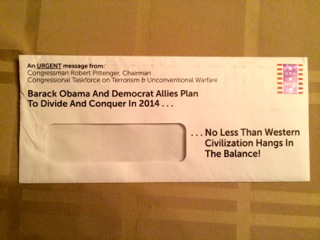
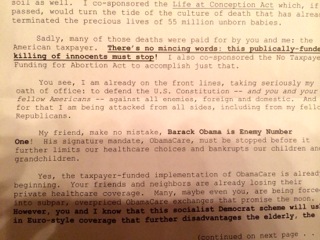
IMG_1209_2Not much shocks me anymore. I know how the right feels about Obama. They’ve made that clear. So when I received an envelope from my congressman, I almost trashed it like I do all the others. Still, since “no less than Western civilization” was apparently hanging in the balance, I thought I should read it. It’s mostly a fundraising screed filled with the usual apocalyptic Tea Party claptrap. Then, I got to this part of the letter [embedded below]:

You see, I am already on the front lines, taking seriously my oath of office: to defend the U.S. Constitution — and you and your fellow Americans — against all enemies, foreign and domestic. And for that I am being attacked from all sides, including from my fellow Republicans. My friend, make no mistake, Barack Obama is Enemy Number One!

enemy-#1

As you can read from the envelope, this is a letter from Congressman Robert Pittenger, Chairman of the Congressional Taskforce on Terrorism & Unconventional Warfare. So, if the chairman of this taskforce has found, no doubt after much hard work and research, that our president is the number one enemy of our country (apparently outranking al Qaeda), then isn’t this breaking news? What does he propose should be done to Enemy Number One? (The letter goes on to discuss Obama’s “Islamo-Communist upbringing,” really just icing the cake.)

I don’t know that I’ve ever read one of these political fundraising letters from a member of Congress of either party that declared the President of the United States to be “Enemy Number One.” I suppose some things still shock me after all.

Dish award glossary here.

Overheating The Bottom Of The Food Chain

Peter Brannen covers global warming’s threat to plankton and the species that depend on it:

It turns out that even in death, plankton can support life, by providing an emergency brake for a planet careening dangerously out of control. Like today, the surface waters of the [Palaeocene-Eocene Thermal Maximum (PETM)] absorbed gigatons of carbon dioxide. When the oceans turned over, these more acidic waters eventually reached the bottom, and the corrosive water dissolved the thick seams of dead plankton lying in repose on the sea floor. The result was something like an antacid settling a dyspeptic stomach. The dissolution of the carbonate shells acted as a buffer, balancing the ocean’s pH so that within 100,000 years, the oceans were once again saturated with calcium carbonate.

‘The turnover time of the ocean is about 1,000 years,’ [palaeoceanographer James] Zachos told me. ‘But most of the anthropogenic CO₂ is accumulating in the upper ocean within 100 years. The ocean can’t mix it fast enough into the deep sea.’ By 2050, Zachos expects the ocean’s pH to drop by the same amount as during the entire PETM.

The Madison Avenue Color Line

Continuing his series on how liberalism failed black Americans, Tanner Colby explores the development of our segregated ad industry and the role affirmative-action policies played in encouraging it:

Culturally, legally, and economically, the industry settled into a pattern which ensured that “white” advertising happened over here and “black” advertising happened over there. White agencies did little more than token hiring and recruiting. Meanwhile, the few black hires who did make it in the door at white agencies now had a very strong incentive to turn around and walk back out to a black agency, because that’s where the short-term benefits were.

Life at a black agency offered decent money, a likelier shot at promotion, and a chance to join in the Black Pride movement that was taking hold in the 1970s. By the mid-1980s, black employment at general market agencies fell from 3.5 percent back to 1.7 percent, with high-profile black defectors frequently leavingwhitefirms to hang out their own shingles on the other side of the color line. Which might have been an acceptable outcome had the black agencies flourished and become a thriving industry of their own.

They didn’t. In 2000, the top 20 black-owned ad agencies combined accounted for 0.5 percent of total industry revenues. Integration on Madison Avenue failed. Black solidarity and empowerment failed as well. In trying to split the difference between the two, we wound up with neither.

Update from a reader:

I publish a neighborhood blog about Roosevelt Island, New York. I read your post and thought you would be interested to know that a Roosevelt Island resident is considered to be the Jackie Robinson of the advertising industry. His name is Roy Eaton and he wrote the Beefaroni commercial jingle. He is also a classical pianist. Here’s a recent post about Mr. Eaton and direct link to a Fox News story on him.

Fix Inequality, Boost Growth?

John Cassidy highlights a study challenging the notion that addressing inequality slows growth:

[T]hanks to three researchers at the International Monetary Fund, we’ve got some striking new findings that answer the second question, whether tackling inequality reduces growth, with a firm no. Countries that take redistributive measures in order to attenuate inequitable market outcomes do not, on average, tend to grow less rapidly than other countries. Indeed, the contrary is true. They tend to grow a bit more rapidly.

The research paper, “Redistribution, Inequality, and Growth,” has been posted on the I.M.F.’s Web site and authorized for distribution by Olivier Blanchard, the I.M.F.’s chief economist. … Its authors—Jonathan D. Ostry, Andrew Berg, and Charalambos G. Tsanarides—begin by pointing to previous empirical findings that sustained economic growth seems, on average, to be associated with more equal income distribution. But this might not, in itself, make the case for using distribution to attain that equality, they explain: “In particular, inequality may impede growth, at least in part, because it calls forth efforts to redistribute that themselves undercut growth. In such a situation…taxes and transfers may be precisely the wrong remedy.”

Drum plays up another finding – that higher inequality correlates with shorter boom periods:

In particular, the authors find that a 1-point increase in a country’s GINI score (a measure of inequality) is associated with a decrease of about 7 percent in the length of its growth spells. In other words, countries with high inequality simply can’t maintain economic booms as long as countries with lower inequality. This is consistent with the idea that growth in these countries is driven partly by the rich loaning money to the middle class, which is obviously less sustainable than growth driven by an increase in middle-class wages. In high-inequality countries, growth is too dependent on financialization and leverage. When the merry-go-round stops, as it inevitably must, the boom times are over.

Let’s drop these ideas into a current real-world example: Stephanie Rudat explains how Venezuela’s foreign exchange regulator fed corruption and added to the country’s economic woes:

Under the pretext of creating a more equal society for the underprivileged, not only has the government nationalized key industries, but has also instituted Comisión de Administración de Divisas (CADIVI), a government institution whose purpose is to regulate foreign currency exchange. Despite the fact Venezuelans could once exchange Bolívares for US Dollars at a local bank through a simple transaction, CADIVI has imposed strict regulations in the currency exchange market. As a consequence of this, a large parallel US Dollar black market has formed in which US Dollars sell for over ten times the official exchange rate, a ratio that increases on a daily basis. The combination of nationalization of the private sector and currency exchange market regulation has driven Venezuela into an economic downward spiral that has led to uncontrollable and ever-increasing inflation rates, and dangerous levels of food and goods shortages at local supermarkets.

But Juan Cristobal Nagel, quoting a friend, suggests that Maduro’s recent attempt to reform CADIVI might have been what set off the protests:

“I think,” she said, “this all has to do with the end of Cadivi. Up until December, things were really bad, but you could still count on your cupo, your folder, and your raspaíto to make a quick buck. Take a subsidized trip abroad, buy a bunch of stuff to bring back home, or charge the credit card for cash, bring the cash home, and you earned a fortune. Now, Cadivi is a lost dream. It’s dead. The drama with the airlines means ticket prices have skyrocketed. There is an increased sense that the days of free Cadivi cash are gone forever. The end of this bubble … is really difficult for many middle-class Venezuelans to accept.”

This makes a lot of sense to me. Cadivi played such a huge role in the life of middle-class Venezuelans, its death should not be underestimated. For years, it was many people’s main source of income. Now, that’s gone, and we’re coming crashing down to Earth. It’s effect on people’s pocketbooks is enough to trigger a protest movement.