Who Killed Her?

Assassinationjohnmooregetty

It seems to me to be hard to understand the implications of the Bhutto assassination until we know who actually murdered her. Al Qaeda is taking responsibility and they have every reason to hate her, but a little skepticism is always in order, when it comes to their pronouncements. The assassin was a suicide bomber, but he shot her first, and shot her in the neck. If you were part of the military or ISI, it would be in your interest to shoot Bhutto to ensure she was killed and then blow yourself up both to associate the murder with Jihadists outside the military and to destroy the evidence.

Until we know more, it seems to me that al Qaeda’s responsibility is actually the more optimistic scenario. If Islamists within the military or ISI did this, then we have the possibility that this is the beginning of something more ominous than the surface event. The collapse of Pakistan into a Jihadist nuclear power is the great nightmare. Here’s hoping that however grim this news, the worst isn’t yet to come.

(Photo: A survivor is overcome with emotion at the site of a bomb blast attack on former Prime Minister Benazir Bhutto on December 27, 2007 in Rawalpindi, Pakistan. By John Moore/Getty Images.)

The Jamie Lynn Spears Debate

Ross and Reihan made a couple of points recently about the way in which lower middle class voters – who may have much higher rates of illegitimacy, teen pregnancy, and abortion than upper middle class Americans – often favor social conservatives such as Mike Huckabee. Ross:

There’s actually a serious argument for why Mike Huckabee (or any social conservative) ought to find his strongest constituency among people with the misfortune to grow up in a world where meeting your boyfriend at church and having his baby out of wedlock aren’t mutually exclusive propositions.

Reihan:

All this brings to mind the debate over, as conservatives put it, the sanctity of marriage, and in particular same-sex marriage. Why is it that the same voters who are most likely to experience divorce or family disruption are often the same voters who oppose same-sex marriage and other socially liberal measures? As Garance Franke-Ruta put it,

Lower-income individuals simply live in a much more disrupted society, with higher divorce rates, more single moms, more abortions, and more interpersonal and interfamily strife, than do the middle- and upper-middle class people they want to be like. It should come as no surprise that the politics of reaction is strongest where there is most to react to.

But, er, what does this actually logically have to do with same-sex marriage? How does allowing gay couples to get married somehow impact the illegitimacy rates of the Spears family? The only conceivable linkage is that many rednecks’ disdain of gays means that allowing us to marry inherently debases the institution and thereby makes it less attractive. But this argument requires raw prejudice as a premise. And a premise that Ross and Reihan – who have not a soupcon of homophobia between them – just assume as a given.

The second assumption is that same-sex marriage is, in Reihan’s words, a "socially liberal measure", and therefore legitimately opposed by social conservatives. But why is it "socially liberal" to encourage mutual responsibility, caring, fidelity, economic prudence, and an institution that fosters self-esteem, family integration and social responsibility? In a society where gay people exist, why is it a socially conservative position to ensure that they are discouraged from mutual caring and responsibility and encouraged – by stigma and marginalization and legal discrimination – to engage in all those activities that the depressed, alienated and despised often do: drug use, alcoholism, sexual irresponsibility, instability, and social isolation?

I know I’ve made this case a thousand times. But it never seems to penetrate. I understand why it makes no sense to Huckabee supporters, for whom gay relationships are anathema for purely Biblical reasons (however irrationally applied). But it still depresses me that allegedly tolerant figures in the intelligentsia still assume it, and almost never challenge it.

The Nano-Word Of God

Chip1

The entire Old Testament can now be squeezed onto something around the size of a pinhead:

Scientists wrote the Bible by utilizing a focused ion beam (FIB) generator shooting tiny Gallium ions that etched the manuscript onto a gold surface, guided by a newly developed computer program written at Technion. Developing the program took more than three months, but writing the full text took only 90 minutes.

You can quit the atheist wise-cracks now.

Best Of The Dish 2007: A Married Man

Aa12_2

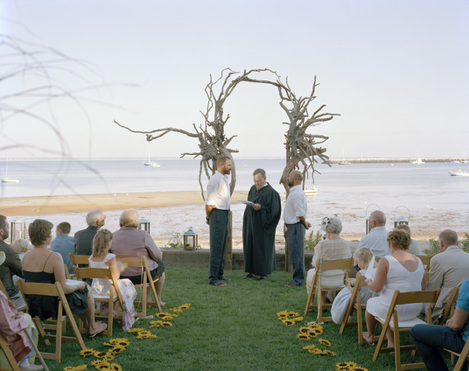
First published August 21 2007. Full wedding pics here.

So this is what it feels like? In a week’s time, I’ll be walking down the aisle with my soon-to-be husband. Our families are both coming for the big day. We’re getting hitched in Massachusetts, where I’ve lived every summer for the past decade or so, and which is the only state in the US where civil marriage is legal for everyone. Every now and again, I have to pinch myself. This is real? For me? It is hardly possible that it could be real for anyone. But me? After so long?

A brief personal history. In 1989, as a jejune junior editor at The New Republic, I got involved in an editorial argument about proposed domestic or civil partnerships for gay couples. The idea had emerged in the 1980s, in several major cities, partly because of the trauma of couples torn asunder by hostile relatives in the AIDS crisis. Some social conservatives were understandably worried that by setting up an institution like "domestic partnership," we were creating "marriage-lite", an institution that would spread to heterosexual couples and weaken the responsibilities and prestige of marriage itself. As a gay conservative, I found both arguments compelling. I saw the pressing need to give gay couples legal protection, but I could also see the danger of a easy-come-easy-go pseudo-marriage could pose for the society as a whole. The solution, however, seemed blindingly obvious to me. "Well, why not let gays get married as well?" I asked. "Isn’t that the true conservative position?"

My liberal bosses loved the idea of irritating conservatives with a conservative argument. So I obliged. The cover illustration was the first time a major magazine had put two guys on a wedding cake on the cover. And the piece created a mini-sensation. I enjoyed the buzz, but the more I thought about it, the more convinced I became that this was not just a necessary change, but a long-overdue one. With straight marriage no longer legally linked to children, and with gays desperately needing integration into their own families and society, it seemed like a no-brainer to me. It was a philosophical decision, not a personal one. I was in my twenties and had no intention of marrying myself. In fact, I was a pretty swinging bachelor. But it was the principle that mattered.

Almost two decades later, after years of intense political debate, after years of personal activism, court cases, Congressional testimony, threatened constitutional amendments, civil disobedience, and a global revolution in marriage rights, the political has now become personal for me. It’s a week away. And I officially have the jitters.

We decided on the most minimalist wedding possible – basically close family only. We’re getting married in the same place – a beach house – that we’re having the tiny reception. It’s a block down the beach from where we live. We have the license, the judge, the clothes, the menu, the photographer (although he hasn’t been in touch lately – gulp), and the rings. I’ve written out the civil liturgy. We’ve settled on the vows. I should relax now, right?

But the other night it hit me for the first time that this is really about to happen. I guess I just put it out of my head until it’s only a matter of a week or so away. My fiance, Aaron, and I have lived together for three years. I have no qualms about our actual relationship. For me, this is for life. But standing up in front of my family and my spouse’s and saying the vows out loud has me in a state of butterflies. I can go on TV and barely break a sweat, but I’m terrified of performing in front of my own family. I’m scared I’ll lose it. I bawled through the last same-sex wedding I went to. When I was diagnosed with HIV fourteen years ago, I assumed this day would never come. And now it has, the emotional impact is a little hard to measure.

You fight for something, never expecting it to happen, let alone to you, and then it does, and it can overwhelm. Taking yes for an answer can be harder than no. Maybe it’s a function of having over-thought this issue for so long; maybe it’s just handling a big family occasion of any sort (Christmas is bad enough). Maybe it’s a lifetime in which my actual relationships have always been private, or so targeted by political enemies I’ve become very defensive. Maybe I’m scared that two decades of passionate advocacy in theory is easier than a simple act in practice. But whatever the reason, going public with my husband – even in front of our supportive families – is suddenly much tougher than I expected. My throat is a little dry. My stomach is a little unsettled.

My sister emailed support:

"Don’t worry, it is natural to stress, I practically had a baby the day before mine! 75 to the church, another 75 in the evening, the food, the flowers, the photos, all those people watching me! On the day it just felt like a dream, I felt like I was letting out a huge breath all day, like that waiting to exhale, I exhaled all day and it was wonderful."

Our wedding is much smaller. My old friend and marriage advocate Evan Wolfson reassured me as well:

"You’re supposed to be in a zombie-state till the beauty of it breaks through."

Are zombies nervous? They never seem to be. They just stagger forward. Oh, well. Here goes …

"I, Andrew, take you, Aaron,
to be no other than yourself.
Loving what I know of you,
trusting what I don’t yet know,
with respect for your integrity,
and faith in your abiding love for me,
through all our years,
and in all that life may bring us,
for better or worse,
for richer or poorer,
in sickness and in health,
till death do us part,
I accept you as my husband
and pledge my love to you."

So revolutionary for some; so simple for me. For the first time in my adult life, I will have a home.

Now They Tell Us

Pete Wehner suddenly discovers the risk of overt religiosity in politics:

Jesus’s entire ministry was directed against the pretensions of earthly power, and Christianity is trans-political, beholden to no party and no ideology. The City of Man and the City of God are different, and we should respect and honor those differences.

Pete has long been a fan of both Karl Rove and Bill Bennett, prime architects of the use of religion as a tool not just in the public square but in partisan politics. Somehow, I don’t remember him caviling at this quote from Tom DeLay pitching to a Republican crowd last year:

"Sides are being chosen, and the future of man hangs in the balance! The enemies of virtue may be on the march, but they have not won, and if we put our trust in Christ, they never will … It is for us then to do as our heroes have always done and put our faith in the perfect redeeming love of Jesus Christ."

The Republican establishment was fine with Christianism as long as they controlled it. But as soon as a Christianist comes along that they cannot control, like Huckabee, they rediscover secularism. How conveeenient. In some ways, I think Huckabee has a chip on his shoulder for a good reason.