"Just because Neal Boortz is the public face of the FairTax does not make it batshit crazy," – Balloon Juice’s Michael D. He even defends it as well.
Mark Penn Was Unavailable?
Clinton cronies Chris Lehane and Mark Fabiani are hired by the studios to help beat the writers’ strike.
Huck On Drugs
An answer that hasn’t been widely noticed in his AP 1992 questionnaire:
In order to curb the flow of illegal drugs, we must work to irradiate the supply and at the same time diminish the demand by changing the public’s attitude toward drugs.
Irradiate away, Huck!
Resisting The Thought Police
One the sanest commentators in Britain, Matthew Parris, argues against criminalizing anti-gay speech. Good for him. Money quote:
When seeking to identify proposed legislation of doubtful practical use, it is a useful rule of thumb to watch out for ministers and lobbyists claiming its virtue to be that it will ‘send out a message’ that this or that is socially unacceptable. It is as though the criminal law was really just a branch of public service advertising — another way, alongside radio, television and the newspapers, or perhaps direct leafleting, of signalling a recommended set of values to the citizenry… When the Theft Act was introduced in 1967, I don’t recall that anyone claimed its value to be that it ‘sent out a message’ that stealing was unacceptable.
If someone bashes me over the head because I’m gay, I want them prosecuted for assault, not bigotry. They have an absolute right to their bigotry, as I have an absolute right to call them on it. But the law should criminalize nothing but specific acts that anyone, regardless of their race, religion, orientation or whatever. Here’s hoping Britain will escape the worst of the hate-crime nonsense peddled by the p.c. left in America. But I’m hardly optimistic.
Genes and Environment
Their interaction – and relative weight – impact so many debates today. But one of the most fascinating digressions into the subject that I’ve read recently is Gregory Clark’s "Farewell To Alms." Benjamin Friedman has an excellent review of the book in the NYT today, that captures both its merits and its obvious weaknesses. Money quote:
Darwinian evolution is usually seen as a process that works over very long periods of time, with consequences for humans that we can observe only by looking far into the past. By contrast, Clark’s explanation for the Industrial Revolution is a change in “our very nature — our desires, our aspirations, our interactions” — that occurred within recorded history, indeed within the last half-dozen centuries. His idea also stands in contrast to the entire orientation of Enlightenment thinking, including Adam Smith’s, toward accepting human nature as it is and asking what social institutions would allow humankind with that nature to flourish (as Rousseau put it, “men as they are and laws as they should be”).
The book doesn’t finally persuade entirely; but it sure provokes.
Face Of The Day
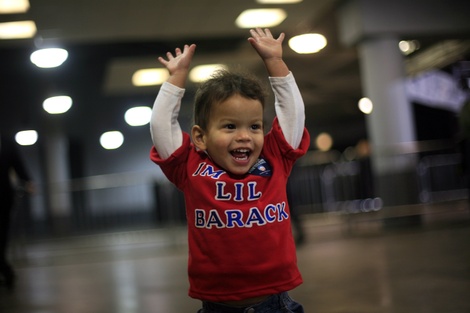
Barack Stroud dances before an event held by Democratic presidential hopeful Sen. Barack Obama (D-IL) at the US Cellular Center December 8, 2007 in Cedar Rapids, Iowa. Obama was campaigning at the event with talk show host Oprah Winfrey. The two are scheduled to make two stops in Iowa before heading off to campaign events in South Carolina and New Hampshire tomorrow. By Eric Thayer/Getty Images.
“Wowser”
Bainbridge discovers a new word in Australia.
The Crippled Dems
Greenwald says it best:
Rockefeller is not just any Democrat. He is the individual whom the Democratic Senate caucus thereafter elected — and still chooses — to lead them on all matters relating to intelligence. Just consider how compromised he is and they are when it comes to investigating abuses by the intelligence community over the last six years. Rockefeller was complicit in all of those abuses, and the Democrats voted for him — and still support him — as their Chairman of the Senate Intelligence Committee. How can Rockefeller possibly preside over meaningful investigations into conduct and policies — including the destruction of the videotapes and the conduct which those videotapes would reveal — of which he approved? And how can Senate Democrats pretend to be outraged at such policies when the leader they chose supports them?
Debating Torture
Here’s my basic point: how can people talk dispassionately about the merits of the president authorizing torture in 2002 as if it weren’t already clearly illegal? We have a prior issue here: can the president act above the law? Is the Constitution suspended in wartime? And when does that suspension end in a war with no defined enemy and no end in sight? I tackle Charles Krauthammer’s glib commentary on this point here.
The View From Your Window

Waverly, Iowa, 2.30 pm.

