The Domino Hits Texas

Allahpundit reacts to the latest Windsor-inspired court ruling in a red state:

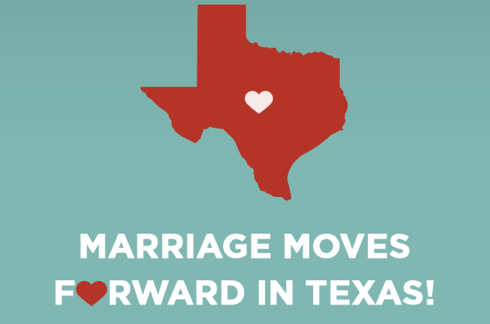
By now, if you’ve read one of these decisions, you’ve read ‘em all. Sometimes they find a violation of equal protection, sometimes Screen Shot 2014-02-27 at 12.17.16 PMthey find a violation of equal protection and of due process insofar as the right to marry is “fundamental.” Sometimes they find that gays are a “suspect class” deserving of special protection for purposes of EP analysis, sometimes they skip that part and find that bans on gay marriage have no rational basis and therefore it doesn’t matter how you classify gays. The judge in Texas, a Clinton appointee, took the latter route in both cases.

The basic point is always the same, though: Federal courts don’t see any compelling reason to restrict marriage to straights only.
Amy Davidson isolates a core rationale in the Texas ruling:

A word that appeared several times in Judge [Orlando L.] Garcia’s ruling was “dignity.” “By denying Plaintiffs Holmes and Phariss the fundamental right to marry, Texas denies their relationship the same status and dignity afforded to citizens who are permitted to marry. It also denies them the legal, social, and financial benefits of marriage that opposite-sex couples enjoy.” The laws, he continued, “demean their dignity for no legitimate reason.”

It’s great to see a word with deep origins in Catholic Christianity coming to the defense of homosexual persons. Garcia’s ruling can be read in full here. Sean Sullivan and Scott Clement put it in context:

More recent data show that Texas ≠America as a whole when it comes to gay marriage.

A December 2013 poll from The Public Religion Research Institute showed that 48 percent in Texas favored allowing gay and lesbian couples to marry legally while 49 percent opposed. That compared with a national rate of 53 percent in favor to 41 percent opposed. In short, even as attitudes nationally have shifted dramatically toward embracing gay rights during the past decade, there are plenty of states, like Texas, where opinions don’t mirror the broader attitude. What Wednesday showed is that even in these states, the laws may change.

Still, these changes will continue to encounter stiff criticism from opponents of gay marriage. Texas conservatives led by the state’s top Republican swiftly criticized Wednesday’s decision, signaling the stiff push back that is sure to surface in the GOP-dominated Lone Star State in the coming days.

But I can remember when the very idea that Texas would be evenly split on the question was incredible. Lyle Denniston looks ahead even further:

Texas Attorney General Greg Abbott immediately announced plans to appeal the case to the U.S. Court of Appeals for the Fifth Circuit. Among the five federal appeals courts where appeals on this issue are or soon will be unfolding, the chances seem greatest in the Fifth Circuit that a panel of conservative judges would be ruling on the case. If that happens, it would likely increase the chances that there will be conflicting decisions on same-sex marriage bans, and that would enhance the chances that the Supreme Court would step in to decide the issue, perhaps as early as next Term.

The Next Country To Decriminalize Weed

It’s shaping up to be Jamaica:

The island’s energy minister, Philip Paulwell, who also leads government business in parliament, has said he will find time this year to decriminalize possession of small amounts of marijuana. At a stroke, the move will cut the number of criminal offenses by as many as a million a week. It will also make a Jamaican break somewhat less nervy for ganja-puffing tourists. Reform proposals have been knocking around for some time: a National Commission on Ganja recommended decriminalization in 2001. But helped by moves towards legalization in Uruguay and decriminalization in the United States, momentum has been growing. A Cannabis Future Growers and Producers Association was launched last month, and a commercial company to support medical marijuana in December.

Alas for the ghost of Peter Tosh, legalization is still a ways off:

It will remain illegal to grow and trade marijuana in large quantities, something that suits the big players just fine. Full legalization would knock the bottom out of the market, hurting the island’s powerful criminal gangs. It would also curtail the potential for extortion; seven police officers appeared in court this month on allegations that they took a $2,750 bribe from a businessman in return for overlooking a ganja find on his premises.

“As A Jew, It Embarrasses Me” Ctd

Judis responds to those calling his new book anti-Semitic. God, I hope we can move past that idiotic and foul rhetorical device. His broader argument:

Screen Shot 2014-02-27 at 10.58.06 AMTheodor Herzl, Chaim Weizmann and the British Zionists who helped draft the Balfour Declaration did not aspire to create an empire like that of the British or French, but to be junior partners of the Western imperialist powers. Herzl, who admired CecilRhodes, described the Jewish state as “a part of a wall of defense for Europe in Asia, an outpost of civilization against barbarism.” The Zionist movement established “colonies” and aspired to create a Jewish state in a territory where, at the beginning of the Zionist movement, Arabs made up 95 percent of the population. American Zionists compared the Zionists in Palestine with American colonial settlers. At the time, colonialism and imperialism were not dirty words they way they are now. So yes, I think much of the Zionist movement—with the exception of Ahad Ha’am and his followers—saw themselves engaged in a mission that could be described as settler colonialism.


I think the problem is that some enthusiastic supporters of Israel may believe that by acknowledging that history, they thereby confirm that Israel is “illegitimate.” But

many states, including the United States, are products of settler colonialism and conquest. There is no going back in these cases. What Israel’s early history does suggest, though, is that Palestinian Arabs have a legitimate grievance against Israelis that has never been satisfactorily addressed. It won’t be addressed by abolishing Israel—that’s not going to happen—but it can be addressed by an equitable two-state solution that gives both peoples a state and that opens the way for Israel’s reconciliation with its neighbors. If there is a lesson to Genesis—and I happen to believe that history can tell us things about the present—that’s what it is.

For a great summary of the bile Leon Wieseltier has unleashed on one colleague after another, check out this Jacob Heilbrunn piece at the National Interest. Money quote:

Among those who have felt the lash are Andrew Sullivan, Peter Beinart, James Wood and Louis Menand. The latter two worked directly for Wieseltier, and he championed both Sullivan and Beinart, at least initially. Some of the quotes that a brief web search excavates include these morsels. On Menand: “Menand is the professor of littleness. He is a man in flight from the seriousness of his own vocation.” Menand’s offense? Not to bow sufficiently at the shrine of Lionel Trilling. In the case of Sullivan, he diagnosed “something much darker,” namely, anti-Semitism: “To me, he looks increasingly like the Buchanan of the left. He is the master, and the prisoner, of the technology of sickly obsession: blogging–and the divine right of bloggers to exempt themselves from the interrogations of editors–is also a method of hounding.”

In another piece, Wieseltier offered a twofer, criticizing (if that is not too andoyne a word) Beinart and Wood simultaneously. On Beinart: “Beinart’s pseudo-courageous article is an anthology of xenophobic quotations by Israeli hawks and anguished quotations by Israeli doves: familiar stuff.” Then came Wood’s spanking: “So what if Wood’s authorities are Jews? Can Jews not be wrong, or anti-Semitic? Wood’s Jews are certainly anti-Zionist.” Is it really an accident that, having left the New Republic, several of its editors have repudiated its long-time reflexive support for Israel?

Dave Camp vs The Tax Code, Ctd

Philip Klein has mixed feelings about the Michigan Republican’s proposal:

Overall, though the bill would represent progress, too much of it still accepts the premise that the federal tax code should be used by the government to promote certain national priorities rather than merely being a neutral way to raise revenue. There are other provisions that I’d take issue with, such as the one targeting investment firm managers (see this Avik Roy post for a good explanation of the issue).

Additionally, I would have liked to have seen Camp tackle payroll taxes, because for most Americans, this is the heavier burden than income taxes. They are also an incredibly economically destructive tax, because not only do they reduce spending power, but they make it more expensive for employers to hire new workers.

I’m sympathetic to that. I’d love a tax code whose sole purpose is the most efficient, simple and least market-distorting mechanism by which to raise revenues. But I’ve learned not to prefer the perfect to the good. In terms of economic impact, Chait says the proposal is the best he’s seen from Republicans:

The evidence suggests that cutting tax rates, financed by deficits, does little or nothing to spur economic growth. But Camp’s plan doesn’t do that. It instead reduces tax rates by eliminating preferences in the tax code. Subsidies for home mortgage debt and employer-sponsored insurance, among others, would be radically scaled back. And eliminating these kinds of favoritism encourages workers and businesses to instead follow market signals, and likely to make more market-friendly decisions.

It would surely be better if Camp agreed to draw up a plan that increased revenue, but let’s get real about this. Republicans were never going to agree to higher tax revenue for nothing.

Drum takes a second look and is more impressed:

I was wrong. It turns out that Camp’s plan specifies the tax breaks he wants to close in considerable detail. And according to the analysis of the Joint Committee on Taxation, which is usually fairly reliable, it would be both revenue neutral and distributionally pretty neutral too. Over ten years it would raise about $3 billion more than present law[.]

But Jared Bernstein insists that the plan is “fundamentally flawed”:

First, it claims to be revenue neutral, but achieves that goal only with timing gimmicks that ensure that its revenue neutrality will not last. Second, revenue neutrality is itself a recipe for an unsustainable budget path. Our demographics alone, not to mention growing challenges like climate change, imply future demands on government programs that clearly show neutrality to be a misguided guidepost for tax reform.

Yes, but you can still raise revenues after tax reform, can’t you? Chye-Ching Huang also warns that the plan will lead to lower revenues in the long run:

The plan’s scaling back of certain tax breaks raises more revenue up front than over time.  For example, the plan ends “accelerated depreciation,” which allows businesses to deduct the cost of new investments at an accelerated rate.  The JCT estimates show that the revenue gains from ending accelerated depreciation peak in 2019 and then dwindle.  Treasury economists have found that ending accelerated depreciation saves much less revenue in the second decade than in the first, and less in the third decade than in the second.

Mark Calabria worries that the proposed bank tax would further enmesh the government with the finance sector:

While standard Pigouvian welfare analysis would recommend a tax to internalize any negatives externalities, [Too Big To Fail] is not like pollution, it isn’t something large banks create. It is something the government creates by coming to their rescue. I don’t see TBTF as a switch, but rather a dial between 100 percent chance of a rescue and zero. By turning the banks into a revenue stream for the federal government, we would likely move that dial closer to 100 percent–and that is in the wrong direction. For the same reason, I have opposed efforts to tax Fannie Mae and Freddie Mac in the past. The solution is not to bind large financial institutions and the government closer together, as a bank tax would, but to further separate government and the financial sector.

Politically, Stan Collender explains why the plan is probably going nowhere:

The plan includes tax increases on key Republican constituencies. No matter how rational that might be from a numerical point of view, that’s not something Camp’s colleagues will be able even to tacitly approve let alone actually vote for before either the next congressional election this November or the next presidential election in 2016.

In fact, Camp’s heir-apparent at ways and means — House Budget Committee Chairman Paul Ryan (R-WI) – and Speaker John Boehner (R-OH), the two most important people on tax reform other than Camp himself, both made it clear today before the Camp plan was formally revealed that they (and, by extension, House Republicans) are not close to being ready to deal with tax increases any time soon. Given that Ryan will likely take over from Camp next year, the very clear message he sent this morning was that the prospects for a tax increase will be different when he’s chairman.

The Huge Cost Of Male Genital Mutilation

A new report (pdf) on operating room procedures in the US finds that the simple procedure of circumcision is still the second twentieth most costly procedure over all, largely because its prevalence makes it the second most common OR procedure in America (after cesarian section). There are, we discover, 1.1 million genital mutilations performed on infant boys in America every year, representing a total 7 percent of all operati0ns; and the total cost comes close to $2 billion a year. In the discussion of an elective procedure that permanently alters the most intimate parts of boys’ bodies without their consent, shouldn’t the sheer cost of it be a factor in weighing its merits?

Quote For The Day

“I feel like ‘embattled’ or ‘disgraced’ will always follow my name. It’s like that black football player who recently came out. He said, ‘I just want to be known as a football player. I don’t want to be known as a gay football player.’ I know exactly what he’s saying,” – Paula Deen.

Not really.

Chaotic In Crimea

Armed men just seized government buildings in Simferopol, the capital of Ukraine’s autonomous Crimea region, raising the Russian flag above the parliament building and refusing to allow workers in (NYT):

Police officers sealed off access to the buildings but said that they had no idea who was behind the assault, which sharply escalated tensions in a region that serves as home to Russia’s Black Sea Fleet and also to a number of radical pro-Russia groups that have appealed to Moscow to protect them from the new interim government in Kiev, the Ukrainian capital.

The Lede is live-blogging. Simon Shuster puts the event in context:

Since revolutionaries took over Ukraine’s capital a week ago, the ethnic Russian majority in the Crimea has largely refused to recognize the new government. In some Crimean cities, citizens have begun forming pro-Russian militias to resist the new authorities. “There’s not a chance in hell we’re going to accept the rule of that fascist scum,” Sergei Bochenko, the commander of a local militia group in the Crimea, told TIME last week in the city of Sevastopol. He said his battalion was armed with assault rifles and had begun training to “defend our land.”

Tatyana Malyarenko and Stefan Wolff take a wider look at Crimean separatism:

Separatist forces have a broad social base in Crimea. Available polling data since 2006 has consistently indicated that more than 50% of residents in the peninsula would support annexation to Russia. These figures suggest a strong pro-Russian sentiment among the region’s ethnic Russians and Russian-speaking Ukrainians, but not one that has so far automatically translated into an active pursuit of separatism.

At the same time, there are also strong anti-separatist forces in Crimea, notably the Crimean Tatars, who make up approximately 12% of the peninsula’s population. One of the Soviet Union’s nationalities that experienced deportation under Stalin, they have gradually returned to the Crimea since the break-up of the Soviet Union in 1991. While they have continued to experience ethnic prejudice and discrimination in Ukraine, they are, for obvious historical reasons, fundamentally opposed to Crimea “returning” to Russia.

Meanwhile, Yanukovych is seeking refuge in Moscow:

Russian newspaper RBK reported on Thursday that ousted Ukrainian President Viktor Yanukovych was spotted at a Moscow hotel and is currently staying at a state-run sanatorium nearby. Although, his presence in Russia is still unconfirmed, the paper carried Yanukovych’s plea for protection from the Kremlin. “I have to ask Russia to ensure my personal safety from extremists,” he wrote. Despite fleeing, he still insists that he is still the rightful leader of Ukraine.

And, as we noted yesterday, Russia is carrying out military exercises not far from Ukraine:

Okay, so according to Ria Novosti, more than 150,000 troops are due to take part in the drills, as well as 90 planes and more than 120 helicopters. While we don’t know precisely where the troops will be, Moscow has said the drills would happen in the Western and Central military districts. … [W]hile the Western district does border Ukraine, it also covers a huge amount of other land, too. It is possible that some of the troops in this district may be relatively close to Ukraine: According to the Wall Street Journal, the 20th Army, based about 200 miles from the border, is listed to be involved in ”operational and tactical exercises.” On the other hand, the military district in the South is the only one that borders Crimea, and Russia says it is not the part of the drill at all.

Ed Morrissey fears that Putin is laying the groundwork for intervention:

For the moment, he’s still playing his cards close to the vest; he’s agreed to sit down for IMF discussions on a Ukraine bailout to take the place of the one Putin suspended, for instance. Yanukovich is simply a clown show, though, as his credibility in Ukraine is shot, and Putin knows it. The Crimean peninsula will be the flashpoint for any action, and it’s not long odds on Ukraine losing it, either diplomatically or otherwise.

But Timothy Snyder warns that meddling in Crimea would be dangerous for Russia, setting a “rather troubling precedent” for similar meddling by China in the east.

Space Elevators?

space_elevator

Meghan Neal highlights a report from last year that says they’re not so crazy after all:

What made people stop laughing? Nanotech. Carbon nanotubes were developed in the 90s and promised to be the uber-strong, light, flexible supermaterial needed to build the kind of 62,000-mile cable that could transport humans into space. By the end of the 90s, NASA had released its report on the technological progress: “Space Elevators: An Advanced Earth-Space Infrastructure for the New Millennium.”

This month’s [International Academy of Astronautics (IAA)] report gives something of an update. “The materials currently being tested in the laboratory have surpassed that level and promise a tether that can withstand the environmental and operational stresses necessary,” it states. “Will it end up being carbon nanotubes, or boron nitrite materials, or something else?”

Nanomaterials are strong and light enough, but the rub is that scientists can’t get them to scale yet. Luckily, billions of dollars are being poured into this area of research. The report predicts a suitable material will be ready by the 2020s.

Good news for Newt’s moon base.

(Illustration: Space elevator by Dean Ellis from Omni, July 1981)

Apathetic Atheism vs New Atheism, Ctd

A reader writes:

First, thank you for giving atheists a say in your conversations about religion. One of your readers referred to atheists like me as “dickheads” because he gets tired of us constantly talking about our disbelief in gods. Okay, I’ll happily join the ranks of feminists who were dickheads about getting the vote, African Americans who were dickheads in the pursuit of equal rights, and those dickhead gays who demand respect and the same rights as heterosexuals.  I only want my government to respect my right to not believe the existence of a god, to remain neutral when it comes to religion, to not push Christianity as a national religion, or give special privileges to religions.  I want a social climate where atheists are not stigmatized.

A number of friends and relatives have told me in private that they, too, don’t believe in the existence of gods but either cannot or prefer not to make that public.  I want that to end someday.  I want to see a day when people believe or don’t believe because it makes sense to them, not because everyone else believes it, or that’s what’s expected of them.

I speak out so that our leaders understand there are atheists out there who feel just as strongly about our belief as they do about their religion.  I never want another person to experience what happened to me a few years ago.

When my wife’s sister collapsed and died suddenly, her whole family was devastated. At the funeral they were still reeling. My wife’s family is devoutly Catholic and she never told them that I was an atheist (she’s accepted it).  During the Catholic service honoring her sister’s life, the priest spoke highly of her sister’s service and devotion to the church, that she is now in a better place with Jesus, and how Great our Lord Jesus is. To reinforce this, he exhorted everyone who believes in the love of Jesus to stand up. My wife and I were seated near the front of the church and I quickly had to decide what to do. I chose not to stand. Everyone saw this and it just added to the pain of the moment for my wife. (I might add that I am not the same race as her family, which added to the awkwardness.)

I want religious leaders to understand that exhortations like this can embarrass those who aren’t Christians, and in some cases it can break up families and marriages.  If the priest had just asked those who believe to say “Amen” few if any would have noticed those who said nothing.  This has left a lasting scar on my marriage and my relationship with my wife’s family.

I honestly don’t care if people believe in a God or not.  I never talk about people’s religion or try to convince them there is no God unless they bring my atheism up first. I’m only a dickhead when people force their religious beliefs on me or on my government.  I want people to understand that there are a lot of atheists out there, that we are sane, moral citizens with rights we are willing to stand up for.

Another atheist:

I don’t think New Atheists are any more militant or angry than other minority advocacy groups, but I can freely admit that there is some actual anger, and that there are some pretty legit reasons for it. There is a large segment of the population that believes that an atheist is inherently immoral because humans are incapable of having a moral compass without divine belief. There is the mirror belief, even among agnostics, that being religious is somehow an indicator of higher ethical standards. Given history, a lot of atheists find this annoying, dismaying, and at times infuriating. Does not every minority encounter and react to these sorts of morally superior arguments and broad based but inaccurate characterizations and assumptions? Why is the bar for anger and militancy set so low when discussing the godless? And I have not even touched on religion’s extraordinary influence on the culture wars and politics, which Thomas Wells makes only the briefest mention of before dismissing it.

Lastly, regarding your reader who analogized atheism to his dislike for soccer, questioning the appropriateness of him constantly berating his friends and relatives if they ever watch the sport: Know what I do at the half-dozen events per month that involve someone telling us to bow our heads in prayer? I remain quietly respectful, as all atheists I know would do. Know what I do if someone asks me about my religion or what church I attend? I tell them I am an atheist. See the difference? The only time it may get a little tense is if I am baselessly accused of immorality, hatred of god, willful disobedience to what I “know must be true”, or encounter the justification of a preferred public policy decision because “its in the Bible.” You tell me who is being the dick in such a conversation.

One more:

Great thread, thanks. Let’s say the New Atheists are indeed “dickheads” and “contrarians,” as your writer argues. That’s even more of a reason to speak out, and do so with grace and kindness.  One of the best compliments I ever received was from a Christian co-worker after she found out about my atheist activism, saying that my kindness disproved the stereotype of the amoral atheist.