Correction Of The Day

182181

D’oh:

In an email, [Virginia Republican Party Treasurer Bob] FitzSimmonds said he thought the word he used had the same meaning as “twaddle,” which is defined as foolish speech. “The minute I found out my error, I deleted the post and apologized,” he told Pilot on Politics. “I don’t use that kind of language.” “Also to be clear,” he added, “my post was not about Barbara Comstock. It was relating to the sexist stereotypes being used by the woman posting.”

Update from a reader:

I am not inclined to come to the defense of the GOP, but even Robert Browning made the exact same mistake in one of his major poems, Pippa Passes.

What Makes A Government Legitimate?

A reader asked in the context of the Venezuela unrest, “Do you really think that every regime that you don’t like is necessarily illegitimate?” Another reader replies:

Egypt is probably the best example here. Mubarak was pro-Western but was very clearly illegitimate and undemocratic. Morsi was popularly elected and certainly had more legitimacy than Mubarak, but also had his authoritarian streak. We can rightly condemn Mubarak’s regime for its lack of legitimacy and then turn around and criticize Morsi and the Muslim Brotherhood for attempting to consolidate power and its increasing authoritarianism. And we can now be wary that the army that replaced Morsi may not guide the country back to democracy.

Venezuela, where I lived for 9 years in the ’80s and early ’90s, is a similar story. The country has had a reasonably democratic, albeit very corrupt, government for many years. It could rightfully be criticized for enriching the elite and ignoring the country’s poor and sowing the seeds for its own electoral overthrow by Hugo Chavez. On the other hand, Chavez, whether you agree with his policies or not, became increasingly un-democratic.

Despite the fact that he used the trappings of democracy, via elections and referenda, he nonetheless became increasingly intolerant of dissent, manipulative of elections, and generally undemocratic, not to mention his economic repression of opponents. This appears to have followed through to the government of Nicholas Maduro. If the opposition does manage to bring down Maduro, there is no way of knowing how things will end up. It could be that a chastened opposition decides that it will govern both effectively and legitimately; it is also possible that Maduro could be replaced with a right-wing dictator, whose policies might be more pro-western but who may be more illegitimate than Chavez or Maduro.

Because there is a gradient in legitimacy from “mostly democratic” to “elected dictatorships,” it is hard to draw a line, especially when an inherently un-democractic means is used to bring about a change in regime. Moreover, as with Egypt, there is no guarantee that the outcome of a popular overthrow of an authoritarian leader won’t lead to his replacement by another authoritarian leader. I didn’t support Chavez in the least, but I thought the military coup against him in 2002 was ill-advised.

But at this point things in Venezuela may have reached a breaking point. It is always my hope that the two sides will seek compromise and that transition from authoritarianism to democracy is (mostly) smooth (and it does happen; for example Augusto Pinochet, perhaps one of the most authoritarian and illegitimate leaders in the Western Hemisphere, nonetheless voluntarily gave up his power and abided by the results of a free and fair referendum on his rule. It is perhaps not surprising that Chile has been a stable Democracy since). I would love nothing more than for Maduro to release political prisoners, loosen restrictions on the press, decentralize power, etc., and for future elections to be completely free and fair. I’m not optimistic.

Richard Obuchi makes related points:

Polity IV is a project of the Center for Systemic Peace, which codifies characteristics of political regimes in order to classify them –in opposite extremes- as “Institutionalized Democracies” or “Autocratic Regimes”. To formulate the indicator, Polity IV considers the election mechanism for the Executive Power (meaning regulations, competition and open participation); institutional constraints on the exercise of power by the Executive Power; and the degree of regulation and political competition.

Even though President Maduro claims that the 19 elections held in Venezuela between 1999 and 2013 confirm Venezuela’s democratic nature, in truth the country’s political system tends toward an autocratic regime.

Rodrigo Linares blames the Venezuelan crisis on institutional decay. He argues that the “rock-bottom-basic institutions a modern country needs – the high school civics triad of the Executive, the Legislature, and the courts – have just plain stopped operating in anything like a recognizable form”:

[I]n theory, there’s supposed to be a National Assembly and an independent Supreme Court in place able to keep an overzealous President in check. That is where Venezuelan institutions, and its politicians, have failed the country. First, in 2004, the Supreme Court was packed with a gaggle of unconditional yes-men (and women), ending any hope for judicial redress. Then our parliament went into a protracted death spiral.

A simplified mission of the Parliament is, of course, to pass legislation, but it is a lot more than that. It is place for different political forces to meet and talk (parler in french). In this space, political forces look for common ground to reach solutions that satisfy all representatives, and through the representatives, the constituents. The Parliament is an outlet for discontent, a space for negotiation where progress is slow but effective.

We talk and argue in Parliament so that we don’t have to do it out in the streets. But we broke Parliament, and turned it into a boxing ring, and we allowed our courts to be packed, breaking the one final check to authoritarian control.

Meanwhile, a reader provides “a personal view of the man Maduro calls a fascist and The Nation considers elitist”:

Leo Lopez and I were roommates in our firstyear at the Kennedy School in 1994. It’s bizarre to seem him branded a right-winger, since his economic views The candidates for the primary electionstended to be closer to what The Nation usually supports, which is to say they tended to be a little on the left side of the norm even at Harvard. Those not being my politics, we had some good debates. What I remember clearly is that what he cared about most, and talked about most, was how to improve the lives of Venezuelan people. Never once did he bemoan how the elites in his country needed to take back power. Quite the opposite.

“The very picture of privilege”? Just before school started, when I went to buy furniture for my room, Leo went trolling the streets of Cambridge for discarded junk with which to outfit his bedroom. The desk he made out of an abandoned door was particularly impressive.

Leo stood out in other ways. He was serious in a way that the rest of us weren’t, surely because while all of us cared about public policy (he and I were both in the Masters in Public Policy program) politics in Venezuela mattered to him in a far more profound way than our American debates about whether Tom Foley or Newt Gingrich should be speaker of the house.

Leo’s no elitist. He’s an idealist. He’s not a fascist, he’s a democrat.

Beyond all that, he was also a hell of a nice guy. It’s hard to be that focused on serious matters and still retain a cheerful disposition, but Leo managed it. While we never became close friends, it was pretty much impossible not to like him. Venezuela’s lucky to have him, and I’m sure you’ll join me in praying he stays safe.

(Photo from Getty)

Centuries-Old Street Views

Google Street View

Someone mashed-up Google Street View images with historical paintings:

Redditer shystone remixes old and new London for us in a delightful mash-up that pairs historic paintings of the city with its modern counterpart. A resident of London, they took their love of art and knowledge of the metropolis and found the locations that the 18th and 19th century works depict. Shystone then layered the paintings on top of the contemporary photographs, and often, the two matched up well – even down to a tree or a railing.

More images here. Elsewhere in Street Views, a reader is spurred by the latest VFYW contest to write:

I never did locate the hi-rise in this week’s image, but I was in the general area of southern California. While looking at street views near Long Beach, hoping to spot building in the skyline, I encountered was has to be a first in Google Maps street view. I attached a screen shot for your amusement:

pigeon

Notice that they did not blur out the face of the pigeon.

Update from a reader:

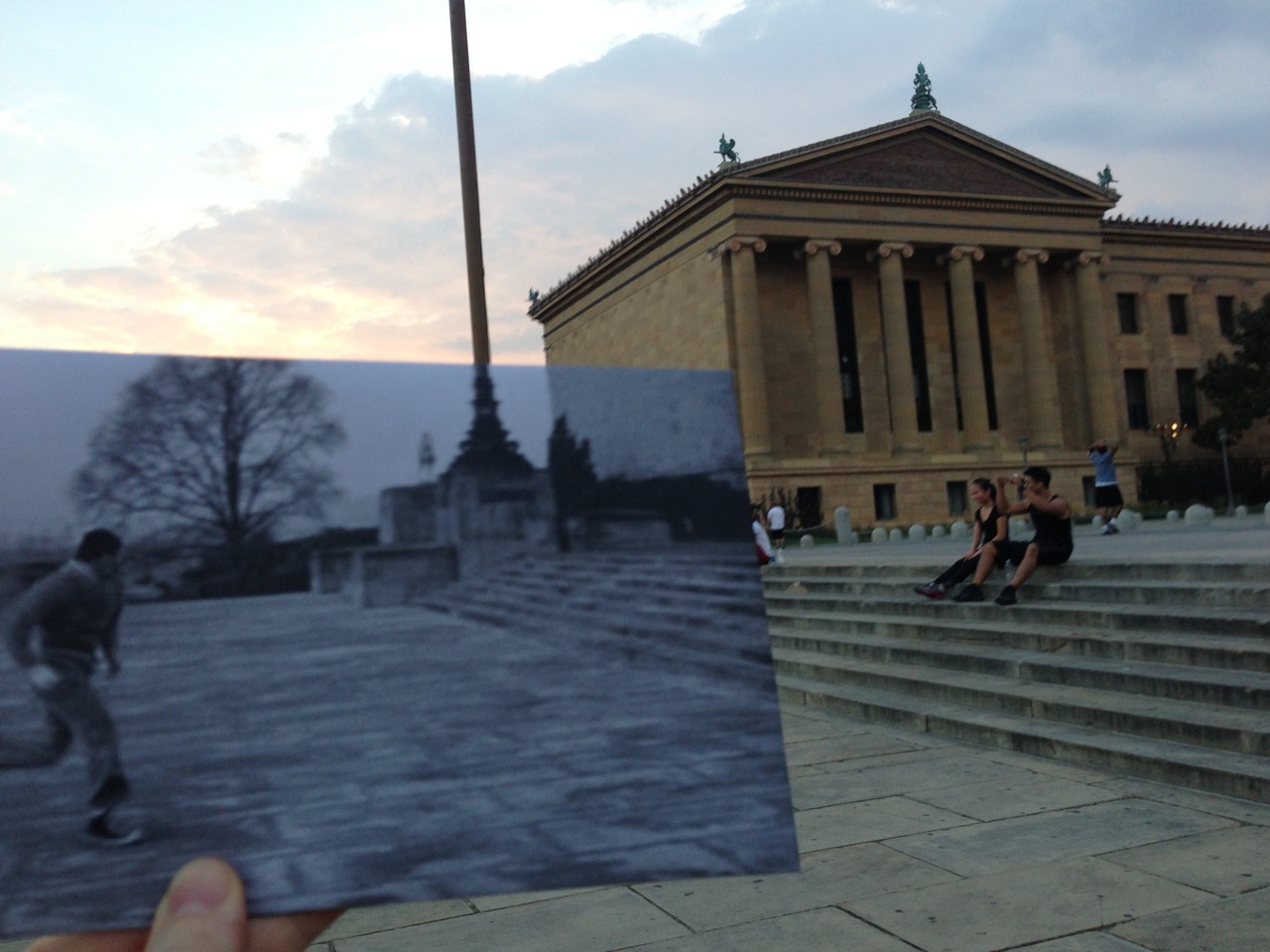
Similar to the painting Street Views is movie Street Views. Here’s Rocky:

tumblr_muaz2d532y1ry9teho1_1280

Russia’s Response To Ukraine

Max Boot fears that it’s forthcoming:

With Ukrainians having overthrown Putin’s ally, Viktor Yanukovych, Putin has ordered a riposte: Russian army units in western Russia and air forces across the country have been scrambled for an unscheduled “exercise.” At the same time, the pro-Russian population of the Crimea, home to an important Russian naval base, has been talking about secession from the rest of Ukraine–no doubt with the Kremlin’s encouragement.

It is by no means inconceivable that the two events could be linked–that Putin could send his troops into part of eastern and southern Ukraine on the pretext of “protecting” the Russian minority, much as Hitler did with Czechoslovakia.

Ukraine expert Alexander Motyl doubts that Russia will be so reckless:

Will Russia lead a charge to reinstall the ancien régime or break off bits of Ukraine? The former scenario is almost impossible, as the regime has melted away and there is no one left to reinstall. The latter is theoretically possible—at least in the Crimea—although it would mean that President Putin has lost all his geopolitical marbles.

If Putin does throw all caution to the wind and acts only on irrational impulse, he will only consolidate democratic rule in Ukraine (nothing rallies people around the flag as much as foreign intervention: even Yanukovych’s financial backer, the multibillionaire Rinat Akhmetov, spoke out against partition on February 24th) and provoke Russian democrats and Crimean Tatars to take to the streets (or, possibly, to arms—in which case, you can kiss the peninsula’s vaunted beaches good-bye). Such action would also be warning Belarus and Kazakhstan that they might be next. When the dust settles, democratic Ukraine will still be standing, Putin’s Russia could be destabilized, and his Customs Union and Eurasian Union would essentially be kaput. An intervention or economic embargo would bring Putin’s Russia nothing at best and enormous risks at worst.

Beards Of The Week

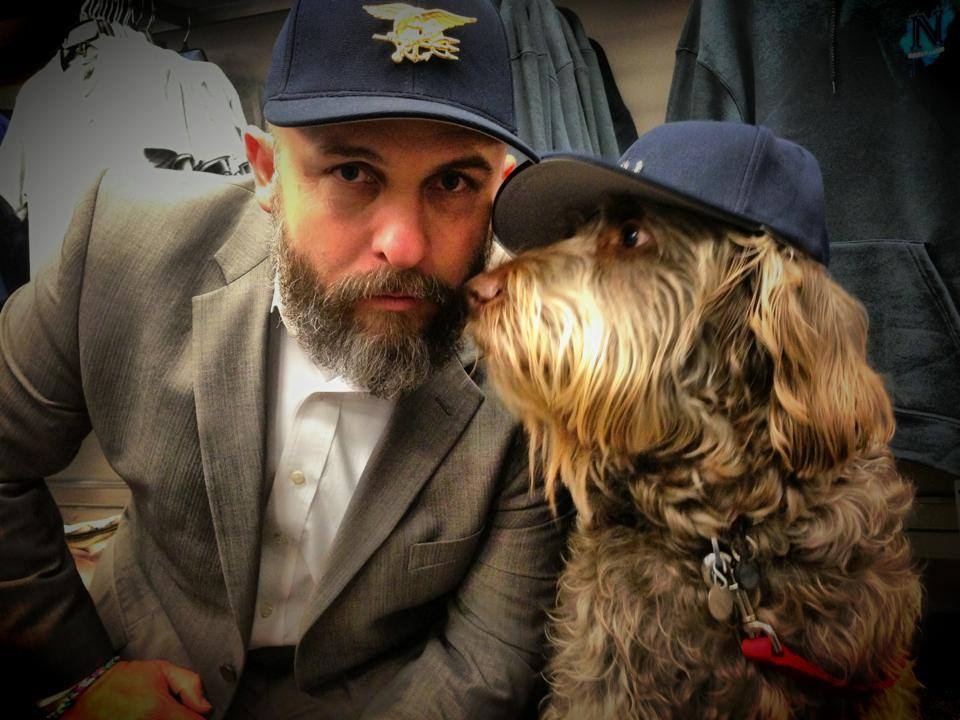
Rob-DuBois-and-Gander

And for a good cause:

Veterans Lon Hodge and Rob DuBois host workshops on conflict resolution and how to defuse stress for other vets. These seminars are especially geared for veterans with service animals—particularly veterans with PTSD (post-traumatic stress disorder) issues. When Lon Photoshopped a picture of Rob, a Navy SEAL, right next to his dog, Gander, it caused such an Internet stir that the two friends made a pact to have a “beard-off” for each of their workshops.

The next beard-off between Rob and Gander will be held from March 1-20 to raise funds for LZ-Grace Special Forces RetreatLt Michael P. Murphy Memorial Scholarship FoundationFreedom Service Dogs, and Warrior Dog Foundation. The winner will be announced on March 21. The loser will be shaved… and not his beard. “SEALs are crazy wild about their beards,” says Lon. “So if Rob loses, he will shave his head—not his beard. If Gander loses, he will get a buzz-cut.”

Follow the beard-off on Gander’s Facebook page.

Quote For The Day

“Pope Francis has described gay people as ‘socially wounded’ because ‘they feel like the church has always condemned them.’ Catholics must examine how we contribute, perhaps even inadvertently, to a culture of fear and shame. In a field hospital after battle, a basic responsibility of the caregivers is to ‘do no harm.’ The church must oppose violence against gay persons and should strongly advocate for the decriminalization of homosexuality. No one should be subject to a criminal penalty simply for being gay. If laws like these do not constitute the ‘unjust discrimination’ against gay people that the church rightly denounces, then what possibly could?” – America, the Jesuit magazine, on the wave of legislation in Africa, re-criminalizing homosexuality and anything to do with it.

It’s The Economy, Estúpido

Venezuela

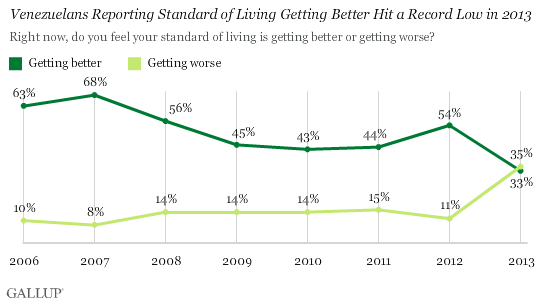
Juan Cristobal Nagel looks at the state of Venezuela’s economy:

I think we are underestimating the extent to which economic expectations took a hit in the last few months. Venezuela’s economy is not yet officially in a recession, but people are, increasingly, sharply worried about their future. According to surveys conducted around early October, the Gallup organization found Venezuelans increasingly concerned about their future well-being.

Max Ehrenfreund argues that Venezuela’s socialism has been relatively ineffective:

While the gap between rich and poor is smaller than in many other Latin American countries, it is still quite large. And while Venezuela is wealthier than some of its neighbors, the economy has performed badly since Chávez took office fifteen years ago, according to data from the World Bank. The economy has expanded by less than 3 percent per year on average, despite an oil boom, and is now in crisis. Shortages of staples and basic commodities are now routine, and Maduro’s government nationalized a major manufacturer of toilet paper last year in a desperate effort to keep shelves stocked. The official inflation rate is now at 56 percent per year, and the true rate might be much higher. (A tip of the hat to David Frum.)

A useful contrast is with Uruguay, where the economy has expanded at a rate of more than 5 percent per year since 2008 and less than 10 percent of the population is living in poverty, according to the World Bank. No one could accuse Uruguayan President José Mojica, who took office in 2010, of being a fascist — he rides around in an old Volkswagen, and his government passed laws legalizing gay marriage and marijuana last year. Yet Mojica is focused on managing the country effectively, not on curtailing the freedoms of his political opponents.

But Raul Gallegos bets against Venezuela’s government collapsing the way Ukraine’s did:

Opposition leaders may gain political capital from the current discontent. But only broad unrest among the poorest members of society could shake Maduro’s control. Former presidential candidate Henrique Capriles Radonski made that clear when he declined to support the recent opposition led protests earlier this month: “Where are the poor in all of this? There’s none, and we won’t participate because we won’t fall for this, we won’t let ourselves be carried away” by events.

The Death Throes Of The Anti-Gay Movement, Ctd

Marc Tracy looks at how the politics around gay rights have changed:

Now, in 2014, reports Politico, the reaction to an Arizona bill that would allow businesses to refuse to serve gay people is this: “top national Republicans just want the issue to go away.” If Arizona Gov. Jan Brewer doesn’t veto the bill, the consensus is that the issue will weigh down Republicans throughout the country who would have to answer for why their party is associated with such an obviously distasteful law.

When even Gingrich demurs, you know the Christianists have jumped the shark. In a sign of their intellectual desperation, check out this piece, “Against Heterosexuality”, in the theocon magazine, First Things. It echoes the far left in denying that homosexuality exists apart from a social construction, which they want to deconstruct. The piece aims to take the debate back to the nineteenth century, before the very concepts of homosexuality and heterosexuality were forged. Well, at least they are trying to be consistent.

On the new “religious liberty” bills proliferating around the country, it’s also worth noticing the deep rift in the Republican coalition. Big business is adamantly against this kind of thing. Here’s Delta Airlines taking a stand:

As a global values-based company, Delta Air Lines is proud of the diversity of its customers and employees, and is deeply concerned about proposed measures in several states, including Georgia and Arizona, that would allow businesses to refuse service to lesbian, gay, bisexual and transgender individuals. If passed into law, these proposals would cause significant harm to many people and will result in job losses. They would also violate Delta’s core values of mutual respect and dignity shared by our 80,000 employees worldwide and the 165 million customers we serve every year. Delta strongly opposes these measures and we join the business community in urging state officials to reject these proposals.

It appears that the Georgia bill is now dead in the state House, but not the Senate. Conor echoes my own core worry:

I can’t help but wonder, when I hear about Christian businesses boycotting gay weddings, is how many of those businesses also refuse to take photographs or bake cakes for other marriages that don’t strictly conform to Biblical codes.

I suspect many, though not all, who object to gay marriage actually do have a specific problem with gays and lesbians. (I’ve known Catholics like that too.) And while I don’t want the state coercing anyone to bake cakes, I do think people with hateful views towards gays should be subject to shame and, more importantly, persuasion.

Millman makes related points:

The principle of non-discrimination is plainly in conflict with the principle that people should be free to deal with whomever they damn well please, and not with anybody else. Both principles are weighty and valuable. …

There is nothing wrong with adjusting the balance of equality-versus-freedom. Of course, as the Arizona law suggests, doing so may get you a lot more than you bargained for. But adjusting the balance only to permit discrimination against married gay couples transparently singles out those couples as uniquely unprotected. It’s practically a textbook example of invidious discrimination in law. If you want to adjust the balance, you have to adjust the balance generally. You don’t just make an exception for people you don’t like.

Beutler zooms out:

As America grows more liberal, conservatives are retreating into a variety of interlinking, but isolated subcultures and, when necessary, making or manipulating law to insulate themselves from contact with the masses. Like a cultural manifestation of Going Galt. Welcome to white America’s waiver society.

We’ve already belabored the right’s parallel argument that religious owners of businesses should be exempt from the Affordable Care Act’s contraception mandate. That argument’s much more widely accepted on the right than is the recent push for state-based anti-gay “rights” bills, but it’s actually identical in construct to the argument that religious individuals and businesses ought to be free to discriminate against gay couples or any number of other people.

The Pope Emeritus In White

Pope Francis Appoints 19 New Cardinals at St. Peter's Basilica

Around the anniversary of Pope Benedict’s almost unprecedented resignation as Pope, there has been a predictable uptick in speculation about what actually happened and why. If he was forced out by scandal, then his resignation would not have been valid. So in response to some pointed questions from La Stampa, Benedict has gone public. Money quote:

There is absolutely no doubt regarding the validity of my resignation from the Petrine ministry. The only condition for the validity of my resignation is the complete freedom of my decision. Speculations regarding its validity are simply absurd.

His rationale was declining health and energy in the face of huge problems – from the Vatican Bank to factionalism in the Curia to the resilient stain of the child-abuse scandal. We may never know the full story – but if we were able to read the report of three cardinals on corruption in the Church, we might get a better sense. It says something about the church’s dysfunction that such critical details about its governance are deemed too sensitive to be revealed to the people of God in the pews, who largely finance it. Maybe Francis might contemplate some sunlight there. It might presumably strengthen his hand against the Curia – or prompt sabotage and revenge.

I’m inclined to believe Benedict on this. It’s plausible, if not completely convincing. But here’s a statement in the letter I do find a little odd:

I continue to wear the white cassock and kept the name Benedict for purely practical reasons. At the moment of my resignation there were no other clothes available. In any case, I wear the white cassock in a visibly different way to how the Pope wears it. This is another case of completely unfounded speculations being made.

So your vestments are like musical chairs: you have to keep the ones you’re wearing at the time of your resignation?

Is he really saying that in the vast ornate closets in which he kept his bewildering variety of Liberace-style outfits, he couldn’t find a suitable one that in no way confused people about who might be the actual Pope? Not buying it. La Stampa elaborates on how Benedict maintains deference to Francis:

Benedict XVI proved this at last Saturday’s Consistory – which Francis had invited him to – when he took a seat along with the cardinal bishops instead of accepting the special seat that was offered to him. When Francis came up to him to greet and embrace him at the start and end of the ceremony, Benedict removed his zucchetto as a sign of respect and also to show that there is only one reigning Pope.

So he keeps his papal name and his white papal outfits, but removes his zucchetto. And his outfits remain as fabulous as ever.

(Photo: Pope Emeritus Benedict XVI, flanked by his former personal secretary and Prefect of the Pontifical House Georg Ganswein, greets cardinals as he leaves the St Peter’s Basilica at the end of the Consistory on February 22, 2014 in Vatican City, Vatican. By Franco Origlia/Getty Images.)