The one and only post you need to read on the subject.
The GOP’s Christo-Authoritarian Future
The die is cast. And the war on Islam – not just Islamist terror – is around the corner. (But I thought Pat Robertson was irrelevant? – ed. That was yesterday’s talking point, dummy.)
Rudy: Right On Socialized Medicine
On specifics, Rudy is wrong. But on the fundamental point, he’s right. Allow a Brit to explain. And another ex-pat:
To say that prostate cancer survival rates are much higher in the US than in England is not "just plain false", however. It is just plain true.
Clinton’s Foreign Policy Experience
According to her own autobiography: not so much.
Farm Bill Hell
Even worse than you think.
McCain’s Honor
McCain’s comments, especially on torture, seemed to resonate with military vets and current National Guard members who attended campaign events during the day.
The Arizona senator specifically criticized fellow GOP presidential candidates Rudy Giuliani, Mitt Romney and Fred Thompson for their lack of military experience and failure to denounce the interrogation technique of waterboarding as torture.
McCain also said that members of the Bush administration should be held responsible as war criminals if waterboarding or other banned activities continued after Congress passed the Detainee Treatment Act, signed into law in 2005, and the Military Commissions Act, which was signed by President Bush in 2006.
"After we passed the Detainee Treatment Act, the Military Commissions Act then obviously anybody who violated any law of the United States would have to be held responsible," he said.
Iraq: A Long-Run Victory?

A reader writes:
I forget … why were you for the war again? Were you ‘fantastically wrong‘ about Iraq because: a) The president lied to you about WMD b) The president criminally mismanaged the war which might otherwise have been a good thing c) Once liberated, the Iraqis proved unable to govern themselves after all d) Abu Ghraib If Iraq stabilizes and the refugees return and civil society begins to take hold again and Iraq ends up with a government that everyone agrees is a tremendous advance over what they had before, would you still have been ‘fantastically wrong’ or just wrong? Or would you be wrong now? Now I’m befuddled…
I was wrong because a) one critical element of the case for war was simply not there (whether lied about or misrepresented or incompetently judged or so riddled with "evidence" from the tortured or the criminal that the info was FUBAR); b) the president did mismanage the war so grotesquely that it clearly made the US less safe, empowered Iran, gave al Qaeda a new lease on life, opened the borders of Iraq to al Qaeda, permitted the ransacking and looting of much of Iraq, and led to tens of thousands of deaths of innocent civilians; c) I fatally misread the history of Iraq and did not fully appreciate the depth of the sectarian divides, the absence of any national identity that could effectively supersede tribal loyalties, and the trauma that Saddam’s regime had imposed; d) I did not realize that the Bush administration would effectively suspend the Geneva Conventions in the war thus leading to the atrocities across the theater that did a great deal to undermine the moral basis for a just war. Even if, in a decade or so, we see something approaching a normal society in Iraq (which would be the first time in centuries), I will still have been fantastically wrong. Just because in the very long run, it is possible that a decision made was retrospectively the right one, that was not the basis on which I supported the war and lambasted its opponents. I’m not going to pull that excuse. And the costs of the enterprise – both human and financial – continue to bear no rational relationship to the benefits we haven’t even begun to see. To have embroiled ourselves in a large, open-ended, $3 trillion occupation of a country that is clearly no longer a country, and to trap the bulk of the military in that theater while threats proliferate globally, and to have no viable exit strategy ever: this is a colossal, historic error. And all this holds even if it turns out in the very long run to have made Iraq a more normal society than it was under Saddam.
I have a clear conscience on it. I didn’t intend evil. I thought in advance it was a just war. I believed the evidence procured, I now know, from torture, that Saddam had contacts with al Qaeda.
Removing Saddam and liberating the Kurds remain alloyed goods. I am also glad I didn’t oppose the war for the wrong reasons – because I hated Bush before I had good reason to or because America could never do right. I still believe in giving any president the benefit of the doubt in such a national crisis. I will do so again – but not, of course, with this president.
I sure hope that things turn out for the best. God knows that what the US and coalition troops have done there has been heroic and, if it does turn out OK in the very long run, it will be their victory and achievement – and no one else’s. I know wars are messy – but this has not been a war with usual mistakes. It was a war waged with criminal incompetence for far too long. It is still completely unclear whether Iraq will resume its hot civil war as US troops depart next spring. It is unclear whether a war against Iran will alter the entire equation as well. It is unclear whether the Turkish border will explode, or whether, as the West’s troops remains trapped in Iraq, a serious crisis of terror and WMDs will emerge from Pakistan or elsewhere on the planet. That these events have not taken place yet doesn’t mean they won’t, and doesn’t mean they might not have while we were stymied in Iraq. The risk we were taking in retrospect was irresponsible. And it’s far too easy to use unknown future events – let alone the decline in violence in the last couple of months – as vindication for a decision that was wrong by any measure on its own terms and in its own time-line.
But let’s hope, shall we, that some day some defense can be made of it. God knows the Iraqis need it and the fallen deserve it. For their sake, I still hope passionately that this will be seen as a long-term not-catastrophe – or maybe even something better. But I cannot see the last five years as evidence for much optimism on that count. And, while one can and should be grateful for some minimal counter-insurgency competence from Petraeus this year, I’m not going to extrapolate madly from the last five weeks.
(Photo: David Furst/Getty.)
Robertson and Giuliani
Since the Bush right insists that Robertson is completely irrelevant to the current GOP, I have no idea why they are fixated by his endorsement of Giuliani. For me, however, it seals the deal. Robertson blamed Americans for causing 9/11. He is a charlatan and a religious phony. He has enriched himself at the expense of millions of gullible Christians who did not understand that this man’s sole principle is his own power and wealth. It doesn’t surprise me that he sees eye to eye with Giuliani. They are very similar characters. But he does represent what may be becoming the consensus among Christianists: that the war on Islamic terrorism is the prime issue; and that the way to tackle it is by increasing military aggression, bombing or occupying Muslim countries, preserving Israel solely to hasten the Apocalypse, and entrenching torture as a pillar of American national security policy. The fusion of Giuliani’s authoritarianism with Robertson’s Christianism is indeed one future path for the GOP. It is enlightening to me to witness two very similar politicians sink their differences to forge that new, fascistic direction.
Debating Obama
I was on NPR yesterday debating the Obama candidacy and talking about my essay, "Goodbye To All That". You can listen here if you want. I was on with Jim Traub who wrote this piece on Obama’s foreign policy and Laura Washington of the Chicago Sun-Times who knows Obama very well.
Clinton & Clinton
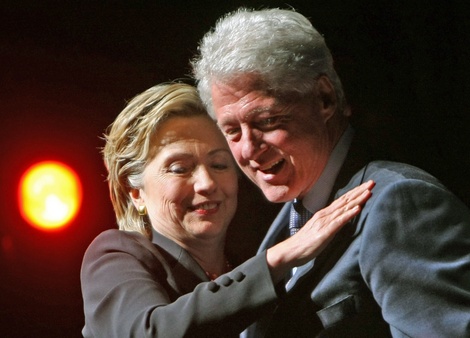
One of the disturbing aspects of having two dynastic presidential families – a sign that a republic truly is turning into a corrupt empire – is that a former president can intervene, with all his partisan power, on behalf of a candidate to whom he is related during a critical primary campaign. This week Bill Clinton showed his usual class by accusing Obama and Edwards of "swift-boating" his wife because they dares to challenge a front-runner in a debate. Clinton’s comment was a classic hardball political maneuver to repair some of the damage done to his wife’s candidacy by the last debate. Here’s the money quote:
"We listened to people make snide comments about whether Vice President Gore was too stiff and when they made dishonest claims about the things that he said that he’d done in his life. When that scandalous Swift boat ad was run against Senator Kerry… Why am I saying this? Because I had the feeling that at the end of that last debate we were about to get into cutesy land again."
The Clinton machine’s spin was that the former president was referring not to Obama, Dodd or Edwards, but to unspecified individuals after the debate on television. Here we go:
Jay Carson, a spokesman for Mrs. Clinton’s campaign, said Mr. Clinton had not been referring to Democratic candidates’ criticisms of his wife but to Republicans’ criticism of her debate performance.
And there were Republicans criticizing Clinton "at the end of the last debate"? We’re back to parsing, aren’t we? Get used to it.
But this little flurry of dynastic opportunism has one advantage in this campaign. It raises the important question of whether the Clinton-Clinton relationship/arrangement/partnership/marriage needs to be put more squarely on the table before it’s too late. Clinton H, it seems to me, needs to be asked publicly if her candidacy is, as her husband described his in 1992, "two-for-one." Will her husband be given an official position in the administration? Will he be co-president again? Is he running with her? What role would he play in office again? These are completely legitimate questions about the content of a third and possibly fourth term for the Clintons.
That’s also why we need to know what is in the sealed records of the Clinton presidency. With the Clintons, we are not dealing with a normal candidacy. They are a power-couple, a team that cannot be understood in isolation from each other, a couple whose private and public lives have long been fused in a mutual pursuit of power. We need to know what the actual, power-sharing deal was from 1992 – 2000, and we deserve to know what the deal will be if they return to power. This need not hurt her candidacy. Many people understandably admire her husband’s skills and would be happy to see them used in the service of his country. But his marital and familial relationship to a future president – and the existence of secret or special power – means we need to know exactly what we are being asked to support. This is not a monarchy yet.
Democrats, it seems to me, also have a right to know whether the Clinton team expects another out-break of the kind of scandals that rocked and roiled the country the last time this couple occupied the White House together. Are we headed back to marital psychodrama as public spectacle? Or are things different now? Even if you believe, as I do, that the private arrangements of public couples are nobody’s business, the way in which the Clintons merge personal relationships with the exercize of public power makes a clear distinction between public and private life much harder to maintain. And it is simply a regrettable fact that in the current media climate, the 1990s could return with a vengeance – and sideswipe the country in a much more perilous time. If the VRWC has something on the Clintons, are they waiting to unveil it next year? What is the Clinton campaign’s planned response? Is there a contingency plan? Do Democrats have a reason to be worried? I don’t think it’s illegitimate to ask these questions. And it may be reckless for Democrats not to.
(Photo: Mario Tama/Getty.)

