A classic:
An Inconvenient Truce
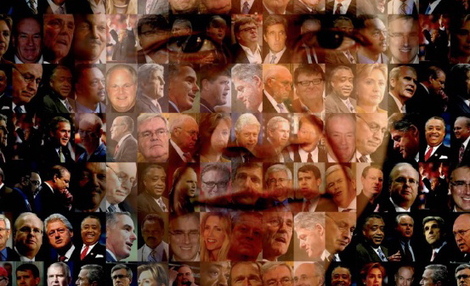
My essay on the Obama candidacy is now online:
[T]he most persuasive case for Obama has less to do with him than with the moment he is meeting. The moment has been a long time coming, and it is the result of a confluence of events, from one traumatizing war in Southeast Asia to another in the most fractious country in the Middle East. The legacy is a cultural climate that stultifies our politics and corrupts our discourse.
Obama’s candidacy in this sense is a potentially transformational one. Unlike any of the other candidates, he could take America—finally—past the debilitating, self-perpetuating family quarrel of the Baby Boom generation that has long engulfed all of us. So much has happened in America in the past seven years, let alone the past 40, that we can be forgiven for focusing on the present and the immediate future. But it is only when you take several large steps back into the long past that the full logic of an Obama presidency stares directly—and uncomfortably—at you.
At its best, the Obama candidacy is about ending a war—not so much the war in Iraq, which now has a momentum that will propel the occupation into the next decade—but the war within America that has prevailed since Vietnam and that shows dangerous signs of intensifying, a nonviolent civil war that has crippled America at the very time the world needs it most. It is a war about war—and about culture and about religion and about race. And in that war, Obama—and Obama alone—offers the possibility of a truce.
The Mukasey Precedent

If you want to see how the pro-torture right will use Feinstein’s and Schumer’s capitulation on the rule of law to advance the torture program, read Rich Lowry:
The Senate had a chance to settle the question in September 2006 when Sen. Ted Kennedy offered an amendment to declare waterboarding and other coercive interrogation techniques a violation of Common Article 3 of the Geneva Conventions. His amendment lost 46-53. So Senate Democrats are now demanding that Mukasey declare waterboarding a violation of Common Article 3 when the Senate declined to do the same just a year ago.
The current Republican standard is that if the Congress does not explicitly forbid specific torture techniques as illegal, then they’re legal. They hold that the clear and broad legal standard – "severe mental or physical pain or suffering" – is too broad and too clear to accommodate what a handful of men, i.e. Bush, Cheney, Rumsfeld, Addington, et al. want to do with prisoners under their control.
Even though waterboarding has always been regarded as torture and is illegal under any meaningful understanding of English; even though the United States prosecuted Nazis as war criminals for performing exactly the same torture techniques now authorized by the United States under the rubric of "enhanced interrogation"; even though the United States has court-martialed soldiers for doing what the president has authorized; unless the specific techniques are entered explicitly into the law, according to Lowry, the Geneva Conventions and settled law don’t apply. And so any vote for Mukasey will now be interpreted by torture advocates like Lowry and Bush administration officials as legal support for torture. Here’s Lowry’s proof:
If waterboarding is torture, whoever has authorized and conducted this training should — as a strict matter of the law — be vulnerable to war-crimes prosecutions… If the Senate disagrees [with allowing the president to waterboard prisoners], it should put itself clearly on record forbidding waterboarding. Otherwise, it should confirm Mukasey as the careful legal mind he has shown himself to be throughout his career and during this controversy.
See? This is how they keep pumping the poison of torture into the American constitution. And so a new precedent will be set; and the torture program, already well-established, will further entrench itself into US law and practices. The current law is not in any way mysterious.
Schumer’s promise that the Congress will now pass a law specifically banning verschaerfte Vernehmung, to use the Gestapo’s name for the Bush-Cheney techniques, is insufficient. It presupposes that the torture techniques described are not already illegal, thus retroactively exonerating all those who authorized them. And Mukasey’s private promise to hold up such a law, if passed, presumes that the president would not then veto the bill. In fact, the deal suggests to me that Mukasey assumes that a veto would occur and so he can retain some sense of personal integrity while knowing he will never be called on it. I’m with Jack Balkin on this:
Which leaves us with this question: Who is the bigger fool, Judge Mukasey for making these representations or Senator Schumer for believing them?
I should add that the law is clear that torture is not defined by graphic comic book pain. Lowry cites "pulling fingernails out" as torture. This gambit is an adolescent canard, only conceivable to those who have no idea about what torture actually is, and no knowledge of history. Sleep deprivation on the scale authorized by Bush and Cheney, stress positions as authorized by Bush and Cheney, hypothermia and extreme heat as authorized by Bush and Cheney are no less and no more torture than waterboarding. We have moreover no proof whatever that this torture has actually produced any actionable accurate intelligence, and considerable evidence that it has produced the opposite.
The stakes in this fight therefore could not be higher: the vote on Mukasey is about the rule of law, the honor of the United States and the security of the West. Mukasey is by all accounts an honorable man. He must know that he is going to work for war criminals whose condition for his appointment is that he not prosecute them for their law-breaking. By acquiescing to this, Mukasey is acquiescing to the elevation of the president above the law. If he does that, he is no better than Gonzales, a man who never hesitated to give his political patrons whatever "legal" sanction they wanted for anything they wanted to do.
This is not some technical issue with respect to interrogation techniques. In my view, it is much more fundamental than that. Many seem to think that because these techniques are only used on terrorists, they are no threat to American liberty. What this complacent view doesn’t grapple with is that these torture techniques can be used against any terror suspect; that such suspects are not subject to due process under president Bush’s understanding of his powers; that such suspects can be captured within the United States; that they can be citizens; and that the war that justifies this extraordinary power is defined as permanent. That is why combining the power to detain without charge with the power to torture is an effective suspension of the rule of law and the Constitution. And such a suspension is astonishingly broad and open-ended.
That is why this has become a fight for the West’s values against the moral relativists, legalistic parsers, and advocates of total executive power. The point is not a subjective judgment about the intentions of the torturers. It is not about whether Cheney and Bush can be trusted. It is about whether any individual can be trusted with such power. In a republic based on the rule of law, the intentions of the torturers – whether good or bad – are utterly irrelevant. In the West, we assume that the intentions of our rulers are likely to be evil. That’s what distinguishes the Anglo-American tradition from those who trust individuals to govern them, rather than those who trust the law to allow us to govern ourselves. The point is that no person in the United States should ever have the power to detain and torture another person without due process. Once you make an exception for one man, the rule of law is over. The Decider may decide out of his own benevolence not to torture again. But he can still torture. And the knowledge that he can, and the knowledge that he was never stopped, and the knowledge that he was able to distort the plain meaning of the law to mean whatever he wants it to mean is a precedent that is staggeringly dangerous.
It would be easy to pretend that we haven’t come to this pass. But we have. We have been incredibly naive about what Cheney wants and believes. His decades-long desire to turn the president of the United States into a protectorate, empowered to do anything to anyone, and restrained only by his own benevolence is a profound threat to the rule of law and the Constitution. He must be stopped – clearly, unequivocally. He is not the people’s master. He is the people’s servant. In America, no one is the master of anyone else. And if the Congress cannot stand up for that principle, then the dark days we have gone through are nothing compared to what’s ahead.
(Photo: Chip Somodevilla/Getty.)
Bottoms Up

"Show Me Your Sloggi" was the slogan for a somehow-missed best bottom contest in Munich last week in which, for some reason known to Europeans, Balkan butts triumphed:
And for those who have spent any time in the region, it will hardly come as a surprise that both winners hail from the Balkans. Kristina Dimitrova, 19, of Bulgaria and Romanian Andrei Andrei, 24, each received €10,000 ($14,500), a modeling contract and an insurance policy for their prize-winning posterior… German finalists in both the male and female categories fell behind and were eliminated before the final round.
(Photo: Johannes Simon/Getty.)
Romney On TechCrunch
An interview. And, yes, he’s a PC guy, not Mac. Like you didn’t already know. (Hat tip: race42008.)
Green Housing
The Canadians are happy to pay a lot more for it.
An Animator Vs His Creations
Quote For The Day
"Oh, I believe in science. I certainly do. In fact, what I believe in is, I believe in God. I don’t think there’s a conflict between the two. But if there’s going to be a conflict, science changes with every generation and with new discoveries and God doesn’t. So I’ll stick with God if the two are in conflict," – Mike Huckabee.
Ron Bailey wonders what Augustine would think.
Fame, Dickinson, Porter
A reader writes:
Emily Dickinson’s poem may or may not have been read by Cole Porter, but he, who would know something of the topic, chose the same theme for the very last song he ever wrote:
Wouldn’t it be fun not to be famous,
Wouldn’t it be fun not to be rich!
Wouldn’t it be pleasant
To be a simple peasant
And spend a happy day digging a ditch!
Wouldn’t it be fun not to be known as an important V.I.P.,
Wouldn’t it be fun
To be nearly anyone
Except me, mighty me!
Wouldn’t it be fun not to be wealthy,
Wouldn’t it be fun not to be great!
How I’d love dearly
To be a beggar merely
And not be bored to death living in state!
Wouldn’t it be fun not to have always deadly diplomats for tea,
Wouldn’t it be fun
To be nearly anyone
Except me, mixed-up me!
Man, how I know how he feels. There are days when I am almost as sick of myself as some of my emailers.
Rule Of Law Friday
Jacob Sullum, a real libertarian, argues that Michael Mukasey’s position on the FISA law is just as disturbing as his refusal to call torture what it is.

