Chutzpah Watch

Bill Kristol’s latest column is close to self-parody:

Kiev is ablaze. Syria is a killing field. The Iranian mullahs aren’t giving up their nuclear weapons capability, and other regimes in the Middle East are preparing to acquire their own. Al Qaeda is making gains and is probably stronger than ever. China and Russia throw their weight around, while our allies shudder and squabble.

Why is this happening? Because the United States is in retreat. What is the Obama administration’s response to these events? Further retreat.

PM Carpenter calls the editorial “a magnificent send-up to flamboyant despair and rhetorical folderol”:

Regional history needn’t be consulted, complexities needn’t be pondered, alternatives needn’t be explored. All trouble spots can be explained by America’s “retreat” in confronting what Kristol obliquely calls the world’s “barbarians”–a perilous legacy, he warns us as well, which is at our gates: “Rome fell not to the majestic Hannibal but to groups of unimpressive barbarians.” You might think Rome fell because of a bloated military complex that had extended its imperial borders beyond both affordability and defensibility–by which point those “unimpressive barbarians” were indeed remarkably impressive–but you would only be committing the error of consulting history.

Michael Brendan Dougherty adds:

[T]he idea that America is in retreat is hysterical gibberish. It can only be made plausible if one takes the immediate years after 2001 as the normal state of American foreign policy, or if you consider the emergence of any regional power (whether it be Iran or Russia) a dire threat. The U.S. still maintains 20 large foreign military bases around the globe, including some 70,000 troops stationed throughout Europe. Any diminishment of our war footing initiated by the Obama administration over his last years in office will leave America far and away the largest military force on the globe, better equipped and more easily deployed than any of its rivals.

Larison piles on:

It is absurd to pin these events on American “retreat,” since for the most part this isn’t even happening. So-called U.S. “retreat” didn’t cause any of these things, and all of them would probably still be happening whether the U.S. was “retreating” or “advancing.” The U.S. is responsible for the effects of its own actions and policies, and to a lesser extent the actions of its allies and clients that it supports, but it isn’t responsible for what authoritarian and illiberal regimes do inside their own countries, and for the most part it can’t be held responsible for how other major powers behave.

Chart Of The Day

Midterms Local

Cillizza looks at how the midterms might impact state legislators:

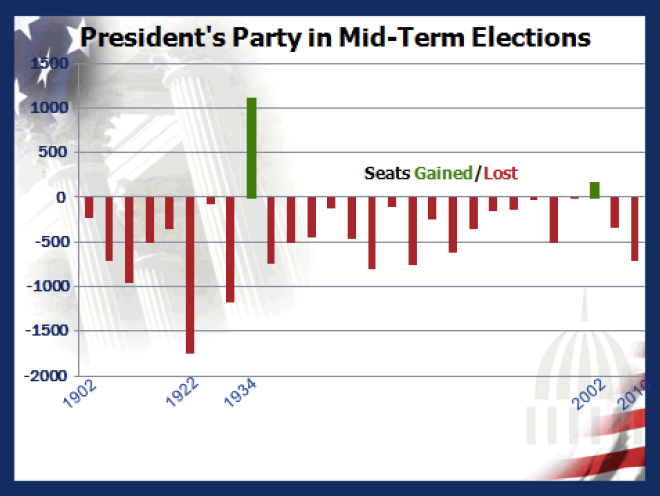
It turns out that the six-year itch is even more devastating at the state legislative level, which, as we documented in a post late last week is a critical piece of the political and policy equation for both parties nationally.  Check out this chart, courtesy of the National Conference of State Legislators, to grasp just how daunting the history of second term, midterm elections are for the president’s party at the state legislative level.

When Press Is The Best Protection

Masha Gessen feels that the American gay rights movement failed the Russian LGBT activists who protested during the games:

These brave Russian activists came out to protest because they thought that the eyes of the world were fixed on them that day and that their American activist allies in Sochi would support them by word and deed, staging their own protests and ensuring that the thousands of international correspondents in Sochi would hear of their protest and the treatment they faced. They were wrong. Their American allies watched the opening ceremony, socialized with Team U.S.A., and visited the famed Sochi gay bar. Their American allies failed them.

Why the lack of publicity matters:

First and foremost, working with LGBTQ activists in Russia has to involve ensuring that their names and their individual arrests and court hearings are well-publicized in the Western media. It also means ensuring that their fines are paid: The point of those extremely high fines is to open the way for further prosecution for nonpayment. Only if Russian authorities know that the world is watching the specific individuals they are targeting will the LGBT activists on the ground be relatively safe—which is to say, alive and unlikely to face long prison sentences in the near future.

The Imperfect Science Of Justice

Balko brings us the latest on Shaken Baby Syndrome:

New research suggests that most humans aren’t capable of shaking an infant hard enough to produce the symptoms in SBS. It usually takes an accompanying blow to the head. And in about half to two-thirds of the 200 or so SBS cases prosecuted each year in the U.S., there are no outward signs of physical injury. Indeed, this is the reason SBS is such a convenient diagnosis. It allows prosecutors to charge a suspected abuser despite no outward signs of abuse. But we now know that other causes can produce these symptoms, which means that some percentage of the people convicted in SBS cases are going to prison for murders that may have never happened.

He contrasts this SBS research with DNA testing:

The blood or semen or hair either matches the defendant, or it doesn’t. It will show that either the defendant raped or murdered the victim, or that someone else did. Things get murkier when the question isn’t who committed the crime, but if a crime was committed at all. The new research into SBS doesn’t state definitively that without external injuries, a child couldn’t have died from shaking. It suggests only that there are other possibilities—that shaking wasn’t the only possible cause of death. It isn’t an advance in science that will produce dispositive exonorations. It’s an advance that merely calls prior convictions into question.

Back To The Futurism

States_of_Mind-_The_Farewells_by_Umberto_Boccioni,_1911

Vivien Greene, curator of the Guggenheim’s new exhibit on the Italian Futurists, explains how F.T. Marinetti and his compatriots violate our ideas about the avant-garde:

This is sort of a scholarly debate, but I think for many people the definition of avant-garde means it follows the idea of the scholar named Bürger, and to be avant-garde means you have to be of the left. So if you break out of that mold—it’s hard to think of an avant-garde that was on the right. And I think with Futurism you have that, because in every other way, they’re satisfying our ideas of what is avant-garde: they’re new, they’re disruptive, and as they continue to develop into the ’20s and ’30s, they are reinventing themselves. It’s not as though they’re painting the same thing over and over again. They evolve while still keeping in mind the basic tenets of what is Futurist: dynamism, simultaneity, speed, technology, the machines. They embrace new things; they’re not at all static. Innovation is very important to the ideas of the avant-garde.

The Economist suggests that the movement’s fascist associates were one reason the Futurists have never had a major retrospective in the US:

Marinetti, a showman who liked to call himself “the caffeine of Europe” for the energy he put into promoting the futurist movement, was an early fan of Benito Mussolini and took part in the founding of the fascist movement in 1919. Marinetti wanted futurism to be Italian fascism’s official art movement. But the dictator refused, preferring to bestow his favours on different art movements at different times. The two men blew hot and cold about one another. Yet when Mussolini fell from power in 1943 and Hitler named him the head of the puppet Italian republic of Salò, the founder of futurism was one of the first to offer his support. Marinetti died just five months before Mussolini was executed, their lives seemingly forever linked.

In a largely complimentary review, Peter Schjeldahl calls Italian Futurism “the most neglected canonical movement in modern art – because it is also the most embarrassing”:

An avant-garde so clownish, in its grandiose posturing, and so sinister, in its political embrace of Italian Fascism, has been easy to shrug off, but the [Guggenheim] show makes a powerful case for second thoughts. It arrays some superb paintings and sculptures, the best of them by Umberto Boccioni, whose death in the First World War, at the age of 33, deprived the movement of its one great artist. And marvels of graphic and architectural invention reward a stroll up the Guggenheim’s ramp.

(Boccioni’s States of Mind II: The Farewells, 1911, via Wikimedia Commons)

Old MacDonald Had An iPhone

Jonathan Dent considers the rise of the farmer selfie, or “felfie”:

The champions of the felfie, the farmers themselves, see this as a much-needed opportunity (in the words of Will Wilson, curator of farmingselfies.com) ‘to put a face to the farmers who work hard to put food on your table,’ while Rob Campbell, writing in the Western Daily Press on January 9, saw the trend as having the potential to connect a scattered farming population with one another, as well as with the outside world. …  The popularity of the felfie, though, seems to be at least as much rooted in the seemingly inexhaustible needs of an increasingly urban society, creating its connections and consuming its information about the outside world through the internet and social media, to share, and stare raptly at photographs of the animals we encounter all too rarely in everyday life. While for many, selfie represented the self-regarding, insular tendencies of modern (online) life, the felfie seems to embody a desire to look beyond the screen to the greener world that city dwellers have been yearning for since the days of Hesiod, Theocritus, and Virgil.

The Dish’s favorite sheep farmer would surely approve.

A Hollow Victory In Mexico’s Drug War?

On Saturday, Joaquín “El Chapo” Guzmán, head of Mexico’s Sinaloa cartel, was captured after a 13-year manhunt. Daniel Hernández profiles the infamous kingpin:

[In 1993, Guzmán] was sentenced to 20 years in a maximum-security prison, but in 2001 he managed to escape, cartoonishly, in a laundry cart. Guzmán expanded his reach by trafficking marijuana, heroin, and cocaine into the United States, Europe, and Australia. He is said to exert control over most of western Mexico, parts of Guatemala, and trafficking ports in West Africa. While his nickname means “Shorty,” there’s nothing diminutive about El Chapo’s stature in the illicit drug world. Forbes has regularly named him in its lists of richest and “most powerful” people.

Juan Carlos Hidalgo asks the obvious question:

Without a doubt, Guzmán’s capture is a huge success for [Mexican president] Enrique Peña Nieto. In the last seven months, the leaders of Mexico’s top three drug cartels (Zetas, Gulf and Sinaloa) were arrested without a single shot being fired. So, are we on the verge of wining the war on drugs? That all depends on what the ultimate goal is.

Is it taking down drug kingpins or stopping the flow of drugs into the United States? If it’s the latter, the war is far from over. A report from the Office of Intelligence and Operations Coordination of the U.S. Custom and Border Protection agency looked at drug seizure data from January 2009 to January 2010 and matched it with the arrests or deaths of drug operatives (11 druglords in total). It found that “there is no perceptible pattern that correlates either a decrease or increase in drug seizures due to the removal of key DTO [drug trafficking organization] personnel.”

Keegan Hamilton warns that Guzmán’s arrest might actually make matters worse:

Each time a kingpin falls, bloody internecine conflict inevitably follows. When the Gulf Cartel boss Osiel Cárdenas Guillén ended up in Colorado’s infamous “supermax” federal penitentiary after his arrest in 2003 (a fate that may await El Chapo—federal prosecutors have already announced that they will seek his extradition), it paved the way for the Los Zetas cartel to commence its reign of terror across Mexico. The current situation in the Mexican state of Michoacán—where peasants have formed heavily armed militias to fight back against corrupt police and extortionist gangs—stems from the fragmentation of the La Familia cartel after the rumored death of its leader, Nazario “El Chayo” Moreno.

Even with El Chapo behind bars, the Sinaloa Cartel remains the most powerful drug-trafficking organization in Mexico, if not the world. Its operatives have been arrested in Africa, Asia, Europe, South America, the Caribbean, and, of course, the United States. The cartel may have lost its CEO, but its board of directors remains intact.

Mark Guarino highlights Sinaloa’s US distribution operation, based out of Chicago:

The city, centrally located, has become a hub for distributing drugs to other cities across the country, and its sizable Mexican population (both legal and illegal) provides the cartel with ready access to foot soldiers. For those reasons, the US Attorney’s Office in Chicago indicted Guzman in absentia in August 2009 for conspiring to transport drugs across international borders, and the US has prosecuted key figures in the cartel’s US operations here. The Chicago Crime Commission named Guzman public enemy No. 1, a designation previously given to a crime boss from another era, Al Capone.

Keating adds that Mexico’s much-touted drop in violence under Peña Nieto’s leadership is misleading:

According to the government’s statistics, the 18 percent drop in murders in 2013 was accompanied by a 35 percent increase in kidnapping. And Molly Molloy, a research librarian and a specialist on Latin America and the U.S.-Mexico border at the New Mexico State University Library, argues that the declining murder rate is the result of the country’s statistical agencies classifying fewer killings as “intentional homicides,” coupled with the fact that “the epicenters of extreme violence have dispersed around the country, making it more difficult to know how many people are dying.” She argues that there’s no evidence to suggest the total number of murders has declined at all, though different regions have seen changes in the level of violence.

The View From Your Window Contest: Winner #193

vfyw_2-22

A reader writes:

Hmmmmm. The fan palms (perhaps Sabals), not much of any other type of palm present except for miniatures, the hint of industry with smokestacks and powerlines in the background, make me think of the area northeast of downtown Jacksonville, FL, perhaps in proximity to Heckscher Blvd, near where I-295 & state 105 intersect, on a heading towards A1A (my favorite state highway in the US today!). If so, I’m glad the photographer caught it during a time of relatively few industrial explosions – looks more appealing then.

Another is apathetic:

This has got to be one of the most uninteresting and mundane views you’ve featured in a contest. The palm trees, flat terrain and mountains in the background appear to be Southern California, and I’ll be a little more specific to guess the L.A. Basin somewhere. But beyond that, I don’t really care.

The views are only as good as the submissions. Another reader:

Palm trees, red curbs, and it sure looks better than today in Minnesota! Hawaii?

Another:

I really don’t know. The vibe is definitely Southeast US – the buildings, the parking lot, the vegetation, to me it looks like any number of small cities in Florida. But the distant cranes and smoke stacks suggest a major port. Could it instead be Georgia? South Carolina? Can’t make out the license plates. Without the skills of many of your contestants, I’m afraid I’m going to have to just guess – how about Charleston, SC?

Nope, the other coast:

This has got to be southern California! Wide parking spaces, GM work van, yellow Prius taxis, combined with palm trees, smog, and mountains faintly visible in the background. What looks like a refinery or chemical processing plant in the background makes me say an area like Long Beach or El Segundo, but I don’t have the time to be a superguesser!

California it is. Another reader:

If I google one more California oil refinery I’m going to end up in GITMO, so I’m giving up. Guessing Huntingdon Beach because their parking lots have those double-line bay dividers and the diamond-shaped islands of shrub, but the distant industrial thing doesn’t seem to match.

Another gets on the right track:

The van and large pickup in the parking lot makes it the U.S.A. The combination of palm trees and eucalyptus trees makes it Southern California. The dark line across the horizon might be mountains, but I don’t think so – I think it’s a marine layer fog bank, and the camera wasn’t pointed toward the mountains. In the background you can make out both refinery towers and port cranes. That puts it somewhere near the ports of Los Angeles–Long Beach, probably the “South Bay” area: Torrance, Wilmington, San Pedro, somewhere like that. I didn’t try to explore it down to the street level.

Another gets the right city:

A completely nondescript yet very typical place in Southern California. The industrial background + a lack of visible landmarks rules out a large number of places in the LA basin but does not help me zero on a particular location. Judging by the shadows, the photographer is facing NNE, yet the mountains are far. So I’ll just guess Torrance.

Another nails the right building:
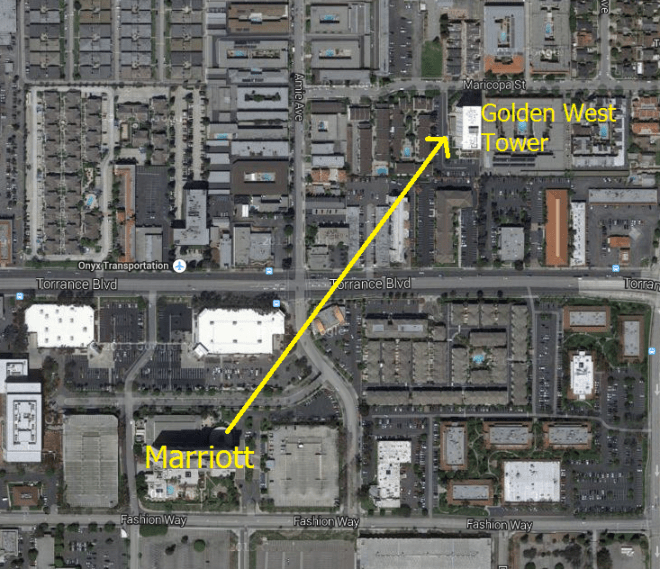
Google Map

When I looked at this week’s contest photo, my first reaction was: “Wow, this is easy.” Eucalyptus trees and palm trees and an oil refinery all in the same picture? Smoggy mountains in the distance? This pretty much has to be somewhere in Southern California.

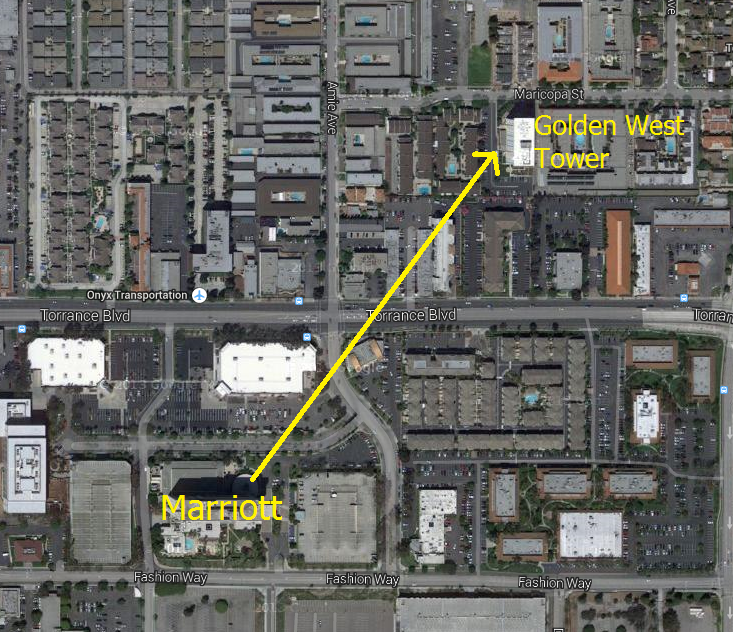
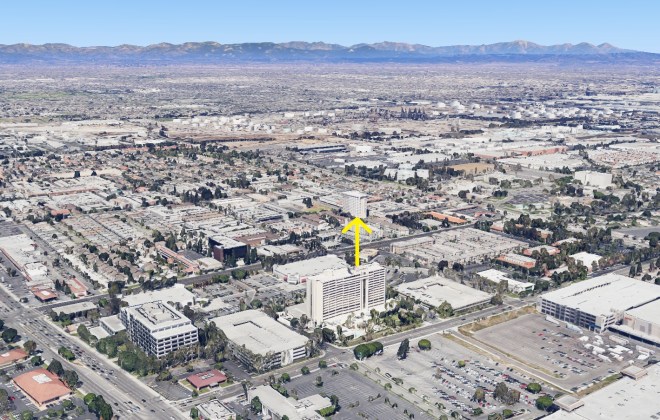
But it was only when I looked more closely at the photo that I realized just how easy it was (at least for me). You see, this is my hometown, Torrance, in the South Bay area of greater Los Angeles. The tallish building in the center of the photo is the Golden West Tower, an apartment complex for seniors built back in the 1970s. (As a child I watched the construction of that building from my second-floor bedroom window.) The refinery in the background is an Exxon Mobil facility (which exploded at least twice during my childhood.) The photograph was apparently taken from the Torrance Marriott South Bay Hotel, located just to the north of the Del Amo Fashion Center on Fashion Way. The person who took the picture is on the north side of the hotel looking to the northeast (you can just make out the San Gabriel Mountains in the haze on the horizon).

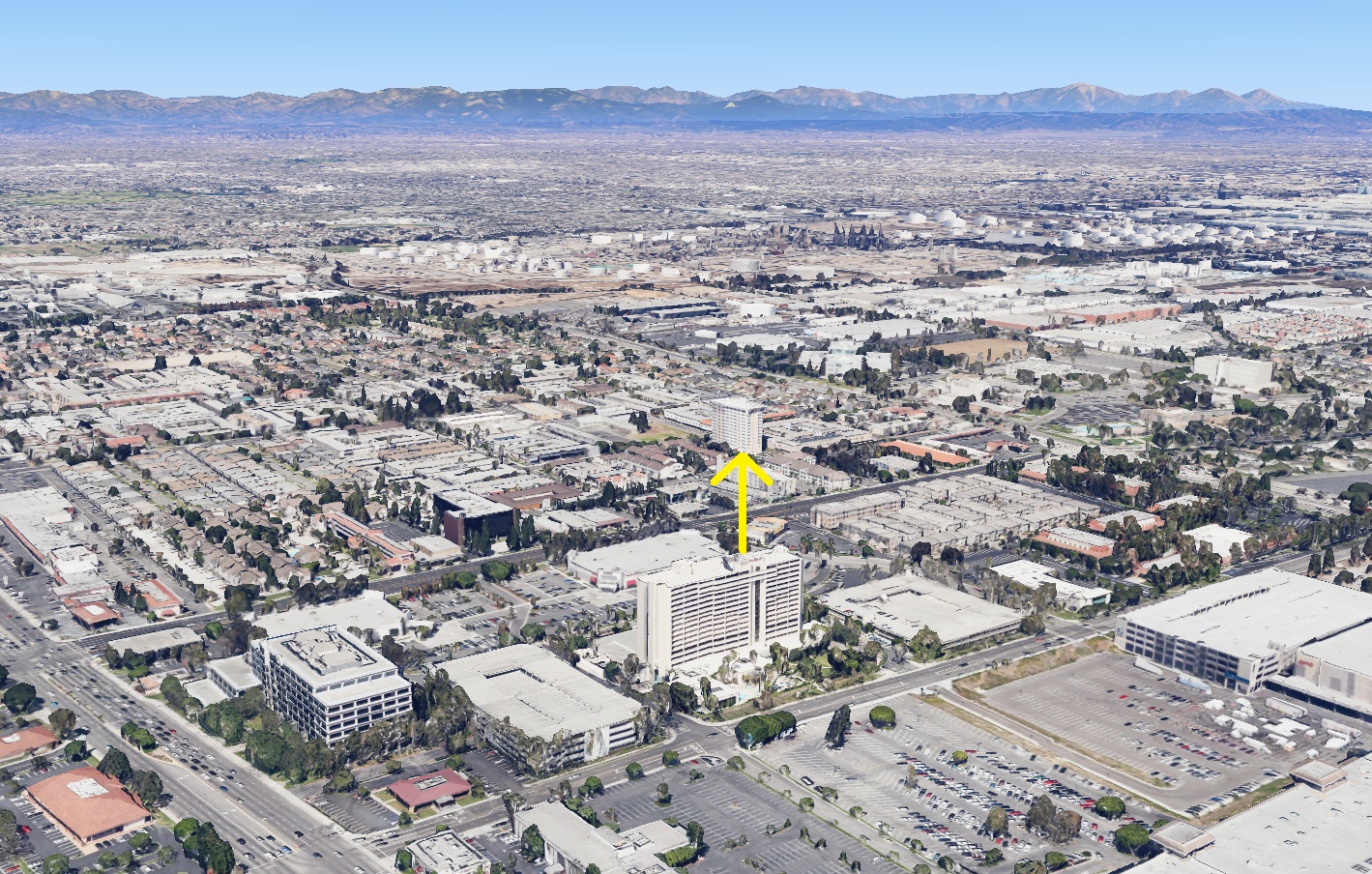
A wider view:
unnamed

Another reader:

Ordinarily I try to send in some interesting tidbit about the places in the picture. But this week’s searches turned up a different type of results. The picture features a large ExxonMobile refinery that was evacuated last year and the Golden West Tower apartment building for seniors where an 80 year old resident committed a double murder-suicide in 2012. Oil and gun violence. A very American landscape.

Another adds, “I thought about calling up the hotel and asking about their room numbering scheme, but that just seemed creepy.” Another ventures a guess at the room number:

I finally got one. I have been reading your blog for years now and am going to join right away. Usually the contests are in some far off place, but this one is in my backyard. The photo in this week’s contest is taken from the Torrance Marriott Hotel. The only lower floors that have balconies are the 3rd and the 4th. So my best guess is Room #337.

Another:

Hi! Founding and renewing member here.  So, I fire up the page, see the picture, turn to the wife and say “I know that building!” My grandparents lived in that large building in the ’70s. When I was a kid, we’d drive up from San Diego about every couple of months for a visit and have lox and bagels for breakfast and later go to the coffee shop around the corner for dinner. Every time. They were also the first and only people I knew that were actually afraid of the microwave oven. I could tell you more about them and my visits but I believe that’s a different contest. Now for the guessing: 6th floor, room 622.

So close. The winner was the only reader to correctly guess the room:
marriott

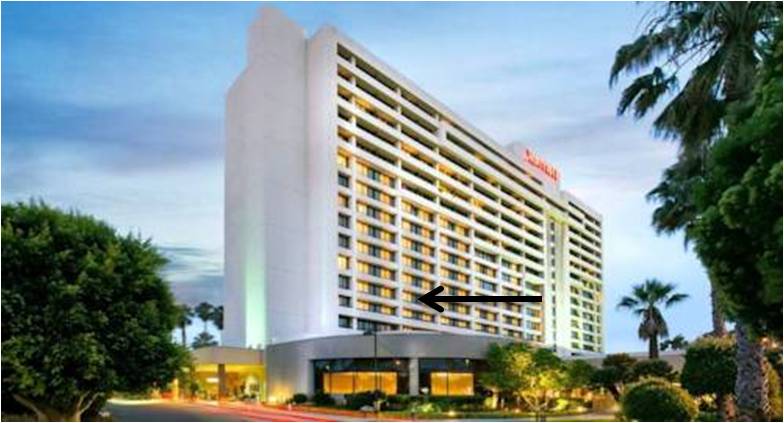
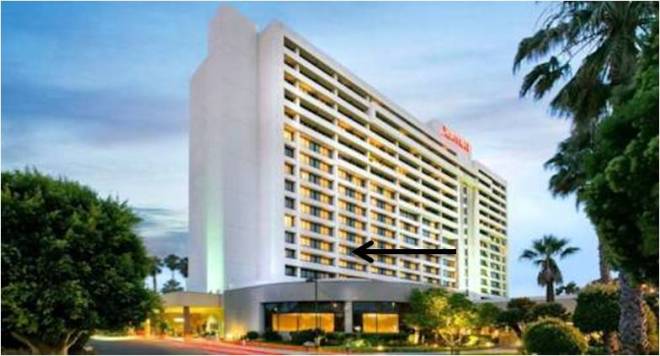
Well this just screams Los Angeles. But where? The real clue in finding the exact location was the refinery in the distance. The obvious first choice was the Exxon-Mobil refinery in Torrance. A quick search of hotels in the area turned up the Marriott at 3635 Fashion Way, Torrance, CA.

Now to guess the room number (argh). It looks like the floor is just above tree level, so it’s probably the sixth or seventh floor. I’ll go with the sixth floor. I can pinpoint the room visually, but I couldn’t turn up a floor plan to be sure of the room number. Taking a guess as to the numbering scheme, I’ll go with 629 (608, 607 and 630 would be my alternatives).

Thanks for an easy one this week. St Paul drove me nuts last week.

From the submitter:

I’m not sure if this one will be too easy, given that you certainly have many followers in Southern California, but I showed it to my husband, who grew up here in Los Angeles in the South Bay, and he didn’t recognize it, so here goes. That building in the distance is of no particular significance, by the way (it’s a retirement community), except that there was a murder-suicide there a couple of years ago, something that sadly is not unheard of in retirement homes. In the farther distance you can see the Exxon Mobil Refinery, and beyond that, mountains.

I had to spend a good part of the weekend chaperoning students from my school who were attending the Junior Statesmen of America Winter Congress that was being held at the Torrance Marriott. This photo was taken at about 11 am on Sunday, February 16 from room 629.

(Archive)
How Many Janitors Is A College President Worth?

St. Mary’s College of Maryland is considering capping its president’s salary at 10 times that of its lowest-paid employees:

Currently for St. Mary’s, the ratio is 13-1 when comparing the president’s salary to that of the college’s lowest-paid employees. In this light, the proposal to cap the ratio at 10-1 is not as much a major cost-cutting effort as it is a push to further address questions of income inequality. The ratio at St. Mary’s is already more reasonable than it is in many corporations or even at other universities ($441,000 was the median compensation for public-college presidents in 2011, according to the Chronicle for Higher Education). Still, those behind the initiative believe it could improve more — and that it’s an important effort to keep the income gap from widening even further.

Ry Rivard puts the proposal in context:

By comparison, in the corporate world, the CEO at clothing retailer Gap, which Wednesday said it would raise the minimum wage for its employees, made 331 times more than its average worker, according to a 2013 analysis by Bloomberg. But St. Mary’s plan isn’t as equitable as the compensation scale Ben & Jerry’s once used, which didn’t allow executives to make any more than five times what an employee made.

The St. Mary’s proposal does more than just tie presidential pay to that of less well-compensated staff members. It also seeks to make sure all employees earn at least $29,976, which is 130 percent of the poverty level—enough to keep a family of four off food stamps.