High-Tech Sex

A NSFW video demonstrates virtual sex:

When Brian Merchant got a visit from Japanese sex toy company Tenga, he found their robot-assisted virtual sex program “more creepy than erotic”:

Ugh. In terms of function, it was pretty accurate; the robotic sex arm synched up with the virtual sex arm on screen.

“The physical dimensions of the Tenga were narrow, which matched the avatar I was virtua-bangin’,” [Merchant’s colleague Dan] Stuckey said. “I wonder if you’re stuck with the same controller though. What if you’re interested in someone else?”

Still, it’s not hard to imagine a future where someone puts all the pieces together and this kind of thing works seamlessly.

Meanwhile, Daniel Engber is disappointed with “the failed promise of 3-D porn”:

“The main problem is there aren’t a lot of 3-D TVs out there. That’s the biggest hold-back,” [adult-industry reporter and erotic 3-D photographer Mark] Kernes argues. But there are other problems, too.

For one thing, the studios had convinced themselves that 3-D DVDs could not be ripped and spread online. Having lost half its business to freebie websites since 2005, executives sought safe harbor in a new video format. But content pirates were not deterred. “The way it was sold to me is that you can’t torrent a 3-D movie,” says porn journalist Gram Ponante, “and of course that’s not true.” Shooting on This Ain’t Avatar took a full week, more than twice the time it takes to shoot most conventional sex films, but the movie sold just 6,000 units, Ponante says, barely enough to make back its production costs. (Ten years ago, the best-selling porn films would sell about 60,000.)

The same occurred in mainstream soft-core. In 2010 Piranha 3D made a $60 million profit on topless ultra-gore and a dismembered penis flying off the screen. The sequel,Piranha 3DD, was released in 2012 and grossed just $375,000 in the U.S. An erotic import from China, 3-D Sex and Zen: Extreme Ecstasy, got lots of credulous press in 2011 for being the “world’s first ever 3-D porn film” (it wasn’t), but failed to sell that many tickets. And last week saw the release in theaters and streaming video of the latest tent-pole 3-D smut: Nurse 3D, the story of a man-killing, girl-kissing, clothes-not-wearing serial killer whose exploits are somehow neither sexy nor fun.

A Journey, Not An Escape, Ctd

Christine Sismondo traveled to the Peruvian rainforest to try ayahuasca, a brew with an active ingredient, dimethyltryptamine or DMT, “that, some claim, can cure illness and addiction, help people gain insight into primary relationships and, for others, offer glimpses into the origin of life.” She describes her own experience ingesting and then purging the drug:

For the next two hours, I felt better than I have – maybe in my whole life. It was like my body had never experienced stress – ever. Gravity was about half as strong as usual. My spine straightened. I listened to the songs and watched shapes form in the trees. I saw friends, Day of the Dead-like images, and, I’m pretty sure, President Taft. I thought thoughts – the kind you don’t really spend a lot of time thinking about in everyday life. Nothing profound. Mostly platitudes about how to have a better life and be a better person. But I felt those platitudes profoundly. This will be disappointing to those who want to hear about aliens and divine beings, I’m sure. I think I saw a third eye image at one point, but I’m also pretty sure I saw Donald Duck. My husband saw a geisha. He, incidentally, took a second dose, and never felt nearly the range of highs and lows I did.

did feel two things that are more on the esoteric side that I was genuinely surprised about. First, I felt, viscerally, for the first time in my life, that stress was a choice and that I might be able to eliminate it. Call it mind-body stuff or, as I prefer, stoicism, I could finally see a path wherein I could exercise some more power over my reactions to things.

Finally, I felt, also for the first time, a sense that the rainforest was a living, breathing thing. That’s obvious, I realize. But I felt the power of the place and even the plants in a non-intellectual way. I can’t explain it perfectly, but I felt I had honestly drunk the spirit of the vine. I didn’t come home with a new plant-based religion or anything. But I feel more like I understand how important it might be to save this sacred, pre-modern place, by patronizing it – or however we can.

Previous Dish on ayahuasca here and here. Further coverage of psychedelics here.

How Long Do You Go?

dish_sexmap2

Kate Hakala captions:

The Spreadsheets App, a mobile app that uses your phone’s accelerometer and speakers to provide statistical feedback about your duration, thrusts, and decibel peak, is taking big data to the bedroom. … Spreadsheets shared the stats of its 10,000 early adopters so we could investigate who has cross-country endurance and who’s a one-minute wonder. Averaging the intercourse time of all users in the United States (the app doesn’t cover foreplay), we’ve provided a ranking of duration in minutes for all 50 states and the District of Columbia as a little bonus. While finishing times of under three minutes may surprise you, remember that these are just the averages among two-pump chumps and Lotharios alike. Besides, previous research has shown that, despite the hubbub about hours-long tantric sessions, intercourse itself usually only lasts for about 3 to 13 minutes.

New Mexico had the longest average duration (7:01), and Alaska the briefest (1:21).  Check out the full list of rankings here.

An Algorithmic “Assault On The Novel”

Tristano, an experimental novel based on the legend of Tristan and Isolde, was way ahead of its time:

First published in Italy in 1966, it has only been in the last decade that digital technology has made it possible for Tristano to be printed as its author Nanni Balestrini intended. Each of its ten chapters has fifteen pairs of paragraphs, arranged differently by an algorithm in each published copy. These are numbered on their covers by Verso Books, who have issued four thousand of its possible 109,027,350,432,000 variations in English for the first time.

In his foreword, Umberto Eco – a member of Italy’s Neoavanguardia movement with Balestrini and others, founded in 1963 – suggests that “originality and creativity are nothing more than the chance handling of a combination”. … Eco suggests several ways to approach Tristano: by reading a single copy and treating it as “unique, unrepeatable and unchangeable”; or “considering it to be the best … possible” version; or by reading several and comparing the outcomes.

Lizzy Davies elaborates on the project:

The first versions were published in Italy in 2007, and subsequently in Germany. Before the English-language editions, 10,000 copies were in circulation. Each has 10 chapters with 20 of a possible 30 paragraphs in different orders, with the paragraphs within the chapters also shuffled. “And from these two rules,” says Balestrini, “comes this number of millions, millions, millions of possible copies.”

When it was published in 1966, Tristano – named in an ironic homage to the hero of the Tristan and Iseult legend – was already an experimental hodgepodge. Needless to say, its digitally-reordered descendants are not novels- let alone love stories- in any traditional sense. Verso describe the book, in fact, as a “radical assault on the novel”; for Balestrini, it is a literary work- but also “a game” into the spirit of which the reader, if he is to appreciate it, must enter.

Holly Baxter wonders if the novel is “just an incredibly astute marketing ploy”:

At its core, as the foreword by Umberto Eco states, Tristano celebrates “an elevated number of possible outcomes”. Its beauty then is in the fact that, like a real life love story, you’ll never quite know what is going to happen. But is this romance, or is it just a kind of extension of the infinite monkey theory? In all honesty, I struggle to see this novel, which is also the anti-novel, as anything more than contrived.

Meanwhile, Brendan C. Byrne considers the novel in the context of other experimental literature:

Tristano is still, at least nominally, a novel, one where the voice and temporality can change not only every line but within every line. … It is tempting to compare Tristano to hypertext fiction, which seems to be undergoing something of a resurgence with Twine, an open-source tool for telling interactive, non-linear stories. And both do indeed seem to be interested in extracting and making visible the “rules” which govern modern and post-modern lit, breaking narrative down into its consituent elements. However, hypertext fictions places great value on “exploring” the possible sequences of these elements, while each iteration of Tristano is fixed, concrete. The computer has already explored; we merely have the path.

“The Great American Novel Is A Chimera”

In response to Lawrence Buell’s essay on the “Great American Novel,” David L. Ulin calls the term into question, writing that, as a concept, the GAN “misreads the fundamental function of literature, which is less about the grand defining statement than it is about empathy”:

What literature offers is not an overview; it is not a way to understand the broad movements of the world. Such aspects may be represented — we can learn a lot about what it was like to live in 19th century London by reading Dickens, or St. Petersburg under the czars by reading Gogol — but they are not the point. No, literature is a connection-making mechanism: We read about people, individuals, and inhabit their lives, their struggles, their desires. We see that they are not unlike we are. This creates both identity and identification, allowing us to step (for a moment, anyway) outside ourselves.

The Great American Novel is something different; it signifies a belief in literature as all-encompassing, as able to gather the diverse strands of an inexplicable and unruly nation, and make sense of them in a single work. That this is impossible should go without saying; it’s more than a little reductive as well. Consciousness is chaos and life has no meaning, and the stories we tell — including the big ones: faith, statehood, family, history — are just a series of dreams we make up to give shape to the shapeless, to build a firewall against the void. That it all falls to pieces is part of the point; we are alone together, after all.

Though he says he would “rather talk about a novel in any other conceivable terms,” Scott Esposito sees some significance in the concept of the GAN:

There are places out there that are both small enough and have young enough literary scenes that such-and-such an author can legitimately be considered the “Great _______ Novelist,” having written the “Great _______ Novel.” One upon a time this was what was meant by the epic, though that’s long, long over now. So in a sense it maybe was possible somewhere, although, in a completely different literary genre and back when people sacrificed bulls. … [A]t some point way, way back, the literary world was small enough that a single figure could dominate a literature for a even a large and diverse country like the U.S. in a way that’s just completely incomprehensible now.

Previous Dish on the topic here, here, and here.

A Poem For Saturday

MartinLutherKingMalcolmX

Dish poetry editor Alice Quinn writes:

Yesterday marked the assassination of Malcolm X, at age 39, on February 21, 1965. In the words of Robert Hayden, Malcolm X “became/much more than there was time for him to be,” and his death inspired many to write poems in his honor, including Gwendolyn Brooks (“He had the hawk-man’s eyes./ We gasped. We saw the maleness./ The maleness raking out and making guttural the air/ And pushing us to walls,”), and Margaret Walker, whose debut collection For My People, was selected by Stephen Vincent Benét in 1942 as winner of the Yale Younger Poets Prize.

A new volume of Walker’s poetry, This is My Century: New and Selected Poems has recently been published by the University of Georgia Press, with a moving introduction by Nikky Finney, winner of the 2011 National Book Award for her collection Head Off & Split. (You can watch Finney give a stirring reading of Walker’s poetry here.) Our poem for today is Walker’s tribute to Malcolm X, included in This is My Century.

“For Malcolm X” by Margaret Walker:

All you violated ones with gentle hearts;
You violent dreamers whose cries shout heartbreak;
Whose voices echo clamors of our cool capers,
And whose black faces have hollowed pits for eyes.
All you gambling sons and hooked children and bowery
bums
Hating white devils and black bourgeoisie,
Thumbing your noses at your burning red suns,
Gather round this coffin and mourn your dying swan.
Snow-white moslem head-dress around a dead black face!

Beautiful were your sand-papering words against our skins!
Our blood and water pour from your flowing wounds.
You have cut open our breasts and dug scalpels in our
brains.
When and Where will another come to take your holy place?
Old man mumbling in his dotage, or crying child, unborn?

(From This is My Century: New and Collected Poems by Margaret Walker © by Margaret Walker Alexander. Reprinted by kind permission of the University of Georgia Press. Photo of Martin Luther King, Jr. and Malcolm X, March 26, 1964, from the United States Library of Congress‘s Prints and Photographs division via Wikimedia Commons)

A Hillbilly Hemingway

Breece D’J Pancake’s short story “Trilobites” was one of the first the Dish highlighted for our Saturday feature. Jon Michaud declares that it’s “high time for a Pancake revival,” praising the writer’s depictions of hard-scrabble life in West Virginia in The Stories of Breece D’J Pancake:

While deeply tied to the details of its Appalachian setting, the book offers a broader portrait of the personal and societal wreckage left behind by mass industrialization. Grim, work-related deaths and ailments abound in Pancake’s fiction: lungs bleed from coal dust; mine gas turns a man “blue as jeans”; another is killed by fragments of metal lodged in his brain. When I heard the news, last month, of the chemical spill that left three hundred thousand West Virginians without usable water for a week, I thought immediately of this sentence from “The Scrapper”: “He could see where the wives had planted flowers, but the plants were all dead or dying from the constant shower of coal dust.” Nearly all of Pancake’s stories share a unity of time, taking place in a matter of hours or days, but they are set against an ever-present awareness of geological time, of the epochs and eras that preceded the present moment. His fictions combine the intimacy and specificity of a Vermeer portrait with the grandeur and fierceness of a Bierstadt panoramic.

These bleak qualities may make Pancake’s stories timely, but it is their compressed artistry and distilled feeling that make them timeless. I read the book with no foreknowledge of Pancake’s work or life—always a welcome experience. On my first pass through, I was reminded of an astonishing variety of other writers. Thematically and structurally, the book owed a lot to “Dubliners” and “Winesburg, Ohio,” but, stylistically, Pancake was fully formed, an uncanny hybrid of dirty realism and Southern gothic. A whole world I didn’t know about was opened up for me. After finishing the book, I would have happily gone spelunking in the library basement for more of Pancake’s work, but there was none. This is Pancake’s only book, originally published in 1979, three years after his death, at the age of twenty-seven, from a self-inflicted gunshot wound. Like the pedestalled feet of a ruined statue, these twelve stories can only hint at the body of work that might have been produced had he lived.

Faces Of The Day

Screen shot 2014-02-13 at 1.11.16 PM

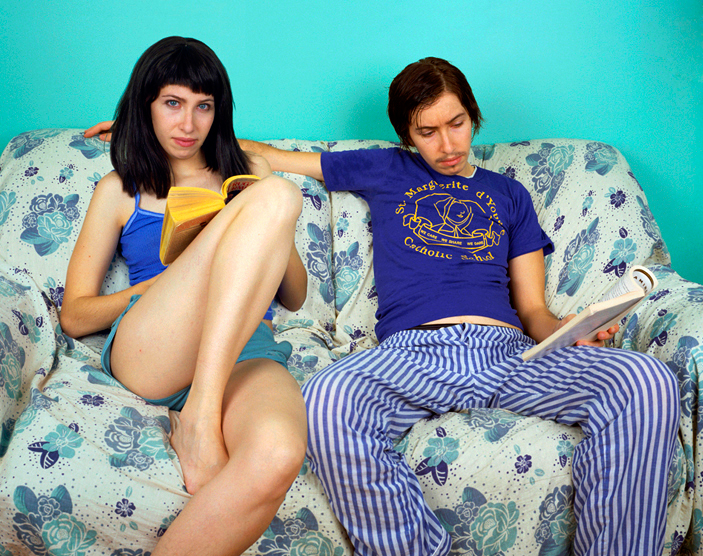
Canadian photographer J.J. Levine explores gender through domestic photographs of “couples”—really, just one person dressed as a man and a woman:

For the series “Alone Time,” Levine recreated and photographed typical domestic environments that play with gender stereotypes. As a twist, he used only one model to play both the male and female characters in the image. The result, Levine said, “challenges the normative idea that gender presentation is stable or constant. Rather, gender expression can be fluid and multiple.”

Each image was shot at the home of the model, often one of Levine’s friends. Levine set up lights, rearranged furniture, and styled the model as both male and female. Each shot took upward of a day to finish and was shot on film. Negatives were then processed and scanned, followed by a lengthy layering and collage process.

More photos from the series here.

(Photo by J.J. Levine)