Quote for the Day

Petraeusbrendansmialowskigetty

"The Vietnam experience left the military leadership feeling that they should advise against involvement in counterinsurgencies unless specific, perhaps unlikely, circumstances obtain — i.e. domestic public support, the promise of a quick campaign, and freedom to employ whatever force is necessary to achieve rapid victory. In light of such criteria, committing U.S. units to counterinsurgencies appears to be a very problematic proposition, difficult to conclude before domestic support erodes and costly enough to threaten the well-being of all America’s military forces (and hence the country’s national security), not just those involved in the actual counterinsurgency," – David Howell Petraeus, The American Military and the Lessons of Vietnam: A study of military influence and the use of force in the post-Vietnam era. PhD Dissertation, Princeton University, 1987. Page 305.

Here’s the key question: why is Petraeus now abandoning every counter-insurgency principle he spent many years articulating? The deeper question is: how badly is the surge threatening the U.S.’s national security? How much more danger is continuing this failed policy putting us in?

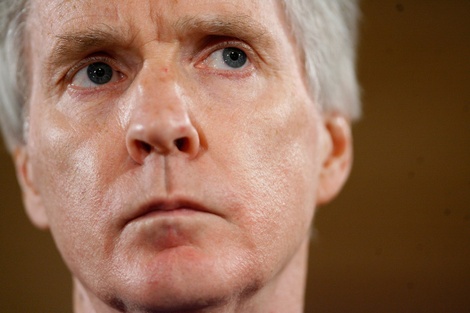
(Photo: Brendan Smialowski/Getty.)

A Writer’s Ironic Illness

I’ve know photographers who have lost much of their sight, but this story is somehow more poignant:

Of all the ways to learn that your brain has suffered an "insult," as medical professionals like to call the effects of strokes, one of the oddest is to get up in the morning and discover your Toronto newspaper seemingly printed in a mix of Serbo-Croatian and Korean. When 70-year-old Howard Engel came back inside with his Globe and Mail that hot July day in 2001 and found he couldn’t read his own books either, the bestselling mystery novelist headed for the hospital. Tests confirmed Engel’s own assumption: stroke, left side, rear. His memory was shot — still is, for that matter, especially for names — and he had lost a quarter of his vision, on the upper right side. But the essence of the diagnosis was a rare and almost incomprehensible condition: alexia sine agraphia. The elegant combination of Greek and Latin words meant that while Engel could still write, he could no longer read.

(Hat tip: BookNinja.)

The Surge’s Real Target: Iran?

That’s NRO’s Andy McCarthy’s instructive take on the Petraeus testimony. He cites this comment from the general:

We cannot win Iraq solely in Iraq.

I predict an echoing chorus from the far right. In fact, I think Petraeus’ testimony and the administration’s agenda makes the most sense if you see all of this as a prelude to a risk of the wider war that Cheney desperately wants. If you keep Iraq occupied and in a state of barely arrested civil war, the chances of a casus belli against Iran increase. You can see the risk in Kurdistan and the South already. The extremist mullahs in Tehran would gladly reciprocate Cheney. Both Bush and Ahmadinejad have a domestic political interest in increasing polarization and conflict. This, I suspect, may even be the fallback reason behind the Anbar strategy. Bush is emboldening the Sunnis not just to take on al Qaeda, but at some point to take on the Shiite government in Baghdad, which the administration fears is too close to Iran. Bush and Cheney may well be trying to leverage this endless, constantly shifting civil war in Iraq – under the guise of fighting al Qaeda – into a mobilization for a campaign against Iran, along with a bombing campaign against their nuclear facilities. They are rhetorically laying the groundwork for such an attack. And they are looking for a reason to extend the conflict. What they need to win the argument is more polarization. Hence the decision to pour as many resources and troops as they can into the quicksand of Iraq. Hence the exclusive cooptation of Republican party outlets like Fox News. They need to portray the complex implosion of Iraq as a war against those who murdered on 9/11; they need to create reasons to portray the war in Iraq as essentially indistinguishable over time from a war with Iran.

I can see the sensible reasons for hanging in there.

David Brooks makes the honest, good faith case for such a strategy today. It’s risky, probably hopeless but not totally irrational to hang in and hope for some kind of gradual partition without a massive genocide. But my fundamental worry is the unknown future actions of Bush and Cheney. They have no qualms about changing their rationale for the war at a moment’s notice. They’ve switched narrative and rationale so many times now it’s close to dizzying. What they’re really doing now, I fear, is finding a personal alibi for the defeat they engineered, playing the Weimar card against the Democrats, and looking for a way to go to war with Iran. Enabling them further by funding troop levels that are essentially unchanged from 2005 and early 2006 means the risk of catastrophe increases. Remember: they don’t believe a president is bound by the rule of law. Their own most-trusted staffers have voiced hopes for another terror attack on Americans so they can shred more constitutional restraints on a president’s dictatorial powers.

The debate on continuing to occupy a slowly disintegrating Iraq is only finely balanced if you believe we have a president and vice-president who can be trusted to act prudently and constitutionally. Do you?

George Will’s Two Questions

George Will has been one of very few conservatives who have kept their wits about them these past few years. That’s more than I can say for myself in the fevered days after 9/11. He is fundamentally right about one fundamental question. It’s worth repeating so that the hysterics and Weimarites on the "right" finally get it into their heads. George puts it baldly enough for them to understand:

The surge has failed, as measured by the president’s and Petraeus’s standards of success.

This is simply indisputable, unarguable, a fact. Crocker’s testimony confirmed it. The entire point of the surge was to facilitate compromise at the center in Baghdad. It has failed. And so we are now given a fallback argument: that we can manage the disintegration of Iraq better by staying than by leaving; that when the surge ends, its fragile achievement of some local security will somehow endure despite the admitted uselessness and sectarianism of local police; that we have to stay because of the genocide leaving would cause. Will asks two basic questions:

Is there an Iraq? Are there Iraqis?

There is no Iraq. Alas, there are Iraqis. The Sunni Arabs and the Shiite Arabs both want to control a unified country, especially the Sunnis. So partition is not something they are interested in. In the most recent poll, 98 percent of Sunnis wanted Iraq in one piece and to be in control of it. So the civil war will continue, and probably intensify once the surge levels fall back to the 2006 military presence. I’ve been trying to weigh the pros and cons of this and I don’t apologize for being conflicted. As an early passionate advocate of bringing democracy to Iraq, it really gives me no pleasure to admit there will be no democracy and there is no Iraq. If that really is true, and if I’m also right to suspect malevolence in the White House, the argument for cutting off funding immediately is stronger than I once thought. For sober conservative reasons, of course. Bush will not listen to reason. He will only listen to a funding cut-off.

Claghorn, Leghorn, Thompson

A reader writes:

You were closer than you knew (presumably) when comparing Foghorn Leghorn to Thompson.  Leghorn was based on the character Senator Beauregard Claghorn, played by Kenny Delmar on Foghorn_leghorn Fred Allen’s radio show in the 1940s. Claghorn was a national sensation – he was a parody of the old-fashioned (racist) Southern Democrats in the Sen. Bilbo mode (cruder, even more ridiculous versions of Sen. Robert Byrd today).  He was so popular he recorded a popular album, starred in a movie, etc., and Warner Brothers then created Foghorn Leghorn to exploit the sensation….

But the story gets even better.  People around America were laughing AT Claghorn, not with him. This parody of an old racist and obstructionist Southern politician – one whose hatred of the Great Emancipator led him to refuse to use the LINCOLN tunnel to drive into New York – was seen as a relic and buffoon, lost in the modern world.  Its no coincidence that this national sensation occured shortly after WWII, at the start of the Cold War, in the years when racial equality emerged as an important issue on the national scene…  Radio in particular, and pop culture in general, helped ease the path towards integration in the military and Brown v. Board of Education…

I say, I say: you learn something every day on the Internets.

Annals Of Propaganda

Brit Hume coaches Petraeus to echo Bush administration talking points, describing the entire conflict in Iraq as a battle against al Qaeda. It was the final word of the GOP infomercial last night, a low-point in military press relations. Now there’s no argument that al Qaeda exists in Iraq – because Bush, Cheney and Rumsfeld gave it the space to come in, and the incentives to flourish. But that it is the central actor in that country, that our woes there are due to al Qaeda and not the inherent sectarian instability of Iraq: well this is absurd, ahistorical and can only be explained by Hume’s desire to advance the interests, as he sees them, of the party he supports and broadcasts for. Petraeus’ exclusive on Fox to my mind reveals that he has sadly been coopted by Rovism. This is about rallying the base of the GOP, by distorting the reality of the war to fit an ideological, propagandistic template. It’s a disgrace.

Responding To Crocker

Crockerchip_somodevillagetty_2

His main argument was avoiding the chaos that leaving Iraq would entail. Kevin Drum’s pre-emptive rejoinder:

Israel has fought war after war in the Middle East. Result: no regional conflagration. Iran and Iraq fought one of the bloodiest wars of the second half the 20th century. Result: no regional conflagration. The Soviets fought in Afghanistan and then withdrew. No regional conflagration. The U.S. fought the Gulf War and then left. No regional conflagration. Algeria fought an internal civil war for a decade. No regional conflagration. …

It’s way past time for us to start formulating a sane national security policy for an age of terror. Leaving Iraq is the first step.

But Iraq is, well, Iraq: a basketcase of a place in the best of times, with an obvious capacity for endless savagery, an ungrateful volcano that splutters lava far and wide just when you don’t want or expect it. The regional war is already here anyway. Iran is already deeply invested in the Shiite parts of Iraq; and the US, by supporting and corralling and training the Sunni tribes in Anbar, is already creating a military force in Iraq to counter Iran and Maliki; the Saudis and Egyptians and other Sunni powers are busy bankrolling the resistance. I think it’s possible that Crocker is right: enormous immediate violence would result from the US withdrawing from Iraq. But the current policy is to facilitate the partition of Iraq in a less violent and more protracted fashion.

The question seems to me to be therefore a simple one: is it worth American lives, billions of dollars, and an open-ended commitment to occupying the Middle East, with all that does to further Jihadist recruitment, in order to give the Iraqis a longer, milder civil war, with the same long-term result? If you compare this statement of the mission with the original concept: the creation of a unified, democratic Iraq as an ally in the war on Islamism, then you see how far we have come. Not so much mission creep, as mission-change. No one voted for this; and I certainly don’t believe it’s vital to national security to pick one path toward Iraq’s disintegration over another. Wouldn’t it be better to get it over with quickly? Given limited military resources, is it really in our interest to tie so much of our military power in a quicksand that, at the peak of the surge, is merely not dragging us down even faster?

(Photo: Chip Somodevilla/Getty.)