The Conservative Principles Poll [Stephen]

A lot of my friends in the center-right blogosphere think Andrew and his readers are a bunch of lefties. So let’s take an unscientific poll. Russell Kirk famously laid out 10 conservative principles. To how many do you subscribe? (I’ve just excerpted the principles here, it’s worth going over here to read Kirk’s entire essay.)

    1. The conservative believes that there exists an enduring moral order. That order is made for man, and man is made for it: human nature is a constant, and moral truths are permanent. … A society in which men and women are governed by belief in an enduring moral order, by a strong sense of right and wrong, by personal convictions about justice and honor, will be a good society—whatever political machinery it may utilize; while a society in which men and women are morally adrift, ignorant of norms, and intent chiefly upon gratification of appetites, will be a bad society—no matter how many people vote and no matter how liberal its formal constitution may be. …
    2. The conservative adheres to custom, convention, and continuity. … Conservatives are champions of custom, convention, and continuity because they prefer the devil they know to the devil they don’t know. …
    3. Conservatives believe in what may be called the principle of prescription. Conservatives sense that modern people are dwarfs on the shoulders of giants, able to see farther than their ancestors only because of the great stature of those who have preceded us in time. Therefore conservatives very often emphasize the importance of prescription—that is, of things established by immemorial usage, so that the mind of man runneth not to the contrary. There exist rights of which the chief sanction is their antiquity—including rights to property, often. … The individual is foolish, but the species is wise, Burke declared. In politics we do well to abide by precedent and precept and even prejudice, for the great mysterious incorporation of the human race has acquired a prescriptive wisdom far greater than any man’s petty private rationality.
    4. Conservatives are guided by their principle of prudence. … Any public measure ought to be judged by its probable long-run consequences, not merely by temporary advantage or popularity. Liberals and radicals, the conservative says, are imprudent: for they dash at their objectives without giving much heed to the risk of new abuses worse than the evils they hope to sweep away. …
    5. The only true forms of equality are equality at the Last Judgment and equality before a just court of law; all other attempts at levelling must lead, at best, to social stagnation.
    6. Human nature suffers irremediably from certain grave faults, the conservatives know. Man being imperfect, no perfect social order ever can be created. … All that we reasonably can expect is a tolerably ordered, just, and free society, in which some evils, maladjustments, and suffering will continue to lurk. … The ideologues who promise the perfection of man and society have converted a great part of the twentieth-century world into a terrestrial hell.
    7. Conservatives are persuaded that freedom and property are closely linked. Separate property from private possession, and Leviathan becomes master of all.
    8. Conservatives uphold voluntary community, quite as they oppose involuntary collectivism. … In a genuine community, the decisions most directly affecting the lives of citizens are made locally and voluntarily. … If, then, in the name of an abstract Democracy, the functions of community are transferred to distant political direction—why, real government by the consent of the governed gives way to a standardizing process hostile to freedom and human dignity.
    9. The conservative perceives the need for prudent restraints upon power and upon human passions. … It is characteristic of the radical that he thinks of power as a force for good—so long as the power falls into his hands. … A just government maintains a healthy tension between the claims of authority and the claims of liberty.
    10. Permanence and change must be recognized and reconciled in a vigorous society. The conservative is not opposed to social improvement, although he doubts whether there is any such force as a mystical Progress, with a Roman P, at work in the world. … He thinks that the liberal and the radical, blind to the just claims of Permanence, would endanger the heritage bequeathed to us, in an endeavor to hurry us into some dubious Terrestrial Paradise.

When Andrew gets back, maybe he’ll do a post telling us which of the ten he holds these days. In the meanwhile, check as many of the principles you want. Or, if you’re a real liberal, there’s a none of the above option:
To Which 10 Conservative Principles Do You Subscribe?
Enduring Moral Order
Custom and Convention
Principle of Prescription
Prudence
Equality Before Law Only
Human Imperfectibility
Private Property = Freedom
Community and Federalism
Balance Authority and Liberty
Balance Progression and Permanence
None of the Above
  
Free polls from Pollhost.com

Ron Paul’s Role [Bruce]

I’ve enjoyed reading Andrew’s supportive comments about Ron Paul. Working on Ron’s congressional staff was the first "real" job I had after giving up on an academic career and leaving graduate school in 1976. He had just been elected the first time in a special election in April of that year and I went to work for him a month later. I applied for a job with him after reading a story about him in the Washington Post in which his opponent accused Ron of being to the right of Barry Goldwater. That sounded good to me. I think I was hired because I had published a couple of articles in The Freeman, a little magazine published by the Foundation for Economic Education that Ron read religiously.

Ron and I haven’t seen too much of each other over the years, but I did interview him earlier this year. I couldn’t see any real difference between the Ron Paul of today and the one I worked for more than 30 years ago. He’s a little grayer, of course, but he still comes across as a regular guy who just happens to be a congressman. I couldn’t help thinking how similar he is to Jefferson Smith, the Jimmy Stewart character in "Mr. Smith Goes to Washington." Like Smith, Ron views his position as an enormous priviledge and he gives thanks every day for the ability to say what he thinks, meet interesting people, and maybe have a little bit of impact on policy.

I think this attitude comes across to every person who sees him in person or hears Ron talk. His sincerity and earnestness are so heartfelt that it is impossible not to like and respect him even when he is talking about stuff like the evils of fiat money that make the eyes of all but a few true believers glaze over. But that is all part of his charm. It is proof positive that Ron is not giving a speech that has been polled, focus-tested and approved by a bunch of inside-the-beltway political consultants. And it’s why we know that when Ron denounces the war in Iraq it is not because he is trying to curry favor with the antiwar crowd, but because it is part of a comprehensive philosophy that is logically consistent to a fault.

In spite of our history, however, I have had trouble getting behind Ron’s campaign. Part of it is that I am deeply alienated from the Republican Party these days and don’t really care who it nominates. But it’s also because I have always seen Ron as a modern day Don Quixote–someone who would rather tilt at windmills like the Federal Reserve than try to really enact legislation that would actually change public policy. I have always felt that Ron would rather die for principle than win any day of the week. But, like I said, that’s part of his charm and why those of an idealistic nature can’t help but be drawn to him.

I am starting to change my mind a little bit, however. As it becomes more and more certain that the Republican candidate has just about zero chance of winning next year, there’s at least a chance that some significant portion of the base may decide that if they are going to lose anyway, it might as well be with a candidate who they admire and respect. I think this a part of what powered Barry Goldwater to the Republican nomination in 1964. Everyone knew he was going to lose, including Goldwater, so it didn’t really matter. Something like that might make Ron Paul semi-viable as well.

The odds of this scenario developing are pretty long, I admit. Republicans’ capacity for self-delusion is strong and most of them probably won’t allow themselves to consider the possibility of a Democratic victory no matter what the polls and experts say. They will delude themselves that they can pull off a Truman-like 1948 miracle right up until the last vote is counted. In my opinion, they would be better off writing off 2008 and thinking about how to make a comeback in the 2010 congressional elections and retake the White House in 2012. But that’s just me.

Bush Promises Help For Minnesota [Eric]

Thanks to Andrew for letting me write here.

A cynic might argue that these promises from the Bush Administration will end up being just as empty as his performance after Katrina — that it’s all about political appearances, and nothing will actually get done.

But in this case, political appearances would actually argue in favor of a positive and vigorous federal intervention: They need the place in good shape for the 2008 Republican National Convention in St. Paul.

No reason to be cynical at all.

If you’re a stickler for civil liberties, you won’t like this… [Liz Mair]

Last night, the Senate voted to give the President pretty much exactly what he’d been asking for on the surveillance front:

The legislation, which is expected to go before the House today, would expand the government’s authority to intercept without a court order the phone calls and e-mails of people in the United States who are communicating with people overseas.

As currently written, the Foreign Intelligence Surveillance Act already gives U.S. spies broad leeway to monitor the communications of foreign terrorism suspects, but the 30-year-old statute requires a warrant to monitor calls intercepted in the United States, regardless of where the calls begin or end.

Note that 16 Democrats and Joe Lieberman voted for this bill.  Details will be forthcoming as to who the Democrats were.

It won’t surprise many people to know that I am skeptical of what was passed.  While I do feel that Congress needed to do something on the issue of surveillance before heading off on holiday, I had thought the proposal put forward by some Democrats last week sounded better in terms of protecting civil liberties, while still allowing the executive branch to collect valuable intelligence via surveillance.  As I understand it, what was passed last night does depart from that proposal quite a bit.  The good news?  Apparently, a six month sunset provision was built into the bill passed last night.  So, at least any trampling of civil liberties won’t be going on for years and years– unless Congress decides to approve legislation like this again in 2008, that is.

UPDATE: Painful though it is for me to cite Kos, here’s the Dkos list of the Dems who voted for this:Evan Bayh (Indiana); Tom Carper (Delaware); Bob Casey (Pennsylvania); Kent Conrad (North Dakota); Dianne Feinstein (California); Daniel Inouye (Hawai‘i); Amy Klobuchar (Minnesota); Mary Landrieu (Louisiana); Blanche Lincoln (Arkansas); Claire McCaskill (Missouri); Barbara Mikulski (Maryland); Bill Nelson (Florida); Ben Nelson (Nebraska); Mark Pryor (Arkansas); Ken Salazar (Colorado); Jim Webb (Virginia).

Wait for the Kossacks to start complaining about centrist Democrats, ad nauseum, again.  Not that I’m sold on this legislation at all… www.lizmair.com

Knocking back Bloomberg [Liz Mair]

Last week, Andrew linked to some stories detailing the latest nanny state plans coming out of the office of the New York Mayor, and possible forthcoming presidential candidate, Mike Bloomberg.  Well, yesterday, those opposing the ridiculous "permits to film or photograph" scheme concocted by the Mayor’s Office had a little victory, if only a temporary one:

The consultation period ended yesterday, but activists at the New York Civil Liberties Union, which backed the protest have already claimed a victory.

The Mayor’s Office of Film, Theatre and Broadcasting has agreed to redraft the rules in light of their concerns – and the new proposals will be open to comments for another 30 days.

In a statement, the office said: ‘We have endeavoured to meet the challenge of identifying a threshold level of activity which necessitates a film permit. The goal is to maintain a safe environment for the public, while balancing the needs of filmmakers whose work may have a significant impact on pedestrian or vehicular use of public space.’

Don’t worry, though, Bloomberg has been setting his sights on other matters of concern besides the intersection between photography and public safety on the New York streets– yesterday he weighed into the debate over bottled versus tap water.

Bloomberg seems to be showing an increasing tendency to meddle in just about everything, on "common good" grounds, and it’s something that I have to say seriously, seriously annoys me.  Especially if we are headed towards a Bloomberg presidential candidacy (which, incidentally, Ed Koch thinks we are— side note to Ed on the title of his piece in tomorrow’s WaPo, though: you may like Mike, but I highly doubt I will, no matter what you say).  Sam Nunn seems to be gunning for Bloomberg, or some independent in any event (maybe even himself) to run, too.

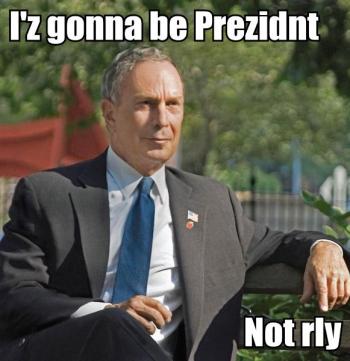
Still, my assessment of Bloomberg’s prospects, whether he runs or not, is pretty well summed up by this image, which comes courtesy of LolPresidents:

www.lizmair.com

On Non-Interventionism [Stephen]

Thanks to Andrew for inviting me to guest blog this week. Over at ProfessorBainbridge.com, I started out blogging about business law and economics (which is what I do for a living as a corporate law professor at UCLA), but eventually expanded into politics, religion, music, cars, cooking, and wine. I may leave a recipe or two behind before I leave, but for the moment let’s start with a topic commonly discussed here; namely, foreign policy.

I was struck today by Gregory Scoblete‘s essay on Ron Paul’s theory of non-intervention:

During the May 15 debate in South Carolina, Paul wondered how Republicans were able to capture the presidency in 2000. "We talked about a humble foreign policy," he said. "No nation-building; don’t police the world." Paul, alone among GOP contenders, opposed the invasion of Iraq and has been a critic of the enterprise ever since.

Such restraint does not sit well with many conservatives intent on seizing what columnist Charles Krauthammer dubbed the "unipolar moment" of American ascendancy in a world without the Soviet Union. To them, only the maximalist goals espoused by President Bush in his second inaugural address are worthy of America. Neoconservative champions of an "American Empire" such as Council on Foreign Relations scholar Max Boot chafe at the notion that there are, or should be, limits to American power or that the American interest should be defined as anything less than a globe-spanning, benevolent imperium. Unfazed by our inability to pacify Iraq, neoconservatives like Norman Podhoretz (recently named as an advisor to the Giuliani campaign) are now agitating to expand the war into Iran.

Nor does Paul’s parsimony sit well with Democrats and liberals, whose predilection to use military force seems to increase as the relevancy of the mission to U.S. security decreases. Supposedly aghast by the civil war in Iraq, Democratic statesmen like Delaware Senator Joseph Biden want to insert the U.S. into Sudan. If you blanched at the President’s Second Inaugural, which pledged to erase tyranny from the pages of human memory, you won’t find much comfort in Barack Obama’s barely-less expansive formulation of America’s interests in Foreign Affairs.

A plague on both their houses. Russell Kirk wrote about Bush 41’s war:

Are we to saturation-bomb most of Africa and Asia into righteousness, freedom, and democracy? And, having accomplished that, however would we ensure persons yet more unrighteous might not rise up instead of the ogres we had swept away?

It remains true today. But Kirk also knew something else, as I discussed in my post Prudence in Iraq: Then and Now:

A soundly conservative foreign policy, in the age which is dawning, should be neither ‘interventionist’ nor ‘isolationist’: it should be prudent. Its object should not be to secure the triumph everywhere of America’s name and manners, under the slogan of ‘democratic capitalism,’ but instead the preservation of the true national interest, and acceptance of the diversity of economic and political institutions.

There have been times when intervention was more consistent with a prudential assessment of our national interest than would be a blanket policy of non-intervention. Afghanistan post-9/11 is a case in point; indeed, even Ron Paul voted to authorize the war in Afghanistan. For that matter, the prudent thing to do would have been an even more aggressive intervention that actually managed to catch and kill Osama bin Laden. And there have been times when non-intervention would have been the prudent choice. Looking ahead, Sudan looks like an extra-large version of Somalia. Intervention there would be imprudent even if the Iraq war hadn’t stretched our military resources to the limit. We would be walking into another civil war.

We don’t need a presumption against either interventionism or non-interventionism. We need a presumption in favor of prudence.

Chillin’

Sleepyhead

I’m taking the next week off for some wedding planning and a vacation (that’s Aaron on the couch). I’m psyched to say that four of my favorite bloggers have agreed to guest-blog for me on the Dish until August 13, when I’ll be back. They are Bruce Bartlett, author of "Impostor" and one of the bravest conservatives out there, a man who took on this administration for its betrayal of conservatism when most others wouldn’t. He’s joined by Stephen Bainbridge, another principled conservative whose blog has become a must-read for right-of-center blog-fans. Eric Kleefeld of Talking Points Memo is also blogging. If you read TPM, you’ll recognize him as one of the sharpest liberal posters on the web. Finally, Liz Mair, a libertarian-conservative blogger and campaign addict will round out the team. Check out their blogs and keep checking in next week. Window views and movie line contest entries will continue uninterrupted. Oh: and be nice. They’re our guests.

A Poem For Friday

Gold

You think, living in this town, no one’s at war
because of how we all respect savage flowerings
for instance, or the queer biker who walks a stranger
to the curb because the wind is lit up from some strange
cellar to make us late. We think we belong
where we are better known.

I ride my bike. I ride my bike through speeds
like flavors, unzip the mile-long zipper that cinches
the street and bay together.
Fletcher names it the Bay of Take What’s Left.
But I have seen mornings when all the bay could do
was give nothing but proof of gold
unwaving. Gold, going on without us.

– Michael Klein, "Proof Of Gold."